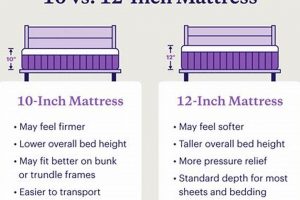
Mattress thickness significantly impacts factors such as support, comfort, and overall bed height. A mattress measuring 11 inches in depth offers a standard profile, often utilizing a combination of foam layers or a hybrid construction with pocketed coils. In contrast, a 14-inch mattress falls into the category of a thicker, more substantial profile, generally incorporating additional comfort layers or a more robust support core.
The implications of mattress depth extend beyond mere aesthetics. A thicker mattress may provide enhanced pressure relief due to the increased volume of comfort materials. It can also offer improved motion isolation, particularly important for couples. Historically, thicker mattresses were associated with luxury and higher quality, although advancements in mattress technology have made comfortable and supportive options available in a range of thicknesses.
The following sections will delve into the key distinctions between mattresses of these two depths, exploring their performance characteristics, suitability for different sleep styles, and considerations for choosing the optimal thickness based on individual needs and preferences. Aspects such as support, comfort, edge support, and bed height implications will be discussed.
Considerations for Mattress Depth Selection
Selecting the appropriate mattress depth is crucial for optimizing sleep quality and overall comfort. Factors such as body weight, sleep position, and the presence of back or joint pain should inform the decision-making process.
Tip 1: Assess Individual Body Weight. Individuals with higher body weights may benefit from a thicker mattress, such as a 14-inch model. The increased material volume can provide enhanced support and prevent bottoming out, ensuring proper spinal alignment. Conversely, lighter individuals might find an 11-inch mattress adequate, provided it offers sufficient comfort layers.
Tip 2: Evaluate Sleep Position. Side sleepers typically require a mattress that conforms to the contours of the body, alleviating pressure on the hips and shoulders. A thicker mattress may offer superior pressure relief in these areas. Back sleepers generally need a firmer surface to maintain spinal alignment, and either depth could be suitable depending on the specific construction and firmness level.
Tip 3: Account for Foundation Height. The height of the bed frame and foundation will influence the overall bed height. Consider how the chosen mattress depth will affect the ease of getting in and out of bed. Individuals with mobility issues may require a lower bed profile, necessitating a thinner mattress or a lower foundation.
Tip 4: Examine Edge Support. Mattresses with enhanced edge support prevent sagging along the perimeter. Thicker mattresses, particularly those with reinforced edges, often offer better edge support than thinner models. Strong edge support is beneficial for individuals who sit on the edge of the bed frequently or who tend to sleep near the edge.
Tip 5: Consider Partner Preferences. If sharing a bed, it’s essential to consider the preferences of both individuals. Compromises may be necessary to find a mattress depth that meets the needs of both partners, particularly regarding firmness, support, and pressure relief.
Tip 6: Review Layer Composition. The composition of the layers within the mattress is as important as the overall depth. Evaluate the materials used in the comfort layers, support core, and transition layers to determine if they align with individual comfort preferences and support needs. Pay attention to materials like memory foam, latex, and innerspring coils.
Selecting the optimal mattress depth necessitates a thorough evaluation of individual needs and preferences. By considering factors such as body weight, sleep position, foundation height, edge support, and partner preferences, individuals can make an informed decision that promotes restful sleep and overall well-being.
The subsequent sections will provide a detailed comparison of specific mattress models within the 11-inch and 14-inch categories, highlighting their unique features and performance characteristics.
1. Support Layer Thickness

The support layer within a mattress is fundamental to its overall performance, influencing factors such as spinal alignment, weight distribution, and long-term durability. The variance in support layer thickness between an 11-inch and a 14-inch mattress directly impacts these characteristics, necessitating careful consideration of individual needs and preferences.
- Core Stability and Alignment
A thicker support layer, often found in 14-inch mattresses, generally offers increased core stability. This is particularly relevant for individuals with higher body weights or those who require enhanced lumbar support. The additional material provides a more robust foundation, preventing excessive sinking and promoting proper spinal alignment throughout the night. Conversely, an 11-inch mattress may offer sufficient support for individuals with lower body weights or those who prefer a softer feel, provided the support layer is constructed from high-density materials.
- Material Composition Influence
The materials used in the support layer significantly affect its performance. High-density foam, pocketed coils, or a combination of both are common choices. A thicker support layer allows for the incorporation of more coils or a greater volume of foam, potentially enhancing durability and reducing motion transfer. For instance, a 14-inch mattress might feature individually wrapped coils with a higher gauge steel, providing targeted support and minimizing disturbances caused by partner movement. In contrast, an 11-inch mattress might rely on a thinner layer of interconnected coils or a less dense foam core.
- Impact on Mattress Durability
The thickness of the support layer is directly related to the mattress’s ability to withstand long-term wear and tear. A thicker layer is generally more resistant to compression and sagging, extending the lifespan of the mattress. This is especially important for individuals who intend to use the mattress for an extended period. An 11-inch mattress with a thinner support layer may exhibit signs of wear sooner than a 14-inch mattress, potentially requiring replacement sooner.
- Edge Support Implications
While not exclusively determined by the support layer, its thickness contributes to overall edge support. A thicker support layer, particularly when combined with reinforced edges, provides a more stable perimeter. This is beneficial for individuals who frequently sit on the edge of the bed or who require a wider sleeping surface. A 14-inch mattress with a robust support layer is more likely to offer consistent edge support than an 11-inch model with a less substantial foundation.
In summary, the support layer thickness within an 11-inch or 14-inch mattress plays a crucial role in determining its overall performance characteristics. While a thicker support layer generally offers enhanced stability, durability, and edge support, the optimal choice depends on individual body weight, sleep preferences, and long-term usage expectations. Selecting a mattress with an appropriate support layer thickness is essential for achieving restful sleep and maintaining proper spinal alignment.
2. Pressure Relief Capacity

Pressure relief capacity is a critical factor in mattress selection, directly influencing comfort and minimizing pressure points that can disrupt sleep. The difference in thickness between an 11-inch and a 14-inch mattress significantly affects its ability to alleviate pressure, impacting individuals with varying body types and sleep preferences.
- Layer Composition and Conforming Ability
A thicker mattress, such as a 14-inch model, typically incorporates more layers of comfort materials, including memory foam, latex, or gel-infused foam. These layers conform to the body’s contours, distributing weight and reducing pressure concentration on areas such as the shoulders, hips, and knees. An 11-inch mattress, with its reduced profile, may offer less conforming ability, potentially leading to increased pressure points for some individuals, particularly side sleepers. For example, a 14-inch mattress with a 3-inch memory foam comfort layer will generally provide greater pressure relief than an 11-inch mattress with a 2-inch layer of similar material.
- Support Core Interaction
The support core, typically composed of innerspring coils or high-density foam, also plays a role in pressure relief. A thicker mattress often allows for a more sophisticated support system, such as zoned coils or a multi-layered foam core. These systems provide targeted support to different areas of the body, optimizing spinal alignment and reducing pressure on sensitive areas. In contrast, an 11-inch mattress may utilize a simpler support core design, which may not offer the same level of targeted support and pressure relief. Consider a 14-inch hybrid mattress with zoned pocketed coils that provide firmer support to the lumbar region and softer support to the shoulders, compared to an 11-inch innerspring mattress with a uniform coil system.
- Weight Distribution Efficiency
The overall thickness of a mattress contributes to its ability to evenly distribute body weight. A 14-inch mattress, with its increased material volume, can effectively spread weight across a larger surface area, reducing localized pressure. This is particularly beneficial for individuals with higher body weights or those who experience chronic pain. An 11-inch mattress may concentrate weight in specific areas, potentially exacerbating pressure points and discomfort. A 14-inch all-foam mattress designed for heavier individuals will likely distribute weight more effectively and alleviate pressure more efficiently than an 11-inch mattress of the same construction.
- Impact on Spinal Alignment
Proper spinal alignment is essential for minimizing pressure and promoting restful sleep. A mattress with adequate pressure relief capacity helps maintain the natural curvature of the spine, preventing misalignment that can lead to back pain and discomfort. A 14-inch mattress, with its enhanced conforming ability and support core design, can often better accommodate the body’s natural contours, promoting optimal spinal alignment. An 11-inch mattress may not provide sufficient support and pressure relief to maintain proper alignment, particularly for individuals with specific spinal conditions. For example, a 14-inch latex mattress that contours to the body while maintaining support can improve spinal alignment compared to a less conforming 11-inch mattress.
In conclusion, the increased thickness of a 14-inch mattress generally translates to improved pressure relief capacity compared to an 11-inch model. The additional comfort layers, sophisticated support core designs, and enhanced weight distribution contribute to a more comfortable and supportive sleep surface. While an 11-inch mattress may suffice for individuals with lower body weights or those who prefer a firmer feel, those seeking optimal pressure relief and spinal alignment may find a 14-inch mattress to be a more suitable choice. The selection should be based on individual needs and preferences, considering factors such as body weight, sleep position, and any pre-existing health conditions.
3. Overall Bed Height

The overall bed height is directly influenced by mattress thickness, creating a significant practical difference between utilizing an 11-inch versus a 14-inch mattress. This height, measured from the floor to the top of the mattress, impacts ease of access and aesthetic considerations within the bedroom. A thicker mattress inherently raises the sleeping surface, potentially requiring adjustments to existing bed frames or bedroom furniture. The choice between an 11-inch and 14-inch option, therefore, necessitates evaluating the compatibility with existing bedroom layouts and the physical capabilities of the user.
Beyond aesthetics, the height of the bed affects accessibility. Individuals with mobility limitations, such as the elderly or those recovering from surgery, may find a lower bed profile, typically achieved with an 11-inch mattress and a low-profile foundation, more convenient for ingress and egress. Conversely, taller individuals might prefer the increased height afforded by a 14-inch mattress, combined with a standard or taller foundation, to avoid excessive bending and strain when getting in and out of bed. For example, a person who uses a wheelchair might find a higher bed, achieved through a 14-inch mattress combined with the appropriate foundation, to be more conducive to transfers. Families with pets that are allowed to sleep on the bed also need to consider the height implications for the pet.
Ultimately, the selection of mattress thickness and its corresponding impact on overall bed height requires careful assessment of individual physical needs, existing bedroom furniture, and personal preferences. While a 14-inch mattress may offer enhanced comfort and support, the resulting increase in bed height may not be suitable for all users or bedroom configurations. Understanding the relationship between mattress thickness and overall bed height is crucial for ensuring both comfort and practicality in the sleeping environment. Ignoring the role of base and other objects to total bed height, could result in a lack of alignment.
4. Edge Support Performance

Edge support performance, a crucial element in mattress construction, exhibits a discernible correlation with mattress thickness, differentiating the functionality of an 11-inch mattress from that of a 14-inch model. The thicker profile of a 14-inch mattress generally allows for the incorporation of more robust edge reinforcement systems, impacting both the usable sleep surface and the long-term structural integrity of the mattress. Inferior edge support can result in a feeling of instability when sitting or sleeping near the perimeter, leading to premature sagging and a reduction in overall comfort. The presence of enhanced edge support, conversely, extends the useable surface area and increases the longevity of the mattress. For example, a 14-inch hybrid mattress might incorporate a high-density foam encasement or reinforced coils specifically designed to prevent edge collapse, whereas an 11-inch all-foam mattress may lack such features, resulting in less stable edges.
The impact of superior edge support extends beyond mere comfort. Individuals who share a bed often benefit significantly from enhanced edge support, as it maximizes the available sleeping space and minimizes the sensation of rolling off the edge. Furthermore, those with mobility issues may find it easier to get in and out of bed when the mattress edges provide a firm and stable surface. Consider a scenario where an elderly individual relies on the edge of the bed for support while standing up; a mattress with weak edge support could compromise their stability and increase the risk of falls. The selection of a mattress with adequate edge support, therefore, has practical safety implications. The material types, which may include high-density foams, metal springs, or unique plastics, also determine how edge support is delivered.
In summary, edge support performance is intrinsically linked to mattress thickness, with thicker mattresses typically offering more robust reinforcement options. The presence of strong edge support enhances usability, prolongs mattress lifespan, and improves safety, particularly for individuals sharing a bed or those with mobility limitations. Evaluating edge support is therefore a critical consideration when selecting a mattress, with the 14-inch option generally presenting a more reliable solution due to its capacity for more advanced edge reinforcement systems. However, specific construction methods and materials play a significant role, requiring a careful evaluation of individual mattress models.
5. Motion Isolation Efficiency

Motion isolation efficiency, a critical determinant of sleep quality, is intrinsically linked to mattress thickness and construction. A thicker mattress, such as a 14-inch model, frequently exhibits superior motion isolation capabilities compared to an 11-inch counterpart. This difference arises primarily from the increased volume of damping materials present within the thicker mattress. These materials, often consisting of memory foam or specialized transitional layers, effectively absorb and dissipate kinetic energy, minimizing the transfer of movement across the sleeping surface. For instance, when one partner shifts positions during sleep, the disturbance is less likely to propagate to the other partner’s side of a 14-inch mattress, thereby reducing sleep interruptions. The effect is amplified when the 14-inch mattress incorporates individually encased coils, as these coils operate independently, further mitigating motion transfer. The absence of such advanced construction in thinner, 11-inch models often results in increased motion propagation and, consequently, reduced sleep quality for both occupants.
The practical significance of enhanced motion isolation efficiency extends beyond mere comfort. Couples with disparate sleep schedules, or those prone to restless sleep, directly benefit from a mattress that minimizes motion transfer. Consider a scenario where one partner works night shifts and the other maintains a traditional daytime schedule. A 14-inch mattress with superior motion isolation allows the day-sleeping partner to rest undisturbed, despite the night-shift worker’s movements. Conversely, an 11-inch mattress with deficient motion isolation could lead to chronic sleep deprivation for the day-sleeping partner, potentially impacting their health and well-being. The material composition of the layers within the mattress also significantly influences motion isolation. Higher density foams and strategically placed gel layers can improve the beds ability to absorb and reduce transfer.
In summary, motion isolation efficiency is a crucial, often underestimated, component of mattress performance, demonstrating a clear relationship with mattress thickness. The increased damping capacity of thicker mattresses, such as 14-inch models, typically translates to superior motion isolation compared to thinner, 11-inch options. This enhanced performance yields tangible benefits for couples, particularly those with differing sleep patterns or restless sleeping habits. While advancements in mattress technology have somewhat narrowed the gap in motion isolation performance between thinner and thicker mattresses, the latter generally retains a distinct advantage due to its greater capacity for incorporating advanced motion-dampening materials and construction techniques. Choosing a bed depends on weighing all elements together to optimize the best sleep.
6. Temperature Regulation Capability

Temperature regulation capability in mattresses significantly influences sleep comfort, particularly for individuals susceptible to overheating during the night. The thickness of a mattress, distinguishing an 11-inch model from a 14-inch option, plays a crucial role in its ability to dissipate heat and maintain a comfortable sleep environment.
- Material Density and Airflow
Thicker mattresses, such as 14-inch models, often incorporate denser foam layers, which can impede airflow and trap heat. However, the increased thickness also allows for the inclusion of advanced cooling technologies, such as gel-infused memory foam or ventilated designs, to counteract this effect. Conversely, an 11-inch mattress may have less material to trap heat, but it also has less space for advanced cooling features. For example, a 14-inch mattress might feature a convoluted foam layer that promotes airflow, preventing heat buildup, while an 11-inch mattress may lack this feature, resulting in a warmer sleep experience. The impact is relevant because trapped heat during the sleep cycle disturbs the quality of sleep, resulting in fatigue or discomfort.
- Cover Material Permeability
The type of material used for the mattress cover directly impacts its breathability and heat dissipation capabilities. Thicker mattresses often utilize thicker, plusher covers, which can potentially reduce airflow. However, many manufacturers incorporate breathable materials like cotton, Tencel, or specialized performance fabrics to mitigate this issue. An 11-inch mattress may utilize a thinner cover, which may be more breathable but less durable or comfortable. A 14-inch mattress with a Tencel cover may effectively wick away moisture and promote airflow, keeping the sleeper cool, while an 11-inch mattress with a less breathable cover may trap heat, leading to discomfort. The correct textile or mesh can also help to regulate temperature efficiently.
- Internal Construction and Ventilation
The internal construction of a mattress significantly affects its ability to regulate temperature. Thicker mattresses often have more complex internal structures, including coil systems that promote airflow and ventilation. Innerspring or hybrid mattresses, regardless of thickness, tend to sleep cooler than all-foam mattresses due to the greater airflow through the coil system. However, all-foam mattresses can incorporate channels or perforations to enhance ventilation. A 14-inch hybrid mattress with pocketed coils and ventilated foam layers may provide superior temperature regulation compared to an 11-inch all-foam mattress with limited ventilation features. In addition, the amount of space between the different mattress layers is also a key factor.
- Impact of Cooling Technologies
The presence of cooling technologies, such as gel infusions or phase-change materials, significantly impacts a mattress’s ability to regulate temperature. Thicker mattresses often incorporate a greater concentration of these technologies, enhancing their cooling capabilities. Gel-infused memory foam absorbs and dissipates heat, while phase-change materials regulate temperature by absorbing or releasing heat as needed. An 11-inch mattress with limited cooling technologies may not effectively regulate temperature, particularly for individuals prone to overheating. A 14-inch mattress with multiple layers of gel-infused memory foam and a phase-change material cover may provide a noticeably cooler and more comfortable sleep experience, particularly for hot sleepers. Certain materials can also increase breathability to help regulate temperature.
The selection of an 11-inch versus a 14-inch mattress, with respect to temperature regulation capability, necessitates considering the interplay between material density, cover breathability, internal construction, and the incorporation of cooling technologies. While thicker mattresses may initially appear prone to heat retention, their capacity for incorporating advanced cooling features often results in superior temperature regulation compared to thinner models. However, individual preferences and environmental factors, such as room temperature and bedding materials, also play a significant role in determining the optimal mattress for temperature-sensitive sleepers. The consideration of multiple variables can help to better manage the issue.
Frequently Asked Questions
This section addresses common inquiries regarding the differences between 11-inch and 14-inch mattresses, providing factual information to aid informed decision-making.
Question 1: What are the primary differences in support provided by an 11-inch versus a 14-inch mattress?
An 11-inch mattress, typically incorporating fewer layers, may offer adequate support for individuals with lower body weights or those preferring a firmer feel. A 14-inch mattress, with its increased material volume, generally provides enhanced support and pressure relief, particularly beneficial for heavier individuals or those seeking improved spinal alignment. Differences in individual experiences can occur.
Question 2: How does mattress thickness affect its suitability for different sleep positions?
Side sleepers generally benefit from the increased cushioning and pressure relief offered by a thicker, 14-inch mattress. Back sleepers often require a firmer surface, which can be found in both 11-inch and 14-inch options depending on the specific construction. Stomach sleepers typically need a firm mattress to prevent excessive sinking, and a thinner, 11-inch model may be preferable.
Question 3: Does a thicker mattress necessarily equate to higher quality?
Not necessarily. Mattress thickness is just one factor influencing overall quality. The materials used, construction techniques, and brand reputation also play significant roles. A well-constructed 11-inch mattress can outperform a poorly made 14-inch option. Mattress evaluations provide assistance.
Question 4: What are the implications of mattress thickness for bed height and accessibility?
A 14-inch mattress will naturally result in a higher bed profile compared to an 11-inch model. This may be advantageous for taller individuals but can pose accessibility challenges for those with mobility limitations. The height of the foundation should also be considered to ensure a comfortable and safe bed height.
Question 5: How does mattress thickness influence temperature regulation?
Thicker mattresses can potentially trap more heat due to increased material density. However, many 14-inch mattresses incorporate advanced cooling technologies, such as gel-infused memory foam or ventilated designs, to mitigate this effect. The breathability of the cover material also plays a crucial role.
Question 6: Is a thicker mattress always more durable than a thinner one?
Generally, a thicker mattress with high-quality materials tends to be more durable due to its increased resistance to compression and sagging. However, the specific materials used and the overall construction are more critical determinants of longevity than thickness alone.
In conclusion, the choice between an 11-inch and 14-inch mattress is a matter of individual needs and preferences, considering factors such as body weight, sleep position, budget, and accessibility requirements. There is no one-size-fits-all solution.
The following section will provide information about key factors in mattress material.
Conclusion
The exploration of the “11 inch vs 14 inch mattress difference” reveals significant distinctions impacting comfort, support, and overall sleep experience. Thicker mattresses, generally those measuring 14 inches, often offer enhanced pressure relief, improved motion isolation, and potentially greater durability due to their increased material volume and capacity for advanced construction techniques. However, thinner, 11-inch mattresses can provide adequate support, particularly for individuals with lower body weights or those who prefer a firmer feel. The selection of a mattress should be informed by a comprehensive evaluation of individual needs, considering factors such as body weight, sleep position, budget, and accessibility requirements. Specific characteristics of the different mattress styles allow for users to select their ideal item to fit their needs.
Ultimately, the optimal mattress is the one that best accommodates individual needs and preferences. The key takeaway is that mattress depth is not the sole determinant of quality or comfort, but rather one of many factors that contribute to a satisfying sleep experience. Prospective buyers are encouraged to thoroughly research specific mattress models, considering material composition, construction techniques, and user reviews, to make an informed decision that promotes restful and restorative sleep. Failure to use the product correctly could nullify some benefits of the product.