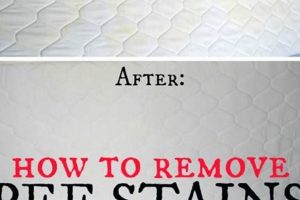
The removal of menstrual blood from a mattress presents a common household challenge. Successful stain removal hinges on prompt action and appropriate cleaning techniques. Addressing the stain quickly prevents it from setting deeply into the mattress fibers, thereby increasing the likelihood of complete removal and minimizing the potential for lingering odors.
Effectively addressing this type of stain offers several benefits, including maintaining the mattress’s cleanliness and extending its lifespan. Furthermore, removing visible stains contributes to a more hygienic sleep environment and promotes a sense of well-being. Historically, various methods, ranging from simple home remedies to commercial cleaning solutions, have been employed to tackle this issue, reflecting the universal need for effective stain removal techniques.
The following sections will outline proven methods for effectively eliminating menstrual blood stains from mattresses. These techniques encompass readily available household materials and specific cleaning agents designed to lift the stain without damaging the mattress. The goal is to provide a comprehensive guide for restoring the mattress to its original condition.
Tips for Mattress Stain Removal
Effective stain removal from a mattress requires a systematic approach. The following tips detail methods for addressing such stains without causing further damage to the material.
Tip 1: Act Promptly: The sooner the stain is addressed, the easier it will be to remove. Fresh stains are more soluble and less likely to deeply penetrate the mattress fibers.
Tip 2: Blot, Do Not Rub: Rubbing can spread the stain and drive it deeper into the mattress. Use a clean cloth or paper towel to gently blot the affected area, working from the outside in.
Tip 3: Cold Water is Crucial: Hot water can cause blood to coagulate and set the stain permanently. Always use cold water when initially treating the stain.
Tip 4: Enzyme Cleaners: Enzyme-based cleaners are specifically designed to break down organic matter, making them highly effective for removing blood stains. Follow the product’s instructions carefully.
Tip 5: Hydrogen Peroxide Application: For stubborn stains, a 3% hydrogen peroxide solution can be used. Apply a small amount directly to the stain, allow it to sit for a few minutes, and then blot with a clean cloth. Be cautious when using hydrogen peroxide on darker mattresses, as it may cause discoloration.
Tip 6: Baking Soda Paste: Create a paste of baking soda and cold water. Apply the paste to the stain, allow it to dry completely, and then vacuum up the residue. This method can help draw out the stain and absorb any lingering odors.
Tip 7: Vacuum Thoroughly: After using any cleaning solution, thoroughly vacuum the mattress to remove any residual cleaner or debris. This step helps prevent mold growth and ensures a clean surface.
Proper stain removal enhances the cleanliness and lifespan of the mattress. Implementing these tips maximizes the probability of effectively eliminating the stain and restoring the mattress to its original state.
The next section will explore the long-term care and maintenance techniques for mattresses to prevent future stains and maintain a healthy sleep environment.
1. Promptness

In the context of mattress stain removal, particularly with regard to menstrual blood, promptness is a critical determinant of success. The speed with which action is taken significantly influences the ease and completeness of stain removal, directly impacting the long-term condition of the mattress.
- Minimizing Penetration
The longer a blood stain remains untreated, the more deeply it penetrates the mattress fibers. This is due to the liquid’s tendency to seep into porous materials over time. Prompt attention reduces the depth of penetration, making the stain more accessible to cleaning agents and physical removal techniques. Delayed action results in a more entrenched stain, demanding more aggressive and potentially damaging cleaning methods.
- Preventing Oxidation and Setting
Blood, upon exposure to air, undergoes oxidation. This process can cause the stain to darken and “set,” making it significantly more difficult to remove. Immediate cleaning interrupts this process, preventing the stain from becoming more resistant to treatment. Oxidation also contributes to odor development; therefore, prompt stain removal minimizes the potential for lingering smells.
- Reducing Bacterial Growth
Blood provides a nutrient-rich environment for bacterial growth. Delaying stain removal can promote the proliferation of bacteria, which may contribute to unpleasant odors and potential hygiene concerns. Quick cleaning action minimizes the time available for bacterial colonization, contributing to a cleaner and healthier sleep environment.
- Simplifying the Cleaning Process
Fresh blood stains are generally more water-soluble than dried stains. This means that simple cleaning methods, such as blotting with cold water, may be sufficient to remove the stain if addressed promptly. As the stain ages and sets, more complex and potentially harsher cleaning solutions or techniques become necessary. Promptness, therefore, translates to a simpler, less invasive, and less time-consuming cleaning process.
The multifaceted benefits of addressing menstrual blood stains on mattresses immediately underscores the importance of preparedness and swift action. Delaying treatment not only increases the difficulty of stain removal but also introduces potential hygiene and long-term mattress condition concerns, all of which can be largely mitigated with an immediate response.
2. Cold Water

The application of cold water is a critical step in the effective removal of menstrual blood stains from mattresses. The rationale for using cold water stems from the properties of blood and its interaction with heat. Blood contains proteins, and when exposed to elevated temperatures, these proteins coagulate. This coagulation process causes the blood to clot and bind more tightly to the fibers of the mattress. Consequently, a stain initially treatable with relative ease becomes significantly more difficult to remove after being exposed to heat.
Employing cold water, conversely, inhibits this coagulation process. The proteins remain in a more soluble state, allowing the blood to be more readily lifted from the mattress fibers. For instance, directly applying cold water to the affected area and gently blotting with a clean cloth allows the blood to be absorbed without setting the stain. This approach is often sufficient for fresh stains, requiring minimal additional cleaning agents. The effectiveness of cold water as a first-line treatment underscores its practical significance.
The consistent application of cold water as the initial step in stain removal significantly impacts the success rate of the overall cleaning process. Failure to use cold water at the outset can render subsequent cleaning efforts less effective, potentially requiring more aggressive and potentially damaging cleaning methods. Therefore, the judicious use of cold water represents a fundamental principle in mattress stain management, influencing both the efficiency and the preservation of the mattress.
3. Blotting Technique

The blotting technique is a fundamental element in the successful extraction of menstrual blood stains from a mattress. Its application, when executed correctly, minimizes the spread of the stain and prevents further penetration into the mattress fibers, thereby maximizing the efficacy of subsequent cleaning procedures.
- Preventing Stain Expansion
The primary function of blotting, rather than rubbing, is to absorb the blood without forcing it deeper into the mattress. Rubbing motions tend to spread the stain across a larger surface area, increasing the overall cleaning effort and potentially embedding the blood further into the fibers. Blotting, conversely, concentrates the cleaning action on the immediate area, minimizing the risk of expansion.
- Maintaining Fiber Integrity
Aggressive rubbing can damage the mattress fibers, particularly delicate materials like memory foam or natural fibers. Blotting, being a gentler process, minimizes the risk of abrasion or tearing. This is especially crucial for maintaining the structural integrity and longevity of the mattress. The use of a soft, clean cloth is recommended to further reduce the potential for damage during the blotting process.
- Facilitating Absorbent Material Action
Blotting, when used in conjunction with absorbent materials such as clean cloths or paper towels, allows these materials to effectively draw the blood away from the mattress. Consistent, gentle pressure applied during blotting aids in the absorption process. Replacing saturated cloths or towels with fresh ones ensures continuous and efficient stain removal.
- Reducing Discoloration
By preventing the stain from spreading and minimizing fiber damage, the blotting technique contributes to reducing the likelihood of lasting discoloration. Deeply embedded stains or damaged fibers are more prone to retaining a visible trace of the blood, even after cleaning. Proper blotting, therefore, aids in preserving the original color and appearance of the mattress.
The consistent application of the blotting technique, as described, forms a cornerstone in the approach to eliminating menstrual blood stains from mattresses. Its impact on minimizing stain expansion, preserving fiber integrity, facilitating absorbent material action, and reducing discoloration underscores its significance in achieving optimal cleaning results.
4. Enzyme Cleaners
Enzyme cleaners represent a specific category of cleaning agents particularly well-suited for addressing organic stains, including menstrual blood, on mattresses. Their efficacy stems from their ability to biochemically break down the complex molecules that constitute blood, facilitating easier removal and minimizing residual staining or odors.
- Mechanism of Action
Enzyme cleaners contain enzymes, which are biological catalysts that accelerate specific chemical reactions. In the context of blood stains, these enzymes target proteins and other organic compounds, breaking them down into smaller, more water-soluble molecules. This process weakens the bond between the blood stain and the mattress fibers, allowing it to be more easily lifted away. Conventional cleaning agents often lack this specific catalytic activity, making enzyme cleaners a more targeted solution.
- Specificity and Safety
Enzyme cleaners are generally formulated to be specific to certain types of organic matter, such as proteins, starches, or fats. This specificity reduces the risk of damage to the mattress material itself, as the enzymes are less likely to react with synthetic or non-organic components. However, it remains crucial to follow the product’s instructions and test the cleaner on an inconspicuous area of the mattress first to ensure compatibility and prevent discoloration.
- Odor Elimination
Beyond stain removal, enzyme cleaners also address the issue of lingering odors associated with blood stains. The enzymatic breakdown of organic matter eliminates the source of the odor, rather than simply masking it. This is particularly beneficial for mattresses, where odors can become trapped within the fibers. The use of enzyme cleaners can therefore contribute to a more hygienic and pleasant sleep environment.
- Application Techniques
The effectiveness of enzyme cleaners is influenced by proper application. Typically, the cleaner is sprayed or applied directly to the stain, allowed to dwell for a specified period, and then blotted away with a clean cloth. It is important to avoid excessive saturation of the mattress, as this can lead to moisture retention and potential mold growth. Multiple applications may be necessary for older or more stubborn stains. Proper ventilation during and after application is also recommended.
In summary, enzyme cleaners provide a scientifically grounded and effective approach to removing menstrual blood stains from mattresses. Their ability to break down the organic components of blood at a molecular level, combined with their relative safety and odor-eliminating properties, makes them a valuable tool for maintaining a clean and hygienic sleep environment. Adherence to product instructions and appropriate application techniques are crucial for maximizing their effectiveness and minimizing any potential risks.
5. Baking Soda
Baking soda, chemically known as sodium bicarbonate, serves as a valuable component in the process of removing menstrual blood stains from a mattress due to its absorbent and deodorizing properties. The compound’s alkaline nature assists in neutralizing acids present in blood, which contributes to stain reduction and odor mitigation. Its granular structure increases the surface area available for absorption, effectively drawing out moisture and stain particles from the mattress fibers.
A practical application of baking soda involves creating a paste with water and applying it directly to the stained area. This paste, left to dry completely, draws out the stain as it absorbs moisture. Upon vacuuming the dried residue, a significant portion of the stain is often lifted. Baking soda’s effectiveness is further enhanced by its ability to neutralize odors associated with blood. For example, a mattress with a persistent, faint stain odor may benefit from a generous application of baking soda spread across the entire surface, left for several hours, and then thoroughly vacuumed. This process can significantly reduce or eliminate the lingering scent.
While baking soda is a generally safe and effective cleaning agent, challenges may arise with deeply set or extensive stains. In such cases, baking soda may need to be combined with other cleaning agents, such as hydrogen peroxide or enzyme-based cleaners, to achieve optimal results. The practical significance of understanding baking soda’s role lies in its accessibility, affordability, and relatively non-abrasive nature, making it a suitable first-line treatment for menstrual blood stains on mattresses before resorting to more aggressive cleaning methods. Its effectiveness contributes to prolonging the mattress’s lifespan and maintaining a hygienic sleep environment.
6. Vacuuming

Vacuuming plays a crucial role in the overall process of removing menstrual blood stains from a mattress. It serves not as the primary stain removal agent, but as a critical supplementary step that ensures the removal of residual cleaning agents and loosened stain particles, thereby contributing to a cleaner and more hygienic outcome.
- Removal of Dried Residue
Many stain removal techniques, such as the application of baking soda paste or enzyme cleaners, leave behind a dried residue on the mattress surface. This residue, if left unattended, can attract dust and allergens, potentially leading to skin irritation or respiratory issues. Vacuuming effectively removes this dried material, ensuring a clean surface and minimizing the risk of adverse reactions. For instance, after applying a baking soda paste and allowing it to dry, thorough vacuuming is essential to eliminate all traces of the powder.
- Extraction of Loosened Stain Particles
Even after applying cleaning solutions, some stain particles may remain loosely attached to the mattress fibers. Vacuuming provides the mechanical force necessary to lift these particles from the mattress, preventing them from settling back into the fabric over time. A vacuum cleaner with a brush attachment can be particularly effective at agitating the fibers and dislodging stubborn particles.
- Prevention of Mold and Mildew Growth
Moisture, often introduced during the stain removal process, can create an environment conducive to mold and mildew growth within the mattress. Vacuuming helps to improve airflow and remove excess moisture, thereby reducing the risk of microbial contamination. This is particularly important in humid environments. Using a wet/dry vacuum can further expedite the drying process.
- Restoration of Mattress Texture
The application of cleaning agents and subsequent drying can sometimes alter the texture of the mattress surface, leaving it feeling stiff or uneven. Vacuuming helps to restore the natural texture of the mattress by lifting and separating compressed fibers. This contributes to a more comfortable sleep surface and prevents premature wear.
The various benefits of vacuuming within the context of mattress stain removal underscore its importance as a final, restorative step. By removing residual cleaning agents, extracting loosened stain particles, preventing microbial growth, and restoring mattress texture, vacuuming ensures a more complete and hygienic cleaning outcome, contributing to the overall preservation and longevity of the mattress.
Frequently Asked Questions
The following section addresses common inquiries regarding the removal of menstrual blood stains from mattresses, providing concise and informative answers.
Question 1: Will hot water effectively remove blood stains from mattresses?
Hot water is not recommended for removing blood stains. It causes the proteins in the blood to coagulate and set, making the stain more difficult to remove. Cold water is the preferred initial treatment.
Question 2: Is it always necessary to use specialized stain removers to address blood stains on a mattress?
Not always. Fresh stains may be effectively removed with cold water and gentle blotting. However, older or more stubborn stains may require the use of enzyme cleaners or other specialized stain removers.
Question 3: Can prolonged use of cleaning solutions damage the mattress?
Yes, excessive use of cleaning solutions can potentially damage the mattress fibers, cause discoloration, or lead to moisture buildup. It is important to use cleaning agents sparingly and to follow the manufacturer’s instructions carefully.
Question 4: How can the potential for mold growth be minimized after cleaning a mattress?
Thoroughly drying the mattress after cleaning is crucial to prevent mold growth. This can be achieved by using fans, opening windows, or employing a wet/dry vacuum to remove excess moisture.
Question 5: What if the stain has been present for an extended period?
Older stains are more challenging to remove. Multiple applications of cleaning solutions, longer dwell times, and potentially more aggressive cleaning methods may be necessary. Professional mattress cleaning services may be considered for deeply set stains.
Question 6: Are mattress protectors beneficial in preventing stains?
Yes, mattress protectors provide a barrier against spills and stains, significantly reducing the likelihood of blood or other fluids penetrating the mattress. They are a proactive measure in maintaining the cleanliness and longevity of the mattress.
Effective stain removal requires prompt action, appropriate cleaning agents, and careful execution to avoid damage to the mattress.
The subsequent section will delve into preventative measures to safeguard mattresses from future stains and maintain a hygienic sleep environment.
Conclusion
The preceding sections have detailed strategies for “how to get a period stain out of a mattress,” emphasizing the importance of prompt action, cold water application, the blotting technique, and the strategic use of enzyme cleaners and baking soda. Furthermore, vacuuming’s role in removing residual cleaning agents has been underscored. The efficacy of these methods hinges on their proper application and consideration of the stain’s age and severity.
Implementing these guidelines facilitates the maintenance of a clean and hygienic sleep environment, extending the lifespan of the mattress and mitigating potential health concerns associated with residual staining. Proactive stain management, including the use of mattress protectors, remains a critical component of long-term mattress care. Addressing this type of stain contributes to overall well-being and promotes a healthier lifestyle.