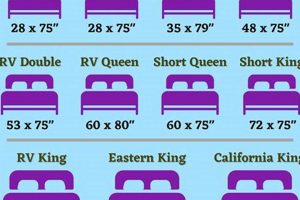
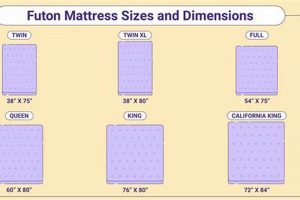
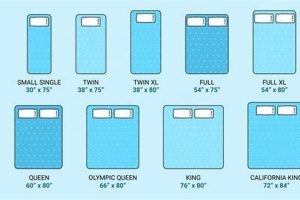
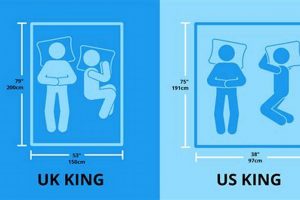
A daybed mattress typically mirrors the size of a twin mattress. These mattresses are designed to fit comfortably within the frame of a daybed, which functions as a sofa during the day and a bed at night. The standard measurement for this type of mattress is around 39 inches in width and 75 inches in length.
The consistent sizing allows for convenient sourcing of bedding and ensures compatibility with most daybed frames. This standardization simplifies the process of finding appropriately sized sheets, blankets, and other bedding accessories. Historically, the dimensions have remained relatively stable, reflecting the compact and versatile nature of daybeds.
Understanding the standard size facilitates informed decisions regarding daybed selection and mattress purchases. Further exploration will detail the specific factors to consider when choosing a mattress for a daybed and how these choices can impact overall comfort and functionality.
Dimensions Guidance for Daybed Mattresses
The following guidelines assist in selecting a suitable mattress for a daybed, focusing on dimensional accuracy and its impact on comfort and functionality.
Tip 1: Verify Frame Compatibility: Prior to purchasing, measure the interior dimensions of the daybed frame. Ensure the intended mattress does not exceed these measurements to avoid overhang or improper fit.
Tip 2: Prioritize Standard Twin Size: A standard twin-size mattress, approximately 39 inches wide and 75 inches long, generally provides the best fit for most daybeds. Deviating from this standard may limit bedding options.
Tip 3: Account for Mattress Height: Consider the overall height of the mattress, especially if the daybed features a trundle unit. An excessively thick mattress may impede the trundle’s operation.
Tip 4: Evaluate Weight Capacity: Confirm that the daybed frame is designed to support the weight of the chosen mattress, in addition to the expected occupant weight. Exceeding the weight capacity can damage the frame.
Tip 5: Consider Corner Construction: Assess the corner construction of the mattress. Reinforced corners can contribute to greater durability and prevent premature sagging, especially in frequently used daybeds.
Tip 6: Research Mattress Density: Investigate the density of the mattress materials, such as foam or innersprings. Higher-density materials can offer improved support and longevity, influencing overall comfort.
Tip 7: Check the Mattress Thickness: Daybed mattresses are generally between 5-8 inches thick, a thinner mattress may affect comfort and lifespan.
Adhering to these recommendations ensures a proper fit and optimal performance of the daybed mattress, enhancing both comfort and the lifespan of the daybed itself.
The concluding sections will delve into specific mattress types suitable for daybeds, offering further insights into material properties and their effects on comfort and support.
1. Standard Twin Size
The standard twin size is intrinsically linked to the dimensional requirements of a daybed mattress. Its measurements, conventionally established at 39 inches in width and 75 inches in length, serve as the primary benchmark for manufacturers and consumers alike. The design of a daybed is frequently predicated on accommodating a mattress of these specific dimensions. The selection of a twin-size mattress provides a balance between space efficiency and usability, allowing the daybed to function as both a seating area and a sleeping surface. Deviation from these established dimensions may result in an ill-fitting mattress, compromising comfort and potentially damaging the daybed frame.
The prevalence of the standard twin size simplifies the process of sourcing bedding and accessories for a daybed. Sheets, comforters, and mattress protectors are readily available in this standardized size, streamlining the purchasing experience. Conversely, if a daybed were designed to accommodate a non-standard mattress size, obtaining suitable bedding would become significantly more challenging and costly. The consistency of the standard twin size also supports the daybed’s versatility. A properly fitting mattress ensures even weight distribution, minimizing wear and tear on the frame and enhancing the longevity of the entire unit.
In summary, the correlation between the standard twin size and the dimensions of a daybed mattress is fundamental to the functionality and practicality of the furniture. Its standardization facilitates ease of use, simplifies procurement of related products, and enhances overall durability. Understanding this relationship is critical for informed purchasing decisions and ensuring long-term satisfaction with a daybed.
2. Mattress Height
Mattress height, though often secondary to width and length, is a critical dimensional aspect of a daybed mattress. Its influence extends to aesthetics, functionality, and overall comfort. Selecting an appropriate height ensures both visual harmony and optimal use of the daybed frame.
- Trundle Bed Compatibility
If the daybed incorporates a trundle unit, the mattress height is paramount. An excessively thick mattress may prevent the trundle from smoothly sliding under the main frame. Conversely, a mattress that is too thin may create a significant height differential when the trundle is extended, resulting in an uneven sleeping surface. Manufacturers typically specify a maximum mattress height for trundle compatibility; adherence to this limit is essential for seamless operation.
- Frame Design Considerations
The design of the daybed frame itself often dictates the ideal mattress height. Frames with high side rails may necessitate a thinner mattress to avoid obscuring the design elements. Conversely, frames with minimal side support may benefit from a thicker mattress for increased visual presence and comfort. The desired aestheticwhether a low-profile, modern look or a more traditional, plush appearanceshould inform the choice of mattress height.
- Seating Comfort
As daybeds function as both seating and sleeping surfaces, mattress height influences seating comfort. A mattress that is too thin may result in inadequate support and an uncomfortable sitting experience. A thicker mattress, while potentially enhancing sleeping comfort, may make it difficult for individuals to sit with their feet comfortably on the floor. A balance must be struck between sleeping and seating comfort, often necessitating a medium-height mattress that provides adequate support for both functions.
- Dust and Ventilation
The height of the daybed mattress may also affect the ability to keep dust off of the bed, or ventilate it. Lower, thinner mattresses might not have as much open space available, and dust could easily accumulate over time with the bed so low to the ground.
In summation, mattress height is an integral dimension when considering daybed functionality. It directly impacts the usability of trundle units, complements the frame’s design, and contributes to both seating and sleeping comfort. Careful consideration of these factors ensures the selection of a mattress that optimally fulfills the dual-purpose nature of a daybed.
3. Frame Interior Width

The frame interior width represents a critical dimensional constraint directly influencing the selection of a suitable daybed mattress. It defines the maximum allowable width of the mattress to ensure proper fit and functionality within the daybed structure.
- Tolerance and Mattress Compression
A slight variance, typically within an inch, between the frame’s interior width and the stated mattress width is often acceptable, accounting for manufacturing tolerances and potential mattress compression over time. However, exceeding this tolerance can result in a mattress that is either too tight, causing bowing or difficulty in insertion, or too loose, leading to instability and uneven support.
- Impact on Bedding Fit
The frame’s interior width directly impacts the fit of bedding accessories, such as fitted sheets and mattress protectors. An excessively narrow frame, relative to the mattress width, can cause these accessories to fit tightly, potentially leading to premature wear and tear. Conversely, an excessively wide frame may result in loose bedding, creating an unkempt appearance and reducing sleeping comfort.
- Influence on Weight Distribution
A properly matched frame interior width ensures even weight distribution across the mattress surface. If the frame is significantly wider than the mattress, the mattress may shift or sag unevenly, compromising support and potentially shortening its lifespan. Conversely, a frame that is too narrow can cause excessive pressure points, leading to discomfort and potential damage to the mattress.
- Custom vs. Standard Sizes
While standard twin-size mattresses (39 inches wide) are generally compatible with most daybeds, custom-sized frames may necessitate custom-sized mattresses. In such cases, precise measurements of the frame interior width are crucial to ensure a proper fit. Failure to account for these variations can result in significant compatibility issues and necessitate costly alterations.
The relationship between the frame’s interior width and mattress dimensions is fundamental to the overall performance and longevity of the daybed. Accurate measurement and careful consideration of these dimensions are essential for selecting a mattress that provides optimal comfort, support, and durability. Discrepancies in these measurements can compromise the structural integrity and functionality of the entire unit.
4. Frame Interior Length

Frame interior length, a critical dimension, directly dictates the compatibility of a daybed mattress within the supporting structure. A mismeasurement of this dimension can result in a mattress that either overhangs the frame, posing safety risks and aesthetic issues, or falls short, creating unsupported gaps and compromising sleeping comfort. The standard length for a twin-size mattress, commonly 75 inches, serves as the baseline for most daybed frame designs; therefore, deviations from this standard necessitate careful consideration. For instance, if a frame’s interior length is only 72 inches, a standard 75-inch mattress will not fit properly, requiring either a custom-sized mattress or frame modification. This incompatibility directly affects the functionality and safety of the daybed.
The importance of frame interior length extends to the longevity of the mattress itself. When a mattress is forced into a space shorter than its designed length, internal components, such as springs or foam layers, may compress unevenly. This uneven compression can lead to premature wear and sagging in specific areas, ultimately reducing the lifespan of the mattress. Consider a scenario where a memory foam mattress, designed for a 75-inch length, is compressed into a 73-inch frame. The foam cells near the edges will experience increased pressure, accelerating their breakdown and causing indentations that diminish the overall sleeping surface. The need for accurate measurement and adherence to dimensional standards is therefore paramount to maintaining both comfort and mattress durability.
In summary, the frame interior length represents a fundamental dimensional requirement when selecting a daybed mattress. Its accurate measurement and proper matching to the mattress length, usually the standard twin size, are critical for ensuring safety, comfort, and the extended lifespan of the mattress. Any discrepancy in this dimension introduces potential risks and compromises the practical utility of the daybed as both a seating and sleeping surface. Understanding this relationship is essential for making informed purchasing decisions and maintaining the daybed’s structural integrity over time.
5. Corner Radius

Corner radius, though less frequently emphasized than length, width, or height, constitutes a relevant dimensional consideration for a daybed mattress, particularly in designs that incorporate curved or rounded frame elements. This dimension refers to the curvature of the mattress corners and must align with the corresponding curvature of the daybed frame to ensure a snug and aesthetically pleasing fit. Discrepancies in corner radius can lead to gaps, pressure points, or an inability to properly seat the mattress within the frame, thus compromising both appearance and support.
The practical impact of corner radius is evident in custom-designed daybeds or those featuring ornate detailing. For instance, a daybed with a sharply angled corner radius might necessitate a mattress with similarly squared corners to avoid unsightly gaps and ensure even weight distribution. Conversely, a frame with a gentler, more rounded corner profile would require a mattress with a matching corner radius to prevent the mattress from overlapping the frame or leaving exposed areas. Failure to account for corner radius in these scenarios can result in an ill-fitting mattress that detracts from the overall design and potentially reduces comfort.
Understanding the corner radius as a dimensional component of a daybed mattress is therefore crucial for achieving optimal integration with the frame. While standard twin-size mattresses often feature relatively standardized corner profiles, custom-made mattresses offer the opportunity to precisely match the frame’s curvature, ensuring a seamless and functional design. Accurate measurement and communication of corner radius specifications are essential in these custom applications to avoid compatibility issues and achieve the desired aesthetic outcome.
Frequently Asked Questions
The following addresses common inquiries regarding the sizing and dimensional aspects of daybed mattresses, providing clarity on selection and compatibility.
Question 1: Are daybed mattresses a unique size, or can a standard mattress be used?
Daybed mattresses typically conform to the dimensions of a standard twin mattress, approximately 39 inches wide by 75 inches long. This allows for convenient use of readily available bedding.
Question 2: What mattress thickness is most suitable for a daybed?
Thickness varies depending on the daybed’s design. Generally, a mattress between 5 and 8 inches thick provides adequate comfort and support without overwhelming the frame or impeding trundle functionality.
Question 3: How does the presence of a trundle affect mattress dimensions?
When a daybed includes a trundle, the mattress height must be carefully considered. A mattress that is too thick may prevent the trundle from smoothly sliding under the main frame. Consult the manufacturer’s specifications for maximum allowable mattress height.
Question 4: What happens if the mattress dimensions do not precisely match the daybed frame?
Dimensional discrepancies can lead to discomfort, instability, and premature wear. A mattress that is too large may be difficult to fit and could damage the frame. A mattress that is too small may shift and provide inadequate support.
Question 5: Is it possible to use a custom-sized mattress for a daybed?
Yes, custom-sized mattresses can be fabricated to accommodate unique daybed frame dimensions. However, this option is generally more expensive and may limit bedding choices.
Question 6: Where can accurate dimensional information about daybed frames and mattresses be found?
Detailed specifications are typically provided by the manufacturer of both the daybed frame and the mattress. Consulting these resources ensures compatibility and informed decision-making.
Accurate understanding of these dimensional aspects is paramount for selecting a daybed mattress that provides optimal comfort, support, and longevity.
The subsequent section will explore specific types of mattresses best suited for daybeds, considering factors such as material composition and support characteristics.
Conclusion
This exploration of “what are the dimensions of a daybed mattress” has underscored the critical importance of dimensional accuracy in ensuring optimal functionality and comfort. The standard twin size, typically 39 inches by 75 inches, serves as the prevailing benchmark, though considerations of mattress height, frame interior measurements, and corner radius are also essential. Deviations from these standards can compromise the integrity of both the mattress and the daybed frame.
Given the dual-purpose nature of a daybed, a comprehensive understanding of these dimensional constraints is crucial for informed purchasing decisions. Prioritizing accuracy and compatibility ultimately contributes to a more comfortable, durable, and aesthetically pleasing furniture solution. Further research into specific mattress types and frame materials can enhance the overall value and longevity of this versatile piece.