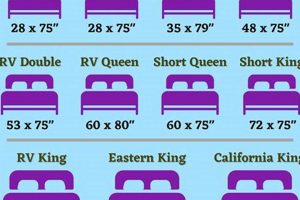
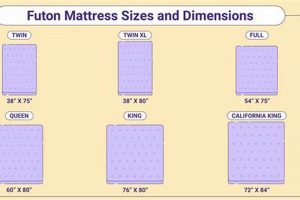
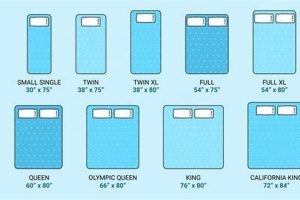
The specifications for a sleeping surface designed for toddlers and young children are commonly standardized to ensure compatibility with cribs that convert into toddler beds, or with dedicated toddler bed frames. These measurements typically fall within a defined range, providing a safe and comfortable sleeping environment. For example, a common size is 28 inches wide by 52 inches long.
Adherence to standard measurements offers numerous advantages. It facilitates easier selection of appropriate bedding, such as fitted sheets and mattress protectors. Furthermore, it ensures the child’s safety within the confines of the bed, minimizing the risk of entrapment or falls. These dimensions reflect a deliberate design evolution, responding to the specific needs of a growing child transitioning from a crib to a more independent sleeping arrangement.
This article will further explore various aspects related to selecting the appropriate sleeping surface for young children, including considerations for material, support, and safety certifications, as well as factors influencing longevity and overall value.
Essential Considerations for Selecting a Child’s Sleeping Surface
Choosing a suitable sleeping surface for a toddler or young child requires careful consideration of several factors to ensure safety, comfort, and optimal sleep quality.
Tip 1: Verify Standard Measurements: Confirm that the specifications align with standard toddler bed frame dimensions (typically 28 inches x 52 inches) to ensure a proper and safe fit. Deviations may create gaps and potential hazards.
Tip 2: Prioritize Safety Certifications: Look for certifications such as GREENGUARD Gold or CertiPUR-US. These indicate that the product has been tested for harmful chemicals and VOC emissions, contributing to a healthier sleep environment.
Tip 3: Evaluate Material Composition: Opt for materials that are hypoallergenic and breathable. Natural latex or organic cotton are excellent choices, minimizing the risk of allergic reactions and promoting airflow.
Tip 4: Assess Firmness Level: A firm sleeping surface is recommended for infants and toddlers to reduce the risk of SIDS and promote proper spinal development. Avoid excessively soft surfaces that can conform too much to the child’s body.
Tip 5: Consider Waterproofing: Invest in a waterproof or water-resistant mattress protector. Young children are prone to accidents, and a protector will safeguard the integrity and hygiene of the mattress.
Tip 6: Check for Durability: Examine the construction quality and materials used. A well-constructed product will withstand the wear and tear associated with toddler use and provide lasting support.
Tip 7: Review Warranty Information: A comprehensive warranty indicates the manufacturer’s confidence in the product’s durability and provides recourse in case of defects or premature wear.
Selecting a sleeping surface involves balancing safety, comfort, and durability. Prioritizing these elements ensures a safe and restful sleep environment for the child, promoting healthy growth and development.
The following sections will delve into the long-term benefits of providing a supportive sleep environment for young children and address common misconceptions.
1. Standardized size (28" x 52")

The measurement of 28 inches by 52 inches constitutes a fundamental component of the concept being examined. This standardized size defines the industry-accepted dimensions for sleeping surfaces designed for toddlers and young children. Its importance stems from its direct impact on safety, compatibility, and the overall suitability of the product for its intended users. Non-compliance with these measurements can lead to hazardous gaps between the mattress and bed frame, potentially causing entrapment. For example, a mattress smaller than 28″ x 52″ in a standard toddler bed frame creates a space where a child could become lodged, posing a significant safety risk.
The adherence to this specification also simplifies the selection process for consumers. Bedding manufacturers design fitted sheets and mattress protectors specifically for this standard size, ensuring a snug and secure fit. This standardization further streamlines the production process, allowing manufacturers to produce at scale and maintain consistent quality. Consider a scenario where a parent purchases a toddler bed and mattress protector. If the mattress deviated significantly from the 28″ x 52″ standard, the protector would either be too loose, creating a hazard, or too tight, potentially damaging the product.
In conclusion, the standardized size of 28 inches by 52 inches is not merely a suggestion but a crucial parameter defining safe and functional sleeping surfaces for young children. Its observance minimizes potential hazards, facilitates the selection of compatible accessories, and ensures consistent quality across the industry. Failure to recognize and adhere to these critical measurements undermines the core purpose of providing a secure and comfortable sleep environment.
2. Thickness considerations

Thickness is a critical, albeit often overlooked, component of overall sleeping surface specifications designed for toddlers and young children. While the 28″ x 52″ measurement establishes the planar dimensions, thickness dictates support, comfort, and conformity to safety standards. Insufficient thickness can compromise support, leading to discomfort and potentially hindering proper spinal development. Conversely, excessive thickness may create difficulties in fitting standard cribs or toddler bed frames, or pose a hazard if the child can climb out more easily.
The selection of appropriate thickness should be guided by safety certifications and manufacturer recommendations. Some certifications mandate specific thickness ranges to ensure adequate firmness and prevent suffocation risks. For instance, a product exceeding the recommended thickness for a given frame could increase the risk of a child rolling out of the bed. Similarly, a product lacking sufficient thickness may not adequately distribute the child’s weight, resulting in pressure points and disturbed sleep. Practical application of this understanding involves careful review of product specifications and alignment with the intended bed frame. Moreover, consideration should be given to the child’s weight and developmental stage when assessing the suitability of the chosen thickness.
In summary, thickness is not an arbitrary attribute; it is an integral element that directly impacts safety, comfort, and the functional compatibility. It should always be examined in conjunction with the planar dimensions and other safety features to ensure a secure and supportive sleep environment for young children. Understanding the implications of this parameter is crucial for parents and caregivers in making informed purchasing decisions and mitigating potential risks.
3. Crib compatibility

The connection between crib compatibility and established sleeping surface specifications is fundamental to ensuring a safe transition for infants and toddlers from cribs to toddler beds or related sleep environments. This compatibility hinges on adhering to precise measurement standards, facilitating seamless integration and minimizing potential hazards.
- Standardization and Safety
The regulated size (28″ x 52″) ensures safety by preventing gaps between the sleeping surface and the crib or toddler bed frame. Such gaps can lead to entrapment, posing a significant risk. Manufacturers must adhere to these measurements to meet safety certifications. Non-compliance can result in product recalls and legal liabilities.
- Transition from Crib to Toddler Bed
Many cribs are designed to convert into toddler beds. Maintaining consistent measurements allows for a smooth transition. The existing sleeping surface can be transferred directly from the crib to the toddler bed frame. This continuity can ease the child’s adjustment to the new sleeping arrangement.
- Bedding Compatibility
Standardized measurements simplify the selection of appropriate bedding. Fitted sheets and mattress protectors designed for the 28″ x 52″ dimension will fit securely, reducing the risk of bunching or slipping, which can create unsafe sleeping conditions. Retailers offer a wide selection of bedding options compatible with standard specifications, streamlining the purchasing process for consumers.
- Regulatory Compliance and Industry Standards
Adherence to industry standards is crucial for manufacturers. Regulatory bodies establish guidelines to ensure that products meet safety requirements. Compliance with these standards demonstrates a commitment to child safety and enhances consumer confidence in the product.
In summary, crib compatibility is intrinsically linked to adhering to established measurement guidelines. This adherence ensures safety, facilitates seamless transitions, simplifies bedding selection, and demonstrates compliance with industry standards. Prioritizing these factors contributes to a safe and supportive sleep environment for young children. Deviation from these standards can have significant repercussions, compromising the child’s well-being and exposing manufacturers to potential liabilities.
4. Toddler bed frames

The design and construction of toddler bed frames are inextricably linked to the established sleeping surface parameters. These frames are specifically engineered to accommodate a standard-sized surface, creating a secure and functional sleeping environment for young children. A direct cause-and-effect relationship exists: deviations from the accepted sleeping surface measurements render the frame incompatible, potentially leading to safety hazards and functional issues. The frame relies on the standardized measurements to provide the necessary support and containment for the sleeping surface, preventing shifting or gaps that could pose risks. For example, a frame built for a 28″ x 52″ surface will not properly secure a larger or smaller one, creating a potential fall hazard or entrapment space.
The importance of the frame as a component is underscored by its role in ensuring the safe use of the entire sleep system. It serves as a structural foundation, providing lateral and vertical support. Real-life examples illustrate this significance. A toddler bed frame with inadequate side rails, even when used with a correctly sized sleeping surface, can still present a risk of the child rolling out of the bed. Similarly, a frame with weak or improperly spaced slats may not provide sufficient support, causing the sleeping surface to sag or collapse, compromising both safety and comfort. Moreover, the design of toddler bed frames often incorporates features like low-to-the-ground construction to minimize fall risk and rounded edges to prevent injuries, all of which depend on the correct dimensions to function effectively.
In conclusion, the functional design of toddler bed frames is inseparable from the standards for the sleeping surface that they support. Understanding this relationship is of utmost practical significance for both manufacturers and consumers. Challenges may arise when non-standardized or incompatible components are used, leading to compromised safety and functionality. Adhering to established measurements and ensuring proper integration of the frame and sleeping surface is critical for creating a safe and comfortable sleep environment for toddlers, aligning with the overarching goal of promoting child well-being and safety.
5. Safety standards

The established measurement specifications for sleeping surfaces intended for young children are intrinsically linked to rigorous safety standards enforced by regulatory bodies. These standards serve as a framework for ensuring the safety and well-being of children during sleep. The dimensional specifications are not arbitrary; they are directly shaped by safety considerations. For example, the standardized dimensions of 28 inches by 52 inches minimize the risk of entrapment between the mattress and the crib or toddler bed frame. Failure to adhere to these dimensions can lead to unsafe gaps, increasing the potential for injury. Real-life instances of product recalls due to non-compliance underscore the critical importance of these standards.
Safety standards extend beyond basic dimensions. They encompass material composition, flammability resistance, and chemical emissions. Materials used in the manufacture of sleeping surfaces must meet stringent criteria to minimize the risk of allergic reactions or exposure to harmful substances. Flammability standards dictate the level of fire resistance required, providing a critical layer of protection in case of a fire. Chemical emission standards, such as those set by GREENGUARD, limit the release of volatile organic compounds (VOCs), promoting a healthier sleep environment. Understanding these multifaceted standards is practically significant for manufacturers, retailers, and consumers alike. Manufacturers must comply to avoid legal and financial repercussions. Retailers must ensure they stock compliant products to protect their reputation. Consumers must be informed to make safe purchasing decisions.
In summary, the relationship between safety standards and junior mattress dimensions is paramount. The dimensional specifications are not independent but are shaped by and inseparable from comprehensive safety requirements. Challenges arise when these standards are disregarded or poorly understood, leading to compromised product safety and potential harm to children. Prioritizing safety requires adherence to established standards and continuous monitoring of product compliance, safeguarding the health and well-being of young children during sleep.
Frequently Asked Questions
This section addresses common inquiries regarding the specifications and considerations surrounding the size and attributes of sleeping surfaces designed for toddlers and young children.
Question 1: What constitutes the standard measurement specifications for a junior mattress?
The industry standard typically defines a “junior” mattress as measuring 28 inches in width by 52 inches in length. This size is specifically intended for use with toddler beds and convertible cribs.
Question 2: Why is adherence to these standard measurement specifications important?
Adherence to these dimensions is critical for safety reasons. It ensures a snug fit within the bed frame, minimizing the risk of entrapment or falls.
Question 3: What level of thickness should be considered when evaluating a junior mattress?
Thickness varies, but it should be sufficient to provide adequate support and comfort while conforming to safety regulations. Consult manufacturer guidelines and certifications for specific recommendations.
Question 4: Are all junior mattresses compatible with any toddler bed frame?
While the 28″ x 52″ dimension is standard, slight variations may occur. Verify that the chosen mattress is specifically designed to fit the intended bed frame. Check product descriptions and specifications thoroughly.
Question 5: What safety certifications are relevant when selecting a junior mattress?
Look for certifications such as GREENGUARD Gold or CertiPUR-US. These indicate that the product has been tested for harmful chemicals and VOC emissions.
Question 6: How does the firmness level of a junior mattress impact a childs sleep and development?
A firm mattress is generally recommended for infants and toddlers to promote proper spinal development and reduce the risk of Sudden Infant Death Syndrome (SIDS).
Selecting a suitable sleeping surface requires careful consideration of dimensions, safety certifications, and material composition. Prioritizing these factors ensures a safe and restful sleep environment.
The subsequent section will delve into specific product recommendations and a comparative analysis of available options in the marketplace.
Conclusion
The preceding analysis has thoroughly examined the critical aspects surrounding junior mattress dimensions. The discussion encompassed the standardized size, thickness considerations, crib compatibility, toddler bed frame integration, and the paramount importance of adhering to stringent safety standards. These elements are not isolated factors but are intricately connected, each influencing the overall safety, comfort, and functionality of the sleep environment for young children.
Understanding these dimensions is not merely a matter of convenience but a fundamental responsibility for manufacturers, retailers, and consumers. Prioritizing adherence to established measurement specifications and recognized safety certifications will contribute to a reduction in potential hazards and an improvement in the well-being of children. Ongoing vigilance and informed decision-making are essential to ensure a safe and supportive sleep environment for the developing child.