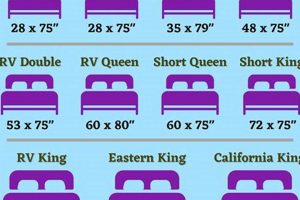
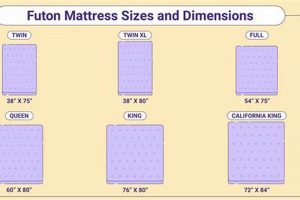
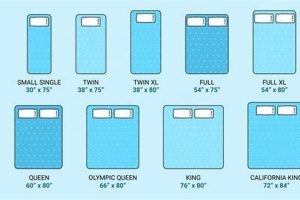
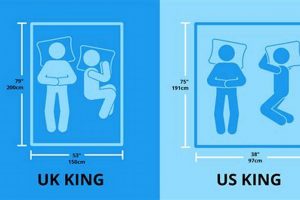
A common inflatable bed size designed to comfortably accommodate two adults, it generally measures approximately 60 inches in width and 80 inches in length. Height can vary significantly between models, ranging from low-profile options around 8 inches tall to elevated versions reaching 20 inches or more. These measurements represent the inflated state and can fluctuate slightly depending on air pressure and material elasticity.
The significance of this size lies in its balance between spaciousness and portability. It offers ample sleeping space for couples while remaining manageable for storage and transport, making it a practical solution for guest accommodations, camping trips, or temporary bedding needs. The widespread adoption of this size has led to readily available fitted sheets and accessories, further enhancing its convenience.
The ensuing sections will delve into the factors influencing the size variations, material considerations affecting comfort and durability, and practical applications of this popular inflatable bed solution across diverse scenarios.
Considerations for Selecting an Inflatable Queen Bed
The following points offer guidance when selecting an inflatable queen bed, ensuring optimal comfort and utility.
Tip 1: Evaluate Height Preferences: Assess desired height based on ease of entry and exit. Lower profiles are suitable for children or those with mobility limitations, while taller options offer a more bed-like experience.
Tip 2: Measure Available Space: Confirm the suitability for the intended room or tent. Allow for several inches of clearance around its perimeter to prevent rubbing against walls and to permit free movement.
Tip 3: Assess Weight Capacity: Verify its maximum weight allowance exceeds the combined weight of its intended occupants. Exceeding the stated capacity may damage the internal structure or lead to deflation.
Tip 4: Consider Integrated Pump Features: Some models feature built-in electric pumps for convenient inflation and deflation. Determine if a built-in pump aligns with portability requirements and power source availability.
Tip 5: Review Material Composition: Examine the material’s puncture resistance and overall durability. Thicker PVC or reinforced fabrics enhance longevity and reduce the likelihood of leaks.
Tip 6: Read User Reviews: Research the experiences of other purchasers, paying attention to reports on air retention, comfort, and pump reliability. User feedback can provide valuable insights beyond manufacturer specifications.
These considerations enable a more informed purchasing decision, facilitating the selection of an inflatable queen bed that effectively meets specific requirements and expectations.
The subsequent sections will explore specific features, such as integrated pumps and material types, in greater detail, providing a comprehensive understanding of the available options.
1. Width

The width of a queen-size inflatable mattress is a primary dimension defining its capacity to comfortably accommodate occupants. A standard dimension of approximately 60 inches directly impacts the sleeping space available for two adults. Reduced width may compromise comfort for co-sleepers, while excessive width, though less common, may present storage or spatial limitations within a room or tent. Therefore, the width is crucial to achieving a balance between sleeping comfort and practical utility.
Variations in the stated width can occur due to manufacturing tolerances or the degree of inflation. Inflatable mattresses with integrated pillow sections or raised edges may exhibit a slight discrepancy between the advertised width and the actual usable sleeping surface. Prioritizing accurate measurements, therefore, proves valuable when selecting a model for a specific spatial context, such as fitting it within a designated tent footprint or ensuring adequate clearance within a guest room.
The width dimension of an inflatable queen mattress, therefore, constitutes a fundamental parameter impacting comfort, suitability, and spatial compatibility. Accurate assessment, considering both advertised and usable dimensions, ensures optimal selection for diverse applications. Failure to consider this critical aspect may result in compromised sleep quality, spatial constraints, or dissatisfaction with the chosen product.
2. Length

The dimension of length, specifically in the context of a queen-size inflatable mattress, directly dictates the accommodation of users’ height and overall sleeping comfort. Measuring approximately 80 inches, this dimension is crucial for ensuring adequate support and preventing discomfort due to overhang.
- Accommodating User Height
The 80-inch length primarily caters to individuals of average height. Those significantly taller may experience discomfort due to their feet extending beyond the mattress edge, impacting sleep quality. Selection should consider the height of potential users to ensure adequate support from head to toe.
- Impact on Sleeping Posture
Insufficient length can force users into awkward sleeping positions, potentially leading to back pain or other musculoskeletal issues. The prescribed length facilitates a natural, supine or lateral sleeping posture, contributing to spinal alignment and reduced pressure points.
- Space Utilization Considerations
The 80-inch length impacts the amount of floor space required for setup. In smaller rooms or tents, the length dimension may present logistical challenges, necessitating careful measurement and placement to optimize space utilization without compromising accessibility.
- Material Expansion Effects
The stated length can be subject to minor variations based on the material composition and inflation level. Inherent elasticity can cause expansion or contraction, influencing the effective sleeping surface. Precise measurements post-inflation are recommended to verify conformity with spatial constraints.
The length dimension of an inflatable queen mattress is thus a crucial determinant of sleeping comfort, postural support, and spatial compatibility. A comprehensive understanding of its implications, as related to user height and ambient spatial constraints, informs judicious selection and application, enhancing overall user satisfaction.
3. Height

Height, as a dimension of a queen size blow up mattress, significantly influences user experience, ranging from ease of access to perceived comfort levels. Its variations directly impact suitability for different users and applications.
- Ease of Access and Egress
Mattress height dictates the ease with which individuals can enter and exit the bed. Lower-profile models, typically 8-12 inches, are advantageous for children or those with mobility limitations, facilitating independent access. Conversely, elevated models, reaching 18-24 inches, more closely resemble traditional bed heights, potentially offering greater comfort and reducing strain during transitions.
- Perceived Comfort and Support
Height contributes to the perceived level of comfort. Elevated mattresses often create a more immersive sleeping experience, mimicking the feel of a conventional bed. This added height allows for greater air volume within the mattress, potentially leading to enhanced support and cushioning. Lower-profile models, while more portable, may sacrifice some level of plushness due to reduced air capacity.
- Storage Considerations
The height of the mattress, when deflated and packed, impacts storage efficiency. Lower-profile models generally compress into a smaller volume, facilitating storage in confined spaces. Elevated models, due to their increased material volume, may require more storage space, potentially posing a challenge for users with limited storage capacity.
- Impact on Room Aesthetics
A mattresss height significantly influences a rooms aesthetics. Lower models have a more minimalist profile, blending subtly with the environment. Taller inflatables command more visual attention, simulating traditional bed frames. Careful consideration ensures the selected height complements the room’s decor and scale.
In summary, the height dimension directly impacts accessibility, comfort, storage, and visual integration within a space. Selection of a height dimension should align with the needs of the end-user and the constraints of the physical environment.
4. Packed Size

Packed size, in relation to an inflatable queen mattress, is a crucial dimension reflecting the volume occupied when the mattress is deflated, folded, and stored within its designated carrying case or packaging. The inflated dimensions dictate sleeping area, while the packed size determines portability and storage feasibility. Larger inflated dimensions do not automatically equate to a proportionally larger packed size, as material elasticity and folding techniques play significant roles. For example, a queen mattress designed for backpacking will prioritize a minimal packed size even if it compromises slightly on comfort, while a model intended for home guest use may have a larger packed size that is less of a concern.
The correlation between these two sets of dimensions is critical in determining the suitability of the mattress for specific applications. Consider a scenario where an individual requires a temporary bed solution for small apartments, the packed size is paramount. Storage constraints limit the usefulness of a comfortable, larger queen mattress if its deflated form occupies an excessive amount of space. Conversely, for car camping, a slightly larger packed dimension might be acceptable in exchange for increased sleeping comfort provided by a thicker or more robust queen mattress. Thus, a careful evaluation of storage space and transportation means is necessary.
Therefore, understanding the interaction between inflated and packed dimensions is vital for informed consumer choice. This analysis goes beyond surface-level considerations. Selecting a mattress without acknowledging this correlation can result in practical challenges related to storage, transport, and intended usage. Balanced consideration of these dimensions facilitates the acquisition of an inflatable queen mattress that effectively fulfills its intended purpose without creating logistical difficulties.
5. Weight

The weight of an inflatable queen mattress is directly related to its dimensions and material composition, influencing portability and ease of handling. Larger dimensions, particularly height and surface area, inherently require more material, thereby increasing the overall mass. Material density and thickness also contribute proportionally; heavier-duty PVC or reinforced fabrics, selected for enhanced durability, correspondingly increase the mattresss weight. For instance, a low-profile camping model, prioritizing portability, utilizes thinner, lighter materials, resulting in a significantly lower weight compared to an elevated home-use version with multiple internal support structures and a thicker outer layer. The weight, measured in pounds or kilograms, becomes a critical factor for individuals intending to transport the mattress frequently, such as campers or those requiring a temporary bedding solution for travel.
The relationship between weight and dimensions also impacts practical applications. A heavier mattress, while potentially offering greater stability and a more substantial feel, presents challenges in terms of maneuverability and setup, particularly for a single individual. Conversely, a lightweight mattress, though easier to transport and deploy, might compromise on durability and support, especially for heavier individuals or couples. Manufacturers often specify a maximum weight capacity, implicitly acknowledging the structural limitations imposed by the combination of material and dimensions. Selecting a mattress necessitates balancing the desire for comfort and support with the practical considerations of transport, setup, and storage.
In summary, the weight of an inflatable queen mattress is an intrinsic consequence of its dimensions and material choices. A lighter mattress allows for easy portability; a heavier one provides stable support. Therefore, understanding this connection is paramount to choosing a product best aligned to the demands of usage, physical capabilities, and storage constraints. Neglecting to consider this critical interplay may result in purchasing a product impractical for its intended application, whether due to excessive weight or inadequate support.
6. Thickness
Thickness, as a dimensional attribute of an inflatable queen mattress, exerts a substantial influence on both the overall volume and user comfort. It refers to the vertical distance from the top to the bottom surface of the inflated mattress. A direct relationship exists: increased thickness contributes to a greater overall volume for a given width and length. This volumetric increase can translate to an enhanced sleeping experience. For example, a mattress with a thickness of 18 inches will inherently contain more air than one measuring 8 inches, potentially providing improved cushioning and support. However, the thicker mattress will typically require more storage space when deflated.
The importance of thickness lies in its effect on user comfort and the mattresses ability to conform to the sleeper’s body. A thicker mattress tends to distribute weight more evenly, reducing pressure points and promoting spinal alignment. Conversely, a thinner mattress may result in increased pressure on bony prominences, such as hips and shoulders, potentially leading to discomfort. Real-life examples of the practical significance include camping situations where ground unevenness is prevalent. A thicker mattress provides greater insulation from the cold ground and absorbs minor irregularities, while a thin mattress might leave the sleeper acutely aware of every bump and pebble.
In summary, thickness stands as a defining dimension inextricably linked to the overall size and performance characteristics of an inflatable queen mattress. It influences comfort, support, storage volume, and suitability for various applications. Therefore, careful consideration of the thickness dimension is paramount when selecting a mattress to meet specific comfort and logistical requirements.
Frequently Asked Questions
The following addresses common inquiries regarding the dimensions of inflatable queen mattresses, providing detailed and objective answers.
Question 1: What are the standard measurements for a queen size blow up mattress?
Typical dimensions are approximately 60 inches in width, 80 inches in length, and a height ranging from 8 to 24 inches, though this can vary by model.
Question 2: How does mattress thickness affect comfort?
Increased thickness often corresponds to enhanced comfort due to better weight distribution and increased cushioning. Thicker models can more effectively mitigate pressure points.
Question 3: What factors influence the packed size of the mattress?
Material composition, thickness, and the efficiency of the deflation and folding mechanisms all contribute to the final packed size.
Question 4: Does mattress weight correlate with durability?
Generally, heavier mattresses imply denser materials and potentially enhanced durability. However, construction methods also play a significant role.
Question 5: What is the typical weight capacity for a queen size inflatable mattress?
Weight capacities vary, but most models are designed to support between 500 and 700 pounds. Consult the manufacturer specifications for precise limitations.
Question 6: How do dimensions impact suitability for different uses (e.g., camping vs. guest room)?
Camping models prioritize portability, resulting in smaller packed sizes and lighter weights, often at the expense of thickness. Guest room models emphasize comfort, with larger dimensions and potentially heavier construction.
A thorough understanding of the dimensional characteristics is paramount to selecting an inflatable queen mattress that adequately meets specific user needs and application scenarios.
The subsequent section will examine the role of material composition in influencing the overall performance and lifespan of these inflatable mattresses.
Conclusion
The preceding examination of dimensions of a queen size blow up mattress underscores their critical role in determining comfort, portability, and overall suitability for various applications. Width, length, height, packed size, weight, and thickness each contribute uniquely to the user experience. Effective selection necessitates careful consideration of these dimensional aspects, aligning them with specific needs and constraints.
Continued advancements in materials and design promise to further refine the interplay between these measurements, potentially yielding more durable, comfortable, and versatile inflatable queen mattresses. A deeper understanding of these core dimensions empowers informed purchasing decisions, ultimately maximizing satisfaction and utility.