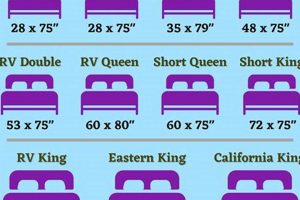
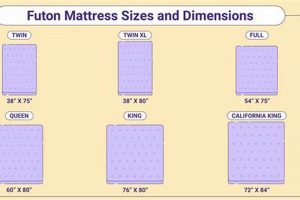
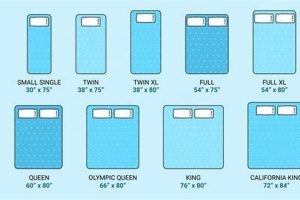
The standard measurements for a queen airbed typically span approximately 60 inches in width and 80 inches in length. The height can vary considerably depending on the model, ranging from low-profile options around 8 inches to elevated styles that reach 25 inches or more. These measurements are intended to mimic the standard sizing of traditional queen mattresses, allowing for compatibility with existing bedding and frames.
Adherence to these general measurements offers several advantages. It allows for easy accommodation of two adults, providing ample sleeping space. The familiar dimensions simplify the process of finding appropriately sized sheets and blankets. Furthermore, the commonality of the size simplifies storage and transportation considerations.
Subsequent sections will delve into a comparative analysis of different airbed heights, explore the impact of material composition on overall size perception, and provide guidance on selecting an airbed based on individual needs and spatial constraints.
Considerations Regarding Queen Airbed Measurements
The following outlines practical advice to aid in informed decision-making related to queen-sized airbeds. Adherence to these points can enhance user satisfaction and ensure compatibility with intended applications.
Tip 1: Verify Actual Measurements: While labeled as “queen size,” slight variations in actual dimensions may occur between manufacturers. Always consult the product specifications for precise measurements before purchase, especially if space is limited.
Tip 2: Account for Inflation: Airbeds expand during inflation. Ensure sufficient clearance within the intended space to accommodate the fully inflated bed without obstruction or damage.
Tip 3: Factor in Bedding: Standard queen-sized sheets and blankets are generally compatible, but the thickness of the airbed should be considered. Deeper-pocketed sheets may be necessary for thicker airbeds to ensure a secure fit.
Tip 4: Evaluate Height for Accessibility: The height of the airbed affects ease of entry and exit. Consider user mobility when selecting an airbed with a lower or higher profile.
Tip 5: Measure Storage Space: When deflated, queen airbeds still require storage space. Confirm that adequate storage is available before purchasing.
Tip 6: Consider Weight Capacity: Airbeds have a maximum weight capacity. Ensure the selected airbed can safely accommodate all intended users to prevent damage or deflation during use.
Tip 7: Check the Pump Type: Internal pumps add to overall measurements. External pumps will need additional space near the airbed when in use.
Careful consideration of these factors contributes to a more satisfactory user experience. Accurate dimension awareness aids in ensuring proper fit, comfort, and safe usage.
The concluding section will summarize key considerations and propose next steps for optimizing the selection of a queen airbed.
1. Width

The width, as a primary component of the overall measurement, dictates the number of occupants who can comfortably occupy the bed. The established standard for queen airbeds is approximately 60 inches. This width is intended to provide sufficient space for two adults to sleep alongside each other without undue constraint. Insufficient width compromises individual sleeping space, potentially leading to discomfort and disturbed sleep.
Variations in width, even marginal discrepancies, can impact the perceived and actual comfort level. For instance, an air mattress falling short of the 60-inch standard may be unsuitable for couples, necessitating a larger bed size. Conversely, if space is limited, careful attention must be paid to the specified width to ensure it fits within the designated area without obstructing movement or access to other parts of the room. Furthermore, bedding compatibility is contingent on the correct width measurement, affecting the ease of purchasing appropriately sized sheets and blankets.
In summary, the width dimension of a queen airbed directly correlates with its capacity to comfortably accommodate its intended users and its spatial suitability. Any deviation from the standard dimensions can result in practical difficulties or compromised user satisfaction, highlighting the importance of verifying the measurement before purchase.
2. Length

The length of a queen airbed, intrinsically linked to its overall size specifications, typically measures around 80 inches. This dimension is engineered to accommodate the average adult height, ensuring comfortable extension during sleep. A length dimension falling short of this standard compromises legroom and can induce discomfort, particularly for taller individuals. This deficiency can lead to disrupted sleep patterns and a general feeling of spatial restriction.
Conversely, a queen airbed exceeding 80 inches in length presents logistical challenges within confined spaces. While extended length might benefit taller users, it necessitates careful consideration of room dimensions to avoid obstructing pathways or hindering access to other furnishings. For example, positioning an excessively long airbed in a smaller guest room could impede door closure or create an impractical living environment. Furthermore, bedding intended for a standard queen size may not fit an airbed with non-standard dimensions, necessitating specialized linens.
Ultimately, the length dimension of a queen airbed functions as a critical element in determining user comfort and spatial compatibility. Selecting an airbed with the appropriate length dimension avoids both physical discomfort for occupants and practical challenges within the intended environment. Accurate measurement and mindful consideration of spatial constraints are essential for achieving optimal functionality.
3. Height

The height dimension of a queen air mattress significantly impacts both comfort and functionality. It refers to the vertical distance from the ground to the top surface of the inflated mattress. Heights can vary considerably, ranging from low-profile models approximately 8 inches high to elevated versions reaching 25 inches or more. This variation directly influences ease of access, particularly for individuals with mobility limitations. A lower profile may be more suitable for those who find it challenging to climb onto a higher surface, while an elevated mattress more closely mimics the experience of a traditional bed, facilitating easier transitions in and out of the sleeping position.
The selected height also affects the choice of bedding and the perceived comfort level. Standard queen-size sheets may not adequately fit thicker air mattresses, potentially requiring deep-pocketed sheets to ensure a secure fit. Furthermore, an increased height can create a more substantial and supportive sleeping surface, particularly beneficial for individuals accustomed to a firmer mattress. Conversely, low-profile models may offer a more streamlined aesthetic and ease of storage when deflated. The height selected should align with user preferences, physical requirements, and practical considerations regarding storage and transportation.
In conclusion, the height dimension is an integral component of a queen air mattress, influencing its accessibility, comfort, and compatibility with bedding. Careful assessment of individual needs and spatial constraints is crucial when selecting an air mattress with the optimal height. A thoughtfully chosen height contributes to a more comfortable and user-friendly experience. Disregard for this dimension can lead to practical difficulties and compromised user satisfaction.
4. Thickness
Thickness, referring to the vertical dimension of the inflated air mattress, plays a crucial role within the framework of queen size air mattress specifications. It directly influences support, comfort, and overall suitability for various users and environments. While width and length define sleeping area, thickness dictates the bed’s profile and its ergonomic impact.
- Support and Comfort
Greater thickness generally provides enhanced support and comfort. Thicker air mattresses often contain more internal baffling and support structures, distributing weight more evenly and reducing pressure points. This is particularly important for individuals with back pain or those seeking a more stable sleeping surface. Thinner mattresses, conversely, may lack sufficient support and could lead to discomfort or sagging.
- Ease of Access
Thickness affects the ease of getting into and out of the bed. A thicker mattress, mimicking a traditional bed’s height, may be preferable for individuals with mobility issues or joint pain. A lower-profile, thinner mattress might present challenges for these users. Conversely, a thinner mattress may be more suitable for children or for situations where a low profile is desired for aesthetic or spatial reasons.
- Sheet Compatibility
The thickness of a queen air mattress directly impacts sheet compatibility. Standard queen-size sheets may not adequately fit air mattresses with a significant thickness, necessitating the use of deep-pocket sheets. Failure to use appropriately sized sheets can result in ill-fitting bedding that comes loose during the night, impacting sleep quality and potentially damaging the mattress.
- Storage Considerations
While thickness applies to the inflated state, it indirectly influences storage. Thicker mattresses typically contain more material and may take up more space when deflated and folded for storage. This is an important consideration for users with limited storage space, as the deflated dimensions and packed volume can vary significantly between different models.
In summary, thickness represents a critical dimension within the context of queen size air mattress specifications, affecting comfort, accessibility, bedding compatibility, and storage considerations. Careful evaluation of this dimension, alongside width and length, is essential for selecting an air mattress that meets individual needs and spatial limitations. The interaction between thickness and these other dimensions contributes to the overall functionality and suitability of the product.
5. Packed Size

The packed size of a queen air mattress is a critical consideration directly influenced by its inflated dimensions and internal construction. It represents the volume occupied when the mattress is deflated and prepared for storage or transportation, a factor particularly relevant for users with limited space or those requiring portability.
- Material Composition and Folding Efficiency
The type and thickness of the air mattress material significantly affect its packed size. Thicker, more durable materials tend to resist tight compression, resulting in a larger packed volume compared to thinner, more pliable materials. Furthermore, the internal baffling structure and seams can impede efficient folding, contributing to a bulkier packed form. Manufacturers often employ specific folding techniques and include straps or bags to minimize the packed size, but the material properties remain a primary determinant.
- Integrated Pump Systems
Air mattresses with integrated electric pumps typically exhibit a larger packed size than those requiring external pumps. The built-in pump mechanism occupies additional volume within the mattress structure, even when deflated. While integrated pumps offer convenience in inflation and deflation, they contribute to a less compact packed form, potentially impacting storage options. Mattresses relying on separate pumps allow for tighter compression and a smaller overall packed size.
- Deflation Effectiveness
The efficiency of the deflation process directly impacts the final packed size. Air mattresses with effective deflation mechanisms, such as wide-mouth valves or integrated deflation functions, enable more complete air expulsion, resulting in a smaller and more manageable packed volume. Incomplete deflation leaves residual air trapped within the mattress, increasing its packed size and potentially hindering storage or transportation. The design and functionality of the deflation system are therefore crucial factors in determining the packed dimensions.
- Included Accessories and Packaging
The inclusion of accessories, such as repair kits, inflation adapters, or carrying bags, can influence the overall packed size. While these accessories enhance the usability and protection of the air mattress, they add to the total volume when stored together. The design and material of the packaging itself also play a role, with more robust and protective packaging contributing to a larger packed size compared to simpler, less bulky options.
In conclusion, the packed size of a queen air mattress is a complex attribute dependent on material properties, integrated components, deflation effectiveness, and included accessories. This dimension should be carefully considered alongside inflated dimensions when selecting an air mattress, particularly when storage space is limited or portability is a primary requirement. The relationship between inflated dimensions and packed size directly impacts the practicality and usability of the product.
6. Weight

The weight of a queen-size air mattress is a multifaceted characteristic intrinsically linked to its dimensions and material composition. This aspect influences portability, ease of handling, and structural integrity. The interplay between weight and dimensions dictates the air mattresss suitability for various applications, from temporary guest accommodations to camping scenarios.
- Material Density and Construction
The primary determinant of a queen air mattress’s weight is the density of the materials used in its construction. Thicker, more durable PVC or reinforced laminates contribute to increased weight. The internal structure, including the number and type of support beams or air chambers, also impacts the overall mass. Higher-quality, more robust construction typically results in a heavier air mattress.
- Integrated Pump Systems and Components
The inclusion of an integrated electric pump adds substantially to the overall weight. Internal pumps, along with their associated wiring and housings, increase the mass compared to models that rely on external pumps. Furthermore, additional features such as built-in pillows or specialized comfort layers contribute incrementally to the total weight.
- Impact on Portability and Handling
Weight directly affects the portability and ease of handling of the air mattress. A heavier mattress is more cumbersome to transport and maneuver, potentially posing challenges for individuals with limited strength or mobility. Lighter models are easier to carry and set up, making them more suitable for travel or situations where frequent relocation is required. The weight should be carefully considered in relation to the intended use and the physical capabilities of the user.
- Effect on Structural Integrity and Longevity
While not always a direct correlation, weight can sometimes be indicative of structural integrity. Air mattresses constructed with heavier, more durable materials may be more resistant to punctures, tears, and general wear and tear. However, excessive weight can also place stress on seams and valves, potentially shortening the lifespan of the product. A balance between weight and material quality is essential for optimal durability and longevity.
In summation, the weight of a queen air mattress is a key attribute intertwined with its dimensions, material composition, and intended functionality. Considering weight alongside other specifications ensures an informed purchase decision, aligning the chosen air mattress with specific needs and usage scenarios. Neglecting this factor may lead to inconvenience during transportation or compromise the overall durability and longevity of the product.
Frequently Asked Questions
The following addresses common inquiries concerning the specifications of queen airbeds. Precise understanding of these dimensions is crucial for informed purchase decisions and optimal user experience.
Question 1: What are the standard measurements of a queen air mattress?
A queen air mattress typically measures approximately 60 inches in width and 80 inches in length. Height can vary, typically ranging from 8 to 25 inches depending on the model. These dimensions generally conform to standard queen mattress sizes.
Question 2: Are the stated dimensions always accurate?
While dimensions are typically consistent, slight variations can occur between manufacturers. Consulting product specifications for precise measurements is advised, especially when space is limited.
Question 3: How does inflation affect the dimensions?
Airbeds expand upon inflation. Adequate clearance within the intended space is essential to accommodate the fully inflated bed. Verify that the inflated dimensions will not obstruct surrounding objects.
Question 4: What type of sheets are required for a queen air mattress?
Standard queen-sized sheets are generally compatible, but the mattress thickness is a key consideration. Deeper-pocketed sheets are often necessary for thicker airbeds to ensure a secure and proper fit.
Question 5: Does the thickness of the air mattress affect its packed size?
Yes, thicker air mattresses typically occupy more space when deflated and folded for storage. The deflated dimensions should be reviewed if storage space is limited.
Question 6: How does weight relate to the overall dimensions?
The weight of an air mattress is influenced by its dimensions and material composition. Lighter models offer greater portability, while heavier models may indicate more robust construction.
Key takeaway: Understanding these dimensions is paramount for ensuring comfort, compatibility, and safe usage of a queen air mattress.
The subsequent section will explore available product variations and their impact on consumer choice.
Queen Size Air Mattress Dimensions
This analysis has meticulously examined the dimensional attributes of a queen airbed, emphasizing width, length, height, thickness, packed size, and weight. Each specification critically impacts user comfort, spatial compatibility, portability, and overall suitability for diverse applications. Precise measurement and careful consideration of these factors are essential when selecting an airbed to ensure a satisfactory user experience.
Ultimately, informed decisions regarding queen size air mattress dimensions are crucial for optimizing functionality and preventing potential issues. By carefully assessing these specifications, consumers can confidently choose a product that effectively meets their needs and expectations, whether for temporary accommodation or portable sleeping solutions. Continued adherence to dimensional standards and advancements in material technology will further refine the performance and practicality of these products in the future.