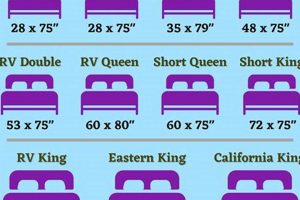
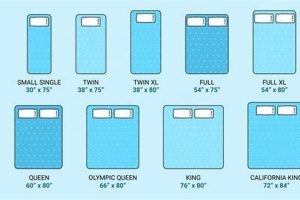
A short queen mattress, also known as an RV queen or an Olympic queen, is a bed size that offers a shorter length compared to a standard queen mattress. The dimensions typically measure around 60 inches in width and 75 inches in length. As a reference, a standard queen is 80 inches long.
This particular size is most often employed in recreational vehicles (RVs) and smaller bedrooms where space is a constraint. Its design optimizes sleeping area while minimizing the overall footprint, allowing for more efficient use of available room. Historically, these sizes were developed to accommodate the limitations imposed by RV layouts and smaller living quarters.
Understanding these dimensions is essential when selecting bedding, frames, and overall bedroom or RV design. This article will further explore the specific applications, related considerations, and alternatives available in the mattress market.
Selecting and Utilizing a Short Queen Mattress
Considerations regarding the dimensions of a short queen mattress are critical for ensuring both comfort and functionality. The following tips outline essential aspects for those considering or currently using this mattress size.
Tip 1: Measure Available Space: Prior to purchase, precisely measure the space where the mattress will reside. Account for any obstructions or constraints within the RV or room. Accurate measurements prevent fitment issues and ensure ease of movement around the bed.
Tip 2: Source Compatible Bedding: Standard queen bedding will not properly fit a short queen mattress. Seek out specifically designed short queen sheets, comforters, and mattress protectors. Using ill-fitting bedding can lead to discomfort and premature wear of the mattress.
Tip 3: Consider Frame Support: Ensure the bed frame is appropriately sized and designed to support the dimensions of the short queen mattress. A frame that is too large or inadequate can compromise mattress support and potentially damage the sleeping surface.
Tip 4: Assess Sleeping Needs: Evaluate individual or shared sleeping preferences. While a short queen mattress provides space savings, it may be less suitable for individuals who require ample legroom or who share the bed with a partner. Consider a standard queen or other alternatives if space allows.
Tip 5: Evaluate Mattress Thickness: Mattress thickness can impact overall comfort and perceived space within an RV or small room. Balance comfort requirements with space limitations. A thicker mattress may reduce headroom or impede movement, while a thinner mattress might compromise support.
Tip 6: Rotate the Mattress Regularly: Rotating the mattress every few months helps ensure even wear and prolongs its lifespan. This is particularly important for mattresses used frequently in RVs or guest rooms.
Adhering to these recommendations will optimize comfort, extend the life of the short queen mattress, and ensure efficient utilization of the available space. Precise measurements and appropriate bedding selection are paramount for a satisfactory sleep experience.
The next section will cover the pros and cons associated with the purchase of this type of mattress.
1. Width

The dimension of 60 inches in width is a defining characteristic of a short queen mattress, directly contributing to its overall dimensional profile. This fixed width, identical to that of a standard queen, establishes a baseline for comparing it to other mattress sizes. It dictates the minimum space required to accommodate the mattress horizontally, impacting room layout and furniture placement. Without this specification, the mattress could not be accurately classified as a “queen,” whether standard or short.
The practical significance of this width becomes apparent when considering bedding purchases and sleeping arrangements. The standard queen width allows for some interchangeability with bedding, though length considerations necessitate specific “short queen” sheets. For couples, this width provides adequate space for two individuals to sleep comfortably, albeit with potentially less personal space than a king-size bed. In RV applications, this fixed width influences aisle space and overall livability of the vehicle.
In summary, the 60-inch width component of the short queen’s dimensions is fundamental to its categorization and functionality. It dictates spatial requirements, influences bedding choices, and affects the sleeping experience. Misunderstanding this dimension can lead to incorrect purchases and compromised comfort. The specified width, in conjunction with the reduced length, creates a unique mattress size optimized for specific environments.
2. Length

The 75-inch length constitutes a defining parameter of a short queen mattress, differentiating it from a standard queen size and directly influencing its suitability for specific applications. This dimension impacts comfort, spatial efficiency, and overall usability, particularly within recreational vehicles (RVs) and compact living spaces.
- Spatial Efficiency in RVs
The reduced length of 75 inches directly addresses spatial limitations inherent in RV design. Standard mattresses often prove unwieldy in these environments. This specific length allows for the installation of a queen-sized sleeping surface without excessively compromising valuable floor space or impeding movement within the RV. The shortened dimension enables more practical layouts and enhanced usability.
- Accommodation of Height Requirements
Individuals exceeding approximately 5’10” in height may find the 75-inch length restrictive. While adequate for many, it necessitates a consideration of personal height preferences when selecting a mattress. Prioritizing legroom is critical, and a standard queen or alternative mattress configuration may be more appropriate for taller individuals to ensure comfortable and restorative sleep.
- Bedding Availability and Compatibility
The non-standard length of a short queen mattress necessitates the purchase of specifically designated bedding. Standard queen sheets will not fit correctly, leading to potential discomfort and aesthetic concerns. The availability of appropriately sized sheets and blankets may be limited compared to standard sizes, requiring careful sourcing from specialty retailers or online vendors to ensure proper fit.
- Frame and Platform Considerations
Bed frames or platforms designed for standard queen mattresses will be incompatible with a short queen size. Utilizing an incorrectly sized frame can compromise mattress support, leading to premature wear and potential damage. Ensuring frame and mattress dimensions are precisely aligned is crucial for maintaining structural integrity and maximizing the lifespan of the sleep system.
In conclusion, the 75-inch length is not merely a numerical value but a critical determinant influencing comfort, compatibility, and functionality within the broader context of a short queen mattress. Its significance extends beyond simple dimensions, encompassing considerations of spatial efficiency, personal height, bedding availability, and frame compatibility. A comprehensive understanding of these factors is essential for informed decision-making and ensuring a satisfying sleep experience.
3. Area (square inches)

The area, measured in square inches, is a direct consequence of the dimensions of a short queen mattress. Given its width of 60 inches and length of 75 inches, the area can be calculated by multiplying these two values. This results in a total surface area of 4,500 square inches. This calculation holds significant practical value, as it quantifies the total sleeping surface available. For example, when comparing the space offered by a short queen versus a twin or full mattress, this value provides a tangible metric for evaluating suitability for one or two sleepers. A smaller area may be insufficient for couples seeking ample personal space, while a larger area, such as that of a standard queen or king, might be unnecessary for a single sleeper.
Understanding the mattress area also facilitates informed decisions about bedding and accessories. While the dimensions dictate the necessary sheet size, the area indirectly affects the choice of mattress protectors and toppers. Selecting accessories that appropriately cover the entire surface ensures adequate protection and enhances comfort. In the context of RVs, where space is often limited, optimizing the usable area within the bedroom or sleeping area is paramount. Accurately calculating the square inches occupied by the mattress helps maximize the efficiency of the available space, enabling better organization and movement within the confined environment. Moreover, the total weight distribution across this area also needs consideration for ensuring the structural integrity of the support system.
In summary, the area in square inches, derived from the mattress dimensions, functions as a fundamental quantitative measure of the sleeping surface. It provides a basis for comparison against other mattress sizes, informs accessory selection, and facilitates spatial optimization within constrained environments such as RVs. While dimensions are the primary descriptive characteristics, the calculated area offers practical insight into the usability and suitability of a short queen mattress for specific needs and applications. Misinterpreting the area could result in inefficient space utilization, discomfort, and suboptimal sleep quality.
4. Thickness (various)

The thickness of a short queen mattress, which varies considerably among models, functions as a critical component when assessing overall dimensions and suitability. While the length and width define the mattress’s footprint, thickness dictates its vertical profile, impacting comfort, support, and compatibility with bed frames and bedroom spaces. A thicker mattress may offer enhanced cushioning and pressure relief, while a thinner model could be more suitable for environments where vertical space is constrained, such as in some RVs. Ultimately, while not a traditional aspect of mattress dimensions, thickness has a profound role in dictating the actual usability of the mattress.
The thickness of a short queen impacts bed height, which in turn influences ease of access. Individuals with mobility challenges may prefer a mattress of a specific thickness to facilitate getting in and out of bed. Additionally, mattress thickness affects the selection of bedding, particularly fitted sheets. Deep-pocket sheets are required for thicker mattresses to ensure a secure and proper fit. Conversely, using deep-pocket sheets on a thinner mattress can result in a loose and wrinkled surface. A mattress’s thickness will influence factors such as the overall support and durability of the mattress. This is due to thicker mattresses often containing more layers of foam or springs for enhanced durability.
In summary, while the traditional dimensions of length and width establish the horizontal area, the thickness dictates the mattress’s vertical dimension, significantly influencing comfort, compatibility with frames, bedding selection, and overall suitability. Recognizing the variability in thickness and considering its impact on different aspects of the sleeping experience is essential for making an informed purchase decision and maximizing satisfaction with a short queen mattress. Its effect on everything from access to longevity makes it a core consideration.
5. Frame compatibility

Frame compatibility is inextricably linked to the specific dimensions of a short queen mattress. The frame must accurately correspond to these dimensions to provide adequate support and prevent damage to the mattress. Discrepancies between frame size and mattress dimensions can lead to compromised comfort, reduced mattress lifespan, and potential structural instability.
- Dimensional Correspondence
A frame designed for a standard queen mattress will not properly accommodate a short queen due to the difference in length. Attempting to use such a frame will result in either a gap at the end of the bed, leading to uneven support and potential sagging, or an overhang, creating a safety hazard. Frame dimensions should precisely match the short queen’s 60-inch width and 75-inch length.
- Support Structure Integrity
The frame’s support system, whether consisting of slats, a solid platform, or springs, must be appropriately configured to distribute weight evenly across the mattress. A frame with insufficient support will cause localized stress points, leading to premature wear and potential mattress failure. The spacing and strength of the support elements must be tailored to the specific weight and dimensions of the short queen.
- Bed Frame Type and Compatibility
Various bed frame styles, including platform beds, sleigh beds, and adjustable bases, must be evaluated for compatibility with the dimensions of the short queen. Platform beds typically require a solid or closely spaced slatted surface, while adjustable bases must be designed to accommodate the reduced length. Sleigh beds may present challenges due to their curved headboards and footboards, which could interfere with the mattress dimensions.
- Headboard and Footboard Attachment
The attachment points for headboards and footboards must align with the dimensions of the short queen frame. Standard queen-sized headboards and footboards may not be compatible due to differences in width or height. Modifying existing attachments or sourcing compatible hardware may be necessary to ensure a secure and aesthetically pleasing connection.
Accurate frame compatibility, predicated on precise dimensional alignment with the short queen mattress, is a non-negotiable requirement for ensuring optimal support, comfort, and longevity. Neglecting this aspect can negate the potential benefits of the short queen’s space-saving design and lead to compromised sleep quality and increased replacement costs.
6. RV Suitability

The suitability of a short queen mattress for recreational vehicles (RVs) is directly contingent upon its dimensions, specifically the balance between comfort and spatial efficiency. The compact nature of RV interiors necessitates careful consideration of every component, and the mattress is no exception. The short queen’s design represents a compromise, aiming to provide adequate sleeping space while minimizing the physical footprint within the vehicle.
- Optimizing Limited Space
RVs are characterized by constrained interior dimensions. A standard queen mattress may prove unwieldy, impeding movement and limiting usable floor space. The reduced length of a short queen, typically 75 inches, allows for easier integration into RV layouts. This dimensional reduction can create valuable walkway space, facilitating access to other areas of the vehicle. For example, in a Class B RV, where every inch counts, a short queen can mean the difference between a cramped and a functional living area.
- Weight Considerations
The overall weight of an RV is a critical factor in determining its fuel efficiency and handling characteristics. A shorter and often thinner mattress contributes to a reduction in overall weight compared to a standard queen. This weight reduction, while seemingly incremental, can collectively impact the vehicle’s performance and fuel economy, particularly on extended trips. A lighter mattress allows for greater payload capacity for essential equipment and personal belongings.
- Customization and Configuration
The short queen dimensions often lend themselves well to custom RV configurations. Many RV owners modify their interiors to suit specific needs. The shorter length facilitates the creation of convertible sleeping areas that can be transformed into seating or storage during the day. This flexibility is particularly valuable in smaller RV models, where maximizing functionality is essential. For example, a short queen might be hinged to fold up against a wall, creating a dinette or workspace.
- Accessibility and Maneuverability
Installing and removing a mattress within the confined space of an RV can be challenging. The reduced dimensions of a short queen often simplify this process. Its smaller size makes it easier to maneuver through narrow doorways and around tight corners. This is especially relevant when replacing an existing mattress or performing maintenance within the RV’s sleeping area. The shorter length minimizes the risk of damaging interior components during installation or removal.
In conclusion, the suitability of a short queen mattress for RVs hinges primarily on its dimensions. The shorter length directly addresses spatial constraints, while the reduced weight contributes to overall vehicle efficiency. The adaptability of these dimensions to custom configurations further enhances its appeal for RV owners seeking to optimize their living space. Understanding the dimensional characteristics of a short queen is therefore paramount for making informed decisions regarding comfort and functionality within the unique context of RV travel.
7. Space optimization

Space optimization, in the context of mattress selection, refers to the practice of maximizing usable area while minimizing the physical footprint of the sleeping surface. The dimensional properties of a short queen mattress directly address this objective, offering a strategic alternative to standard-sized mattresses where spatial constraints are paramount.
- Reduction of Length
The defining characteristic of a short queen is its reduced length compared to a standard queen. This dimensional modification directly correlates with space savings, particularly in environments such as recreational vehicles (RVs) or smaller bedrooms. A shorter mattress facilitates easier movement and allows for the incorporation of additional furniture or storage solutions within the same area. The 75-inch length, in contrast to a standard queen’s 80 inches, represents a tangible reduction in the occupied floor space.
- Efficient Footprint
The overall footprint of a short queen mattress, a product of its width and length, is deliberately smaller than that of a standard queen. This smaller footprint is critical for optimizing the layout of confined spaces. It allows for the creation of wider aisles in RVs, more functional bedside tables in small bedrooms, or the accommodation of other essential furnishings. The reduction in total area facilitates a more efficient use of available space without significantly compromising sleeping area.
- Vertical Space Considerations
While the length and width primarily influence horizontal space optimization, the thickness of a short queen mattress also plays a role. A thinner mattress may be preferred in situations where vertical space is limited, such as in RV bunks or bedrooms with low ceilings. While thickness contributes to comfort, it is also a factor in maximizing the perceived spaciousness of a room. Maintaining a lower profile can enhance the overall sense of openness and reduce feelings of confinement.
- Multifunctional Design Integration
The dimensions of a short queen mattress are often conducive to multifunctional design solutions. For example, in RVs, these mattresses may be incorporated into convertible sleeping areas that can be transformed into seating or dining spaces during the day. The reduced length facilitates the integration of folding or sliding mechanisms, allowing for a more versatile use of the available space. The mattress dimensions are thus not merely a factor in sleeping comfort but also a key component in broader design strategies aimed at optimizing functionality.
In summation, the dimensions of a short queen mattress directly contribute to space optimization by reducing length, minimizing the overall footprint, influencing vertical space considerations, and facilitating multifunctional design integration. These factors collectively enhance the usability and perceived spaciousness of confined environments, making the short queen a practical solution where maximizing area is a priority.
Frequently Asked Questions
This section addresses common inquiries regarding the specific measurements and applications of a short queen mattress. It aims to provide clarity on various aspects related to its dimensions and suitability for diverse needs.
Question 1: Is a short queen mattress the same size as a standard queen?
No, a short queen mattress differs from a standard queen in length. While both share a width of 60 inches, a short queen measures 75 inches in length, whereas a standard queen is 80 inches long.
Question 2: Where are short queen mattresses typically used?
Short queen mattresses are commonly used in recreational vehicles (RVs) and smaller bedrooms where space is limited. Their reduced length allows for better maneuverability and optimized utilization of available area.
Question 3: Will standard queen-size sheets fit a short queen mattress?
No, standard queen-size sheets are not designed to fit a short queen mattress properly. Purchasing sheets specifically manufactured for short queen dimensions is necessary to ensure a snug and secure fit.
Question 4: Does the reduced length of a short queen mattress compromise comfort?
The impact on comfort depends on individual height preferences. Individuals taller than approximately 5’10” may find the reduced length restrictive, while those of average or shorter height may experience no significant discomfort.
Question 5: Are short queen mattresses more expensive than standard queen mattresses?
Pricing can vary depending on brand, materials, and retailer. Generally, short queen mattresses may be priced comparably to standard queen mattresses of similar quality, although availability may be more limited, potentially influencing cost.
Question 6: Can a short queen mattress be used on a standard queen bed frame?
Using a short queen mattress on a standard queen bed frame is not recommended. The dimensional discrepancy will result in uneven support and potential mattress damage. A frame designed specifically for the dimensions of a short queen is essential.
In summary, the defining characteristic of a short queen mattress is its reduced length, making it suitable for space-constrained environments. Understanding its dimensions and compatibility with bedding and frames is crucial for ensuring optimal comfort and longevity.
The following section will discuss the pros and cons of a short queen mattress.
What Are The Dimensions Of A Short Queen Mattress
This exploration of the short queen mattress has illuminated the critical significance of its dimensions. Specifically, the width of 60 inches and the length of 75 inches define its unique position within the mattress market. This particular size optimizes spatial efficiency, primarily within recreational vehicles and smaller living spaces, while balancing the need for adequate sleeping area. Understanding these dimensions is paramount for ensuring proper frame compatibility, appropriate bedding selection, and ultimately, a satisfactory sleep experience.
Future purchasing decisions should be guided by a precise awareness of the mattress’s dimensional characteristics and a thorough evaluation of individual needs. By considering the factors outlined herein, individuals can make informed choices that maximize comfort, optimize space utilization, and ensure the longevity of their investment.