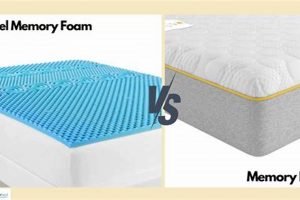
The discussion centers on two prevalent mattress types, each constructed with distinct materials and designs. One combines the support of innerspring coils with the conforming comfort layers of materials like latex or polyurethane foam. The other relies primarily on a dense, visco-elastic foam formulation known for its pressure-relieving qualities and ability to contour to the body’s shape.
The selection between these mattress constructions significantly impacts sleep quality, spinal alignment, and overall comfort. Historically, innerspring mattresses dominated the market. However, the introduction of visco-elastic foam revolutionized the industry by offering enhanced pressure relief. The subsequent development of the combined type aimed to synthesize the benefits of both, providing a balance of support and cushioning.
The following sections will explore the construction differences, performance characteristics, suitability for various sleep styles, and other considerations that influence the decision-making process when selecting between these prominent mattress categories. This exploration will facilitate a more informed choice based on individual needs and preferences.
Considerations for Selecting a Mattress
The selection process for a sleep surface requires careful evaluation of individual needs and preferences. The following points offer guidance in navigating the options available.
Tip 1: Understand Construction Differences: Hybrid models incorporate innerspring coils for support and airflow, combined with foam layers for comfort. Fully conforming models use visco-elastic foam exclusively, potentially trapping heat more readily.
Tip 2: Assess Sleep Style: Side sleepers often benefit from the pressure relief offered by the conforming type, particularly in the shoulder and hip areas. Stomach and back sleepers may require the firmer support of a combined build to maintain spinal alignment.
Tip 3: Evaluate Firmness Preferences: Firmness levels vary significantly within each type. Test multiple options to determine the optimal level of support and cushioning for individual comfort.
Tip 4: Account for Body Weight: Individuals with higher body weights generally require firmer support to prevent excessive sinking and maintain proper spinal alignment. Hybrid models with reinforced coil systems are often a suitable choice.
Tip 5: Consider Temperature Regulation: If overheating during sleep is a concern, look for hybrid options with breathable coil systems and gel-infused foam layers designed to dissipate heat. Some fully conforming models also incorporate cooling technologies.
Tip 6: Check for Motion Isolation: Conforming types excel at isolating motion, making them ideal for couples. Hybrid models can also provide good motion isolation depending on the coil system and foam density.
Tip 7: Review Warranty and Trial Periods: A generous warranty and trial period allow for thorough testing and ensure satisfaction with the selected product.
Careful consideration of these factors will improve the likelihood of selecting a sleep surface that promotes restful sleep and long-term comfort.
The subsequent sections will provide more detailed information on specific features and benefits to aid in the final decision.
1. Support and Conformance

The interplay between support and conformance is central to evaluating mattress performance. It dictates spinal alignment, pressure distribution, and, ultimately, sleep comfort. The degree to which a mattress offers adequate support while conforming to the body’s contours distinguishes one type from another.
- Core Support Systems
Core support refers to the underlying structure that prevents excessive sagging and maintains spinal alignment. In combined types, this is typically provided by an innerspring coil system, which offers varying degrees of firmness and responsiveness. Fully conforming constructions rely on high-density foam layers to provide support. The effectiveness of either system depends on the coil gauge and design in combined models, and the foam density and layering in conforming designs. Without adequate core support, the spine can misalign, leading to discomfort and potential long-term issues.
- Pressure Relief Mechanisms
Pressure relief minimizes stress on sensitive areas like hips and shoulders. Conforming foam achieves this by molding to the body’s shape, distributing weight more evenly. Combined types incorporate foam comfort layers to achieve a similar effect. The depth and density of these comfort layers dictate the degree of pressure relief. Insufficient pressure relief can cause pressure points, leading to tossing and turning and disrupted sleep.
- Surface Conformity
Surface conformity is the immediate sensation of the mattress adapting to the body’s contours. Visco-elastic foam excels in this area due to its slow response and ability to mold to the body’s shape. Combined types offer less immediate conformity but can still provide significant contouring depending on the composition and thickness of the comfort layers. The level of surface conformity impacts the initial comfort perception and can influence overall satisfaction.
- Spinal Alignment Maintenance
Maintaining proper spinal alignment is crucial for long-term comfort and health. It requires a balance of support and conformance, preventing both excessive sinking and insufficient contouring. Combined types offer a balance, while conforming types can be more challenging to maintain alignment for stomach sleepers or those with higher body weights. The ability of a mattress to maintain proper spinal alignment throughout the night determines its suitability for different individuals and sleep styles.
The selection of a sleep surface hinges on the capacity to deliver both adequate support and conforming comfort. Each construction offers unique approaches to achieving this balance. Understanding the mechanics of support and conformance enables a more informed evaluation and ultimately leads to a selection that aligns with individual needs and preferences.
2. Temperature Regulation

Temperature regulation during sleep is a critical factor influencing comfort and sleep quality. Mattress materials significantly impact heat retention and dissipation, with notable differences between combined and fully conforming constructions. Understanding these differences is essential for selecting a mattress that promotes a comfortable sleep environment.
- Airflow and Material Permeability
The degree to which air circulates through the mattress materials influences heat dissipation. Combined designs, with their innerspring coil systems, inherently promote airflow, allowing heat to escape more readily. Fully conforming constructions, composed of dense visco-elastic foam, typically exhibit lower air permeability, potentially trapping heat. The structure of the materials is paramount in influencing its heating retention, leading to discomfort.
- Foam Density and Composition
The density and composition of the foam layers directly affect heat retention. High-density visco-elastic foam tends to retain more heat than lower-density foams. Some fully conforming models incorporate gel infusions or open-cell foam structures to mitigate heat retention. Combined types leverage the airflow provided by the coil system to offset the potential heat retention of the foam layers.
- Cover Materials and Breathability
The material used for the mattress cover also plays a role in temperature regulation. Breathable fabrics, such as cotton or bamboo, promote airflow and wick away moisture. Non-breathable covers can exacerbate heat retention. The cover material is the immediate point of contact for the sleeper and contributes to perceived comfort in a huge deal.
- Heat Dissipation Technologies
Mattress manufacturers employ various technologies to enhance heat dissipation. Gel infusions, phase-change materials, and ventilated foam layers are common strategies. These technologies aim to draw heat away from the body and promote a cooler sleep surface. In the end, this is the most important part in all constructions, it is the added advantage which leads to more comfortable sleep.
The selection of a sleep surface should consider the interplay between construction, materials, and heat-dissipation technologies. Individuals prone to overheating during sleep may benefit from combined models with enhanced airflow or fully conforming models incorporating advanced cooling features. The overall goal is to choose a mattress that maintains a comfortable temperature throughout the night, thereby promoting restful and restorative sleep.
3. Motion Isolation

Motion isolation, the ability of a mattress to minimize the transfer of movement across its surface, is a critical factor for individuals sharing a bed. The effectiveness of motion isolation varies significantly between mattress types, influencing sleep quality and partner disturbance. Examining the construction differences between the two predominant mattress types provides insight into motion isolation capabilities.
- Material Damping Properties
Visco-elastic foam inherently possesses damping properties, absorbing and dissipating energy from movement. Fully conforming mattresses leverage this characteristic to minimize motion transfer. Combined designs incorporate foam layers, but the underlying coil system can transmit some motion. The damping properties of the materials directly correlate with the degree of motion isolation achieved.
- Coil System Configuration
In combined designs, the type of coil system significantly impacts motion isolation. Individually wrapped or pocketed coils reduce motion transfer compared to interconnected coil systems. The independence of each coil allows it to respond individually to pressure, minimizing disturbance to adjacent areas of the mattress. The design and configuration of the coil system are crucial for mitigating motion transfer in combined constructions.
- Layer Construction and Density
The arrangement and density of mattress layers affect motion isolation. Thicker and denser comfort layers contribute to greater motion absorption. In fully conforming mattresses, multiple layers of visco-elastic foam enhance motion isolation. Combined types rely on a combination of foam layers and coil system configuration to achieve a balance of support and motion isolation. The interplay between layer construction and density is essential for optimizing motion isolation performance.
- Impact on Sleep Quality
Effective motion isolation minimizes partner disturbance, promoting uninterrupted sleep. Individuals sharing a bed often experience improved sleep quality when using mattresses with superior motion isolation capabilities. Fully conforming designs are generally considered superior for motion isolation, but advanced combined models can provide comparable performance. The ultimate benefit is enhanced sleep quality and reduced partner disturbance, contributing to overall well-being.
The selection of a sleep surface requires careful consideration of motion isolation capabilities. Individuals sharing a bed should prioritize mattresses with features designed to minimize motion transfer. While fully conforming designs typically excel in this area, advanced combined models offer viable alternatives. The choice hinges on balancing motion isolation with other factors such as support, temperature regulation, and personal preference.
4. Durability Considerations
The longevity of a mattress is a significant economic and practical consideration for consumers. The expected lifespan and resistance to wear and tear differ markedly between hybrid and fully conforming models, impacting long-term value. Understanding the factors influencing durability is crucial for making an informed purchase.
In combined builds, the coil system’s quality and gauge directly affect durability. High-quality, tempered steel coils resist sagging and maintain support over time. The foam layers also contribute; denser foams exhibit greater resistance to compression and degradation. Conversely, lower-density foams may develop impressions and lose support more quickly. Fully conforming models’ durability hinges on foam density and construction. High-density visco-elastic foam can provide years of reliable support, while lower-density foams are prone to softening and sagging. Mattress construction plays a role; multi-layer constructions distribute weight more evenly, reducing stress on individual layers. Real-life examples show individuals experiencing premature sagging in all-foam mattresses with lower-density comfort layers, requiring replacement sooner than anticipated. The practical significance lies in recognizing that a higher initial investment in a mattress constructed with durable materials often translates to a longer lifespan and reduced replacement costs.
Ultimately, durability considerations should be weighed against other factors, such as comfort and support. While a more durable mattress may offer longer-term value, it must also meet individual comfort and support needs. Regular rotation of the mattress, proper support from the bed frame, and the use of a mattress protector can extend the lifespan of either type. The key insight is that careful attention to material quality and construction details can significantly impact the lifespan and overall satisfaction with a mattress investment.
5. Cost Implications

The financial investment associated with selecting a sleep surface constitutes a significant consideration for consumers. Cost varies considerably depending on construction type, material quality, brand reputation, and features. Understanding the cost implications of different mattresses is essential for making a budget-conscious decision without sacrificing comfort or long-term value.
- Initial Purchase Price
Combined mattresses typically command a higher initial purchase price compared to all visco-elastic foam models. This price differential reflects the more complex construction, which involves innerspring coil systems and multiple layers of different materials. Premium coil systems, such as individually wrapped coils with reinforced edge support, further increase the initial cost. For instance, a high-end combined mattress with advanced cooling features may cost significantly more than a basic all-foam model of similar size. The initial expenditure represents a notable factor in the decision-making process.
- Material Composition and Manufacturing Processes
The cost of raw materials and the complexity of manufacturing influence the final price. High-density visco-elastic foam, specialty foams like gel-infused or plant-based foams, and advanced coil systems contribute to higher production costs. Sustainable or ethically sourced materials can also increase the price. Mattresses manufactured using automated processes may have lower production costs than those requiring significant manual labor. The materials utilized and manufacturing techniques employed ultimately translate to the retail price.
- Longevity and Replacement Costs
While initial purchase price is a primary concern, the lifespan and potential replacement costs should also be considered. A lower-priced mattress with inferior materials may degrade more quickly, necessitating earlier replacement. High-quality mattresses, though initially more expensive, may offer greater longevity and lower long-term costs. The expected lifespan varies depending on the construction and usage patterns; for example, a high-density visco-elastic foam mattress may last longer than one constructed with lower-density foams. The frequency of replacement directly impacts the total cost of ownership.
- Warranty and Trial Periods
Warranty terms and trial periods offer some protection against premature failure or dissatisfaction. Mattresses with longer warranties typically reflect greater confidence in the product’s durability. Generous trial periods allow consumers to assess the mattress’s comfort and suitability before committing to the purchase. While these factors do not directly affect the initial price, they provide added value and reduce the risk of financial loss due to product defects or incompatibility. A comprehensive warranty and a risk-free trial period can mitigate the perceived cost of a more expensive mattress.
The selection requires a careful evaluation of initial cost, material quality, expected lifespan, and warranty protection. While all-foam models may offer a lower entry point, a durable, well-constructed combined model may represent a more cost-effective investment over the long term. Balancing upfront expense with long-term value and individual needs is essential for making a financially sound decision.
Frequently Asked Questions about Hybrid vs Memory Foam Mattresses
The following section addresses common inquiries and clarifies prevalent misconceptions concerning the selection of appropriate mattresses.
Question 1: What distinguishes the construction of a combined build from a visco-elastic foam mattress?
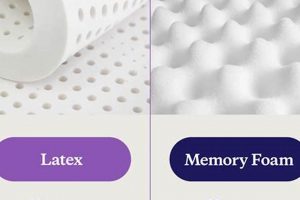
A combined build integrates an innerspring coil system with layers of foam (typically visco-elastic or latex) for comfort. A visco-elastic foam mattress relies primarily on layers of foam, without an innerspring core. This construction difference significantly affects support, airflow, and motion isolation.
Question 2: Which mattress type is more suitable for individuals experiencing back pain?
The suitability depends on the specific cause of back pain and individual preferences. Combined mattresses often provide a balance of support and contouring, beneficial for some back pain sufferers. All visco-elastic foam mattresses excel at pressure relief, which can alleviate pain for others. A consultation with a healthcare professional is recommended to determine the optimal support level.
Question 3: How does temperature regulation differ between the two mattress types?
Combined models generally offer superior temperature regulation due to the airflow facilitated by the innerspring coil system. All visco-elastic foam mattresses may retain more heat, although models with gel infusions or open-cell foam structures can mitigate this issue. Consider individual temperature sensitivities when making a selection.
Question 4: What is the expected lifespan of each mattress type?
The lifespan depends on material quality and usage patterns. High-quality combined types can last 7-10 years or more, while all visco-elastic foam mattresses typically last 6-8 years. Proper maintenance, such as regular rotation, can extend the lifespan of either type.
Question 5: Which mattress type offers better motion isolation for couples?
All visco-elastic foam mattresses generally provide superior motion isolation compared to combined models. The foam’s damping properties absorb and minimize motion transfer. However, combined types with individually wrapped coils can offer improved motion isolation compared to those with interconnected coil systems.
Question 6: What are the cost considerations for combined versus visco-elastic foam mattresses?
Combined mattresses often have a higher initial purchase price due to their complex construction. All visco-elastic foam mattresses can be more budget-friendly. However, the long-term cost depends on durability and replacement frequency. Consider the total cost of ownership, including potential replacement costs, when making a decision.
In summary, the optimal selection between combined and all visco-elastic foam mattresses hinges on individual preferences, sleep needs, and budgetary considerations. No single option is universally superior; rather, the ideal choice aligns with specific requirements.
The next section provides a concise comparison table to facilitate a clearer understanding of the key differences between the two mattress types.
Hybrid vs Memory Foam Mattress
This exploration has dissected the critical attributes of both combined and visco-elastic foam mattresses. Key distinctions in construction, support, temperature regulation, motion isolation, durability, and cost have been examined. The analysis reveals that each type offers unique advantages, catering to distinct sleep preferences and individual requirements. No single option emerges as universally superior; the optimal choice hinges on aligning specific needs with the inherent characteristics of each mattress construction.
The ultimate decision rests on a thorough self-assessment of sleep habits, physical needs, and budgetary constraints. Informed consumers, equipped with a comprehensive understanding of the nuances between these mattress types, are better positioned to make a selection that promotes restful sleep and long-term satisfaction. Continued advancements in materials and construction techniques promise further refinements in both mattress categories, offering consumers an ever-expanding array of options to optimize their sleep experience.