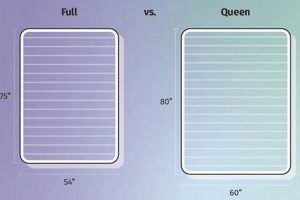
The terms “double” and “full” refer to a common mattress size, measuring approximately 54 inches wide and 75 inches long. This dimension offers a sleeping surface that is wider than a twin but narrower than a queen. It provides an alternative for individuals seeking more space than a single bed allows, or for smaller spaces where a larger mattress would be impractical. For instance, a guest room or a teenager’s bedroom might benefit from the dimensions of this mattress size.
This particular mattress dimension has become established as a practical compromise, offering additional sleeping area without demanding the significant floor space required by larger sizes. Its adoption reflects a balance between comfort and spatial efficiency, proving advantageous in situations where space is a constraint. Historically, this size served as a step up from single beds, providing greater sleeping comfort for individuals.
The subsequent discussion will delve into a more detailed analysis of the applications, suitability for different sleepers, and the factors to consider when selecting this specific mattress dimension. It will also examine how it compares to other standard sizes available in the market.
Selecting a Mattress of This Dimension
The following guidelines offer practical advice when evaluating a mattress of this dimension, ensuring a choice that aligns with individual needs and spatial constraints.
Tip 1: Assess Sleeper Size and Occupancy: Consider the dimensions in relation to the sleeper’s body size. It generally accommodates a single adult comfortably, but may prove restrictive for couples or individuals who prefer ample sleeping space.
Tip 2: Evaluate Room Dimensions: Measure the intended space before purchase. This mattress dimension, while smaller than a queen, still requires sufficient room to allow for comfortable movement around the bed.
Tip 3: Prioritize Support and Comfort Layers: Examine the internal construction of the mattress. Adequate support is crucial for spinal alignment, while comfort layers contribute to pressure relief and overall sleep quality.
Tip 4: Investigate Mattress Material Options: Various materials, including innerspring, memory foam, and latex, offer distinct advantages. Research the properties of each to determine which best suits individual preferences and sleep needs.
Tip 5: Check Edge Support Quality: Edge support is particularly important for individuals who tend to sleep near the edge of the bed. Stronger edge support prevents sagging and maximizes the usable sleeping surface.
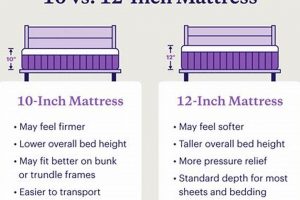
Tip 6: Consider Mattress Height: The height of the mattress affects both aesthetics and accessibility. Factor in bed frame height and individual preferences when determining the appropriate mattress thickness.
Tip 7: Review Warranty and Return Policies: Familiarize oneself with the manufacturer’s warranty and return policies. This provides recourse in the event of defects or dissatisfaction with the mattress.
Adhering to these guidelines should facilitate an informed decision, ensuring the selected mattress provides adequate comfort and support within the confines of the available space.
The subsequent section will explore the comparative advantages and disadvantages of this mattress size relative to other common dimensions, further aiding in the selection process.
1. Equivalence

Equivalence, in the context of “double mattress vs full,” represents the foundational understanding that these two terms denote the identical mattress size. This understanding is paramount to avoid confusion and ensure accurate product selection during the purchasing process.
- Synonymity in Marketing
Marketing materials and product listings frequently employ either term, “double” or “full,” to describe the same mattress. This interchangeability streamlines advertising, allowing vendors to reach a broader audience without causing unintentional ambiguity. Consumers should be aware that encountering both terms refers to the same physical product specifications.
- Dimensional Standards
Despite terminological variations, dimensional standards for both “double” and “full” mattresses remain consistent. The established measurement of 54 inches in width and 75 inches in length serves as the definitive characteristic. Deviations from these measurements indicate either manufacturing errors or product mislabeling, warranting scrutiny before purchase.
- Inventory Management
Retailers and manufacturers treat “double” and “full” mattresses as the same item for inventory management purposes. This simplifies logistics, reducing the risk of overstocking or shortages due to perceived differences. Effective inventory tracking relies on recognizing this synonymity to accurately forecast demand and optimize stock levels.
- Consumer Expectations
Equivalence shapes consumer expectations regarding size and compatibility. Individuals searching for a “double” mattress should anticipate receiving a product with identical dimensions to one labeled “full.” Any discrepancies between advertised features and actual product dimensions undermine consumer trust and necessitate clear communication from vendors.
The recognition of equivalence allows consumers to navigate product listings and marketing claims with confidence, ensuring they select a mattress that conforms to their spatial and comfort requirements, irrespective of the specific term employed. Failing to understand this fundamental synonymity can lead to unnecessary confusion and potentially incorrect purchasing decisions.
2. Dimensions
The term “dimensions,” when discussing “double mattress vs full,” represents the core physical attributes defining this particular mattress size. These measurements directly impact the suitability for specific individuals and room layouts. Understanding these dimensions is crucial for making informed purchasing decisions.
- Standard Measurements
The standard dimensions of a full, or double, mattress are approximately 54 inches in width and 75 inches in length. These measurements dictate the available sleeping surface and are universally recognized within the mattress industry. These dimensions are vital to determine its real size and how well it accomodate a person’s size.
- Impact on Occupancy
The dimensions dictate the mattress’s capacity for accommodating sleepers. While sufficient for a single adult, its width may prove restrictive for couples or individuals who prefer a larger sleeping area. The length is crucial for taller individuals, as insufficient length can lead to discomfort and disrupted sleep.
- Spatial Considerations
Room dimensions directly influence the practicality of this mattress size. Before purchase, it is essential to measure the intended space to ensure the mattress fits comfortably, allowing for adequate movement around the bed and placement of accompanying furniture. The dimensions also need to consider the size of the bedframe it sits on.
- Comparison to Other Sizes
Understanding the dimensions relative to other mattress sizes provides a broader perspective. A double mattress offers more width than a twin but less than a queen. This comparative awareness aids in choosing the most appropriate mattress size based on individual needs and available space. Different sizes can support different needs for persons.
In summary, the dimensions of a double, or full, mattress are not merely numerical values but rather essential determinants of its suitability. Consideration of these measurements relative to individual needs, room size, and comparison with alternative sizes is critical for a satisfactory purchase.
3. Availability

The term “availability,” as it pertains to the selection of a “double mattress vs full,” reflects the pervasive presence and accessible nature of this particular size within the mattress market. Its consistent production and stocking by manufacturers and retailers significantly influence consumer choice and purchasing convenience. High availability ensures that consumers face minimal difficulty in locating and acquiring a mattress of this dimension. Limited production or restricted distribution would, conversely, impede access and potentially shift purchasing decisions toward more readily available alternatives.
The widespread availability is further underscored by the consistent presence of mattresses of this dimension across diverse retail channels, spanning from brick-and-mortar stores to online marketplaces. This ubiquity facilitates comparison shopping and allows consumers to readily assess various brands, materials, and price points. A concrete example is the consistent stocking of full-size mattresses at major furniture retailers and the dedicated sections on e-commerce platforms specifically catering to this dimension. Furthermore, the presence of readily available accompanying bedding, such as sheets and comforters, for this size reinforces its practical significance.
In conclusion, the high availability of the “double mattress vs full” solidifies its position as a mainstream mattress option. This accessibility not only simplifies the purchasing process but also contributes to its ongoing popularity. While other sizes may offer specific advantages, the consistent presence and ease of acquisition of this dimension remains a significant factor in consumer decision-making. Challenges associated with availability, such as supply chain disruptions, could impact future purchasing patterns; however, the established market infrastructure currently supports its widespread accessibility.
4. Terminology

The connection between “terminology” and “double mattress vs full” centers on the fact that two distinct words are used to indicate an equivalent product. This equivalence is the crux of understanding the terminology involved. The terms “double” and “full,” when referring to mattresses, represent a specific size category with defined dimensions. Erroneous understanding of this terminological relationship can cause confusion and potentially lead to selection errors during purchase. The term “terminology” becomes important because it highlights the need to be aware that both terms point to the same item, not to two different products. For example, a customer might erroneously assume that a “double” mattress possesses different characteristics than a “full” mattress, when in actuality, they are dimensionally and functionally identical.
The interchangeability of the terms has practical implications for retailers and manufacturers. Marketing campaigns and product listings must clearly convey this synonymity to prevent customer misinterpretations. Inventory management also relies on this understanding; maintaining separate stocks for “double” and “full” mattresses would be inefficient and inaccurate. Furthermore, consumer education plays a vital role in reinforcing this terminological consistency, thereby ensuring customers are equipped to make informed decisions. Failure to grasp the equivalence can result in consumers unnecessarily limiting their search or erroneously excluding suitable options from consideration.
In conclusion, the core insight is that the seemingly distinct terminology of “double” and “full” masks a fundamental equivalence in the mattress market. Recognizing this linguistic relationship is vital for consumers, retailers, and manufacturers alike. Challenges arise when this equivalence is not explicitly communicated, potentially leading to confusion and inefficiency. By acknowledging and emphasizing this terminological reality, stakeholders can foster a more transparent and streamlined purchasing experience.
5. Interchangeability

The concept of “interchangeability” directly addresses the practical implications of the “double mattress vs full” terminology, highlighting how the terms can be used synonymously without affecting the product’s specifications or functionality. This interchangeability is crucial for consumers and businesses, streamlining communication and simplifying purchasing decisions.
- Retail Applications
Retailers commonly use “double” and “full” interchangeably in product listings, marketing materials, and store signage. This allows them to efficiently manage inventory and cater to a wider customer base without creating confusion. For example, a website might categorize all mattresses of this dimension under a single “Full/Double” category, enabling users to easily find the desired size, regardless of the term they initially search for. This simplifies the online shopping experience and ensures that consumers are presented with all relevant options.
- Bedding Compatibility
Bedding manufacturers design sheets, comforters, and other accessories to fit both “double” and “full” mattresses. This standard compatibility means that consumers can purchase bedding labeled for either size with the assurance that it will properly fit their mattress. For instance, a sheet set marketed as “Full Size” will invariably accommodate a “Double” mattress, eliminating the need to search for specific labels. This facilitates a seamless shopping experience and reduces the likelihood of purchasing incompatible accessories.
- Frame and Foundation Options
Bed frames and foundations are also designed to accommodate both “double” and “full” mattresses. The standardized dimensions ensure that the mattress will fit securely on the frame, providing adequate support and stability. A bed frame described as “Full Size” will reliably support a “Double” mattress, offering consumers a range of choices without dimensional concerns. This standardization across different manufacturers allows for easy integration of components, regardless of the terminology employed.
- Warranty and Customer Service
Warranty policies and customer service departments treat “double” and “full” mattresses as identical items. Any claims or inquiries regarding mattresses of this dimension are handled without regard to the specific term used. For example, a customer experiencing a defect with a “Double” mattress can expect the same level of service and support as someone with a “Full” mattress, provided that the mattress meets the warranty criteria. This consistent approach reinforces the equivalence of the terms and ensures that customers receive equitable treatment, irrespective of the label on their mattress.
These examples illustrate how the interchangeability of “double mattress vs full” simplifies transactions and enhances consumer confidence. The consistent application of dimensions and compatibility across various product categories creates a cohesive marketplace, allowing individuals to focus on factors such as comfort and materials without being hindered by terminological discrepancies.
Frequently Asked Questions
The following questions address common inquiries and misconceptions surrounding the “double mattress vs full” terminology and product characteristics. They aim to provide clarity and assist in informed decision-making.
Question 1: Are “double” and “full” mattresses truly the same size?
Yes, “double” and “full” are effectively interchangeable terms describing a mattress measuring approximately 54 inches wide and 75 inches long. Minor dimensional variations may exist due to manufacturing tolerances, but these differences are typically negligible.
Question 2: Is a “double” or “full” mattress suitable for couples?
While a “double” or “full” mattress can accommodate two adults, it offers limited personal space, potentially leading to discomfort for some couples. Individuals seeking more space should consider a queen or king-sized mattress.
Question 3: Will “full” size sheets fit a “double” mattress, and vice versa?
Yes, bedding labeled as “full” size is designed to fit a “double” mattress, and vice versa. Standardized dimensions ensure compatibility across different manufacturers and product lines.
Question 4: Is a “double” or “full” mattress a good choice for a teenager’s bedroom?
A “double” or “full” mattress can be a suitable option for a teenager’s bedroom, offering more sleeping space than a twin while still fitting comfortably in smaller rooms. Consider the teenager’s size and personal preferences when making a decision.
Question 5: Where can “double” or “full” mattresses be purchased?
“Double” or “full” mattresses are widely available at major furniture retailers, department stores, and online marketplaces. Their widespread availability reflects their popularity and common usage.
Question 6: Does the term “double” or “full” affect the price of the mattress?
The term used does not inherently affect the price. Mattress price is primarily determined by factors such as materials, construction quality, brand reputation, and retailer markup, rather than whether it is labeled “double” or “full.”
In summary, understanding the equivalence of the terms “double” and “full” simplifies the purchasing process. Consumers should focus on evaluating mattress features and construction quality rather than being concerned with terminological differences.
The subsequent discussion will delve into strategies for maximizing the lifespan and maintaining the quality of mattresses of this specific dimension.
Double Mattress vs Full
The preceding exploration has clarified the relationship between the terms “double mattress” and “full.” These terms, while distinct, represent an identical product within the mattress industry. Differentiation based on terminology is, therefore, misleading. Consumers should direct their attention towards the tangible attributes of the mattress dimensions, materials, construction rather than fixating on the descriptor used by manufacturers or retailers. The documented synonymity serves to streamline the purchase process, enabling informed decisions grounded in factual characteristics rather than perceived differences. A clear understanding of this equivalence minimizes potential for confusion and optimizes the consumer experience.
In conclusion, recognizing the interchangeability of “double mattress vs full” is paramount. While individual preferences for specific brands and mattress features remain crucial, consumers can confidently navigate the market knowing these terms denote the same size. Future purchasing decisions should prioritize evaluating the physical properties of the mattress and disregard any perceived significance in the labeling. This approach promotes efficiency and ensures resources are directed toward selecting a product that aligns with individual needs and requirements. The persistent use of both terms necessitates ongoing consumer education to reinforce this established equivalence within the marketplace.