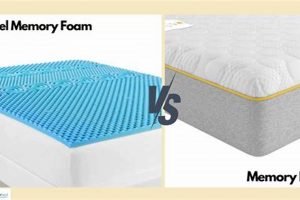
The central topic involves a comparison between two prevalent mattress types, one constructed primarily of viscoelastic foam, the other combining foam layers with an innerspring system. These designs offer distinct sleep experiences based on their construction and materials. The former is known for its conforming properties and pressure relief, while the latter seeks to balance support with comfort.
Understanding the features of each mattress type is crucial for informed consumer decision-making. Key factors like spinal alignment, temperature regulation, and motion isolation are significantly influenced by the construction of the chosen sleep surface. The decision between these two constructions can impact sleep quality and overall well-being.
A detailed analysis of their construction, benefits, and drawbacks will provide a clearer understanding of how each addresses diverse sleeper needs. Evaluating these options will allow individuals to determine which design best suits their preferences and sleep requirements.
Key Considerations for Mattress Selection
Selecting the appropriate mattress requires careful consideration of individual needs and preferences. The following points highlight crucial factors to evaluate when comparing mattresses, particularly those incorporating viscoelastic foam or hybrid designs.
Tip 1: Assess Spinal Alignment: Prioritize mattresses that promote neutral spinal alignment. Proper alignment minimizes pressure points and reduces the risk of back pain. Side sleepers may benefit from thicker comfort layers, while back and stomach sleepers often require firmer support.
Tip 2: Evaluate Temperature Regulation: Viscoelastic foam can retain heat. Consider mattresses with cooling technologies, such as gel infusions or open-cell structures, to mitigate heat buildup. Hybrid designs often offer better airflow due to the innerspring system.
Tip 3: Consider Motion Isolation: Viscoelastic foam excels at absorbing motion, reducing disturbance from a partner’s movements. Hybrid mattresses with individually wrapped coils also offer good motion isolation, though potentially less than all-foam options.
Tip 4: Determine Edge Support Requirements: Individuals who sleep near the edge of the bed should assess edge support. Hybrid mattresses generally offer stronger edge support due to the reinforced perimeter of the innerspring system.
Tip 5: Evaluate Firmness Preference: Firmness levels vary widely among mattress models. Consider personal preference and sleeping position when selecting firmness. A mattress that is too soft or too firm can disrupt sleep quality.
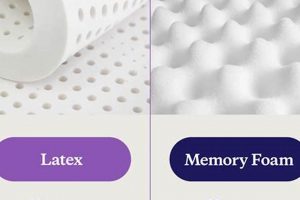
Tip 6: Review Material Composition: Investigate the materials used in the mattress construction. Certifications such as CertiPUR-US indicate that the foam has been tested for harmful substances. Natural latex foam is an alternative to memory foam that provides good support and contouring without the same level of heat retention.
Tip 7: Evaluate Long Term Durability: Mattress longevity is important. Higher density foams and well constructed coil systems in hybrid designs are generally more durable.
Selecting a mattress involves balancing multiple factors to optimize sleep comfort and overall well-being. Careful consideration of the above tips can inform the decision-making process.
The following sections will explore specific advantages and disadvantages associated with these distinct mattress types.
1. Conformity

Conformity, in the context of mattresses, refers to the degree to which the sleep surface molds to the body’s shape. This characteristic significantly influences pressure relief, spinal alignment, and overall comfort, playing a critical role in distinguishing the sleep experience offered by viscoelastic foam and hybrid mattress designs.
- Viscoelastic Response
Viscoelastic foam exhibits a unique response to pressure, slowly conforming to the body’s contours. This characteristic allows for a distribution of weight across a larger surface area, reducing pressure points at areas like the shoulders and hips. In contrast, the innerspring system of a hybrid mattress offers more resistance to pressure, resulting in a less pronounced conforming effect.
- Pressure Relief
The conforming properties of viscoelastic foam contribute to enhanced pressure relief. By cradling the body, it minimizes stress on joints and promotes circulation. While hybrid mattresses can incorporate comfort layers designed to provide pressure relief, the support cores inherent rigidity limits their ability to fully contour to the body.
- Spinal Alignment Adaptation
Conformity impacts spinal alignment, particularly for side sleepers. Viscoelastic foam allows the spine to maintain a more neutral posture by filling the gap between the mattress and the body’s curves. Hybrid designs, with their firmer support core, may require additional consideration regarding comfort layer thickness to achieve optimal spinal alignment, especially for individuals with pronounced curves.
- Impact on Motion Transfer
The high conformity of viscoelastic foam contributes to superior motion isolation. This is because the foam absorbs and dissipates movement, limiting its transfer across the mattress surface. While hybrid mattresses can incorporate features to reduce motion transfer, the innerspring system generally transmits more movement than an all-foam construction.
The degree of conformity desired is a highly individual preference. Viscoelastic foam offers enhanced contouring and pressure relief, whereas hybrid designs provide a more responsive and supportive feel with potentially less conforming ability. Evaluating conformity requirements in relation to individual sleep preferences and physical needs is essential in selecting the appropriate mattress design.
2. Support

In the context of mattress design, support refers to the mattress’s capacity to maintain proper spinal alignment and prevent excessive sinking or sagging. Adequate support is crucial for minimizing back pain, promoting healthy posture, and ensuring restful sleep. Distinctions in support mechanisms are fundamental when comparing memory foam and hybrid mattresses.
- Core Construction
Memory foam mattresses typically rely on a high-density foam core for support. The density of this core dictates the overall firmness and ability to resist compression. In contrast, hybrid mattresses employ an innerspring system, often utilizing pocketed coils, to provide the primary support structure. The gauge and configuration of these coils determine the mattress’s overall firmness and responsiveness.
- Weight Distribution
Memory foam mattresses distribute weight evenly across the surface, conforming to the body’s shape and minimizing pressure points. However, without sufficient density, they can exhibit excessive sinkage, particularly for heavier individuals. Hybrid mattresses offer a more buoyant support system, with the coils actively pushing back against the sleeper’s weight, providing a more consistent level of support across the mattress surface.
- Edge Support
Edge support refers to the stability and firmness of the mattress perimeter. Memory foam mattresses often lack robust edge support, leading to a feeling of roll-off and reduced usable sleep surface. Hybrid mattresses, particularly those with reinforced edge coils, generally offer superior edge support, providing a more stable and secure sleeping experience.
- Long-Term Durability
The long-term support characteristics of memory foam and hybrid mattresses differ based on the materials and construction methods employed. Over time, memory foam can soften and lose its original shape, potentially compromising support. High-quality innerspring systems, particularly those with individually pocketed coils, tend to maintain their support characteristics for a longer period, providing greater long-term value.
The choice between memory foam and hybrid mattresses in terms of support hinges on individual preferences and needs. Memory foam provides contouring and pressure relief, while hybrid mattresses offer a more responsive and buoyant feel with potentially superior edge support and long-term durability. Careful consideration of these factors is essential for selecting a mattress that promotes proper spinal alignment and restful sleep.
3. Temperature

Temperature regulation is a significant factor in mattress selection, impacting sleep comfort and overall quality. Mattress materials and construction influence the degree to which heat is retained or dissipated, with memory foam and hybrid designs exhibiting distinct thermal properties. The inherent density of memory foam can restrict airflow, leading to heat retention, while the innerspring systems in hybrid mattresses often promote greater ventilation.
Memory foam’s closed-cell structure tends to trap body heat, potentially causing discomfort for some sleepers. Manufacturers address this issue through various methods, including incorporating gel infusions, open-cell foam structures, or phase-change materials designed to regulate temperature. Hybrid mattresses, due to the presence of an innerspring unit, typically offer enhanced breathability, allowing for better air circulation and reduced heat buildup. The coils create pathways for heat to dissipate away from the sleeper’s body. Examples include hybrid designs incorporating breathable covers and natural fibers like cotton or wool to further enhance temperature regulation.
The suitability of a mattress in terms of temperature regulation depends on individual preferences and environmental factors. Individuals who tend to sleep hot may find hybrid mattresses more comfortable due to their enhanced breathability. Conversely, those who prefer a warmer sleep environment or live in colder climates may find the heat-retaining properties of memory foam acceptable, or even desirable. Understanding the thermal characteristics of each mattress type is crucial for making an informed decision that aligns with personal sleep needs and environmental conditions. The ultimate goal is to choose a mattress that promotes a comfortable and consistent sleep temperature throughout the night.
4. Motion Isolation
Motion isolation, defined as the capacity of a mattress to minimize the transfer of movement across its surface, is a crucial consideration when evaluating mattresses, particularly when comparing viscoelastic foam and hybrid models. A mattress with effective motion isolation prevents disturbances caused by one sleeper’s movements from affecting the sleep of another. This characteristic is particularly important for couples or individuals sharing a bed with restless sleepers. Differences in material composition and construction techniques between the two mattress types directly influence their respective motion isolation capabilities. Failure to isolate motion can lead to frequent awakenings and disrupted sleep cycles.
Viscoelastic foam excels in motion isolation due to its inherent density and ability to absorb energy. When pressure is applied to one area, the foam contours to the body while minimizing the transmission of movement to adjacent areas. This characteristic is evident in scenarios where one partner gets in or out of bed without significantly disturbing the other. Hybrid mattresses, which combine foam layers with an innerspring system, typically offer less effective motion isolation. While individually pocketed coils can mitigate motion transfer, the interconnected nature of the coil system allows some movement to propagate across the mattress surface. For example, a hybrid mattress may exhibit noticeable movement when one partner tosses and turns, impacting the other partner’s sleep. The type and thickness of the foam layers in a hybrid mattress also contribute to motion isolation. Thicker, higher-density foam layers can improve motion isolation compared to thinner, less dense layers.
In summary, viscoelastic foam mattresses generally provide superior motion isolation compared to hybrid mattresses. However, advancements in hybrid mattress design, such as the use of individually pocketed coils and specialized foam layers, have narrowed the gap. Understanding the principles of motion isolation and the construction differences between the two mattress types allows consumers to make informed decisions based on their individual sleep needs and preferences. Factors such as sleeping habits, partner disturbance, and sensitivity to movement should be considered when prioritizing motion isolation in the mattress selection process.
5. Durability
Durability, in the context of mattress selection, signifies the lifespan and resistance to wear and tear under normal use conditions. The connection between durability and mattress type is crucial, as it directly impacts the long-term value and cost-effectiveness of a sleep surface. When considering viscoelastic foam versus hybrid mattress designs, the component materials and construction techniques play pivotal roles in determining their respective lifespans.
Viscoelastic foam mattresses, composed primarily of polyurethane foam, are susceptible to degradation over time. Factors such as foam density, the presence of additives, and the sleeper’s weight influence the rate of compression and deformation. Lower-density foams tend to break down more quickly, leading to sagging and a loss of support. In contrast, hybrid mattresses, which combine foam comfort layers with an innerspring support core, often exhibit greater durability due to the inherent resilience of the coil system. The gauge and configuration of the coils contribute to the overall structural integrity and resistance to compression. For instance, a hybrid mattress with individually pocketed coils and reinforced edge support is likely to maintain its shape and support characteristics longer than a viscoelastic foam mattress of comparable price.
Ultimately, the durability of both viscoelastic foam and hybrid mattresses depends on the quality of materials and construction. Higher-density foams, robust coil systems, and reinforced edges contribute to increased longevity. Selecting a mattress from a reputable manufacturer that provides warranties and certifications can offer consumers additional assurance regarding the product’s expected lifespan. The informed consumer must weigh the initial investment against the anticipated durability to assess the long-term value of either mattress type.
6. Cost
The financial investment required for a mattress represents a significant factor in consumer decision-making. Examining the cost implications associated with viscoelastic foam and hybrid mattress options is crucial for informed budget allocation and long-term value assessment.
- Initial Purchase Price
Viscoelastic foam mattresses, particularly those constructed with basic materials and simpler designs, often present a lower initial purchase price compared to hybrid models. The more complex construction of hybrid mattresses, incorporating both foam layers and innerspring systems, typically translates to higher manufacturing costs, which are then reflected in the retail price.
- Material Composition Impact
The quality and type of materials used in the construction of either mattress type influence the final cost. High-density viscoelastic foam, specialty foams with cooling properties, or the use of natural latex can increase the price of a viscoelastic foam mattress. Similarly, hybrid mattresses employing individually pocketed coils, high-gauge steel, or premium comfort layers will command a higher price point.
- Longevity and Replacement Frequency
While a viscoelastic foam mattress may have a lower initial cost, its lifespan can be shorter compared to a well-constructed hybrid model. The degradation of foam over time may necessitate more frequent replacement, potentially offsetting any initial savings. Hybrid mattresses, with their resilient innerspring systems, often offer greater long-term durability, reducing the need for premature replacement.
- Warranty Considerations
Mattress warranties provide a level of consumer protection and can influence the perceived value of a purchase. Longer warranty periods, offered by some manufacturers, may justify a higher initial cost, as they indicate greater confidence in the product’s durability and minimize the risk of unexpected replacement expenses. The terms and conditions of the warranty should be carefully reviewed to understand the coverage provided.
In summary, the cost of a mattress is a multifaceted consideration encompassing the initial purchase price, material composition, expected lifespan, and warranty provisions. A thorough evaluation of these factors is essential for determining the most cost-effective option that aligns with individual sleep needs and budgetary constraints when choosing between viscoelastic foam and hybrid mattress designs.
Frequently Asked Questions
The following addresses common inquiries regarding mattress types, with a focus on distinguishing features pertinent to consumer decision-making.
Question 1: Is one mattress type inherently superior for back pain relief?
Neither mattress type possesses an intrinsic advantage. Back pain relief depends on individual spinal alignment needs and preferred sleeping position. A mattress supporting neutral spinal alignment is crucial, irrespective of its construction.
Question 2: Do hybrid mattresses invariably offer superior temperature regulation?
While hybrid designs often exhibit better airflow due to the coil system, temperature regulation also depends on the materials used in the comfort layers. Viscoelastic foam with cooling technologies can mitigate heat retention.
Question 3: Are all memory foam mattresses equally effective at isolating motion?
Motion isolation effectiveness varies based on foam density and construction. Higher-density foams generally provide better motion isolation. Hybrid mattresses with individually pocketed coils can also offer decent motion isolation, though usually less than all-foam options.
Question 4: What factors contribute to the overall durability of a mattress?
Durability depends on the quality of materials and construction. High-density foams, robust coil systems, and reinforced edges enhance longevity. The sleeper’s weight and usage patterns also influence durability.
Question 5: Does a higher price point automatically equate to superior mattress quality?
Price does not guarantee quality. Evaluate the materials, construction, certifications, and warranty before making a purchase. Compare different models within a similar price range to assess value.
Question 6: How can one determine the appropriate firmness level for individual needs?
Firmness preference is subjective. Consider sleeping position and body weight. Side sleepers may prefer a softer mattress, while back and stomach sleepers often require firmer support. Trial periods, when available, are valuable for assessing comfort.
Selecting a mattress involves balancing various factors to optimize sleep comfort and well-being. Consider individual needs and preferences when evaluating mattress options.
The next section explores factors related to purchasing and maintaining mattresses.
Conclusion
The preceding analysis has presented a detailed examination of viscoelastic foam and hybrid mattress designs, emphasizing the distinctions in construction, support, temperature regulation, motion isolation, durability, and cost. Informed decision-making necessitates a thorough understanding of these characteristics to align mattress selection with individual sleep needs and preferences. The exploration has demonstrated that neither mattress type is inherently superior, with optimal choice contingent upon subjective requirements and objective performance attributes. A consumer must weigh the advantages and disadvantages of each type to determine suitability.
Ultimately, the decision regarding viscoelastic foam versus hybrid mattresses requires careful consideration. Further research, comparative analysis, and product testing are encouraged to ensure a selection that promotes optimal sleep health and long-term satisfaction. Prioritizing individual needs and objectively evaluating mattress specifications remains paramount.