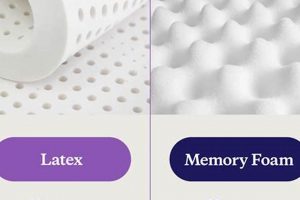
A comparison between these two mattress types highlights differing construction materials and their resulting effects on sleep experience. One is manufactured from either natural or synthetic rubber, known for its resilience, while the other is created from viscoelastic polyurethane foam, conforming closely to the body.
Selecting the appropriate bedding can significantly improve sleep quality and overall well-being. Understanding the distinct characteristics of each option including differences in support, temperature regulation, durability, and pressure relief empowers informed consumer choices. The growing awareness of material composition and its impact on health and the environment further emphasizes the importance of this comparative analysis.
The subsequent sections will delve into a detailed comparison of the key features of these mattress options, covering aspects such as construction, comfort, support, temperature regulation, motion isolation, durability, and cost, providing a balanced perspective to facilitate a sound purchasing decision.
Guidance on Choosing Between Latex and Memory Foam Mattresses
This section presents practical guidance for navigating the selection process. Evaluating individual needs and preferences is paramount to making an informed choice between these two mattress types.
Tip 1: Prioritize Support Requirements: Consider preferred sleep position and body weight. Latex generally offers more consistent, buoyant support, while memory foam contours more closely to the body. Side sleepers may benefit from the pressure relief of memory foam, while back and stomach sleepers might prefer the firmer support of latex.
Tip 2: Evaluate Temperature Sensitivity: Memory foam tends to retain heat more than latex. Individuals prone to overheating during sleep might find latex a more breathable option. Look for open-cell memory foam or gel-infused options, although they may not match the inherent coolness of latex.
Tip 3: Assess Motion Isolation Needs: Memory foam excels at isolating motion, minimizing disturbance from a partner’s movements. Latex offers moderate motion isolation, depending on its density and construction.
Tip 4: Consider Durability Expectations: High-quality latex mattresses are typically more durable than memory foam mattresses. Expect a longer lifespan from a natural latex mattress compared to a standard memory foam mattress, although higher-density memory foam can also offer good durability.
Tip 5: Investigate Material Composition: Latex can be natural, synthetic, or a blend. Natural latex is generally considered more eco-friendly and hypoallergenic. Memory foam composition varies; look for CertiPUR-US certification to ensure low VOC emissions.
Tip 6: Factor in Budget Constraints: Latex mattresses often carry a higher price tag than memory foam mattresses, especially those made with natural latex. Establish a budget beforehand and compare the features and benefits within that price range.
Tip 7: Check Warranty and Return Policies: Reputable manufacturers offer warranties and trial periods. Review these policies carefully before making a purchase to ensure recourse if the mattress does not meet expectations.
Careful consideration of these factors will facilitate a more confident decision when selecting bedding. Each option presents distinct advantages, tailored to accommodate diverse sleep preferences and needs.
The concluding section will summarize the key differences and offer final thoughts to aid in this important purchase.
1. Support

The level and type of support provided by a mattress significantly influence spinal alignment, pressure distribution, and overall sleep comfort. These factors are critical in differentiating the suitability of latex versus memory foam options.
- Spinal Alignment and Posture
Proper spinal alignment is essential for minimizing back pain and promoting restful sleep. Latex, particularly Dunlop latex, generally offers a more uniform and resilient support, preventing excessive sinking and maintaining a neutral spinal posture. Memory foam, conversely, contours more closely to the body, potentially leading to misalignment if the density and thickness are not appropriate for the individual’s weight and sleep position.
- Pressure Distribution
Effective pressure distribution minimizes pressure points that can cause discomfort and disrupt sleep. Memory foam excels at distributing weight and reducing pressure on areas like the shoulders and hips, particularly beneficial for side sleepers. Latex, while offering good pressure relief, may not conform as precisely as memory foam, potentially creating slight pressure points for some individuals.
- Responsiveness and Ease of Movement
Mattress responsiveness, or how quickly it recovers its shape after pressure is removed, affects ease of movement during sleep. Latex is known for its responsiveness, allowing for easier position changes without feeling “stuck.” Memory foam, especially higher-density varieties, can be slower to respond, potentially hindering movement and creating a feeling of being enveloped.
- Edge Support
Edge support refers to the stability and support provided along the perimeter of the mattress. Adequate edge support is important for maximizing the usable sleep surface and preventing a “roll-off” feeling. Latex mattresses often exhibit superior edge support compared to memory foam mattresses, especially those without reinforced edges. Improved edge support can allow one to sleep closer to the edge of the bed without experiencing discomfort or a feeling of instability.
The choice between latex and memory foam for support hinges on individual needs and preferences. While memory foam excels in pressure relief and conforming to the body’s curves, latex generally provides more consistent and resilient support, promoting spinal alignment and ease of movement. Assessment of these support-related factors is crucial in making an informed decision, balancing comfort with the need for proper postural support.
2. Temperature

Temperature regulation is a critical factor in sleep comfort, and discernible differences exist between latex and memory foam mattresses in this regard. Material composition and construction influence how effectively each mattress dissipates heat, affecting the sleeper’s thermal environment. Memory foam, by its nature, tends to retain heat due to its dense, closed-cell structure. This property can be advantageous for individuals who prefer a warmer sleep environment, but detrimental for those prone to overheating. Latex, particularly natural latex, possesses a more open-cell structure that promotes airflow, facilitating heat dissipation and creating a cooler sleeping surface. Examples include complaints of night sweats when using traditional memory foam, contrasting with reports of a more consistent and comfortable temperature on latex mattresses. The significance of temperature control stems from its direct impact on sleep cycles; elevated body temperature can disrupt sleep onset and maintenance.
Modifications to memory foam, such as the incorporation of gel infusions or open-cell designs, attempt to mitigate its heat-retentive properties. While these modifications can improve airflow and reduce heat build-up, they may not fully replicate the inherent breathability of latex. Real-world tests often demonstrate that even with these modifications, memory foam typically sleeps warmer than latex, especially over extended periods. Consequently, individuals living in warmer climates or those who naturally sleep hot should carefully consider this temperature difference when selecting between mattress types. The practical application of this understanding lies in optimizing the sleep environment for individual thermal needs, potentially leading to improved sleep quality.
In summary, the relationship between temperature and these mattress types is driven by inherent material properties. Memory foam’s heat retention versus latex’s breathability has a profound effect on sleep comfort. Despite modifications to improve heat dissipation in memory foam, latex generally remains the cooler option. Awareness of these thermal characteristics allows consumers to make choices aligned with their individual temperature preferences, ultimately contributing to a more restful and restorative sleep experience. The challenges of optimizing temperature lie in balancing individual preferences with the inherent limitations of each material.
3. Durability

Durability, representing the lifespan and resistance to wear and tear, stands as a critical factor when evaluating bedding options. Differing material properties and manufacturing processes between these two distinct mattress types result in notable variations in longevity and performance over time.
- Material Degradation
Material breakdown is a primary determinant of a mattress’s lifespan. Latex, especially natural latex, exhibits inherent resilience and resistance to degradation. Its elastic properties allow it to withstand repeated compression and decompression without significant loss of support or shape. Memory foam, conversely, is susceptible to gradual softening and indentation over time, particularly in areas of concentrated pressure. This breakdown can result in reduced support and comfort. Examples include latex mattresses maintaining their original feel and support for upwards of 10 years, while memory foam mattresses may develop noticeable body impressions within a shorter timeframe.
- Structural Integrity
The structural integrity of a mattress refers to its ability to maintain its original form and support characteristics. High-quality latex mattresses, often manufactured using the Dunlop or Talalay process, demonstrate excellent structural stability. The interconnected cell structure of latex provides uniform support and prevents sagging. Memory foam mattresses can experience structural compromise due to the viscoelastic nature of the material, leading to uneven support and potential discomfort. For instance, the edges of memory foam mattresses may exhibit less support than the center, reducing the usable sleeping surface.
- Resistance to Compression Set
Compression set describes the permanent deformation of a material after prolonged compression. Latex demonstrates superior resistance to compression set compared to memory foam. Repeated pressure on memory foam can lead to a permanent indentation, diminishing its ability to provide conforming support. Latex, due to its natural elasticity, recovers its original shape more effectively, minimizing compression set and maintaining its support characteristics over extended use. This difference translates to latex mattresses retaining their original loft and feel for a longer duration.
- Impact of Usage and Environmental Factors
Usage patterns and environmental conditions can influence the durability of both mattress types. Excessive weight, improper support foundations, and exposure to high humidity or extreme temperatures can accelerate material degradation. However, latex generally exhibits greater resistance to these external factors. Its antimicrobial properties also contribute to a longer lifespan by inhibiting the growth of mold and bacteria. In comparison, memory foam may be more susceptible to moisture retention and the accumulation of dust mites, potentially affecting its hygiene and longevity.
The superior durability of latex, particularly natural latex, stems from its inherent material properties and structural characteristics. While memory foam offers distinct comfort advantages, its susceptibility to material degradation and compression set often results in a shorter lifespan. Considering these durability-related factors is essential for making a cost-effective and long-term investment in bedding.
4. Motion Isolation
Motion isolation, the ability of a mattress to minimize the transfer of movement from one area of the bed to another, is a significant factor influencing sleep quality, especially for couples. The distinct properties of latex and memory foam mattresses result in notable differences in their ability to dampen motion transfer.
- Material Viscoelasticity and Dampening Properties
Memory foam’s viscoelastic nature allows it to absorb and dissipate energy, effectively isolating motion. When pressure is applied to one area, the surrounding foam compresses and conforms, minimizing the transmission of movement to other areas of the mattress. Latex, particularly natural latex, possesses greater elasticity and less viscosity, resulting in a more responsive surface. While latex still absorbs some motion, it does not dampen movement as effectively as memory foam. For example, a partner tossing and turning on a memory foam mattress is less likely to disturb the other sleeper compared to a latex mattress.
- Internal Mattress Construction and Design
Mattress construction plays a role in motion isolation. Mattresses with individually wrapped coils, often paired with a memory foam or latex comfort layer, can further enhance motion isolation by preventing the transfer of movement across the spring system. Hybrid mattresses that combine latex or memory foam with innerspring systems offer a balance of support and motion isolation. The arrangement and density of the foam layers also contribute to motion isolation performance, with thicker, denser layers generally providing better motion isolation.
- Density and Thickness of Comfort Layers
The density and thickness of the comfort layers significantly impact motion isolation. Thicker and denser layers of memory foam provide greater motion isolation compared to thinner, less dense layers. Latex, even in thicker layers, may not offer the same level of motion isolation due to its greater responsiveness. Higher density latex is generally better at motion isolation than lower density latex.
- Impact on Sleep Disturbance and Partner Compatibility
Effective motion isolation reduces sleep disturbances caused by a partner’s movements, leading to improved sleep quality and overall well-being. Couples with different sleep schedules or those who tend to toss and turn frequently during the night may particularly benefit from a mattress with excellent motion isolation. Memory foam mattresses are often recommended for couples due to their superior motion isolation properties, while latex mattresses may be a suitable choice for individuals who prioritize responsiveness and support over complete motion isolation.
In summary, the differing material properties of latex and memory foam, along with variations in mattress construction and design, result in distinct motion isolation characteristics. Memory foam generally excels at dampening motion transfer, making it a preferred choice for couples seeking to minimize sleep disturbances. While latex offers good support and responsiveness, it may not provide the same level of motion isolation as memory foam. The choice between the two hinges on individual preferences and the specific needs of co-sleeping partners.
5. Conformity
Conformity, in the context of mattresses, refers to the ability of the material to adapt to the body’s shape, distributing weight and alleviating pressure points. This characteristic significantly influences comfort and support, making it a crucial differentiator between the two mattress types.
- Pressure Point Relief
Memory foam excels at conforming to the body’s contours, providing targeted pressure relief. This is particularly beneficial for individuals with joint pain or those who sleep on their side, as it minimizes stress on pressure points like shoulders and hips. Latex, while offering some level of conformity, generally provides more uniform support, which may not alleviate pressure points as effectively for some individuals. An example is the way memory foam cradles the body to reduce joint pressure, versus the more supportive resistance of latex.
- Surface Hug and Envelopment
The degree to which a mattress envelops or “hugs” the sleeper varies significantly. Memory foam is known for its pronounced “sink-in” feel, providing a sense of being enveloped by the mattress. This can be comforting for some, while others may find it restrictive. Latex offers a more buoyant feel, where the sleeper rests “on top” of the mattress rather than sinking into it. The choice depends largely on individual preference, with some individuals preferring the close contouring of memory foam and others preferring the support with less envelopment of latex.
- Adaptation to Sleep Position
A mattress’s ability to conform to different sleep positions is critical for maintaining spinal alignment and preventing discomfort. Memory foam adapts readily to various sleep positions, contouring to the body’s shape regardless of whether the sleeper is on their back, side, or stomach. Latex provides more consistent support across different positions, which may be preferable for those who change positions frequently during the night. Some side sleepers may find memory foam is better for conforming to their shape.
- Impact on Spinal Alignment
While conformity contributes to comfort, its impact on spinal alignment is paramount. Excessive sinking into a mattress can lead to spinal misalignment, potentially causing back pain. Memory foam mattresses must provide adequate support in addition to conformity to prevent this. Latex generally offers more consistent support, reducing the risk of misalignment. The key lies in striking a balance between conformity and support to maintain proper spinal posture.
In conclusion, the degree of conformity offered by a mattress significantly influences comfort, pressure relief, and spinal alignment. Memory foam’s ability to closely contour to the body provides targeted pressure relief, while latex offers more uniform support and a buoyant feel. The ideal choice depends on individual preferences, sleep position, and the need for a balance between conformity and support to maintain proper spinal alignment and prevent discomfort.
6. Cost
The economic dimension represents a substantial factor in the selection between bedding types. The pricing structures of these mattress types exhibit notable disparity, influenced by material sourcing, manufacturing processes, and inherent qualities. The higher cost often associated with latex originates from the harvesting and processing of natural rubber, particularly when considering organic or sustainably sourced materials. In contrast, memory foam, typically derived from synthetic materials and mass-produced, generally presents a more economical initial investment. A practical example illustrates this point: a queen-size natural latex mattress may command a price 50% to 100% higher than a comparable memory foam mattress. This cost differential directly affects consumer decisions, potentially prioritizing budget constraints over specific material characteristics or performance attributes.
However, a comprehensive cost evaluation necessitates considering the lifespan and potential long-term value of each option. While the initial outlay for latex may be greater, its enhanced durability and resistance to degradation could translate to a lower cost per year of use. Memory foam, though initially more affordable, might require replacement sooner due to softening or loss of support. Furthermore, the environmental implications and potential health benefits associated with natural latex can factor into the perceived value for some consumers, justifying a higher upfront cost. Analyzing customer reviews and comparing warranty periods provides additional insight into the expected lifespan and long-term cost implications of each mattress type. Real-world scenarios reveal that consumers often weigh the upfront expense against the projected durability and potential health benefits, creating a trade-off between immediate affordability and long-term value.
Ultimately, the economic decision surrounding bedding involves balancing budgetary constraints with individual needs and priorities. While memory foam offers a more accessible entry point, the long-term cost-effectiveness and potential health and environmental advantages of latex may justify its higher price point for some. The challenge lies in accurately assessing individual needs, understanding the material properties, and projecting the long-term value proposition to make an informed and financially sound choice. The broader theme emphasizes the need for comprehensive cost-benefit analysis, moving beyond immediate price tags to encompass long-term value and personal well-being.
Frequently Asked Questions
The following addresses common inquiries regarding considerations of different bedding options, offering clear and concise information to aid in decision-making.
Question 1: Is one type inherently superior for back pain relief?
Neither type is universally superior. The ideal choice depends on the specific cause of the back pain, preferred sleep position, and individual body weight. Firmer support may benefit some, while pressure relief may be more suitable for others.
Question 2: Do these mattresses off-gas harmful chemicals?
Some memory foam mattresses, particularly those manufactured using less regulated processes, may emit volatile organic compounds (VOCs). Natural latex mattresses are less prone to off-gassing. Certifications like CertiPUR-US can help identify memory foam options with lower emissions.
Question 3: Which is more suitable for allergy sufferers?
Natural latex possesses inherent antimicrobial properties and resistance to dust mites, making it generally more suitable for allergy sufferers. Memory foam can accumulate dust mites, but hypoallergenic covers can mitigate this issue.
Question 4: What are the primary differences in feel?
Memory foam provides a conforming, “sink-in” feel, while latex offers a more buoyant, responsive feel. This is a highly subjective factor, and personal preference plays a significant role.
Question 5: How does firmness level vary within each type?
Both types are available in a range of firmness levels, from soft to firm. Firmness is typically measured on a scale, allowing for comparison across different brands and models. Latex firmness is often described in terms of ILD (Indentation Load Deflection).
Question 6: Which is more environmentally friendly?
Natural latex, particularly when harvested sustainably and processed without harmful chemicals, is generally considered more environmentally friendly than memory foam, which is typically derived from petroleum-based products. However, recycled memory foam options are becoming more available.
These answers provide a foundation for understanding key distinctions. However, consulting with a sleep specialist or testing mattresses in person is recommended for making an informed choice.
The next section provides a final summary and conclusion for deciding what mattress is suitable for you.
Latex Mattress vs Memory Foam Mattress
The preceding analysis underscores the significant distinctions between these mattress types, highlighting differences in support, temperature regulation, durability, motion isolation, conformity, and cost. The choice between the two necessitates a careful evaluation of individual needs, sleep preferences, and budgetary considerations. No single option presents a universal advantage; rather, suitability depends on the alignment of material properties with specific requirements.
Ultimately, the decision to purchase rests on informed discretion. Further research, coupled with in-person testing when feasible, remains crucial. A commitment to understanding the nuanced attributes of each option empowers consumers to make choices that optimize sleep quality and long-term satisfaction. The investment in appropriate bedding represents an investment in personal well-being, warranting careful consideration and diligent evaluation.