The selection of appropriate bedding can significantly impact sleep quality and overall well-being. Two common mattress types are those combining disparate materials and those relying primarily on a coil support system. One integrates foam and coil components to offer both contouring and support. The other employs interconnected or individually wrapped springs as its core structure, providing a more traditional feel.
The relevance of choosing between these constructions lies in their distinct performance characteristics. The former often excels in motion isolation and pressure relief due to the foam layers, leading to potentially fewer sleep disturbances. The latter, with its coil system, can offer enhanced airflow and a firmer, more responsive surface. Historically, coil-based mattresses dominated the market, but advancements in foam technology have led to the rise of blended designs offering a more nuanced sleep experience.
The following sections will delve into the specific attributes of each mattress type, examining construction details, performance capabilities, and suitability for different sleep preferences and physical needs. Factors such as support, comfort, durability, and cost will be considered to provide a detailed comparison.
Selection Guidance
Careful consideration should be given to individual needs and preferences when selecting new bedding. The following guidance will aid in evaluating the suitability of different mattress constructions.
Tip 1: Assess Sleep Style: Consider whether one primarily sleeps on their side, back, or stomach. Side sleepers often benefit from the enhanced pressure relief provided by foam layers within a blended construction. Back and stomach sleepers may prefer the firmer support of a coil-based system.
Tip 2: Evaluate Body Weight: Individuals with higher body weights typically require greater support. Mattresses with a robust coil system, particularly those with higher coil counts or thicker gauge steel, can offer increased durability and resistance to sagging.
Tip 3: Consider Motion Isolation: If sharing a bed, evaluate the degree of motion transfer. Blended constructions, particularly those with memory foam, often excel at isolating movement, minimizing disturbances from a partner’s tossing and turning.
Tip 4: Examine Temperature Regulation: Individuals who tend to sleep hot should prioritize airflow. Coil-based options generally offer better ventilation than all-foam mattresses. Look for designs with breathable cover materials or cooling gel infusions in foam layers.
Tip 5: Determine Firmness Preference: Firmness is subjective, but it is essential to determine whether one prefers a softer, more conforming surface or a firmer, more supportive feel. This preference will greatly influence the choice of either a blended or coil-based system.
Tip 6: Check Edge Support: Strong edge support prevents roll-off and maximizes the usable sleep surface. Look for reinforced edges, particularly in foam models, which can be prone to compression at the perimeter.
Tip 7: Review Warranty and Trial Period: A generous warranty and trial period allow for assessment of the mattress in one’s own home. Take advantage of these opportunities to ensure satisfaction.
By carefully considering these factors, one can make a more informed decision and select a mattress that provides optimal comfort and support for restful sleep.
The final section will summarize the key considerations and provide concluding remarks on the process of selecting the right mattress.
1. Construction Materials

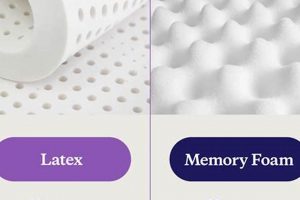
The selection of construction materials is a primary determinant of performance characteristics. In the context of mattresses, it directly influences factors such as comfort, support, durability, and temperature regulation. With a hybrid construction, layers of differing materials, such as memory foam, latex, or gel-infused foam, are combined with an innerspring coil system. The composition of these layers significantly impacts the mattress’s ability to conform to the body, alleviate pressure points, and isolate motion. For instance, a hybrid mattress incorporating a thick layer of high-density memory foam will generally offer superior pressure relief compared to one using only a thin layer of conventional foam.
In contrast, traditional innerspring mattresses rely almost exclusively on coil systems for both support and comfort. While some may include a thin comfort layer of padding or fiberfill, the primary experience is dictated by the type and arrangement of the coils. Variations in coil gauge, design (e.g., Bonnell, pocketed), and coil count can dramatically alter the firmness, responsiveness, and overall feel of the mattress. For example, a mattress with individually wrapped pocketed coils will typically provide better motion isolation and contouring compared to one using interconnected Bonnell coils.
Ultimately, the choice of materialswhether a combination of foams and coils or primarily a coil systemfundamentally shapes the mattress’s performance. The selection must align with individual preferences for comfort, support, and other key factors. The materials’ quality and density also play a significant role in the mattress’s long-term durability and ability to maintain its performance characteristics over time.
2. Motion Isolation

Motion isolation, the ability to minimize the transfer of movement across a sleep surface, represents a significant differentiator between hybrid and innerspring mattresses. The architectural distinctions inherent to each design contribute directly to variations in this performance metric. In innerspring mattresses, interconnected coils often act as a single unit, causing movement on one part of the mattress to propagate across the entire surface. This can result in noticeable disturbances for a sleep partner when one individual shifts position during the night. A real-world example might be a restless sleeper whose movements consistently awaken their partner due to the coupled nature of the innerspring system. The importance of motion isolation becomes pronounced in scenarios where individuals maintain differing sleep schedules or experience nocturnal restlessness.
Hybrid mattresses, conversely, typically exhibit enhanced motion isolation capabilities. This improvement stems from the incorporation of viscoelastic foam layers, such as memory foam or latex, which effectively dampen and absorb movement. These materials, positioned above or between the coil support system, act as a barrier, preventing the transmission of disturbances across the mattress surface. Furthermore, the use of individually pocketed coils in some hybrid designs further mitigates motion transfer by allowing each spring to react independently to pressure. Consider, for example, a scenario where one partner gets out of bed early in the morning. The integration of motion-isolating materials within a hybrid mattress can significantly reduce the likelihood of the other partner being awakened by the resulting movement.
The practical significance of understanding the relationship between mattress construction and motion isolation lies in its impact on sleep quality and relationship harmony. Selecting a mattress that effectively minimizes motion transfer can lead to fewer sleep disruptions, improved restfulness, and an enhanced overall sleep experience for both individuals sharing the bed. Choosing between hybrid and innerspring options necessitates a careful assessment of individual sleep needs and preferences, particularly concerning motion sensitivity. Although innerspring mattresses can address this to some degree with pocketed coils, hybrid construction generally provides a greater level of motion isolation overall.
3. Temperature Regulation

Temperature regulation is a key factor influencing sleep comfort, and the construction of a mattress significantly impacts its ability to dissipate heat and maintain a comfortable sleeping temperature. The inherent properties of materials used in hybrid and innerspring mattresses dictate their respective thermal performance characteristics. Understanding these differences is essential for individuals who tend to sleep hot or live in warmer climates.
- Airflow and Breathability
Innerspring mattresses, by virtue of their open coil structure, generally offer superior airflow and breathability compared to hybrid designs. The spaces between the coils allow for greater air circulation, facilitating heat dissipation and preventing the buildup of moisture. This is especially beneficial for individuals who are prone to night sweats or live in humid environments. A practical example would be an individual experiencing a more comfortable sleep on an innerspring mattress during a hot summer night compared to a memory foam mattress, where the dense foam can trap heat.
- Foam Density and Composition
Hybrid mattresses, which incorporate layers of foam, can exhibit varying degrees of temperature regulation depending on the density and composition of the foam used. High-density foams, such as traditional memory foam, tend to retain heat due to their closed-cell structure, restricting airflow. However, manufacturers often incorporate cooling technologies, such as gel infusions or open-cell foam structures, to mitigate this issue. For example, a hybrid mattress with gel-infused memory foam may feel cooler initially, but its long-term temperature regulation depends on the effectiveness of the cooling technology and the overall airflow within the mattress.
- Cover Materials
The material used for the mattress cover also plays a role in temperature regulation. Breathable fabrics, such as cotton or bamboo, promote airflow and wicking of moisture, contributing to a cooler sleep surface. Conversely, synthetic materials can trap heat and moisture, leading to discomfort. A cover made of natural fibers on either an innerspring or hybrid mattress will generally enhance its breathability and contribute to a more comfortable sleep environment. Consider the difference between sleeping on a cotton sheet versus a polyester sheet, where the former allows for greater air circulation.
- Heat Dissipation Mechanisms
Both mattress types can employ various mechanisms to enhance heat dissipation. Some innerspring mattresses utilize breathable border fabrics or ventilation systems to improve airflow within the coil core. Hybrid mattresses may incorporate phase-change materials or cooling gel layers designed to absorb and dissipate heat. These technologies aim to regulate the temperature at the sleep surface and prevent the buildup of heat throughout the night. For instance, a mattress with phase-change material will actively absorb heat when the body temperature rises and release it as the body temperature cools, helping to maintain a consistent sleep temperature.
The interplay between these factors determines the overall thermal performance of both types of mattresses. While innerspring mattresses generally offer better inherent breathability due to their open coil structure, hybrid mattresses can achieve comparable or even superior temperature regulation through the incorporation of advanced cooling technologies. Selecting the most appropriate mattress requires careful consideration of individual sleep preferences, environmental conditions, and the specific materials and construction features of each option.
4. Support Characteristics
The support characteristics of a mattress directly correlate with spinal alignment and pressure distribution, crucial factors in achieving restful sleep and preventing musculoskeletal discomfort. Regarding mattresses, the underlying support system differentiates the offerings. The firmness, responsiveness, and contouring ability of these mattresses dictate their impact on the sleeper’s body. Without adequate support, the spine can misalign, leading to back pain, muscle stiffness, and compromised sleep quality. For example, an individual with scoliosis requires a mattress that provides targeted support to maintain spinal alignment and alleviate pressure points. Understanding how support mechanisms function within each design is paramount to selecting a mattress that meets individual needs.
Within blended-construction mattresses, support is derived from a combination of coil systems and various foam layers. The coil system, often composed of pocketed coils or interconnected springs, provides the foundational support, while the foam layers contribute to contouring and pressure relief. The density and firmness of the foam, as well as the coil gauge and arrangement, determine the overall support level. For instance, a blended mattress with a high-density memory foam comfort layer and a pocketed coil system can provide exceptional pressure relief and spinal alignment for side sleepers. In contrast, innerspring mattresses rely primarily on the coil system for support. The type of coil (Bonnell, offset, continuous), coil gauge, and coil density are critical determinants of firmness and support. An innerspring mattress with a high coil count and a thicker coil gauge will generally offer firmer support, suitable for back and stomach sleepers who require greater spinal stability. The absence of significant foam layers in traditional innerspring designs, however, often results in less contouring and pressure relief compared to blended options.
The practical significance of understanding support characteristics lies in its ability to inform mattress selection based on individual sleep preferences and physical needs. Individuals with back pain or spinal issues should prioritize mattresses that provide adequate spinal alignment and pressure relief. Side sleepers typically benefit from softer mattresses that contour to the body, while back and stomach sleepers often require firmer support to prevent excessive sinkage. Choosing between blended and innerspring options involves a careful assessment of the interplay between coil systems, foam layers (in the case of blended options), and individual support requirements. The objective is to select a mattress that promotes healthy spinal alignment, minimizes pressure points, and contributes to restorative sleep.
5. Longevity Expectations

The anticipated lifespan of a mattress is a primary consideration for consumers, influencing purchase decisions and long-term satisfaction. Mattress durability is intrinsically linked to construction materials, manufacturing quality, and usage patterns. Determining the expected use period is crucial when weighing the benefits of blended and innerspring designs. Premature degradation of a mattress can lead to decreased comfort, inadequate support, and potential health implications stemming from poor spinal alignment. For example, a sagging mattress necessitates replacement, incurring additional costs and disrupting sleep patterns. Therefore, an understanding of the factors influencing mattress longevity is paramount for informed selection.
Blended-construction mattresses, by combining foam and coil components, present a complex longevity profile. The durability of foam layers, particularly memory foam, is contingent upon density and composition. High-density foams typically exhibit greater resistance to compression and degradation compared to lower-density alternatives. Coil systems within blended mattresses also contribute to overall durability, with pocketed coils often outperforming interconnected coils in terms of long-term support. However, foam degradation remains a primary factor limiting the lifespan of blended designs. In contrast, innerspring mattresses, relying predominantly on coil systems, tend to exhibit greater resistance to compression and sagging over time. The gauge and density of the coils directly influence their ability to maintain support and resist deformation. While the comfort layers of innerspring mattresses may degrade, the core support structure often retains its integrity for an extended period. As an illustration, a high-quality innerspring mattress with robust coil construction may provide adequate support for ten years or more, whereas a blended mattress with lower-density foam may require replacement within five to seven years due to foam compression.
In conclusion, the anticipated lifespan of a mattress is a critical factor in the selection process. While blended mattresses may offer enhanced comfort and pressure relief, their longevity can be compromised by foam degradation. Innerspring mattresses, with their robust coil systems, often exhibit greater durability, albeit with potentially reduced contouring capabilities. The optimal choice depends on individual priorities, budget considerations, and the anticipated use period. Regular maintenance, such as rotating the mattress, can help extend its lifespan and maintain its performance characteristics.
Frequently Asked Questions About Mattress Types
The following addresses common queries concerning the selection of mattresses.
Question 1: What is the fundamental difference between a hybrid mattress and an innerspring mattress?
The primary distinction lies in construction. A blended mattress combines a coil support core with comfort layers of foam, while an innerspring relies predominantly on a coil system for both support and comfort.
Question 2: Which type of mattress offers superior motion isolation?
Blended designs typically excel in motion isolation due to the presence of foam layers, which absorb and dampen movement more effectively than traditional coil systems.
Question 3: Is one type inherently better for temperature regulation?
Innerspring mattresses generally promote greater airflow due to their open coil structure. However, hybrid mattresses with cooling technologies can mitigate heat retention and offer comparable or superior temperature regulation.
Question 4: Which mattress type tends to have a longer lifespan?
The longevity is contingent upon the quality of materials and usage. However, innerspring mattresses, with their robust coil systems, often exhibit greater resistance to compression and sagging over time compared to some blended designs.
Question 5: Is one type of mattress better suited for individuals with back pain?
The optimal choice depends on the specific cause and nature of the back pain. Blended mattresses often provide better pressure relief, while innerspring mattresses can offer firmer support for spinal alignment. Consultation with a healthcare professional is recommended.
Question 6: Do blended mattresses cost more than innerspring mattresses?
Generally, blended mattresses tend to be priced higher than innerspring mattresses due to the incorporation of multiple materials and advanced technologies. However, pricing varies widely based on brand, quality, and features.
Careful consideration of individual sleep preferences, physical needs, and budget constraints is crucial when selecting either type.
The subsequent section will provide a detailed comparison of specific mattress models.
Conclusion
The preceding analysis has illuminated the distinct characteristics of both mattress types. Hybrid mattresses, with their combination of foam and coil systems, offer a balance of pressure relief and support, often excelling in motion isolation. Innerspring mattresses, distinguished by their coil-centric construction, typically provide enhanced airflow and a firmer, more responsive surface. Factors such as sleep style, body weight, and temperature preferences should guide the selection process.
Ultimately, the choice between a hybrid vs innerspring mattress rests on individual needs and priorities. Careful consideration of the factors outlined herein, coupled with thorough product research, is essential to securing a mattress that promotes optimal sleep health and long-term satisfaction. Prospective buyers are encouraged to evaluate mattresses in person, assess trial periods, and consult with sleep professionals to make an informed decision.