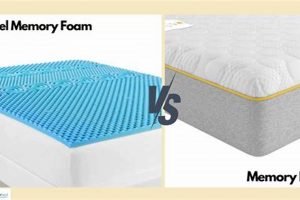
A comparison of sleep surfaces often involves considering models constructed entirely from viscoelastic foam against those integrating the same material with an innerspring system. The former relies solely on the properties of the foam for support and comfort, while the latter combines the foam’s conforming capabilities with the traditional bounce and support provided by metal coils.
The selection of a sleep surface influences factors such as pressure relief, spinal alignment, temperature regulation, and motion isolation. Historically, innerspring models dominated the market. However, advances in material science have led to increased popularity of all-foam options, driven by their ability to contour to the body and minimize motion transfer. The integration of foam with innerspring systems seeks to offer a balance between these characteristics.
This discussion will delve into the specific attributes of each construction method, analyzing their comparative advantages and disadvantages with respect to support, comfort, durability, and overall suitability for various sleep preferences and individual needs. Considerations include the type of innerspring system, foam density, and construction techniques used in manufacturing both categories of sleep products.
Guidance for Selecting a Sleep Surface
Choosing between sleep surfaces constructed entirely of viscoelastic foam and those incorporating innerspring systems requires careful consideration of individual needs and preferences. The following guidance aims to provide clarity and facilitate informed decision-making.
Tip 1: Evaluate Support Requirements: Assess individual support needs based on body weight and sleeping position. Viscoelastic foam models offer conforming support, while innerspring systems provide a firmer, more traditional feel. Consider whether spinal alignment requires enhanced or moderate support.
Tip 2: Assess Pressure Relief Needs: Viscoelastic foam excels at pressure point relief due to its conforming nature. Individuals experiencing joint pain or pressure sensitivity may benefit from this attribute. Innerspring models may require thicker foam layers to achieve comparable pressure relief.
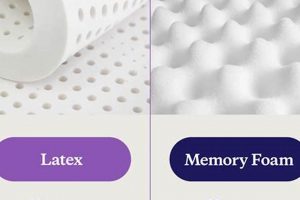
Tip 3: Consider Temperature Regulation: Viscoelastic foam can retain heat. Individuals who sleep hot should investigate models with cooling technologies, such as gel-infused foam or open-cell structures. Innerspring systems generally offer better airflow due to the open space within the coil system.
Tip 4: Examine Motion Isolation Properties: Viscoelastic foam is highly effective at isolating motion, minimizing disturbance from a partner’s movements. Innerspring systems transmit more motion, although models with individually wrapped coils offer improved isolation compared to traditional interconnected coil systems.
Tip 5: Investigate Durability and Longevity: The durability of a sleep surface depends on the quality of materials and construction. High-density viscoelastic foam and tempered steel coils are indicators of increased longevity. Research warranties and read reviews to assess long-term performance.
Tip 6: Determine Edge Support Preference: Strong edge support prevents sagging and provides a stable surface for sitting or sleeping near the edge. Innerspring systems often offer better edge support than all-foam models. Look for reinforced edges in viscoelastic foam options.
Tip 7: Budgetary Considerations: Prices vary significantly depending on materials, construction, and brand. Determine a realistic budget and compare options within that range. Consider long-term value and potential replacement costs when evaluating affordability.
These guidelines emphasize the importance of aligning sleep surface selection with individual needs. By carefully evaluating support, comfort, and practical considerations, individuals can enhance sleep quality and overall well-being.
This understanding will assist in navigating the complexities of selecting the most suitable sleep surface to optimize sleep quality.
1. Support and Conformance

Support and conformance represent critical determinants in the overall performance and suitability of sleep surfaces, directly influencing spinal alignment and pressure distribution. Models constructed entirely from viscoelastic foam excel at conforming to the body’s contours, thereby distributing weight and reducing pressure on sensitive areas such as the hips and shoulders. This characteristic is particularly beneficial for side sleepers who require enhanced pressure relief to maintain spinal alignment. The degree of support is directly related to the foam’s density; higher density foams offer greater resistance to compression, resulting in firmer support. Conversely, models integrating viscoelastic foam with innerspring systems provide a different support profile. The innerspring unit furnishes a foundational level of support, while the foam layer offers a degree of conformance. The effect of this combination is a more resilient sleep surface with targeted pressure relief. However, the level of conformance may be less pronounced compared to all-foam models, potentially impacting individuals with pronounced pressure sensitivity.
The importance of understanding the interplay between support and conformance is evident in addressing specific sleep needs. For instance, individuals with back pain may require a balance of both support and conformance to alleviate pressure while maintaining proper spinal alignment. An all-foam mattress may provide superior conformance but insufficient support, leading to spinal misalignment. Conversely, an innerspring hybrid with inadequate foam layers may offer ample support but insufficient pressure relief, exacerbating pain. Therefore, the thickness and density of the foam layer in hybrid models are crucial considerations. Real-life examples demonstrate that selecting a sleep surface without considering these factors can result in discomfort, disrupted sleep, and even exacerbate existing musculoskeletal conditions. Retailers often provide opportunities to test different models, but understanding the underlying principles of support and conformance allows for more informed evaluations.
In summary, the relationship between support and conformance is a defining characteristic differentiating all-foam and innerspring hybrid sleep surfaces. All-foam models prioritize conformance and pressure relief, while innerspring hybrids seek to balance support and conformance. Challenges arise in accurately assessing individual needs and preferences without a thorough understanding of these principles. The practical significance of this understanding lies in the ability to select a sleep surface that optimizes spinal alignment, minimizes pressure points, and promotes restful sleep, ultimately contributing to improved overall well-being.
2. Temperature Regulation

Temperature regulation constitutes a significant factor in sleep quality and comfort, particularly concerning the selection between all-viscoelastic foam and innerspring hybrid sleep surfaces. Viscoelastic foam, by its inherent nature, tends to retain heat due to its dense structure and limited airflow. This characteristic can lead to increased body temperature during sleep, potentially causing discomfort and sleep disruption, especially for individuals prone to night sweats or residing in warmer climates. The effect of heat retention can be mitigated through various manufacturing techniques, such as incorporating gel-infused foam, open-cell foam structures designed to promote airflow, or phase-change materials that absorb and release heat to maintain a consistent temperature. Conversely, innerspring hybrid models, characterized by the inclusion of metal coils within their construction, generally offer superior temperature regulation. The open space within the coil system facilitates air circulation, allowing heat to dissipate more readily. This inherent breathability contributes to a cooler sleeping environment, minimizing the risk of overheating and promoting a more comfortable sleep experience. Real-life examples illustrate that individuals switching from traditional innerspring models to all-foam options often report initial satisfaction with pressure relief but subsequently experience discomfort due to increased heat retention.
The practical significance of understanding the temperature regulation properties of different sleep surfaces extends to informed product selection and customization. Consumers sensitive to temperature fluctuations should prioritize models incorporating cooling technologies or opt for innerspring hybrids. In addition, the choice of bedding materials, such as breathable cotton or linen sheets, can further enhance temperature regulation regardless of the sleep surface. Sleep surface manufacturers often highlight the temperature regulation features of their products, but independent research and reviews can provide valuable insights into real-world performance. For instance, studies comparing the internal temperature of all-foam and innerspring models under controlled conditions consistently demonstrate the superior breathability of innerspring systems. Challenges remain in accurately quantifying and comparing the temperature regulation properties of different models, as subjective perceptions of comfort can vary significantly among individuals.
In summary, temperature regulation represents a crucial consideration when evaluating all-viscoelastic foam and innerspring hybrid sleep surfaces. The inherent heat retention properties of viscoelastic foam can be mitigated through advanced manufacturing techniques, while innerspring systems generally offer superior breathability due to their open coil structure. Selecting a sleep surface that addresses individual temperature regulation needs is essential for promoting comfortable and restful sleep, highlighting the importance of informed decision-making and considering factors beyond initial comfort assessments. This consideration links directly to the broader theme of optimizing sleep quality through tailored product selection, reflecting the multifaceted nature of sleep surface technology and its impact on overall well-being.
3. Motion Isolation

Motion isolation, the ability of a sleep surface to minimize the transfer of movement, represents a significant differentiator between models constructed solely from viscoelastic foam and those integrating it with an innerspring system. The inherent properties of viscoelastic foam contribute to superior motion isolation. When pressure is applied to one area of a viscoelastic foam mattress, the surrounding material absorbs and dissipates the force, preventing it from propagating across the entire surface. This characteristic is particularly advantageous for couples or individuals sharing a sleep surface, as it minimizes disturbance from a partner’s movements during the night. Models utilizing innerspring systems, conversely, tend to exhibit a higher degree of motion transfer. The interconnected nature of the coils allows movement in one area to propagate across the surface, potentially disrupting the sleep of a partner. However, advancements in innerspring technology, such as individually pocketed coils, have sought to mitigate this effect by reducing the interconnectedness of the springs and minimizing motion transfer.
The practical significance of understanding motion isolation is evident in scenarios involving individuals with varying sleep schedules or sensitivities to movement. For instance, a light sleeper sharing a bed with a restless sleeper may find that a viscoelastic foam mattress significantly reduces sleep disturbances compared to a traditional innerspring. Furthermore, the level of motion isolation can also influence the perceived firmness of the sleep surface. In viscoelastic foam models, the lack of motion transfer can contribute to a feeling of greater stability and support. Conversely, the increased motion transfer in innerspring systems may create a sensation of greater bounciness or responsiveness. Challenges arise in accurately quantifying and comparing motion isolation across different models. Manufacturers often employ metrics such as motion transfer coefficients, but these measurements may not fully capture the subjective experience of motion isolation. Real-world testing, such as placing a glass of water on one side of the mattress and observing its stability while movement occurs on the other side, can provide a more intuitive understanding of motion isolation capabilities.
In summary, motion isolation constitutes a critical factor differentiating viscoelastic foam and innerspring hybrid sleep surfaces. Viscoelastic foam’s inherent properties contribute to superior motion isolation, minimizing sleep disturbances caused by movement. While advancements in innerspring technology have sought to improve motion isolation, these models generally exhibit a higher degree of motion transfer compared to all-foam options. Selecting a sleep surface that effectively isolates motion is essential for promoting undisturbed sleep, particularly for individuals sharing a bed or sensitive to movement, highlighting the importance of considering motion isolation alongside other factors such as support, comfort, and temperature regulation. This consideration strengthens the understanding that a tailored product selection process is a pivotal point to ensure the best sleep possible.
4. Durability and Longevity

Durability and longevity represent critical considerations when evaluating sleep surfaces, directly impacting long-term value and overall satisfaction. The construction method, whether all-viscoelastic foam or an innerspring hybrid, significantly influences the lifespan and performance of the sleep surface.
- Foam Density and Degradation
Foam density plays a pivotal role in the durability of viscoelastic foam models. Higher density foams exhibit greater resistance to compression and deformation, resulting in improved long-term support and reduced sagging. Over time, viscoelastic foam can experience gradual degradation, leading to a loss of firmness and support. This degradation is accelerated by factors such as body weight, sleeping position, and environmental conditions. The implications of foam degradation include decreased comfort, compromised spinal alignment, and a reduced lifespan of the sleep surface.
- Coil Quality and Fatigue
In innerspring hybrid models, the quality and construction of the coil system significantly influence durability. Tempered steel coils exhibit greater resistance to fatigue and deformation compared to non-tempered coils. Coil fatigue can lead to sagging, uneven support, and reduced motion isolation. The gauge (thickness) of the coils also affects durability, with thicker coils generally providing greater support and resistance to deformation. Furthermore, the type of coil system (e.g., Bonnell, pocketed) can influence durability, with pocketed coils often exhibiting greater resistance to motion transfer and localized wear.
- Construction Integrity and Material Quality
The overall construction integrity of a sleep surface, including the seams, quilting, and edge support, contributes to its durability. Weak seams or inadequate edge support can lead to premature wear and tear, reducing the lifespan of the sleep surface. The quality of the materials used in the cover and comfort layers also impacts durability. Breathable, durable fabrics can resist wear and tear, while low-quality materials may degrade quickly, affecting the overall comfort and support of the sleep surface. For example, reinforced edges are crucial to prevent sagging and maintain edge support, especially in models that lack robust coil support along the perimeter.
- Warranty and Expected Lifespan
The manufacturer’s warranty provides an indication of the expected lifespan and durability of a sleep surface. Longer warranties typically indicate greater confidence in the product’s long-term performance. However, it is important to carefully review the terms and conditions of the warranty to understand the specific coverage and limitations. The expected lifespan of a sleep surface varies depending on the construction method, material quality, and usage patterns. All-foam models typically have a shorter lifespan compared to innerspring hybrids, but high-quality all-foam models can provide several years of comfortable sleep.
In conclusion, durability and longevity are critical considerations when evaluating viscoelastic foam and innerspring hybrid sleep surfaces. Foam density, coil quality, construction integrity, and the manufacturer’s warranty all contribute to the long-term performance and value of the sleep surface. Understanding these factors enables informed consumer decisions and promotes the selection of a sleep surface that provides lasting comfort and support.
5. Cost Comparison

The financial outlay associated with sleep surfaces constitutes a significant factor in purchasing decisions. Variations in construction materials, manufacturing processes, and brand positioning contribute to a broad spectrum of prices observed within both viscoelastic foam and innerspring hybrid categories. Generally, all-foam models offer a lower entry point compared to hybrid options. The simplified construction and reduced material diversity contribute to this cost advantage. However, premium all-foam models, particularly those incorporating advanced cooling technologies or high-density foams, can rival or exceed the price of mid-range hybrid models. The innerspring hybrid category encompasses a wider price range, influenced by the type of coil system, the thickness and density of the foam layers, and the inclusion of additional features such as reinforced edges or specialized comfort materials. For instance, a hybrid model with individually pocketed coils and multiple layers of high-density foam is expected to command a higher price compared to a model with a basic Bonnell coil system and minimal foam layers. The impact of cost extends beyond the initial purchase price. Long-term cost considerations include durability and expected lifespan, influencing the overall value proposition. A less expensive model with a shorter lifespan may ultimately prove more costly than a more durable, albeit pricier, option.
Examples from the retail landscape illustrate the cost disparities between these sleep surface types. Budget-friendly all-foam models can be found within a few hundred dollars, appealing to cost-conscious consumers. Mid-range all-foam models, offering enhanced comfort and support features, typically range from several hundred to over a thousand dollars. Innerspring hybrid models, depending on their specifications, can range from under a thousand dollars to several thousand dollars, reflecting the added complexity and material costs associated with their construction. The practical significance of cost comparison lies in aligning budgetary constraints with individual needs and preferences. Consumers must weigh the initial purchase price against factors such as comfort, support, durability, and temperature regulation to make informed decisions. Furthermore, cost should be considered in the context of potential health benefits. Investing in a higher-quality sleep surface that promotes proper spinal alignment and pressure relief may offset the cost through improved sleep quality and reduced healthcare expenses associated with musculoskeletal issues.
In summary, cost comparison represents a crucial aspect of sleep surface selection. All-foam models generally offer a lower entry point, while hybrid options span a wider price range depending on their features and construction. The decision must balance initial cost with long-term value, durability, and individual comfort needs. Challenges arise in accurately assessing the value proposition of different models, as price does not always correlate directly with performance or longevity. Ultimately, informed consumer decisions require a comprehensive understanding of the cost implications of different sleep surface technologies, ensuring the best balance of price, performance, and overall well-being.
Frequently Asked Questions
The following questions address common concerns and misconceptions regarding the selection between sleep surfaces constructed entirely of viscoelastic foam and those incorporating innerspring systems.
Question 1: Are all viscoelastic foam mattresses equally effective at pressure relief?
No. The effectiveness of pressure relief depends on foam density and the thickness of the comfort layers. Higher density foams and thicker layers generally provide greater pressure relief.
Question 2: Do innerspring hybrid mattresses always sleep cooler than all-foam mattresses?
While innerspring systems generally offer better airflow, the presence of thick foam layers can still contribute to heat retention. Models incorporating cooling technologies may mitigate this effect.
Question 3: Is an all-foam mattress always the best choice for motion isolation?
Generally, yes. Viscoelastic foam excels at motion isolation. However, the specific design and construction of the innerspring system in hybrid models can influence motion transfer.
Question 4: What factors contribute to the durability of a viscoelastic foam mattress?
Foam density, the quality of the support core, and proper maintenance all influence durability. Higher density foams and robust support cores typically provide greater longevity.
Question 5: Are innerspring hybrid mattresses always more expensive than all-foam mattresses?
Not necessarily. While some premium hybrid models command higher prices, entry-level hybrid models may be comparable in price to mid-range all-foam options. Cost depends on materials and construction.
Question 6: How does sleeping position influence the optimal choice between these sleep surface types?
Side sleepers often benefit from the enhanced pressure relief of all-foam models, while back and stomach sleepers may prefer the firmer support of innerspring hybrids.
In summary, the selection between all-viscoelastic foam and innerspring hybrid sleep surfaces requires careful consideration of individual needs and preferences. No single option is universally superior; the optimal choice depends on a variety of factors.
The following section will provide actionable recommendations for selecting the appropriate sleep surface based on individual circumstances.
Memory Foam Mattress vs Memory Foam Spring Mattress
This exploration of sleep surfaces has elucidated the critical distinctions between models constructed entirely of viscoelastic foam and those integrating this material with an innerspring system. The analysis encompassed support characteristics, temperature regulation capabilities, motion isolation properties, durability considerations, and cost implications. A comprehensive understanding of these factors enables a more informed purchasing decision.
The data presented underscore the importance of aligning sleep surface selection with individual needs and preferences. Prioritizing spinal alignment, pressure relief, and thermal comfort are crucial steps in optimizing sleep quality. Further research and diligent product evaluation remain paramount in navigating the complexities of the sleep surface market. Selection of the appropriate sleep system constitutes a significant investment in long-term health and well-being.