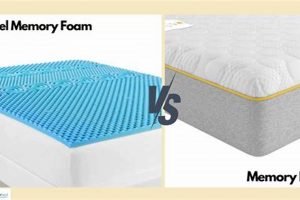
The selection of a sleep surface often involves a comparison between two common types: one constructed primarily of resilient material offering contouring support, and another relying on a network of metal coils for its structural foundation. These two options differ significantly in their materials, construction, and resulting performance characteristics.
The importance of this comparison stems from the direct impact a sleep surface has on rest quality, spinal alignment, and overall physical well-being. Understanding the inherent qualities of each type allows for a more informed decision based on individual needs and preferences. Historically, coil-based constructions were the standard, but advancements in material science have led to the increased popularity of alternative compositions offering unique advantages.
This analysis will delve into the key distinctions between these two types, examining factors such as support, pressure relief, motion isolation, temperature regulation, durability, and cost considerations. This detailed exploration aims to provide the necessary information for consumers to navigate the selection process effectively.
Selection Guidance for Sleep Surfaces
The following guidance assists in the discernment between different sleep surface technologies, focusing on crucial attributes to consider before making a purchasing decision.
Tip 1: Prioritize Support Needs: Assess individual support requirements based on sleeping position, body weight, and any existing musculoskeletal conditions. Different constructions offer varying levels of support and spinal alignment.
Tip 2: Evaluate Pressure Relief: Consider the material’s capacity to alleviate pressure points, particularly at the shoulders, hips, and knees. Superior pressure relief can contribute to reduced tossing and turning throughout the night.
Tip 3: Assess Motion Isolation: If sharing the sleep surface, evaluate the ability to minimize motion transfer. Constructions with excellent motion isolation reduce disturbances caused by a partner’s movements.
Tip 4: Examine Temperature Regulation: Evaluate the potential for heat retention or dissipation based on the materials used. Individuals sensitive to temperature fluctuations should prioritize materials that promote airflow and breathability.
Tip 5: Scrutinize Durability and Longevity: Research the expected lifespan and warranty provisions of each type. Higher-quality materials and construction techniques typically result in increased durability and long-term performance.
Tip 6: Consider Cost-Effectiveness: Balance the initial investment with the potential long-term benefits, including comfort, support, and durability. Investigate available financing options and compare prices across different brands and retailers.
Tip 7: Investigate Material Composition: Inquire about the materials used in the manufacturing process. Certifications, such as CertiPUR-US, guarantee the absence of harmful substances and adherence to environmental standards.
These guidelines emphasize the importance of carefully evaluating individual needs and preferences when selecting a sleep surface. Consideration of support, pressure relief, motion isolation, temperature regulation, durability, and cost-effectiveness is crucial for making an informed decision.
The concluding section will provide a summary of key considerations to guide the final selection process.
1. Support and Alignment

The relationship between sleep surface construction and proper spinal alignment is a critical factor in mitigating musculoskeletal discomfort and promoting restful sleep. The ability of a sleep surface to maintain the natural curvature of the spine throughout the night directly impacts posture, reduces pressure on intervertebral discs, and minimizes muscle strain. This section explores distinct facets of this crucial interaction.
- Conforming Properties and Spinal Curvature
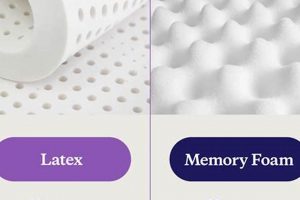
Resilient materials such as memory material or latex adapt to the individual’s body shape, providing targeted support to various regions of the spine. This conforming ability is particularly beneficial for side sleepers, as it fills the gap between the sleep surface and the body, preventing spinal misalignment. Conversely, coil systems may offer less precise contouring, potentially leading to pressure points and compromised spinal posture if the firmness level is not appropriately matched to the sleeper’s needs.
- Zoned Support Systems and Anatomical Variations
Advanced designs incorporate zoned support systems, featuring variations in firmness across different sections. This caters to the differing support requirements of the shoulders, hips, and lumbar region. A zoned sleep surface can promote optimal spinal alignment regardless of sleeping position. While both types can incorporate zoned systems, their effectiveness depends on the precision of the zoning and the quality of the materials used.
- Firmness Level and Individual Weight Distribution
The optimal firmness level is directly correlated with individual body weight and sleeping position. Lighter individuals may find a softer surface preferable, allowing for sufficient compression and contouring. Conversely, heavier individuals typically require a firmer surface to prevent excessive sinking and maintain spinal alignment. A mismatch between firmness and weight distribution can lead to discomfort and poor sleep quality regardless of the underlying construction.
- Edge Support and Spinal Stability
Adequate edge support is essential for maintaining spinal stability when sleeping near the edge of the sleep surface. Stronger edge support prevents sagging, ensuring a consistent level of support across the entire sleep surface. Coil-based constructions often incorporate reinforced edges, while resilient material designs may rely on denser perimeter materials. Inadequate edge support can lead to spinal misalignment and a sensation of rolling off the sleep surface.
In conclusion, the degree to which a sleep surface promotes proper spinal alignment is a function of its material properties, construction techniques, and the individual’s unique physical characteristics. Careful consideration of conforming properties, zoned support systems, firmness level, and edge support is essential for selecting a sleep surface that effectively supports the spine and promotes restful sleep. It is therefore important to consider each of these aspects when deciding between these two common types.
2. Pressure Point Relief

Pressure point relief, the reduction of concentrated pressure on specific areas of the body during sleep, is a primary factor influencing comfort and overall sleep quality. The effectiveness of pressure relief is significantly influenced by the construction and materials of the sleep surface, presenting notable differences between common types.
- Conformability and Pressure Redistribution
Resilient material, such as memory material or latex, exhibits superior conformability, adapting to the sleeper’s body contours. This adaptation facilitates a more even distribution of weight, minimizing pressure on bony prominences like the hips, shoulders, and spine. Coil-based constructions, while providing support, often lack the same degree of conformability, potentially resulting in localized pressure points.
- Material Density and Responsiveness
The density and responsiveness of materials directly impact their ability to alleviate pressure. High-density memory material, for example, slowly conforms to the body, providing sustained pressure relief. Conversely, responsive latex rebounds quickly, offering a more dynamic form of pressure relief. Coil systems, with their inherent lack of conforming capabilities, typically offer limited pressure relief compared to high-density resilient materials.
- Zoned Construction and Targeted Relief
Advanced designs may incorporate zoned construction, varying the firmness of different sections to target specific pressure points. For example, a softer zone may be implemented in the shoulder region to accommodate side sleepers, while a firmer zone supports the lumbar region. While both types can be engineered with zoned support, the effectiveness of the zoning depends on the precision of the design and the properties of the materials used.
- Surface Indentation Load Deflection (ILD) and Firmness Perception
The ILD rating, which measures the firmness of a material, correlates with its ability to provide pressure relief. Lower ILD ratings indicate softer materials that readily compress, offering greater pressure relief. Higher ILD ratings indicate firmer materials that provide more support but may compromise pressure relief. The ideal ILD rating depends on individual preferences and body weight, influencing the perceived comfort and pressure relief of the sleep surface.
The degree to which a sleep surface effectively alleviates pressure points is determined by its conformability, material density, zoned construction, and ILD rating. Resilient material constructions generally offer superior pressure relief compared to coil-based systems due to their inherent ability to conform to the body’s contours. However, advanced coil designs with zoned support and specialized comfort layers can mitigate some of these limitations. Ultimately, the optimal choice depends on individual preferences and specific needs.
3. Motion Transfer Control

Motion transfer control, defined as the degree to which movement on one area of a sleep surface is isolated and not transmitted to other areas, is a critical consideration for individuals sharing a bed. The design and materials inherent in common sleep surface constructions significantly influence this attribute, leading to notable variations between prevalent types.
- Interconnectedness of Coils and Motion Propagation
Traditional innerspring systems often feature interconnected coils, meaning that pressure applied to one coil can affect adjacent coils. This interconnectedness facilitates the propagation of motion across the sleep surface. When one partner moves, the resulting disturbance is more likely to be felt by the other partner. The gauge and configuration of the coils directly influence the degree of motion transfer. Lower gauge coils and tightly packed configurations tend to amplify motion transfer.
- Density and Viscoelasticity in Motion Absorption
Resilient materials, particularly viscoelastic options such as memory material, possess properties that dampen and absorb motion. High-density resilient materials deform under pressure but resist transferring that force laterally. This characteristic effectively isolates movement, preventing it from spreading across the sleep surface. The thickness and density of the resilient material layer are directly proportional to its ability to control motion transfer.
- Hybrid Designs and Motion Isolation Strategies
Hybrid constructions that combine resilient materials with coil systems often incorporate design features aimed at mitigating motion transfer. Individually pocketed coils, encased in fabric, reduce the interconnectedness of the coils and limit motion propagation. When combined with a substantial layer of resilient material, these hybrid designs can offer a balance of support and motion isolation.
- Quantitative Metrics for Motion Transfer Assessment
Motion transfer can be quantitatively assessed using various testing methodologies. Accelerometers placed on different areas of the sleep surface measure the magnitude and duration of motion resulting from a simulated disturbance. These measurements provide objective data for comparing the motion isolation capabilities of different constructions. Lower acceleration values indicate superior motion transfer control.
The effectiveness of motion transfer control is primarily a function of material properties and construction techniques. Resilient materials, particularly those with high density and viscoelasticity, generally provide superior motion isolation compared to traditional innerspring systems. However, hybrid designs that incorporate individually pocketed coils and substantial layers of resilient material can offer a viable compromise. The choice between these two depends on individual priorities.
4. Temperature Regulation

The ability of a sleep surface to regulate temperature significantly impacts sleep quality and overall comfort. The materials and construction methods employed in common sleep surface designs directly influence temperature regulation, leading to distinct performance characteristics between the prevalent types. Elevated temperatures can disrupt sleep cycles, leading to restlessness and reduced restorative rest. Conversely, effective temperature regulation promotes a stable sleep environment conducive to deeper, more consistent sleep. The choice of sleep surface, therefore, must consider individual thermal preferences and environmental factors.
Resilient materials, particularly high-density formulations, exhibit a tendency to retain heat due to their reduced airflow. Memory material, for instance, conforms closely to the body, minimizing air circulation and potentially trapping heat. This characteristic can be problematic for individuals prone to night sweats or those residing in warmer climates. Conversely, coil-based constructions, with their inherent open structure, generally offer better airflow and heat dissipation. The spaces between the coils facilitate ventilation, allowing heat to escape and maintaining a cooler surface temperature. Some manufacturers incorporate cooling technologies into resilient materials, such as gel infusions or open-cell structures, to mitigate heat retention. However, the effectiveness of these technologies varies, and careful evaluation is warranted. Natural materials, such as latex, tend to offer better temperature regulation compared to synthetic materials.
The selection of a sleep surface should align with individual temperature preferences and environmental conditions. Individuals who tend to sleep hot may benefit from coil-based constructions or resilient material designs incorporating advanced cooling technologies. Conversely, individuals who prefer a warmer sleep environment may find resilient materials more suitable. Careful consideration of material properties, construction techniques, and available cooling features is essential for optimizing sleep surface temperature and promoting restful sleep. The overall goal is to create a sleep environment that facilitates thermoregulation and minimizes disruptions caused by temperature fluctuations.
5. Durability and Longevity

The lifespan and endurance of a sleep surface represent a crucial investment consideration. The inherent materials and construction methodologies of different surface types directly influence their ability to withstand prolonged use and maintain structural integrity. An understanding of these factors is essential for optimizing long-term value.
- Material Composition and Structural Degradation
Resilient material compositions, such as polyurethane or memory material, are subject to gradual degradation over time due to factors like oxidation, compression set, and UV exposure. Lower-density materials tend to degrade more rapidly than higher-density formulations. Coil systems, while structurally robust, are susceptible to fatigue and deformation, particularly in areas of high stress concentration. The gauge and temper of the coils directly influence their resistance to fatigue. The quality of the materials used in the construction significantly impacts its overall durability and longevity.
- Construction Techniques and Joint Integrity
The manner in which different components are assembled influences the long-term structural integrity of the sleep surface. Weak or poorly executed seams, bonding agents, or fastening mechanisms can lead to premature failure and reduced lifespan. Reinforced edges, strategically placed support elements, and high-quality stitching contribute to enhanced durability. Examining the construction methods used in both surface types provides valuable insights into their potential longevity.
- Weight Distribution and Sagging Resistance
The ability of a sleep surface to evenly distribute weight is a critical factor in preventing localized sagging and deformation. Inadequate support in high-pressure areas, such as the hips and shoulders, can lead to premature sagging and reduced comfort. The design and materials of both systems impact their resistance to sagging. Coil systems with zoned support and reinforced perimeters offer enhanced resistance to sagging. Likewise, high-density resilient materials tend to exhibit greater sag resistance than lower-density counterparts.
- Warranty Provisions and Expected Lifespan
Warranty provisions provide a measure of the manufacturer’s confidence in the product’s durability and longevity. Longer warranty periods typically indicate higher-quality materials and construction methods. However, it is essential to carefully review the terms and conditions of the warranty, as they may exclude certain types of damage or degradation. While warranty provisions provide some assurance, real-world usage and maintenance practices also significantly influence the actual lifespan of the sleep surface.
Ultimately, the durability and longevity is determined by a complex interplay of material composition, construction techniques, weight distribution characteristics, and environmental factors. Selecting a sleep surface that aligns with individual needs and preferences requires careful consideration of these factors to ensure long-term value and optimal sleep quality. Regular maintenance, such as rotating the sleep surface, can also extend its lifespan.
Frequently Asked Questions
The following addresses common inquiries regarding the selection between prevalent sleep surface constructions. This information aims to clarify misconceptions and provide accurate insights for informed decision-making.
Question 1: Is one type inherently superior for all individuals?
No. The optimal sleep surface is contingent upon individual preferences, body weight, sleeping position, and specific needs. Generalizations about inherent superiority are inaccurate. A thorough evaluation of individual requirements is paramount.
Question 2: Do coil systems invariably transfer more motion than resilient material?
While traditional interconnected coil systems exhibit a tendency for greater motion transfer, modern designs incorporating individually pocketed coils can significantly mitigate this issue. Hybrid designs that combine pocketed coils with resilient layers often provide excellent motion isolation.
Question 3: Are resilient materials always prone to overheating?
High-density formulations with limited airflow can retain heat. However, advancements in material science have produced resilient material with enhanced breathability. Gel infusions, open-cell structures, and the use of natural materials like latex can improve temperature regulation.
Question 4: Do coil-based systems inherently offer better support for heavier individuals?
While coil systems can provide firm support, the optimal firmness level depends on individual weight distribution and sleeping position. High-density resilient material can also offer excellent support for heavier individuals, provided the firmness level is appropriately selected.
Question 5: Is the lifespan of a sleep surface solely determined by its material composition?
Material composition is a significant factor, but construction techniques, weight distribution, and maintenance practices also play crucial roles. Well-constructed systems using high-quality materials and proper care will exhibit greater longevity.
Question 6: Do higher prices always correlate with superior quality and performance?
While price often reflects the quality of materials and construction, it is not a foolproof indicator. Thorough research, comparison of specifications, and consideration of individual needs are essential for making informed purchasing decisions, regardless of price point.
In summary, generalizations about the inherent advantages or disadvantages of different surface types are often misleading. Informed selection requires careful consideration of individual needs, material properties, construction techniques, and maintenance practices.
The subsequent segment will synthesize the key considerations outlined throughout this discussion, offering a concluding perspective to guide the decision-making process.
Foam Mattress vs Spring Mattress
This analysis has explored key distinctions between two primary sleep surface categories. Material composition, construction techniques, support characteristics, motion isolation capabilities, temperature regulation properties, and durability factors have been examined. These parameters significantly influence the overall performance and suitability for individual needs. The decision between a resilient material construction and a coil-based system necessitates a comprehensive assessment of personal preferences, physical requirements, and budgetary constraints. Superficial comparisons based solely on marketing claims or general assumptions should be avoided. Rather, informed selection should be grounded in a thorough understanding of the attributes discussed herein.
The selection of a sleep surface represents a long-term investment in personal well-being. Prioritizing objective evaluation over subjective perceptions will yield the most satisfactory outcome. Further research into specific product specifications, warranty provisions, and consumer reviews is strongly encouraged prior to finalizing a purchase. The potential benefits of a carefully chosen sleep surface extend beyond mere comfort; it directly impacts rest quality, physical health, and overall quality of life.