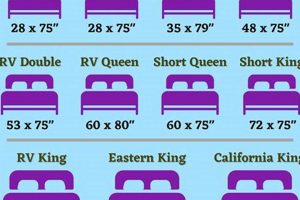
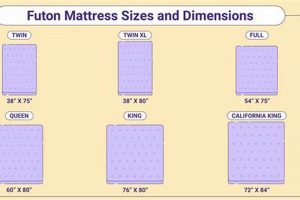
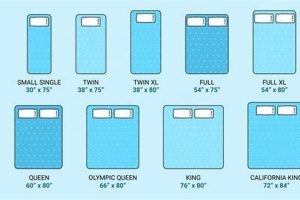
A sleeping surface intended for use within a pull-out bed frame, often stored underneath another bed, typically possesses specific measurements to ensure compatibility. These figures are vital for proper fit and function within the designated space. The length, width, and thickness dictate whether the bed will retract smoothly when not in use and provide adequate support for a sleeper. For instance, a twin-size mattress, approximately 39 inches wide and 75 inches long, is frequently utilized, but its height must be lower than a standard mattress to fit under the primary bed.
Precise sizing enables space optimization, particularly in rooms with limited square footage. This allows for versatile sleeping arrangements without permanently occupying excessive floor space. Historically, these under-bed structures provided accommodation for servants or children. Contemporary application extends to guest rooms, children’s rooms, or any setting where maximizing usable area is paramount. Selecting the appropriate size ensures comfort and avoids potential damage to the main bed frame or the stored unit.
Understanding the relevant measurements is fundamental before purchasing. Key aspects to consider include the available clearance under the main bed, the weight capacity of the frame, and the desired level of comfort. Subsequent sections will delve into specific size categories, material considerations, and factors influencing overall suitability for various applications.
Essential Guidance for Under-Bed Sleeping Surface Considerations
The selection of a suitable sleeping surface for a pull-out bed requires careful consideration of several critical factors. Adhering to these guidelines will ensure optimal functionality, comfort, and longevity of the system.
Tip 1: Verify Internal Frame Clearance: Accurately measure the available vertical space within the bed frame. This measurement dictates the maximum permissible height of the chosen mattress. Exceeding this limit will impede proper retraction and may cause damage.
Tip 2: Consult Manufacturer Specifications: Refer to the manufacturer’s documentation for the pull-out bed frame. These specifications typically outline the recommended size and weight limits for the intended sleeping surface. Deviating from these recommendations can compromise structural integrity.
Tip 3: Prioritize Low-Profile Designs: In most scenarios, a thinner mattress profile is preferable. Low-profile designs maximize clearance and facilitate easier storage. Memory foam or latex options often provide adequate support while maintaining a reduced height.
Tip 4: Assess Weight Distribution Capabilities: The frame supporting the stored sleeping surface has a specific weight capacity. Ensure the selected mattress, in combination with the anticipated occupant’s weight, does not exceed this limit. Overloading can lead to frame failure.
Tip 5: Consider Material Properties: Different materials offer varying levels of support and durability. Options include innerspring, memory foam, and latex. Select a material that aligns with individual comfort preferences and provides adequate support for the intended user.
Tip 6: Account for Bedding Thickness: Factor in the thickness of any blankets, sheets, or mattress toppers that will be used. These additions contribute to the overall height and can impact the ability to smoothly retract the unit.
Tip 7: Evaluate Storage Environment: Consider the environment in which the unit will be stored. Excessive humidity or temperature fluctuations can degrade certain materials over time. Select a mattress constructed from durable and resilient components.
By following these recommendations, the selection process becomes more informed, leading to a functional and comfortable under-bed sleeping solution. Optimal utilization relies on meticulous attention to detail and adherence to established guidelines.
The following sections will explore various materials and construction methods utilized in the manufacture of these specific sleeping surfaces, providing further insight into their suitability for different applications.
1. Width (typically 39")

The horizontal measurement, often standardized at approximately 39 inches, is a fundamental parameter directly impacting the proper functioning of an under-bed storage and sleeping solution. This dimension must align with the internal specifications of the containing frame to ensure smooth deployment and retraction.
- Standard Twin Bed Compatibility
The 39-inch width corresponds to the standard twin bed size in many regions. This standardization allows for readily available bedding and ease of replacement. Deviation from this width necessitates custom bedding solutions, increasing expense and reducing convenience.
- Space Optimization Considerations
Maintaining a 39-inch width contributes to overall space efficiency. It allows the unit to be stowed discreetly beneath the primary bed without significantly encroaching upon available floor space. Wider dimensions compromise this space-saving benefit.
- Structural Integrity Implications
The supporting frame is engineered to accommodate a mattress of a specific width. Exceeding the recommended width can place undue stress on the frame, potentially leading to structural failure or premature wear. Adherence to specifications is crucial for long-term durability.
- Occupant Comfort and Accessibility
While space-saving is a priority, the 39-inch width provides adequate sleeping space for a single occupant. Significantly narrower options may compromise comfort. Conversely, increasing the width beyond this standard may negate the space-saving advantages.
The 39-inch width, therefore, represents a critical balance between standardization, space optimization, structural integrity, and occupant comfort. Accurate adherence to this specification is paramount for the proper utilization of sleeping surfaces designed for under-bed storage.
2. Length (usually 75")

The longitudinal measurement, typically 75 inches, is a defining aspect concerning sleeping surfaces intended for under-bed storage units. This parameter, critical for accommodation and functionality, warrants detailed examination in relation to overall dimensions.
- Standard Twin Bed Equivalence
The 75-inch length directly corresponds to the dimensions of a standard twin-size bed. This correspondence allows it to accommodate individuals who would typically utilize a standard twin, thereby expanding the capacity of a room without sacrificing standardized sleeping space. Its application is observed in children’s rooms, guest rooms, and environments with limited floor space.
- Frame Accommodation Requirements
The frame designed to house the pull-out unit is engineered with specific length constraints. Deviations from the specified 75-inch measurement can lead to incompatibility, preventing proper retraction of the sleeping surface under the primary bed. An example includes frames constructed with internal support structures that obstruct oversized mattresses.
- Ergonomic Considerations for Occupants
A 75-inch length provides adequate space for the average adult, while accommodating growing children. Shorter lengths compromise comfort, particularly for taller individuals, impacting sleep quality. Consider, for example, situations where space constraints necessitate a shorter bed, potentially leading to discomfort for users exceeding the length limitation.
- Effect on Storage Capacity
The 75-inch dimension, while standardized, must also be evaluated in the context of the containing frame’s storage capacity. Extending the length beyond the designated space reduces available storage within the under-bed compartment, affecting its utility for other items. Balancing sleeping surface length with storage requirements is a key design consideration.
These facets highlight the interconnectedness of length with overall functionality. This dimension is not merely a physical attribute, but a critical parameter influencing frame compatibility, user comfort, and effective space utilization within confined environments. Selection requires careful assessment of these interdependencies to optimize the effectiveness of the under-bed sleeping solution.
3. Thickness (max 8")

Thickness, capped at a maximum of 8 inches, presents a critical constraint within the broader parameters defining under-bed sleeping surfaces. This limitation directly impacts compatibility, comfort, and material selection.
- Frame Clearance and Retraction Mechanisms
The primary function of the 8-inch thickness restriction is to ensure proper retraction under the main bed frame. Under-bed units are designed with specific vertical clearance, and exceeding the maximum thickness prevents smooth storage. For example, a mattress measuring 9 inches in thickness would likely obstruct the retraction mechanism, rendering the bed unusable. Adherence to this limit is thus non-negotiable for operational functionality.
- Material Composition and Support Considerations
Achieving adequate support and comfort within an 8-inch profile necessitates careful material selection. Traditional innerspring designs may be less suitable due to space constraints, favoring memory foam or latex configurations. These materials can provide comparable support at reduced thickness. However, the compromise between support and thickness requires careful evaluation, potentially impacting the suitability for various occupant weights and preferences.
- Impact on Bedding and Accessories
The reduced thickness influences the selection of bedding and accessories. Standard fitted sheets designed for thicker mattresses may not fit snugly, requiring specialized or adapted bedding. Moreover, the limited height restricts the use of thick mattress toppers or pads. Compatibility with existing bedding inventories becomes a relevant consideration.
- Durability and Longevity Implications
Thinner mattresses may exhibit reduced durability compared to thicker counterparts, particularly under consistent use. The compressed materials may degrade more rapidly, affecting the lifespan and overall value proposition. The type and quality of the materials employed become especially critical to mitigating this effect and extending the usable life of the sleeping surface.
The 8-inch thickness limit underscores the inherent trade-offs in designing under-bed sleeping solutions. While essential for functionality, it imposes constraints on material selection, support, and overall comfort. Careful consideration of these factors is paramount in selecting an appropriate unit that balances space efficiency with usability and longevity. Material quality, manufacturing processes, and intended use are critical variables influencing the ultimate suitability of a sleeping surface adhering to these specifications.
4. Frame Clearance Needed

Frame clearance represents the vertical space available within an under-bed structure to accommodate a trundle mattress. This dimension dictates the maximum permissible height of the stored sleeping surface and is inextricably linked to overall system functionality. Insufficient clearance prevents proper retraction, rendering the bed unusable and potentially damaging the frame. The dimensions of the trundle mattress, particularly its thickness, directly influence the clearance requirement.
Clearance issues arise when the mattress thickness exceeds the available vertical space. This excess can impede the rolling mechanism, causing friction and difficulty in extending or retracting the unit. Consider a situation where the frame is designed for a mattress with a maximum thickness of 6 inches. If a 7-inch mattress is inserted, the frame might not close completely, or the wheels could be strained, leading to premature wear or breakage. Accurate measurement and adherence to the frame’s specifications are crucial to prevent such problems.
Optimal utilization requires a thorough understanding of both the mattress measurements and the frame’s clearance specifications. Manufacturers typically provide detailed diagrams or technical documents outlining these dimensions. Neglecting these details can lead to operational difficulties and compromise the intended space-saving benefits. The relationship between frame clearance and mattress dimensions is thus a fundamental consideration for ensuring the seamless integration and functionality of under-bed sleeping solutions.
5. Weight support rating

Weight support rating, directly influenced by the dimensions of a trundle mattress, is a critical specification governing the safe and effective utilization of under-bed storage and sleeping systems. The dimensional parameters of the mattress, including its thickness and composition, interact significantly with the frame’s ability to support a given weight.
- Material Density and Compression Resistance
The materials constituting the trundle mattress directly affect its weight support rating. Higher-density materials, such as high-density memory foam or robust innerspring coils, inherently offer greater resistance to compression. A thicker mattress constructed of lower-density materials may exhibit a lower weight capacity compared to a thinner, high-density option. This distinction becomes crucial in environments where the under-bed unit is intended for use by adults or individuals with higher body mass. Disregarding this factor can lead to premature mattress degradation and compromised support, negatively impacting sleep quality and potentially causing discomfort or injury.
- Frame Construction and Load Distribution
The frame supporting the trundle unit plays a vital role in distributing the load exerted by the mattress and its occupant. The frame’s design, material composition (e.g., steel versus wood), and the presence of reinforcing elements directly influence its weight-bearing capacity. A larger mattress, while potentially offering greater surface area, may overstress a frame not designed to handle the combined weight. The trundle mattress dimensions, particularly its length and width, directly determine the surface area over which the weight is distributed. Inadequate frame strength results in sagging, instability, and potential structural failure, rendering the under-bed system unsafe.
- Thickness and Edge Support
The thickness of the trundle mattress, a key dimensional parameter, impacts edge support and overall stability. Thicker mattresses often incorporate reinforced edges to prevent sagging and maintain consistent support across the entire surface. A thinner mattress may lack sufficient edge support, particularly if constructed from lower-density materials. This lack of support becomes more pronounced when the occupant is near the edge of the mattress, potentially leading to roll-off and discomfort. The weight support rating must account for the mattress’s thickness and edge support capabilities to ensure a stable and secure sleeping surface.
- Intended User and Usage Frequency
The intended user profile and the frequency of use significantly influence the weight support requirements. An under-bed unit designed primarily for occasional use by children necessitates a lower weight rating compared to one intended for frequent use by adults. The trundle mattress dimensions should be selected in conjunction with the weight support rating to accommodate the anticipated user population. Failing to consider these factors can result in premature wear, compromised support, and a reduced lifespan for the under-bed system.
These facets underscore the interconnected nature of weight support rating and trundle mattress dimensions. Proper selection requires a holistic assessment of material properties, frame construction, mattress thickness, and intended usage patterns. Neglecting any of these considerations can compromise safety, comfort, and the overall effectiveness of under-bed sleeping solutions. It is imperative to consult manufacturer specifications and guidelines to ensure compatibility and adherence to recommended weight limits.
Frequently Asked Questions
The following addresses common inquiries regarding the specific measurements associated with mattresses intended for use in trundle beds and similar under-bed storage systems.
Question 1: What are the standard dimensional characteristics of a mattress designed for a trundle bed?
Typically, the dimensional properties mirror those of a standard twin bed, measuring approximately 39 inches in width and 75 inches in length. A critical difference lies in the thickness, which is generally restricted to a maximum of 8 inches to facilitate proper storage and retraction within the under-bed frame. These are the “trundle mattress dimensions” people seek.
Question 2: Why is the thickness limited in these types of mattresses?
The thickness limitation serves to ensure compatibility with the under-bed frame’s available vertical clearance. Exceeding the specified thickness can impede smooth operation and may even prevent the unit from closing completely, resulting in damage to both the mattress and the frame itself.
Question 3: What impact do specific measurements have on the overall comfort level?
The 39-inch width and 75-inch length provide sleeping space comparable to a standard twin bed, generally accommodating a single adult or child comfortably. However, the restricted thickness necessitates careful material selection to maintain adequate support and cushioning. Compromises in material quality can diminish comfort and long-term support.
Question 4: How do trundle mattress dimensions influence the selection of bedding?
While the width and length align with standard twin sizes, the reduced thickness may require specialized or adapted bedding. Fitted sheets designed for thicker mattresses may not fit properly, necessitating adjustments or the purchase of sheets specifically designed for thinner profiles.
Question 5: Are variations in dimensional specifications common, and what are the implications?
While the aforementioned dimensions represent the norm, slight variations may exist. Adhering to the manufacturer’s specifications for both the mattress and the frame is paramount. Deviations can lead to operational problems and compromise the structural integrity of the system.
Question 6: How does the weight capacity of a trundle bed relate to the thickness and dimensions of the mattress?
The weight capacity is influenced by both the frame’s construction and the mattress’s composition. A thicker mattress comprised of high-density materials may offer greater weight support compared to a thinner, lower-density alternative. However, the frame must also be capable of supporting the combined weight of the mattress and the occupant. Consulting the manufacturer’s recommendations is crucial for ensuring safe and effective operation.
In summary, meticulous attention to dimensional specifications is crucial for ensuring the proper functionality, comfort, and longevity of under-bed sleeping solutions. Disregarding these parameters can result in operational difficulties, compromised comfort, and potential safety hazards. Trundle mattress dimensions can vary.
The next section will delve into the selection of appropriate materials for under-bed sleeping surfaces, taking into account the dimensional constraints and intended usage scenarios.
Conclusion
The preceding examination of “trundle mattress dimensions” has underscored the critical importance of adhering to specified parameters for proper functionality and user satisfaction. Frame clearance, weight support rating, and material composition are inextricably linked to these measurements. Neglecting dimensional requirements can result in operational difficulties, compromised comfort, and potential safety hazards. Standard measurements approximate those of a twin bed, with thickness as the primary differentiating factor.
Continued adherence to established guidelines is essential for maximizing the lifespan and utility of under-bed sleeping solutions. Buyers should consult manufacturer specifications and prioritize accurate measurements to ensure compatibility and optimal performance. The integration of these detailed considerations will result in a seamless and secure sleeping arrangement for various applications.