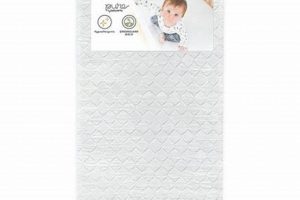
This bedding setup is a smaller alternative to standard-sized baby beds, typically designed for nurseries where space is limited or for families who frequently move. It includes both the compact bed frame and the corresponding sleeping surface engineered to fit its dimensions, ensuring infant safety and comfort.
Its significance lies in its space-saving design, offering a practical solution for urban living or smaller homes. The reduced footprint does not compromise safety standards, and these systems often provide comparable comfort levels to larger alternatives. Historically, they have gained popularity as families seek adaptable solutions for modern living environments and prioritize portability during travel.
The following sections will delve into the specific advantages, safety considerations, and available features of such compact sleeping arrangements, providing a comprehensive overview for prospective users.
Optimizing the Utilization of Compact Infant Bedding Systems
The subsequent recommendations are designed to maximize the utility and safety of scaled-down infant sleep solutions, enhancing the well-being of the child and the practicality for caregivers.
Tip 1: Measure Available Space: Prior to acquisition, meticulously measure the intended location for the infant’s sleep space. Verify the compact bed frames dimensions do not impede movement or create obstructions within the room.
Tip 2: Verify Mattress Firmness: Ensure the included or replacement sleeping surface offers appropriate firmness. Pediatricians typically recommend a firm sleeping surface to mitigate risks associated with infant suffocation.
Tip 3: Adhere to Weight and Height Limits: Strictly observe the manufacturer’s specified weight and height restrictions for the compact bed. Exceeding these limits may compromise structural integrity and pose a potential hazard.
Tip 4: Regularly Inspect Hardware: Periodically examine all screws, bolts, and locking mechanisms on the bed frame. Tighten any loose components to maintain structural stability and prevent accidental disassembly.
Tip 5: Use Fitted Sheets Exclusively: Employ only fitted sheets designed explicitly for the specified sleeping surface dimensions. Loose bedding can present a suffocation hazard and should be strictly avoided.
Tip 6: Consider Portability Needs: If frequent relocation is anticipated, prioritize models designed with enhanced portability features, such as folding capabilities and integrated carrying bags.
Tip 7: Research Safety Standards: Before purchasing, research whether the equipment has been certified by relevant safety organizations. Certification indicates adherence to established safety protocols and testing procedures.
Adherence to these guidelines ensures the safe, effective, and long-term utilization of scaled-down infant sleeping arrangements. The integration of these practices contributes to a secure and nurturing environment for the child’s development.
The following sections will address common concerns and frequently asked questions regarding these systems.
1. Space optimization

Compact infant sleeping arrangements inherently prioritize space optimization due to their reduced footprint compared to standard-sized options. The cause-and-effect relationship is direct: limited room dimensions necessitate a smaller bed, and this demand spurred the development of scaled-down sleeping solutions. Space efficiency is not merely a benefit but an integral component of these infant beds; without it, the core functionality of accommodating infant sleep in confined areas would be absent. A family residing in a compact urban apartment, for example, might find a standard bed impractical. This unit provides a viable alternative, enabling proper infant care without compromising living space.
Understanding the practical significance of space optimization dictates purchasing decisions. Before acquiring any sleeping arrangement, evaluating the room’s dimensions is essential. The chosen compact bed should facilitate movement and ensure accessibility to other nursery items. For example, obstructing doorway or storage spaces negates the advantage of space-saving design. Models with integrated storage can further optimize room space. Prioritizing this characteristic ensures the unit serves not only as a sleeping area but also contributes to an organized living environment, ultimately enhancing user convenience and safety.
In summary, the connection between compact infant beds and space optimization is undeniable. This relationship is rooted in a demand for practical solutions in constrained living spaces. Overlooking space-saving as a core design element diminishes the overall utility of the product. Future enhancements might include multi-functional designs that integrate changing tables or storage units, further addressing the challenge of limited space. Ultimately, the value of these compact beds rests on the effective balance of infant safety, comfort, and the maximization of available space.
2. Safety certifications

Adherence to safety standards is paramount in infant product design and manufacturing. Certifications from recognized bodies provide independent verification that a particular sleeping arrangement meets established safety benchmarks. The cause is consumer demand for safer products, and the effect is manufacturers seeking certification to build trust and mitigate liability. A compact infant bed lacking pertinent certifications raises immediate safety concerns due to the absence of external validation.
The significance of safety certifications as a component of such a bed is crucial. These certifications, such as those from the Juvenile Products Manufacturers Association (JPMA) or compliance with ASTM standards, ensure structural integrity, non-toxicity of materials, and adherence to specific dimensional requirements that prevent entrapment or suffocation hazards. For example, a JPMA-certified compact infant bed has undergone rigorous testing for stability, hardware durability, and lead content in paint finishes. Non-certified alternatives offer no such assurance, creating a potential risk of structural failure or exposure to harmful substances.
In summary, the acquisition of a sleeping arrangement without verifiable safety certifications undermines the very purpose of providing a secure sleep environment for an infant. Understanding the practical implications of certification status guides informed purchasing decisions. The connection between safety certifications and a compact infant bed is indispensable, ensuring consumer confidence and protecting the well-being of the child. Future models may integrate smart technology to continuously monitor safety parameters, further enhancing risk mitigation.
3. Mattress Firmness
The firmness of the sleeping surface within a compact infant bed setup is not merely a comfort consideration but a critical safety parameter. Its selection necessitates careful evaluation due to its direct impact on infant well-being and risk mitigation.
- Sudden Infant Death Syndrome (SIDS) Risk
Excessively soft sleeping surfaces elevate the risk of SIDS. An infant’s face can sink into a yielding mattress, obstructing airways and hindering breathing. Firm mattresses mitigate this risk by providing a stable surface that reduces the likelihood of suffocation. Pediatricians and safety organizations consistently recommend firm surfaces for infant sleep environments.
- Developmental Impact
While firmness is paramount for safety, excessively hard surfaces can potentially impede proper spinal alignment and musculoskeletal development. The ideal balance involves a surface that is firm enough to prevent sinking but possesses sufficient give to accommodate the infant’s developing anatomy. This requires meticulous consideration of material composition and internal construction.
- Mattress Material Composition
The materials used in construction directly influence the firmness and overall safety of the infant bed mattress. High-density foam or innerspring construction generally provides greater firmness compared to low-density foam or fiberfill. Moreover, the use of non-toxic, hypoallergenic materials is essential to prevent allergic reactions and minimize exposure to volatile organic compounds (VOCs).
- Standards and Regulations
Industry standards, such as those set by ASTM International, establish minimum firmness requirements for infant sleeping surfaces. Compliance with these standards is a crucial indicator of safety and quality. Verifying that a mattress meets or exceeds these standards offers a degree of assurance regarding its suitability for infant use.
The careful selection of a firm, appropriately constructed sleeping surface in a compact infant bed directly influences infant safety and development. Ignoring this critical aspect introduces unnecessary risks. These inter-dependencies highlight the importance of informed decision-making when choosing an infant sleep environment.
4. Portability features
The integration of portability features in compact infant sleeping arrangements directly addresses the needs of families with active lifestyles or limited living spaces. The cause is the demand for adaptable infant care solutions, and the effect is the design and manufacture of units with features that facilitate easy transport and storage. These features are not merely aesthetic enhancements; they are integral to the functionality of a compact infant bed, transforming it from a stationary object into a mobile care station. For instance, a family relocating frequently, or one residing in a small apartment, benefits directly from a compact infant bed equipped with folding mechanisms, lightweight construction, and integrated carrying bags. Without these features, the unit would remain confined to a single location, negating its potential value for such users.
The practical applications of enhanced portability are varied and significant. Compact beds with integrated wheels offer ease of movement within a home, allowing caregivers to relocate the infant without disruption. Collapsible frames and included travel bags simplify transportation during travel, maintaining a familiar sleep environment for the infant in unfamiliar surroundings. Models designed for portability often prioritize lightweight materials without sacrificing structural integrity, balancing ease of transport with safety considerations. An understanding of these features enables prospective buyers to select a compact infant bed that aligns with their specific mobility requirements, whether for occasional trips or daily relocation within a residence.
In summary, the relationship between portable features and compact infant sleeping arrangements is essential for families seeking adaptable solutions. Portability is a key differentiator in the marketplace, enabling caregivers to maintain a consistent and secure sleep environment for their infants, irrespective of location. Future advancements might include integrating GPS tracking for enhanced security during travel or developing self-folding mechanisms for even greater convenience. The inherent value lies in the mobility it affords.
5. Weight limits

Weight limits are a critical safety specification of every compact infant bed and corresponding sleeping surface, directly influencing its safe operational lifespan. The underlying cause for such restrictions is the structural capacity of the bed frame and the material properties of the sleeping surface. Exceeding these prescribed weight thresholds can initiate structural compromise, leading to potential collapse or failure of components. For example, a compact infant bed designated for a maximum weight of 30 pounds may exhibit signs of stress, such as bending or cracking, if subjected to a load exceeding this limit. The resulting instability jeopardizes infant safety, potentially causing injury due to falls or entrapment.
The significance of weight limits as a component of compact infant beds is paramount, as they define the parameters within which the product guarantees safe performance. Manufacturers establish these limits based on rigorous testing and engineering analysis to ensure the product maintains structural integrity under anticipated loads. A failure to adhere to these limits effectively voids any warranty and places the infant at immediate risk. Understanding this principle is crucial for caregivers, as it dictates the duration of safe usage. As the infant grows and gains weight, monitoring their mass relative to the specified limit is essential to facilitate a timely transition to a larger, more robust sleeping arrangement.
In summary, weight limits are not arbitrary figures but fundamental safety guidelines integral to the design and application of compact infant beds and sleeping surfaces. These limits protect the infant from potential structural failures and associated injuries. Disregarding the weight capacity compromises the integrity and intended functionality. Future designs may incorporate weight sensors that alert caregivers upon approaching or exceeding prescribed limits, providing a proactive layer of safety. Ultimately, the responsible utilization of a compact infant bed hinges on diligent adherence to weight limitations.
6. Airflow design
Airflow design within compact infant beds and their associated sleeping surfaces directly impacts infant thermal regulation and respiratory health. The cause is the inherent vulnerability of infants to overheating and their sensitivity to air quality, and the effect is the intentional engineering of airflow pathways to mitigate these risks. Restricted airflow around the infant can lead to heat retention, elevating the risk of hyperthermia. A poorly ventilated mattress can trap moisture, fostering the growth of mold and bacteria, which in turn can compromise air quality and potentially trigger respiratory distress. Therefore, airflow design is not merely an aesthetic consideration but a crucial functional element.
The significance of airflow design as a component of compact infant beds stems from its ability to regulate temperature and minimize the buildup of allergens and irritants. Examples include strategically placed ventilation holes in the mattress core, breathable mattress covers made of materials like organic cotton or bamboo, and slatted bed frame designs that promote air circulation around the entire structure. These features collectively work to dissipate heat and moisture, creating a more comfortable and hygienic sleep environment. Moreover, increased airflow reduces the concentration of exhaled carbon dioxide near the infant’s face, further contributing to respiratory well-being. Understanding these design elements facilitates informed purchasing decisions, enabling caregivers to prioritize models that emphasize proper ventilation.
In summary, airflow design is inextricably linked to the health and safety of infants utilizing compact sleeping arrangements. Its contribution to temperature regulation, moisture control, and air quality underscores its importance. Neglecting airflow design can undermine the overall integrity of a compact infant bed system, potentially negating other safety features. Future innovations may involve incorporating active ventilation systems to provide even greater control over the sleep environment. The value in proper airflow design lies in its proactive approach to minimizing potential health hazards associated with infant sleep.
7. Material composition
The material composition of a compact infant bed and its accompanying sleeping surface directly influences infant safety, health, and product durability. The selection of materials dictates factors such as allergen exposure, off-gassing of volatile organic compounds (VOCs), flammability, and ease of cleaning. The effects of material choice are far-reaching, impacting not only the immediate sleep environment but also potentially affecting long-term health. For instance, a sleeping surface constructed from conventional polyurethane foam may release VOCs, potentially triggering respiratory irritation or allergic reactions in sensitive infants. Similarly, fabrics treated with flame retardants, while meeting safety standards, may expose infants to potentially harmful chemicals through skin contact or inhalation. Therefore, material composition is not a trivial aspect but a central determinant of the overall suitability of a compact infant bed.
The significance of material composition as a component of such beds resides in its capacity to mitigate or exacerbate potential health risks. For example, opting for a sleeping surface made from organic cotton, natural latex, or CertiPUR-US certified foam reduces the likelihood of exposure to harmful chemicals. Similarly, selecting bed frames constructed from sustainably sourced wood with non-toxic finishes minimizes the risk of off-gassing and contributes to environmental responsibility. The practical implications of this understanding are substantial, guiding informed purchasing decisions. Caregivers should prioritize units with transparent labeling indicating material sourcing and certifications, ensuring they are making choices that prioritize infant well-being and environmental sustainability.
In summary, the connection between material composition and compact infant sleeping arrangements is crucial, shaping both the immediate sleep environment and long-term health outcomes. Ignoring this aspect can undermine other safety features. Future advancements may incorporate bio-monitoring sensors to detect potentially harmful emissions. The value of careful material selection lies in its proactive approach to minimizing health risks and promoting a safer, more sustainable sleep environment for the infant.
Frequently Asked Questions
The following questions address prevalent inquiries concerning compact infant sleeping arrangements and their associated safety and usage parameters.
Question 1: What distinguishes a “mini” version from a standard infant bed?
The primary distinction resides in overall dimensions. Compact models exhibit a smaller footprint, generally ranging from 24 inches wide by 38 inches long, while standard beds typically measure around 28 inches wide by 52 inches long. This size difference influences suitability for space-constrained environments and portability considerations.
Question 2: Are standard-sized sleeping surfaces compatible with compact bed frames?
No. Standard surfaces are not compatible with compact frames due to dimensional disparities. Attempting to utilize a standard surface within a compact frame poses a significant safety risk, potentially leading to gaps, instability, and increased risk of infant entrapment or suffocation. Only surfaces specifically designed for the intended bed frame should be used.
Question 3: What are the primary advantages of utilizing a compact infant bed?
The key advantages encompass space optimization within smaller living spaces, enhanced portability for travel purposes, and ease of maneuverability within confined areas. These advantages cater to families with limited square footage or frequent relocation requirements.
Question 4: At what age or developmental stage should an infant transition from a compact bed to a larger sleeping arrangement?
The transition timeframe is dictated by the infant’s physical growth and the manufacturer’s specified weight and height limits for the compact bed. Typically, a transition is warranted when the infant approaches these limits or demonstrates the ability to climb out of the compact bed, posing a fall risk.
Question 5: What safety certifications should be verified prior to acquiring a compact infant bed?
Pertinent safety certifications include those issued by the Juvenile Products Manufacturers Association (JPMA) and compliance with ASTM International standards for infant beds. These certifications indicate adherence to established safety protocols regarding structural integrity, material toxicity, and entrapment hazards.
Question 6: What considerations are paramount when selecting a compact sleeping surface?
Key considerations encompass mattress firmness (prioritizing a firm surface), material composition (opting for non-toxic and hypoallergenic materials), and proper fit within the compact bed frame. These considerations directly impact infant safety, comfort, and overall sleep quality.
The understanding and application of these answers contributes to the safe and effective utilization of compact infant sleep environments. Prioritizing these considerations ensures optimal infant well-being.
The following sections will delve into specific product recommendations and purchasing guidelines.
Conclusion
The preceding exploration of the compact infant sleep system, encompassing the bed frame and its corresponding sleeping surface, underscores several critical considerations. Space optimization, strict adherence to safety standards verified through certifications, appropriate mattress firmness, and careful evaluation of material composition form the core tenets of responsible selection and utilization. These factors are not merely desirable features but essential safeguards for infant well-being.
Ultimately, the decision to employ a compact infant sleeping arrangement demands diligent research and a commitment to prioritizing infant safety above all else. Understanding the nuances of weight limits, airflow design, and portability ensures a secure and nurturing sleep environment during a critical stage of development. Continued vigilance in monitoring product recalls and evolving safety guidelines remains paramount for all caregivers utilizing these systems.


![Best Organic Crib Mattress Protector [Safe Sleep] | Organic & Natural Mattress Buyer’s Guide: Non-Toxic Sleep Solutions](https://mattressworldpa.com/wp-content/uploads/2025/07/th-1363-300x200.jpg "Best Organic Crib Mattress Protector [Safe Sleep] Organic & Natural Mattress Buyer’s Guide: Non-Toxic Sleep Solutions")