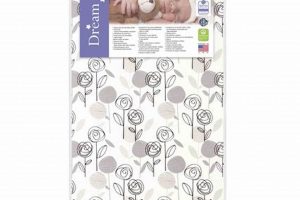
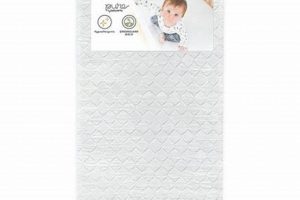
The central question concerns the compatibility of a standard-sized crib mattress with a portable playard, often referred to as a pack ‘n play. Determining whether the larger dimensions of a crib mattress are suitable for the confined space of a playard is crucial for safe and comfortable use. For example, attempting to force a mattress that is too large can create gaps between the mattress and the playard walls, posing a potential hazard.
Understanding the appropriate fit has implications for infant safety, parental convenience, and responsible product utilization. A correctly sized sleep surface helps minimize risks such as entrapment, suffocation, and injury from falls. Historically, portable playards were designed with thinner, often less comfortable padding; therefore, the desire to improve sleep comfort has led to exploration of alternative mattress solutions. This subject highlights the importance of adhering to manufacturer guidelines and understanding the specific dimensions of both the mattress and the playard.
The subsequent discussion will delve into specific dimensions, safety considerations, alternative solutions, and considerations for ensuring a secure and appropriate sleep environment for infants within a portable playard.
Guidance on Playard Mattress Selection
This section provides essential guidance regarding the appropriate mattress for use in a portable playard. It emphasizes safety and suitability over convenience, prioritizing the well-being of the infant.
Tip 1: Verify Dimensions. Prior to introducing a crib mattress into a playard, meticulously measure the interior of the playard and the external dimensions of the mattress. These measurements must align closely; any significant discrepancy indicates incompatibility.
Tip 2: Assess Fit Security. If a crib mattress appears to fit within a playard, evaluate the perimeter. No gaps exceeding one inch should exist between the mattress edge and the playard walls, as such gaps can pose an entrapment risk.
Tip 3: Consult Manufacturer Guidelines. Always refer to the playard manufacturer’s recommendations regarding mattress type and size. Deviation from these guidelines may void warranties and compromise safety.
Tip 4: Evaluate Mattress Firmness. Ensure the mattress is sufficiently firm. A mattress that is too soft increases the risk of suffocation. Firmness should comply with established safety standards for infant sleep surfaces.
Tip 5: Prioritize a Tight Sheet. Utilize a fitted sheet designed specifically for the mattress in use. The sheet must fit snugly and securely to prevent bunching or becoming dislodged during sleep.
Tip 6: Resist Alterations. Avoid modifying either the crib mattress or the playard in an attempt to force a fit. Alterations can compromise structural integrity and introduce unforeseen hazards.
Tip 7: Monitor Continuously. Regularly inspect the mattress and playard for signs of wear, damage, or shifting. Address any issues promptly to maintain a safe sleep environment.
Adherence to these recommendations ensures a safer sleep environment for infants using portable playards. Compatibility and security are paramount, superseding any perceived convenience.
The subsequent section will provide additional resources and expert opinions to further clarify this complex issue.
1. Dimensions compatibility

The question of whether a crib mattress fits a playard, depends significantly on dimensional compatibility. This refers to the degree to which the length, width, and thickness of the crib mattress correspond to the interior dimensions of the playard. The direct effect of dimensional incompatibility is the creation of gaps. For example, if a crib mattress is narrower than the playard’s interior, gaps form along the sides. Conversely, a mattress that is too long or wide might buckle or fail to lie flat, creating an uneven and potentially hazardous sleep surface. The “will crib mattress fit pack play” query essentially seeks to avoid these scenarios.
Dimensions compatibility serves as a foundational component of ensuring a safe sleep environment when considering the use of a crib mattress within a playard. Accurate measurements of both the mattress and the playard are necessary. A real-life example could involve a standard crib mattress, nominally 28 inches wide and 52 inches long, being placed in a playard with interior dimensions of 24 inches by 36 inches. The incompatibility here is obvious and presents an immediate safety concern. Practical significance stems from understanding that forcing a fit is never advisable; instead, one must seek a sleep surface explicitly designed and sized for the playard, ensuring that it meets relevant safety standards.
In summary, dimensional compatibility is not merely a matter of convenience, but a critical safety prerequisite when addressing the “will crib mattress fit pack play” question. Ignoring this aspect can lead to a compromised sleep surface and increased risks of injury or suffocation. Prioritizing appropriately sized and safety-certified mattresses designed specifically for playards remains the recommended practice.
2. Entrapment hazards

The potential for entrapment is directly linked to the question of whether a crib mattress is suitable for a portable playard. Entrapment occurs when an infant’s body, or part thereof, becomes wedged between the mattress and the sides of the playard. The causes of such entrapment typically stem from dimensional incompatibility: if the crib mattress does not precisely fit the playard’s internal space, gaps arise, creating opportunities for a child to become trapped. For example, a mattress narrower than the playard’s floor will leave side gaps. The importance of addressing this hazard cannot be overstated; it relates directly to infant safety, potentially leading to suffocation or injury. A real-life example involves an infant sliding into a gap created by an ill-fitting mattress and becoming unable to free themselves, demonstrating the practical significance of choosing the correct size and fit.
Further analysis reveals that the risk of entrapment extends beyond simple dimensional mismatches. Even a mattress that appears to fit initially can become problematic over time due to compression, shifting, or movement by the infant. Furthermore, the firmness of the mattress plays a role; a softer mattress may compress more easily, exacerbating existing gaps. Practical applications of this understanding include routine inspection of the mattress fit, ensuring that the mattress remains snug against all sides of the playard. Use of fitted sheets specifically designed for the mattress type can also help to minimize the risk of mattress shifting.
In summary, the connection between entrapment hazards and the question of whether a crib mattress should be used in a playard is critical. Ensuring a secure, gap-free fit is paramount to infant safety. This requires a thorough understanding of dimensions, materials, and potential movement. Challenges include consistently monitoring the fit and selecting products that prioritize both compatibility and safety. The broader theme is the responsibility of caregivers to create and maintain a safe sleep environment for infants, recognizing that seemingly minor details can have significant consequences.
3. Manufacturer guidelines
Manufacturer guidelines serve as a critical resource in determining the suitability of a crib mattress for use within a portable playard. These guidelines offer specific instructions and recommendations regarding mattress dimensions, safety standards, and usage limitations, directly addressing concerns related to the core question.
- Specified Mattress Dimensions
Playard manufacturers often stipulate precise mattress dimensions that are compatible with their product. These specifications ensure a snug fit, mitigating the risk of entrapment hazards. Deviation from these dimensions can compromise the structural integrity of the playard and void warranties. For example, a manufacturer might specify a mattress thickness no greater than 3 inches to prevent a child from climbing out or falling over the side.
- Safety Standards Compliance
Guidelines frequently reference applicable safety standards, such as those established by ASTM International or other regulatory bodies. These standards mandate specific mattress firmness, material composition, and construction techniques to minimize suffocation and other potential hazards. Adherence to these standards provides an assurance of product safety that is often highlighted within the manufacturer’s documentation.
- Prohibited Mattress Types
Manufacturers may explicitly prohibit the use of certain mattress types within their playards. This could include innerspring mattresses, memory foam mattresses, or mattresses exceeding specific weight limits. Such prohibitions are typically based on safety considerations or performance limitations of the playard itself. Ignoring these prohibitions can compromise the functionality and safety of the product.
- Warranty Implications
The use of a non-compliant mattress within a playard can void the manufacturer’s warranty. Warranties typically cover defects in materials or workmanship, but they are often contingent on the product being used in accordance with the manufacturer’s instructions. Therefore, selecting a mattress that adheres to the manufacturer’s guidelines is essential for maintaining warranty coverage.
In summation, manufacturer guidelines are instrumental in addressing the core question of mattress compatibility. Adhering to these guidelines promotes infant safety, preserves product functionality, and maintains warranty coverage. Failing to consult and comply with these instructions can have serious consequences, underscoring the importance of thorough research and informed decision-making.
4. Mattress firmness

Mattress firmness is a critical parameter when evaluating the suitability of a crib mattress for use in a portable playard. Its significance extends beyond mere comfort, directly impacting infant safety and the structural integrity of the sleep environment. A detailed understanding of mattress firmness, and its interplay with playard design, is essential.
- Suffocation Risk Mitigation
A firm mattress is crucial in reducing the risk of Sudden Infant Death Syndrome (SIDS) and suffocation. A too-soft mattress can conform to the infant’s face, potentially obstructing airways. Conversely, a firm surface provides resistance, minimizing this hazard. In the context of “will crib mattress fit pack play,” even if a mattress seems to fit dimensionally, inadequate firmness can render it unsafe. Regulatory bodies and pediatricians universally advocate for firm mattresses for infant sleep environments, regardless of the specific sleeping device used.
- Structural Support and Posture
A firm mattress provides adequate support for the infant’s developing spine. Insufficient firmness can lead to improper spinal alignment, potentially contributing to discomfort or long-term postural issues. When considering “will crib mattress fit pack play,” the support offered by the mattress is as important as its dimensions. A mattress that sags or deforms significantly under the infant’s weight is unsuitable, even if it otherwise fits the playard.
- Gap Prevention and Entrapment
Mattress firmness can influence the likelihood of gap formation between the mattress and the playard walls. A firm mattress maintains its shape and resists compression, reducing the potential for gaps to emerge as the infant moves or sleeps. In contrast, a softer mattress may compress, creating spaces where an infant could become entrapped. The question of “will crib mattress fit pack play” must also consider the long-term stability of the fit, taking into account the potential for compression over time.
- Consistency with Safety Standards
Established safety standards, such as those promulgated by ASTM International, specify minimum firmness requirements for infant mattresses. These standards aim to mitigate identified hazards and ensure a consistent level of safety across different products. The “will crib mattress fit pack play” decision must be informed by these standards. Even if a crib mattress physically fits a playard, it is unsuitable if it fails to meet the required firmness benchmarks. Compliance with safety standards supersedes convenience or perceived cost savings.
In summary, mattress firmness is inextricably linked to the safety and suitability of using a crib mattress within a portable playard. The “will crib mattress fit pack play” question cannot be adequately addressed without careful consideration of firmness. Prioritizing a firm, supportive mattress that complies with relevant safety standards is paramount for safeguarding infant well-being.
5. Suffocation risks
The potential for suffocation represents a critical concern when evaluating the use of a crib mattress within a portable playard. Improper mattress selection can create conditions that elevate this risk, necessitating a comprehensive understanding of the factors involved.
- Gaps and Entrapment
Dimensional incompatibility between a crib mattress and a playard generates gaps, increasing the risk of an infant becoming entrapped. If an infant’s face becomes pressed against a gap between the mattress and the playard wall, suffocation can occur. For example, a mattress that is too small for the playard creates spaces where the infant may slide and become wedged. The correlation with “will crib mattress fit pack play” is direct: a precise fit is essential to minimize this hazard.
- Mattress Firmness and Airway Obstruction
Insufficient mattress firmness contributes to suffocation risk. A mattress that is too soft can conform to the infant’s face, obstructing the airway. While a crib mattress may fit the dimensions of a playard, if it lacks the requisite firmness, it poses a significant threat. Examples include memory foam mattresses or those with thick pillow tops, which are generally not recommended for infant use. In addressing “will crib mattress fit pack play,” assessing firmness is as critical as verifying dimensions.
- Overlays and Additional Padding
Introducing overlays or additional padding to improve comfort can inadvertently increase suffocation risk. Non-breathable materials or loose padding can obstruct airflow, especially if the infant rolls onto their stomach. Even if the original crib mattress fits securely within the playard, adding such layers compromises safety. The guidance on “will crib mattress fit pack play” generally discourages the use of any supplementary materials not specifically designed for that playard model.
- Improper Sheet Fit
Loose or ill-fitting sheets can bunch up and pose a suffocation hazard. If a sheet comes detached from the mattress and covers the infant’s face, it can restrict breathing. Even with a correctly sized crib mattress inside a playard, an improperly fitted sheet negates some of the safety benefits. The relevance to “will crib mattress fit pack play” includes ensuring that any sheet used is specifically designed to fit the chosen mattress within the playards dimensions.
These factors underscore the critical importance of considering suffocation risks when deciding whether a crib mattress is suitable for use within a playard. The issue of “will crib mattress fit pack play” extends beyond simple dimensional compatibility; it encompasses a thorough assessment of firmness, additional materials, and the potential for entrapment and airway obstruction.
6. Safety standards

Safety standards establish a framework for evaluating the compatibility of a crib mattress with a portable playard. These standards, typically set by organizations such as ASTM International or government regulatory bodies, define acceptable dimensions, firmness levels, and material compositions for infant sleep surfaces. The question of whether a crib mattress can be used within a playard is directly influenced by adherence to these standards. Deviation can introduce hazards such as entrapment or suffocation, directly contravening the intended safety parameters. A real-life example involves a crib mattress failing to meet fire retardancy standards; while dimensionally compatible with a playard, its use would violate safety protocols.
Further analysis reveals that safety standards extend beyond the mattress itself to encompass the playard’s construction. Standards dictate the mesh size, frame stability, and locking mechanisms of the playard. Even if a crib mattress adheres to relevant safety criteria, incompatibility with the playard’s design can negate these benefits. For instance, if the playard’s side walls are too low relative to the mattress height, an infant could climb out, resulting in a fall. Understanding the interaction between mattress and playard safety features is, therefore, critical. Practical applications include verifying both the mattress and playard carry certifications from recognized safety organizations.
In summary, safety standards provide the definitive criteria for determining whether a crib mattress is appropriate for use within a portable playard. The question of “will crib mattress fit pack play” must be answered in the affirmative only if both products conform to relevant safety guidelines and are compatible in design and function. Challenges include keeping abreast of evolving standards and ensuring consumers have access to accurate information. The broader theme is the importance of prioritizing infant safety through informed product selection and adherence to established safety protocols.
Frequently Asked Questions
The following addresses common inquiries concerning the compatibility and safe usage of crib mattresses within portable playards, often referred to as pack ‘n plays.
Question 1: Is it safe to use a standard crib mattress in a portable playard?
The safety of using a standard crib mattress in a portable playard depends entirely on dimensional compatibility and adherence to safety standards. If the mattress creates gaps or fails to meet firmness requirements, its use is not recommended.
Question 2: How do I determine if a crib mattress is the correct size for a playard?
Measure the interior dimensions of the playard and compare them to the external dimensions of the crib mattress. A snug fit, with no gaps exceeding one inch, is required.
Question 3: What are the risks associated with using an ill-fitting mattress in a playard?
Risks include infant entrapment, suffocation, and increased potential for falls. Gaps between the mattress and playard walls can create hazardous spaces.
Question 4: Do playard manufacturers recommend using standard crib mattresses?
Most playard manufacturers provide specific mattress size and type recommendations. Deviating from these recommendations may void warranties and compromise safety.
Question 5: What alternatives exist if a standard crib mattress does not fit a playard?
Alternatives include using the mattress pad provided by the playard manufacturer or purchasing a mattress specifically designed to fit that particular playard model.
Question 6: Where can I find more information on safe sleep practices for infants?
Consult resources from organizations such as the American Academy of Pediatrics (AAP) and the Consumer Product Safety Commission (CPSC) for evidence-based guidelines.
Selecting an appropriate sleep surface for an infant within a portable playard necessitates careful consideration of dimensions, firmness, and adherence to manufacturer guidelines.
This concludes the discussion of frequently asked questions regarding mattress compatibility. The next section will provide a conclusion summarizing the key recommendations.
Conclusion
The inquiry of “will crib mattress fit pack play” necessitates a thorough assessment of dimensional compatibility, adherence to safety standards, and mitigation of potential hazards. A precise fit, compliant with manufacturer guidelines and devoid of significant gaps, remains paramount for infant safety. The use of a standard crib mattress within a portable playard should proceed only after meticulous evaluation of these critical factors.
Prioritizing infant well-being demands a commitment to informed decision-making and diligent observation of established safety protocols. Caregivers are urged to remain vigilant in ensuring a secure sleep environment, recognizing that seemingly minor discrepancies can have substantial consequences. Continued awareness and adherence to best practices are essential in safeguarding infant health.
![Best Organic Crib Mattress Protector [Safe Sleep] | Organic & Natural Mattress Buyer’s Guide: Non-Toxic Sleep Solutions](https://mattressworldpa.com/wp-content/uploads/2025/07/th-1363-300x200.jpg "Best Organic Crib Mattress Protector [Safe Sleep] Organic & Natural Mattress Buyer’s Guide: Non-Toxic Sleep Solutions")