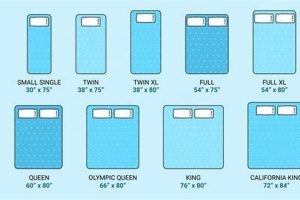
A standard sleeping surface for a convertible couch, often referred to as a “double,” typically measures approximately 54 inches wide and 75 inches long. These measurements are consistent across various manufacturers, providing a standardized fit for frames designed to accommodate this particular size. This facilitates ease of replacement and ensures compatibility between different futon frames and mattresses.
The size offers a practical solution for accommodating two adults or providing a spacious single sleeping area. Its compact nature is particularly advantageous in smaller living spaces where maximizing functionality is paramount. Historically, futons offered an affordable and versatile furniture option, and the adoption of standardized measurements streamlined their production and distribution.
The subsequent sections will delve into the specific materials used in construction, considerations for choosing the appropriate thickness and firmness level, and factors influencing overall durability and longevity of these sleeping surfaces.
The following guidance offers insight into optimizing the selection and utilization of a standard full futon mattress.
Tip 1: Accurate Measurement is Essential. Before purchasing, meticulously measure the interior dimensions of the futon frame. Variations, even slight ones, can lead to ill-fitting mattresses, compromising comfort and functionality. Refer to the frame manufacturer’s specifications.
Tip 2: Consider Room Size. Account for the expanded footprint when the futon is converted into a bed. Ensure sufficient clearance for comfortable movement around the extended futon. The bed will extend the initial sofa footprint.
Tip 3: Thickness Impacts Comfort and Support. Thicker mattresses generally provide greater support and conform to the body more effectively. However, excessive thickness may hinder the futon’s ability to fold smoothly into its seating configuration. Balance must be considered.
Tip 4: Evaluate Material Composition. Inquire about the internal composition of the mattress. Cotton, foam, and innerspring constructions exhibit varying degrees of firmness, breathability, and longevity. Choosing the construction materials can either elevate the comfort and durability or have the opposite effect.
Tip 5: Weight Capacity Matters. Adhere to the manufacturers stated weight limit. Exceeding this limit may result in premature wear, structural damage to the frame, and a reduction in the mattress’s lifespan. Adhering to manufacturer’s guidance prevents both short term and long term consequences.
Tip 6: Rotate Regularly. Periodic rotation of the mattress can help to distribute wear evenly, preventing premature sagging or compression in localized areas. Regular rotation enhances even compression over time.
These tips will contribute to informed decision-making, enhancing the overall utility, comfort, and lifespan of the specified mattress size.
The succeeding sections will offer information about cleaning and maintenance protocols for futon mattresses.
1. Width

The designation of “54 inches” for the width is intrinsic to the definition of a “double” or “full futon mattress dimensions.” This measurement dictates the mattress’s capacity to comfortably accommodate two adults, influencing its selection for shared sleeping arrangements or providing ample space for a single occupant. Deviations from this standard width compromise compatibility with frames designed to accommodate it and alter the overall utility of the furniture piece. For example, if a futon frame is specifically engineered for a 54-inch-wide mattress, employing a narrower or wider mattress would result in an improper fit, potentially leading to instability or impaired functionality of the folding mechanism.
The fixed dimension directly impacts spatial planning within a living area. When unfolded, the 54-inch width becomes a critical factor in determining the clearance required around the futon. Retailers often specify this dimension when marketing the product. A user purchasing a mattress without verifying compatibility may face difficulties assembling the futon or find it encroaching excessively into the room’s usable space. Conversely, understanding the measurement ensures the mattress integrates seamlessly into the intended environment. This width enables a middle ground, larger than a twin but more space-conscious than a queen.
In conclusion, the 54-inch width is not merely an arbitrary number; it represents a fundamental element of standardization and functional design for full futon mattress dimensions. Disregard for this specification presents practical challenges related to frame compatibility, spatial utilization, and overall user satisfaction. Its proper consideration is paramount for making informed purchasing decisions and ensuring seamless integration into a given living space. Future standards may lead to further dimension refinement.
2. Length

The length of 75 inches is a definitive dimension that, in conjunction with the width, establishes the overall sleeping surface area of a standard full futon mattress. This measurement is not arbitrary; it contributes directly to the usability and comfort of the product.
- Occupant Accommodation
The 75-inch length accommodates individuals of average height. It is essential for ensuring that occupants can fully extend their bodies without discomfort. Inadequate length would render the futon unsuitable for many adults, limiting its utility. Conversely, excessive length would be superfluous and potentially wasteful of materials. Understanding that this figure adheres to the physical requirements of its target demographic allows manufacturers to tailor the product to consumer needs.
- Frame Design and Compatibility
Futon frames are designed with the 75-inch length as a critical parameter. Adherence to this standard allows manufacturers to produce mattresses that integrate seamlessly with widely available frame designs. Deviation from this measurement necessitates custom frames, increasing costs and limiting consumer choice. Therefore, compatibility facilitates both production and accessibility.
- Space Optimization
The specified length contributes to the futon’s role as a space-saving furniture solution. A 75-inch mattress balances the need for a comfortable sleeping surface with the constraints of typical living spaces. Its relatively compact footprint, when compared to larger mattress sizes, makes it a practical choice for apartments, guest rooms, or multi-functional areas. This measurement allows a practical trade-off of space and comfort.
- Material Utilization and Cost Efficiency
The length impacts the amount of material required in production, directly affecting manufacturing costs. By adhering to a standard length, manufacturers can optimize material usage and streamline production processes. Deviations can lead to increased waste and higher retail prices. This optimized usage benefits the consumer in the form of value and allows for a more affordable product offering.
The 75-inch length, therefore, represents a critical dimension within the broader context of full futon mattress dimensions. It informs design, influences compatibility, affects space utilization, and impacts manufacturing efficiency. The specification represents an equilibrium point derived from functional considerations and practical limitations.
3. Thickness variations

Thickness variations within the specified full futon mattress dimensions exert a significant influence on comfort, support, and functionality. This characteristic dimension, measured perpendicularly from the top sleeping surface to the bottom, directly correlates with the density and composition of the internal materials, and affects the overall user experience. A thinner mattress, for example, may compromise support, particularly for individuals with higher body weights or those seeking orthopedically sound sleeping surfaces, resulting in a less restful experience. Conversely, an excessively thick mattress may impede the futon frame’s ability to fold efficiently between its seating and sleeping configurations, hindering its intended convertible function.
The choice of mattress thickness also has direct implications for the futon’s longevity and suitability for specific applications. Mattresses with greater thickness, often incorporating multiple layers of foam, cotton, or innerspring coils, tend to exhibit superior resistance to compression and sagging over time. This durability makes them a better choice for high-use scenarios, such as in guest rooms or living areas where the futon is frequently employed as both a sofa and a bed. Lower-thickness models, while generally more budget-friendly, may be more susceptible to wear and tear, rendering them less appropriate for heavy or prolonged use. Additionally, the thickness plays a role in heat retention; thicker mattresses may retain more body heat, which is a consideration for users in warmer climates or those prone to night sweats.
In summary, thickness variations within full futon mattress dimensions are not merely aesthetic considerations but are integral determinants of comfort, support, durability, and functional compatibility with the intended futon frame. Understanding the implications of differing thicknesses allows consumers to make informed decisions aligned with their individual needs and usage patterns, optimizing the overall value and satisfaction derived from the furniture purchase. Ultimately, thickness must be balanced against other factors for optimal function.
4. Frame compatibility

Frame compatibility, in the context of a futon, is inextricably linked to its standard measurements. A futon’s design inherently presupposes that its support structure conforms precisely to the established width and length of the mattress intended for use. The dimensions of the mattress are therefore causative factors in determining whether a given frame will properly accommodate it. A deviation from the standardized 54-inch width and 75-inch length inevitably results in either an insecure fit, where the mattress is too small and shifts during use, or an inability to install the mattress altogether, rendering the futon unusable in its intended configuration. It could also cause damage to both the mattress and frame.
Consider a practical example: If a futon frame designed for a standard “double” is paired with a mattress that is either shorter or narrower by even a few inches, the lack of full support can lead to premature sagging and uneven wear. Similarly, if an attempt is made to force a larger mattress onto a smaller frame, the stress placed on the frame’s joints and folding mechanism can result in structural failure. Several futon frame manufacturers explicitly state that warranty claims are voided if the futon is used with a non-standard mattress. This underlines the financial significance of adhering to compatibility specifications. Moreover, using components that do not align with the intended specifications of the overall design introduces an element of risk, compromising both the functionality and longevity of the futon.
In conclusion, frame compatibility is not merely a desirable feature but a fundamental requirement for the proper operation and longevity of a futon system. Understanding the dimensional relationship between the mattress and frame is critical for avoiding potential damage, ensuring user comfort, and realizing the full intended lifespan of the product. Lack of proper compatibility can make the purchase useless and lead to additional, avoidable costs.
5. Folded footprint

The “folded footprint” of a futon is directly determined by its “full futon mattress dimensions,” representing the floor space occupied when the unit is configured as a sofa. The mattress’s width, length, and, critically, its thickness dictate the depth and width of the folded structure. A thicker mattress will, by necessity, result in a larger folded footprint than a thinner one with identical width and length. This is a direct causal relationship; the physical characteristics of the mattress directly determine the amount of floor space the futon requires when not in use as a bed. Careful consideration of this parameter is crucial for optimizing space utilization, particularly in smaller living environments. For example, a studio apartment dweller selecting a futon with a particularly thick mattress may find the folded footprint excessively intrusive, impeding movement or restricting furniture placement.
The importance of the “folded footprint” stems from the inherent multi-functionality of the futon design. Its utility hinges on its ability to transition seamlessly between a seating arrangement and a sleeping surface. A disproportionately large folded footprint negates the space-saving benefits typically associated with futons, undermining their value proposition. Consider the common scenario of a guest room that doubles as a home office. If the futon consumes a significant portion of the available floor space when folded, it restricts the functionality of the room as a workspace. Conversely, a smaller folded footprint allows for greater flexibility in arranging other furniture and maintaining an open, uncluttered environment. Effective space planning necessitates a clear understanding of how the mattress’s dimensions contribute to the overall footprint of the unit in its folded state.
In conclusion, the “folded footprint” is an essential component directly linked to its dimensions, impacting practical space utilization. A comprehensive understanding of this relationship facilitates informed purchasing decisions, enabling consumers to select a futon that aligns with their spatial constraints and functional requirements. Ignoring the impact of mattress dimensions on the “folded footprint” can lead to dissatisfaction and compromise the intended benefits of the futon design. Proper consideration ensures efficient use of available space and optimizes the overall usability of the furniture piece.
Frequently Asked Questions Regarding Full Futon Mattress Dimensions
The following section addresses common inquiries regarding the defining measurements and related considerations for standard “double” futon mattresses.
Question 1: What are the precise dimensions of a standard “double” futon mattress?
A standard “double” futon mattress measures approximately 54 inches in width and 75 inches in length. Thickness varies.
Question 2: Why is adherence to these dimensions critical when purchasing a futon mattress?
Adherence to the specified dimensions ensures proper frame compatibility, prevents premature wear, and maintains the intended functionality of the futon.
Question 3: How do thickness variations impact the performance of a full futon mattress?
Thickness influences comfort, support, and the ease with which the futon frame can be converted between its seating and sleeping configurations.
Question 4: Does the “folded footprint” differ based on varying mattress thicknesses?
Yes, thicker mattresses generally result in a larger “folded footprint,” requiring greater floor space when the futon is configured as a sofa.
Question 5: Can non-standard mattresses be used with frames designed for standard measurements?
The use of non-standard mattresses is strongly discouraged. Doing so can compromise structural integrity and void manufacturer warranties.
Question 6: How should one account for the full futon mattress dimensions when planning a living space?
Careful consideration must be given to the dimensions when folded as a sofa, and when extended to bed configuration to ensure adequate clearance and usability.
Proper understanding of these measurements and their implications contributes to informed decision-making and optimizes the user experience.
The subsequent section will explore materials, maintenance, and lifespan expectations.
Concluding Remarks on Full Futon Mattress Dimensions
The preceding discussion has underscored the critical importance of standard measurements in the selection and utilization of “double” futon mattresses. The established 54-inch width and 75-inch length are not arbitrary figures but fundamental parameters that govern frame compatibility, occupant comfort, and spatial efficiency. Variations in thickness, while offering customized levels of support, directly impact the folded footprint and overall suitability for diverse living environments. A comprehensive understanding of these interdependencies is essential for making informed purchasing decisions and optimizing the functionality of this versatile furniture piece.
As space constraints continue to influence furniture design and consumer preferences, the standardized dimensions of the full futon mattress retain their significance. Adherence to these established measurements ensures both longevity and usability, while fostering innovation in materials and construction techniques. Further research and development may yield enhanced comfort and durability; however, maintaining a commitment to standardized dimensions remains paramount for ensuring seamless integration and continued user satisfaction. Therefore, diligent consideration of these principles is crucial for both consumers and manufacturers seeking to maximize the value and versatility of the full futon.