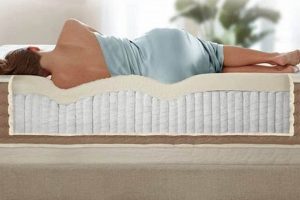
The optimal sleep surface for shared sleep arrangements is a crucial element in ensuring both parental comfort and infant safety. This type of bedding is designed to mitigate risks associated with suffocation, overheating, and entrapment, while also providing adequate support for adults. A key characteristic is firmness, which is essential for reducing the likelihood of the infant sinking into the mattress. For example, a high-density foam or innerspring mattress that meets safety standards would be considered a suitable option.
Selecting a bedding solution that prioritizes safety and support fosters a secure environment conducive to infant well-being. Historically, co-sleeping practices have varied across cultures, but modern recommendations emphasize adherence to guidelines that minimize potential hazards. Benefits can include easier nighttime feeding and increased parental responsiveness; however, these advantages must be carefully weighed against the potential risks associated with an inappropriate sleep surface.
The following discussion will delve into the specific features to consider when choosing a sleep surface for shared sleeping, including material composition, firmness levels, size considerations, and recommendations from pediatric sleep experts. It will further explore regulatory standards and certifications relevant to infant sleep safety. Understanding these factors is paramount in making an informed decision.
The selection of a suitable sleep surface is crucial for ensuring safety and comfort when practicing shared sleeping. Prioritize adherence to established safety guidelines and recommendations.
Tip 1: Firmness is Paramount: Choose a high-density mattress that provides firm support. This minimizes the risk of infant sinking or entrapment, a significant safety concern.
Tip 2: Flat and Even Surface: Ensure the sleep surface is entirely flat and free of any gaps or indentations. Uneven surfaces increase the risk of positional asphyxia.
Tip 3: Avoid Soft Bedding: Refrain from using excessively soft bedding, such as thick mattress toppers or plush pillows. These can pose a suffocation hazard.
Tip 4: Mattress Size Matters: Opt for a larger mattress size, such as a king or California king. This provides ample space for both parents and the infant, reducing the likelihood of accidental rolling.
Tip 5: Consider Edge Support: Select a mattress with reinforced edges to prevent sagging and provide stable support along the perimeter. This minimizes the risk of the infant rolling off the bed.
Tip 6: Hypoallergenic Materials: Choose hypoallergenic materials that are resistant to dust mites and allergens. This helps maintain a healthy sleep environment for the infant.
Tip 7: Temperature Regulation: Select breathable mattress materials that promote airflow and regulate temperature. Overheating is a risk factor for Sudden Infant Death Syndrome (SIDS).
The consistent application of these guidelines ensures a safer sleep environment for infants while also addressing parental comfort and support requirements. Diligent attention to these details contributes significantly to risk mitigation.
The following sections will discuss potential product recommendations based on these criteria and available research. It is important to consult with a pediatrician or qualified healthcare professional before making any decisions regarding infant sleep arrangements.
1. Firmness

Firmness is a critical characteristic of a sleep surface intended for co-sleeping arrangements. The relationship between firmness and infant safety is one of direct cause and effect; insufficient firmness can increase the risk of Sudden Infant Death Syndrome (SIDS) and other sleep-related hazards. A yielding surface allows an infant to sink, potentially obstructing airways and impairing the ability to regulate body temperature effectively. A sufficiently firm mattress, conversely, provides a stable and supportive platform that mitigates these risks.
As a component of an appropriate sleep surface, firmness addresses specific physiological vulnerabilities in infants. Unlike adults, infants lack the motor skills to reposition themselves if their breathing is compromised. For example, a baby placed on a soft mattress may roll onto their stomach and be unable to lift their head, leading to suffocation. The practical significance of understanding this connection lies in its direct impact on preventing such tragic outcomes. Studies consistently demonstrate a correlation between firmer sleep surfaces and reduced SIDS incidence.
In conclusion, firmness in a co-sleeping mattress is not merely a comfort preference, but a fundamental safety requirement. Ensuring the sleep surface meets or exceeds recommended firmness standards is paramount for reducing the risk of infant suffocation and promoting a safe sleep environment. While challenges may exist in balancing parental comfort with the need for a firm surface, prioritizing infant safety remains the overarching concern and the foundational principle guiding sleep surface selection.
2. Surface Flatness

Maintaining a consistently flat surface on a shared sleep mattress is non-negotiable for ensuring infant safety. Any deviations from a level plane introduce potential hazards that can compromise an infant’s well-being. The integrity of the sleep surface is directly correlated with reduced risks of positional asphyxia and entrapment.
- Minimizing Positional Asphyxia
A flat surface mitigates the risk of an infant’s head tilting forward, which can obstruct airways and lead to positional asphyxia. For example, an infant placed on a surface with a slight incline may experience compromised breathing due to the unsupported position of the head and neck. Maintaining a level plane ensures proper spinal alignment and unencumbered respiration.
- Reducing Entrapment Hazards
Inconsistencies in the mattress surface, such as dips or gaps, can create entrapment hazards for infants. Should an infant roll into such a depression, they may lack the strength or coordination to reposition themselves, leading to suffocation. A consistently flat surface eliminates these potential entrapment zones, promoting a safer sleep environment.
- Ensuring Consistent Support
A flat mattress provides uniform support across the entire surface area. This is particularly important when co-sleeping, as parental movement during sleep can cause shifts in weight distribution. A consistent level of support prevents localized sinking, which could create an uneven sleep plane and increase the risk of infant positional compromise.
- Material Degradation and Surface Integrity
Over time, even high-quality mattresses can develop indentations or sagging. Regular inspection of the sleep surface is crucial to identify and address any deviations from flatness. For example, consistent use in the same sleeping position can create localized depressions. Mattress rotation and the use of supportive mattress protectors can help maintain surface integrity.
The aforementioned facets illustrate the interconnectedness of surface flatness and infant safety in shared sleep environments. While achieving and maintaining a perfectly flat surface may present practical challenges, consistent effort and vigilance in monitoring the sleep surface are essential steps in mitigating potential hazards and promoting a safer co-sleeping arrangement.
3. Edge Support

Edge support is a critical, often overlooked, component of a sleep surface designed for shared sleep environments. Its function extends beyond mere aesthetic consideration, serving a vital role in preventing roll-off incidents, a significant concern when an infant shares a bed with adults. The absence of adequate edge support can lead to a compromised sleep surface, increasing the likelihood of accidental falls, and undermining the safety of the co-sleeping arrangement. Strong edge support provides a stable perimeter, effectively creating a defined boundary that minimizes the risk of infants or adults inadvertently rolling off the mattress during sleep. As a component of the best mattress for co sleeping it helps keep the baby safely within the boundaries.
The efficacy of edge support directly impacts the usable sleep area. Mattresses with weak edges often compress under pressure, reducing the available surface and making it more challenging for adults to maintain a safe distance from the infant. For example, consider a scenario where a parent shifts closer to the edge during sleep; without proper reinforcement, the edge may give way, potentially causing the adult to roll off and posing a risk to the infant nearby. Furthermore, robust edge support facilitates safer transfers in and out of bed, particularly for postpartum parents who may experience physical limitations. This adds extra safety to the best mattress for co sleeping.
In summary, edge support should be a primary consideration when selecting a co-sleeping mattress. Its contribution to preventing roll-off incidents, maximizing usable sleep space, and facilitating safer transfers makes it an indispensable element. While challenges may arise in assessing edge support solely through online product descriptions, seeking mattresses with reinforced edges and reading user reviews that specifically address this feature can help ensure a safer and more secure shared sleep environment. The practical effect of a mattress with good edge support helps provide a comfortable and safe surface.
4. Material Safety

The selection of materials in a sleep surface for shared sleeping environments carries significant implications for infant health and well-being. Material safety constitutes a foundational element in the determination of an appropriate sleep surface for co-sleeping, directly impacting the risks associated with chemical exposure, allergen sensitization, and thermal regulation. For example, mattresses constructed with volatile organic compounds (VOCs) can emit gases that may contribute to respiratory irritation or other adverse health effects in vulnerable infants. Therefore, careful material selection is paramount.
Consider the instance of a mattress labeled as “organic” but lacking verifiable certifications. Such a product might contain undisclosed synthetic chemicals or allergenic components, undermining the intended safety benefits. Conversely, a mattress certified by independent organizations, such as OEKO-TEX or GREENGUARD, undergoes rigorous testing to ensure compliance with stringent emissions standards and the absence of harmful substances. This provides a measurable level of assurance regarding material safety. Moreover, the breathability of mattress materials influences temperature regulation, a critical factor in reducing the risk of Sudden Infant Death Syndrome (SIDS). Materials like organic cotton or natural latex promote airflow, preventing overheating.
In conclusion, material safety is not a superficial attribute, but an essential prerequisite for a co-sleeping mattress. The practical significance of understanding this connection lies in the ability to make informed purchasing decisions based on verifiable certifications and transparency in manufacturing processes. While complete elimination of all potential risks may be unachievable, prioritizing mattresses constructed with non-toxic, hypoallergenic, and breathable materials constitutes a proactive measure in promoting a safer sleep environment for infants, and contributes toward achieving the goals of a safe co-sleeping arrangement. The best mattress for co sleeping prioritizes the baby’s safety, it’s not just a comfort product.
5. Temperature Regulation

Temperature regulation is a crucial consideration in the selection of a sleep surface for co-sleeping arrangements. Infants are particularly susceptible to overheating, which is a known risk factor for Sudden Infant Death Syndrome (SIDS). Therefore, the mattress must facilitate effective heat dissipation and maintain a comfortable sleep temperature.
- Breathability of Materials
The breathability of mattress materials directly influences temperature regulation. Materials such as organic cotton, natural latex, and wool allow for enhanced airflow compared to synthetic alternatives like memory foam. This airflow wicks away moisture and dissipates heat, preventing the infant from becoming overheated. For example, a mattress with a tightly woven synthetic cover may trap heat, while one with a loose-knit cotton cover promotes better ventilation.
- Moisture Management
Effective moisture management is intertwined with temperature control. Mattresses that effectively wick away moisture from the infant’s body help maintain a stable temperature. Accumulation of moisture can lead to discomfort and potentially lower body temperature excessively, creating a different set of risks. Materials with moisture-wicking properties, such as wool or bamboo, are advantageous in this regard. The ideal mattress will minimize both overheating and excessive cooling.
- Mattress Construction and Airflow Channels
The internal construction of the mattress can also impact temperature regulation. Some mattresses incorporate airflow channels or open-cell foam structures to enhance ventilation. These design features facilitate the movement of air throughout the mattress core, further aiding in heat dissipation. For instance, a mattress with a solid foam core may retain more heat compared to one with strategically placed ventilation channels. Mattress firmness should be prioritized.
- External Factors and Bedding Choices
External factors, such as room temperature and bedding choices, also play a role in temperature regulation. Overdressing an infant or using heavy blankets can negate the benefits of a breathable mattress. Maintaining a comfortable room temperature (typically between 68 and 72 degrees Fahrenheit) and using lightweight, breathable sleepwear are essential components of a safe sleep environment. In this way external factors help contribute to using the best mattress for co sleeping with the proper temperature.
In summary, temperature regulation is an integral aspect of selecting a sleep surface for shared sleep arrangements. The breathability of materials, effective moisture management, mattress construction, and external factors all contribute to maintaining a safe and comfortable sleep temperature for the infant. When selecting the optimal bedding solution, prioritize mattresses that promote airflow and prevent overheating to minimize the risk of SIDS. A focus on these temperature regulation characteristics enhances the likelihood of using the best mattress for co-sleeping.
6. Size Adequacy

Size adequacy in a sleep surface directly influences the safety and comfort of co-sleeping arrangements. The dimensions of the mattress must accommodate all occupants without compromising individual space or increasing the risk of accidental injury to the infant. Inadequate size can lead to compromised sleep quality for adults and potentially hazardous proximity between the infant and parental body weight.
- Minimizing Roll-Over Risk
A sufficient mattress size reduces the likelihood of parents inadvertently rolling onto the infant during sleep. A larger surface area provides ample space for each occupant, establishing a safer boundary between adult body mass and the infant’s sleep zone. For example, a full-size mattress may be inadequate for two adults and an infant, whereas a king-size mattress offers a greater buffer zone.
- Maintaining Sleep Quality for Adults
Adequate space contributes to improved sleep quality for adults sharing the bed. Restricted movement and proximity to the infant can cause disrupted sleep patterns. A larger mattress allows for greater freedom of movement, minimizing disturbances and promoting restful sleep for parents. Compromised parental sleep can lead to fatigue, which may inadvertently increase the risk of unsafe sleep practices.
- Accommodating Growth and Development
Consideration of future growth is pertinent. An infant may quickly outgrow a smaller co-sleeping arrangement, necessitating a change in sleeping arrangements sooner than anticipated. Planning for a larger mattress initially can provide a longer-term solution, accommodating the infant’s developmental needs and reducing the frequency of sleep surface transitions.
- Facilitating Safe Sleep Practices
A larger mattress facilitates adherence to safe sleep guidelines. The ability to maintain a clear and defined space for the infant, free from pillows, blankets, and other potential hazards, is enhanced with greater surface area. Adequate size promotes the creation of a safe zone, distinct from the adult sleeping area. All these aspects must be considered to help make sure you have the best mattress for co sleeping.
The facets presented illustrate the inherent connection between mattress size and the safety and efficacy of co-sleeping. When selecting a sleep surface, prioritizing adequate dimensions is paramount in promoting both infant well-being and parental rest. While individual needs and preferences may vary, the overarching objective remains the creation of a safe and comfortable shared sleep environment through appropriate mattress size selection.
The following questions address common concerns and misconceptions pertaining to the selection and utilization of sleep surfaces designed for shared sleep arrangements.
Question 1: What firmness level is recommended for a mattress used in co-sleeping?
A high-density, firm mattress is recommended. Softer mattresses pose a suffocation risk due to potential infant sinking. A firm surface ensures support and reduces the risk of airway obstruction.
Question 2: Are there specific certifications to look for when purchasing a co-sleeping mattress?
Certifications such as OEKO-TEX Standard 100 and GREENGUARD Gold indicate that the mattress has been tested for harmful substances and VOC emissions. These certifications provide an added layer of assurance regarding material safety.
Question 3: What mattress size is most suitable for co-sleeping with an infant?
A king-size or California king-size mattress is generally recommended. These larger sizes provide ample space for both parents and the infant, minimizing the risk of accidental roll-over and promoting more comfortable sleep.
Question 4: How often should a co-sleeping mattress be inspected for wear and tear?
The mattress should be inspected regularly, at least monthly, for any signs of sagging, indentations, or compromised edge support. Degradation of the sleep surface can increase the risk of infant entrapment or positional asphyxia.
Question 5: What type of mattress material is best for temperature regulation in co-sleeping scenarios?
Materials such as organic cotton, natural latex, and wool are known for their breathability and moisture-wicking properties. These materials help regulate temperature and reduce the risk of infant overheating.
Question 6: Are mattress toppers recommended for co-sleeping mattresses?
Mattress toppers, particularly those made of soft materials like memory foam, are generally discouraged. They can compromise the firmness of the sleep surface and pose a suffocation risk. If a topper is deemed necessary, it should be thin, firm, and made of breathable material.
Selecting a safe and appropriate mattress for shared sleep arrangements requires careful consideration of firmness, material composition, size, and certifications. Prioritizing infant safety is paramount.
The subsequent section will address cleaning and maintenance practices to ensure the continued safety and longevity of a co-sleeping mattress.
The Imperative of Informed Selection
This exploration has underscored the critical factors that define the “best mattress for co sleeping.” Firmness, surface flatness, edge support, material safety, temperature regulation, and size adequacy have been examined as essential components of a safe sleep environment. The absence of any of these attributes elevates the risk of infant suffocation, overheating, or accidental injury. Therefore, a comprehensive understanding of these elements is indispensable for making informed purchasing decisions.
The selection of a sleep surface for shared sleep arrangements is not merely a matter of comfort, but a decision with profound implications for infant well-being. Continued vigilance, adherence to safety guidelines, and consultation with healthcare professionals are paramount in mitigating potential risks. The commitment to providing a safe sleep environment reflects a dedication to protecting the most vulnerable members of society and warrants unwavering attention and responsibility.