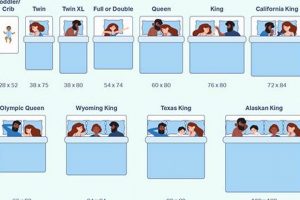
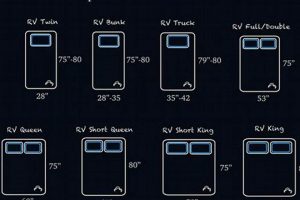
Dimensions of a sleeping surface are standardized categories defining length and width. These categories, expressed in linear units such as inches or centimeters, dictate the physical space a mattress occupies. As an illustration, a “queen” typically measures 60 inches wide and 80 inches long.
These dimensional classifications are vital for ensuring compatibility with bed frames, bedding, and bedroom size. Understanding these spatial parameters allows for informed purchasing decisions, preventing issues with fit and optimizing room layout. Historically, the evolution of these standards reflects societal changes in living spaces and sleeping preferences, demonstrating a move towards larger sleeping surfaces over time.
The subsequent discussion will delve into the specifics of each common standard, detailing their respective spatial properties and outlining their suitability for various individuals and living situations. An examination of less common, specialized options will also be presented.
Guidance on Dimensional Mattress Categories
The following recommendations aim to assist in selecting a sleep surface based on its dimensions, optimizing comfort and spatial considerations.
Tip 1: Assess bedroom dimensions prior to purchase. Accurately measure the available floor space to ensure the selected size comfortably fits without obstructing movement.
Tip 2: Consider the number of occupants. Individuals sharing a bed should prioritize larger dimensions, such as a queen or king, to minimize sleep disturbance.
Tip 3: Evaluate individual height. Taller individuals require longer surfaces, often necessitating a twin XL or king size to prevent feet from hanging off the edge.
Tip 4: Account for sleeping style. Those who tend to move frequently during sleep benefit from wider options, such as a queen or king, to avoid rolling off the edge.
Tip 5: Factor in budget constraints. Smaller sizes generally have a lower cost, but prioritizing comfort and long-term sleep quality may justify a larger investment.
Tip 6: Research specific brands and models. Measurements can vary slightly between manufacturers, so confirm precise dimensions before finalizing a purchase.
Tip 7: Anticipate future needs. Consider potential changes in living arrangements or lifestyle when selecting a size, opting for a versatile option that accommodates future adjustments.
Careful consideration of these dimensional factors facilitates a more informed decision, leading to a sleep surface that optimally supports individual needs and spatial limitations.
The subsequent section will conclude the discussion, summarizing the essential considerations for selecting a sleeping surface according to its dimensions.
1. Length

Dimensional length is a foundational characteristic when categorizing sleeping surfaces. It directly impacts the suitability of a mattress for individuals of varying statures, playing a key role in overall sleep comfort and support.
- Suitability for Height
Length is the primary determinant of whether a sleeping surface can comfortably accommodate an individual’s height. Insufficient length results in discomfort and potential sleep disruption as the sleeper’s feet may hang off the edge. For example, a standard twin mattress, typically 75 inches long, may be inadequate for individuals exceeding six feet in height.
- Bed Frame Compatibility
Accurate length dimensions are essential for ensuring compatibility with bed frames. Standardized lengths allow for consistent fitment within designated frame sizes. Discrepancies between mattress and frame length can lead to instability and premature wear.
- Impact on Bedroom Space
Length contributes significantly to the overall footprint of the sleep setup within a bedroom. Longer mattresses consume more floor space, impacting room layout and maneuverability. Consideration of available space is crucial when selecting a mattress length.
- Influence on Sleeping Posture
Adequate length provides room for natural spinal alignment during sleep. A mattress that is too short can force the sleeper into a curled or contorted position, potentially leading to muscle strain and discomfort.
The interplay of these elements underscores the critical role of length in defining the utility and ergonomic value within dimensional standards. Selecting a mattress that offers sufficient length is a primary consideration in optimizing sleep quality and overall well-being.
2. Width

The width dimension is an essential component of dimensional sleeping surface standards, directly impacting the comfort and usability, especially for multiple occupants or individuals with specific sleep habits. Variations in width significantly influence the degree of personal space afforded to each sleeper, affecting sleep quality and overall satisfaction. For instance, a full-size, while adequate for a single sleeper, may prove restrictive for two adults, potentially causing sleep disturbances due to limited space. Conversely, a king-size offers substantial width, providing ample room for couples or individuals who prefer a wider sleeping area.
Furthermore, width must be considered in conjunction with other dimensions to determine overall suitability. A narrow width, even with sufficient length, may restrict movement during sleep. Additionally, the choice of bed linens, such as sheets and blankets, is directly dependent on the mattress width. Standard sheet sets are designed for specific width dimensions; therefore, an incorrect measurement can lead to poor fit and reduced comfort. In smaller bedrooms, the impact of width on available floor space is considerable. A wider option may necessitate careful planning of furniture placement to maintain adequate maneuverability within the room.
Therefore, understanding the effect of mattress width on comfort, compatibility with bedding, and efficient use of space is critical for informed purchasing decisions. The width dimensions should align with the needs of the sleeper(s), the size of the room, and the compatibility of bedding accessories. This considered approach ensures a sleep surface that supports both comfort and functionality.
3. Thickness

Thickness, as it relates to dimensional sleeping surfaces, represents the vertical measurement from the top to the bottom surface. This dimension significantly influences overall height and perceived comfort. As a component of dimensional standards, thickness affects the support and feel provided by the mattress. For example, a thin mattress, typically less than eight inches, may lack adequate support for heavier individuals, potentially leading to discomfort and spinal misalignment. Conversely, an excessively thick mattress can present challenges with bed frame compatibility and accessibility, particularly for individuals with mobility limitations.
The thickness also impacts the type of bedding that can be used. Deep-pocket sheets are often required for mattresses with substantial thickness, adding to the overall cost and potentially limiting selection. Moreover, the perceived accessibility of the sleeping surface is altered by its thickness. A higher sleeping surface may be difficult for shorter individuals or those with physical disabilities to mount and dismount comfortably. Understanding the interaction of thickness with other size parameters is crucial for ensuring a proper fit with bed frames and bedding, thereby optimizing comfort and safety.
In summary, thickness is an integral aspect of dimensional sleeping surface characteristics, with direct implications for support, comfort, bedding compatibility, and accessibility. Choosing an appropriate thickness involves carefully considering individual needs, bed frame specifications, and potential limitations posed by the height of the sleeping surface. Proper assessment facilitates optimal sleep quality and user satisfaction.
4. Perimeter

The perimeter of a sleeping surface, derived from the sum of all its sides, correlates directly with “mattress size measurements.” As a fundamental geometric property, perimeter influences practical aspects such as determining the necessary length of bed skirts or decorative trim. For example, a king-size mattress, possessing larger length and width dimensions than a twin, inherently exhibits a significantly greater perimeter. Consequently, selecting bed skirts, or similar decorative items, necessitates an understanding of the perimeter to ensure proper fit and aesthetic integration with the bed frame and bedroom dcor.
Furthermore, the perimeter, when considered alongside the height of the mattress, can be used to estimate the amount of material required for fully encasing the mattress, such as for dust mite protection or allergen control. A larger perimeter invariably translates to a greater material requirement. Failure to account for the perimeter can result in inadequate coverage, diminishing the effectiveness of the encasement. In commercial settings, such as hotels or hospitals, precise perimeter calculations are essential for efficient inventory management of protective mattress covers, optimizing supply chain logistics, and minimizing waste.
In summary, perimeter functions as a key derived metric directly linked to the foundational dimensions. While not a primary descriptor of a mattress’s utility for sleep, its understanding facilitates practical considerations related to aesthetic enhancements, protective measures, and resource allocation. Accurate assessment of the perimeter ensures the seamless integration of ancillary products and promotes efficient resource management.
5. Surface Area

Surface area, calculated by multiplying length by width, directly reflects the available space on a sleeping surface. As a derived measurement from dimensional properties, surface area strongly correlates with “mattress size measurements”, determining the usable area for rest and influencing comfort levels.
- Occupancy and Comfort
Surface area dictates the comfort level for one or more sleepers. Larger dimensions, resulting in increased surface area, provide greater individual space and reduce disturbances. A full-size mattress, while suitable for a single occupant, may prove restrictive for two adults due to limited surface area.
- Sleeping Style Accommodation
Surface area accommodates diverse sleeping styles. Individuals who move frequently during sleep or prefer to sprawl require a greater surface area to avoid rolling off the edge or disturbing a partner. A king or California king offers ample surface area for such preferences.
- Thermal Regulation
The surface area impacts thermal regulation during sleep. A larger surface area exposes more of the body to the surrounding air, potentially promoting better airflow and reducing overheating. Conversely, a smaller surface area may retain more heat. A smaller perimeter allows smaller body area to cool off during nightime.
- Bedding Material Requirements
Surface area directly dictates the quantity of bedding material needed. Larger dimensions require larger sheets, blankets, and mattress protectors. Accurate surface area measurements are therefore crucial for ensuring proper bedding fit and preventing discomfort due to ill-fitting linens.
These facets illustrate that surface area, intrinsically linked to dimensional properties, governs occupancy comfort, adapts to sleeping style, influences thermal regulation, and dictates bedding requirements. By understanding the relationship between surface area and “mattress size measurements,” consumers can make informed decisions to optimize their sleep environment.
6. Standard Name

A “standard name,” such as “twin,” “queen,” or “king,” functions as a succinct descriptor encapsulating a predetermined set of dimensional properties. This nomenclature serves as a shorthand for indicating length and width parameters, enabling efficient communication and facilitating consistent product categorization within the mattress industry. The standard name acts as a key identifier, allowing consumers and manufacturers to quickly reference a specific configuration without explicitly stating individual measurements. For instance, the designation “full” implies a length of approximately 75 inches and a width of approximately 54 inches. Deviations from these nominal dimensions can lead to confusion and incompatibility with standard bedding and bed frames.
The consistent application of standard names is crucial for ensuring seamless transactions and minimizing errors in the purchase process. Retailers utilize these terms to categorize inventory, while consumers rely on them to select appropriately sized products. The presence of established dimensional standards, denoted by these names, allows for the standardized production of complementary goods, such as sheets, blankets, and bed frames. The absence of such standardization would result in a fragmented market, necessitating bespoke bedding solutions for each mattress, thereby increasing costs and logistical complexity. Example: A “queen” mattress is expected to fit “queen” sized bed frame so that proper placement of the mattress in the frame can ensure better sleeping quality.
In conclusion, the standard name represents more than a mere label; it embodies an industry-wide agreement on dimensional consistency. It is pivotal for streamlining manufacturing processes, facilitating informed consumer choices, and ensuring compatibility across a range of related products. Challenges may arise from slight variations in measurements across manufacturers, but adherence to the core dimensions associated with each standard name remains paramount for maintaining order and efficiency within the mattress market.
Frequently Asked Questions
The following addresses common inquiries regarding dimensional sleeping surface standards, offering clarity on size-related concerns.
Question 1: Why do dimensional standards vary slightly between manufacturers?
Variations arise due to differences in manufacturing processes, material tolerances, and design considerations. While adhering to nominal dimensions is standard practice, minor deviations are permissible within accepted industry ranges.
Question 2: How critical is it to precisely measure the available bedroom space before selecting a mattress?
Accurate measurement is essential for ensuring comfortable fitment and maneuverability within the room. Failure to properly assess available space can result in overcrowding and restricted movement.
Question 3: What is the primary factor driving the choice between a queen and king-size mattress?
Occupancy and personal space requirements are the defining factors. A king offers increased individual space for couples, whereas a queen may suffice for single individuals or couples with limited bedroom space.
Question 4: Why is mattress thickness relevant beyond aesthetic considerations?
Thickness directly impacts support, comfort, and compatibility with bed frames and bedding. It affects accessibility, suitability for different body types, and the type of sheets that can be used.
Question 5: Are there dimensional standards for mattresses intended for children or infants?
Yes, specialized standards exist for crib mattresses and toddler mattresses, designed to ensure safety and proper fitment within corresponding crib or toddler bed frames.
Question 6: How does mattress size influence sleep quality?
Adequate dimensions promote undisturbed sleep by allowing for comfortable positioning, minimizing partner disturbance, and accommodating individual sleeping styles. Insufficient dimensions can lead to restlessness and compromised sleep quality.
In summary, a thorough understanding of dimensional sleeping surface standards is paramount for optimizing comfort, ensuring proper fitment, and maximizing sleep quality. Consideration of individual needs and spatial constraints is crucial for making informed purchasing decisions.
The subsequent section will conclude the exploration of dimensional properties and their significance in mattress selection.
Conclusion
This exploration has underscored the critical role of “mattress size measurements” in ensuring optimal sleep comfort, compatibility, and utility. Precise dimensional properties directly influence factors such as individual space, bed frame fit, bedding compatibility, and overall room layout. Accurate assessments of length, width, thickness, perimeter, and surface area, coupled with an understanding of standard names, are essential for making informed purchasing decisions.
A comprehensive understanding of these measurement standards empowers consumers to prioritize both comfort and practicality in their selection process. Continued adherence to established dimensional guidelines within the mattress industry remains crucial for maintaining product consistency and facilitating seamless transactions. Future innovations in mattress design should continue to respect these core standards to ensure enduring consumer satisfaction and compatibility within existing bedroom infrastructure.
![Best Queen Size Adjustable Mattress [Deals] | Organic & Natural Mattress Buyer’s Guide: Non-Toxic Sleep Solutions](https://mattressworldpa.com/wp-content/uploads/2025/07/th-2362-300x200.jpg "Best Queen Size Adjustable Mattress [Deals] Organic & Natural Mattress Buyer’s Guide: Non-Toxic Sleep Solutions")

![RV Comfort: Custom Size Mattress for RVs [Guide] | Organic & Natural Mattress Buyer’s Guide: Non-Toxic Sleep Solutions](https://mattressworldpa.com/wp-content/uploads/2025/07/th-2359-300x200.jpg "RV Comfort: Custom Size Mattress for RVs [Guide] Organic & Natural Mattress Buyer’s Guide: Non-Toxic Sleep Solutions")