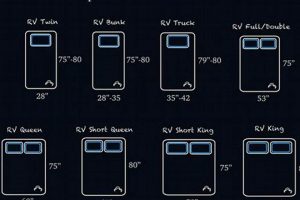
Dimensions of sleeping platforms within commercial motor vehicles are crucial for driver comfort and regulatory compliance. These sleeping areas, typically found in the sleeper berth section of a semi-truck, accommodate mattresses of varying lengths and widths. As an illustration, a common dimension for these mattresses is 36 inches wide by 80 inches long, although variations exist based on truck model and configuration.
Adequate rest is paramount for driver safety and operational efficiency. The selection of a correctly sized sleeping surface contributes significantly to sleep quality, reducing fatigue and enhancing alertness behind the wheel. Historically, the evolution of these in-cab sleeping spaces reflects a growing awareness of the impact of driver well-being on overall transportation safety and productivity. Larger, more comfortable sleeping arrangements have become increasingly common as regulations and driver demands have evolved.
The subsequent sections will delve into specific aspects of choosing appropriate mattress dimensions, materials, and features. Considerations will include comfort preferences, support requirements, and the impact of mattress choice on overall driver health and regulatory adherence, ultimately focusing on maximizing rest within the constraints of the semi-truck environment.
Selecting Optimal Dimensions for Truck Mattresses
The selection of an appropriate mattress for a semi-truck sleeper berth demands careful consideration of several factors. The following guidelines offer insights into maximizing comfort and utility within the limited space available.
Tip 1: Measure the Sleeper Berth Accurately: Prior to purchase, precise measurements of the sleeper berth are essential. Length, width, and any obstructions must be accounted for to ensure a proper fit and avoid unnecessary returns.
Tip 2: Prioritize Comfort Based on Individual Needs: Mattress firmness should align with the driver’s personal preferences and sleeping habits. Consider factors such as body weight and preferred sleeping position when evaluating comfort levels.
Tip 3: Consider Mattress Thickness for Headroom: The thickness of the mattress impacts available headroom within the sleeper berth. Opt for a thickness that allows for comfortable movement and prevents contact with the ceiling.
Tip 4: Evaluate Material Composition for Temperature Regulation: Mattress materials affect temperature regulation and airflow. Options such as memory foam, latex, and innerspring offer varying degrees of breathability. Choose a material that minimizes heat retention and promotes a comfortable sleeping environment.
Tip 5: Assess Edge Support for Stability: Strong edge support prevents mattress sagging and enhances stability, particularly when sitting or lying near the edge of the sleeping surface. Reinforced edges contribute to the overall lifespan and structural integrity of the mattress.
Tip 6: Check for Compatibility with Existing Bed Frames: Ensure that the mattress is compatible with the existing bed frame or support structure within the sleeper berth. Modifications may be necessary to accommodate non-standard mattress dimensions.
Tip 7: Research Warranty and Return Policies: Before finalizing a purchase, carefully review the manufacturer’s warranty and return policies. A comprehensive warranty provides protection against manufacturing defects and premature wear, while a flexible return policy allows for exchanges if the mattress does not meet expectations.
By addressing these considerations, drivers and fleet managers can optimize the sleep environment within semi-trucks. Improved sleep quality translates to enhanced driver alertness, reduced fatigue-related incidents, and increased operational efficiency.
The following section will examine various mattress materials and their suitability for different applications within the trucking industry.
1. Width

The width of a semi-truck mattress directly influences the quality of rest obtained by the driver. Limited width constrains movement during sleep, potentially leading to discomfort and disturbed sleep patterns. Conversely, excessive width, while seemingly advantageous, can present challenges in smaller sleeper berths, hindering movement and access within the cab. The selection of an appropriate width, therefore, balances the need for sufficient personal space with the practical limitations imposed by the vehicle’s design. For instance, a driver with a broader frame may require a mattress with a greater width to ensure adequate support and prevent shoulder compression when sleeping on their side. Inadequate width, on the other hand, can contribute to musculoskeletal strain and fatigue, impacting driver performance and safety.
Several real-world examples illustrate the practical significance of mattress width. Fleet operators, aiming to improve driver retention and reduce fatigue-related incidents, often invest in mattresses with wider dimensions. These investments reflect an understanding that driver comfort directly impacts operational efficiency and safety. Furthermore, many drivers personally upgrade their mattresses, prioritizing width as a key factor in their purchasing decisions. Data from driver surveys consistently reveals that mattress width is a significant determinant of sleep quality and overall job satisfaction. The choice between a 36-inch and 42-inch wide mattress, for example, can significantly alter the driver’s sleep experience, with the wider option providing increased freedom of movement and reducing feelings of confinement.
In summary, the width component of mattress dimensions is crucial in determining the effectiveness of the sleeping surface within a semi-truck. Challenges persist in balancing the desire for increased width with the spatial limitations of the sleeper berth. Nevertheless, understanding the cause-and-effect relationship between mattress width and driver comfort is essential for promoting driver well-being and ensuring safe and efficient transportation operations. Future innovations in sleeper berth design may further optimize the available space, allowing for even wider mattresses without compromising functionality or safety, contributing to a broader industry focus on driver health and performance.
2. Length

The length of a semi-truck mattress is a critical dimension directly impacting the driver’s ability to achieve restful sleep. Insufficient length forces the driver to assume a fetal position or hang their feet off the edge, disrupting spinal alignment and hindering proper rest. Conversely, excessive length within the limited space of a sleeper berth can impede movement and access to essential controls. The cause-and-effect relationship between mattress length and sleep quality is well-documented; appropriate length promotes optimal spinal alignment, reducing pressure points and minimizing sleep disturbances. As a component of overall size, it is an essential parameter for maximizing the functionality of the sleeper area.
Real-life examples demonstrate the practical significance of mattress length. Drivers who are taller than average often experience discomfort with standard-length mattresses, leading to chronic back pain and fatigue. Fleet operators who invest in longer mattresses for their taller drivers report improved driver satisfaction and reduced incidence of musculoskeletal issues. Furthermore, the increasing demand for custom mattress sizes, tailored to individual driver heights, underscores the importance of length as a key consideration. The difference between a 72-inch and an 80-inch mattress, for instance, can significantly affect the sleep experience of a driver who is 6 feet tall, with the longer option providing adequate support for the entire body.
In summary, mattress length is a determining factor in promoting restful sleep within the constraints of a semi-truck sleeper berth. Challenges arise in accommodating varying driver heights within standardized cab designs. However, understanding the impact of mattress length on spinal alignment and overall comfort is essential for optimizing driver well-being and ensuring safe and efficient transportation operations. The move towards custom mattress options and ergonomic sleeper berth designs reflects a growing industry recognition of the importance of tailoring the sleep environment to meet individual driver needs, a trend set to continue as awareness of the connection between sleep and performance increases.
3. Thickness

The thickness of a semi-truck mattress, an integral component of its overall size, plays a significant role in both comfort and practicality within the confined space of a sleeper berth. Mattress thickness affects headroom, support, and temperature regulation. An excessively thick mattress reduces headroom, potentially causing discomfort and limiting movement. Conversely, insufficient thickness may compromise support, leading to pressure points and inadequate spinal alignment. The relationship between mattress thickness and driver well-being is a demonstrable cause-and-effect scenario: optimized thickness contributes to improved sleep quality, reducing fatigue and enhancing alertness during operation.
Real-world examples illustrate the practical significance of this dimension. Fleet managers often consider mattress thickness when retrofitting sleeper berths, balancing comfort with available space. Drivers frequently report that an increase in mattress thickness improves support and reduces back pain, but excessive thickness can impede access to overhead storage or controls. Furthermore, the material composition of the mattress often dictates its optimal thickness; memory foam mattresses, for instance, may require a greater thickness to provide adequate support compared to innerspring models. The choice between an 8-inch and a 12-inch mattress, as an example, often depends on the height of the driver, the configuration of the sleeper berth, and the desired level of support.
In summary, mattress thickness, while seemingly a straightforward dimension, is a crucial consideration in optimizing the sleep environment within a semi-truck. The challenge lies in balancing the desire for increased comfort and support with the practical limitations imposed by the sleeper berth. Understanding the interplay between mattress thickness, material composition, and available space is essential for making informed decisions that promote driver health and safety, contributing to improved operational efficiency and compliance. Future advancements in sleeper berth design may focus on maximizing vertical space, allowing for thicker mattresses without compromising functionality, reflecting a continued emphasis on driver well-being within the transportation industry.
4. Sleeper Berth Fit

The correlation between sleeper berth fit and mattress dimensions is paramount for driver safety and optimal rest within a commercial vehicle. A correctly sized mattress, in terms of length, width, and thickness, ensures secure placement within the sleeper berth, minimizing movement during transit and preventing potential hazards. Mismatched dimensions can lead to mattress shifting, creating uncomfortable sleeping conditions and potentially obstructing access to essential controls or emergency exits. The accurate “Sleeper Berth Fit” is therefore an essential component of achieving the desired “semi truck mattress size” and is directly related to compliance. For example, a mattress that is too wide may not fit properly, causing it to bunch up or become damaged, while one that is too short may slide during braking or turning, endangering the driver. Ensuring proper “Sleeper Berth Fit” prevents these adverse effects.
Practical applications of understanding this connection are evident in fleet management and driver training. Fleet managers who prioritize accurate measurements of sleeper berths and provide drivers with appropriately sized mattresses demonstrate a commitment to safety and driver well-being. Driver training programs should emphasize the importance of verifying mattress fit to prevent potential hazards and maximize comfort. Some manufacturers offer custom-sized mattresses to accommodate specific sleeper berth dimensions, reflecting an awareness of the need for precise fit. The investment in correctly sized mattresses, and attention to “Sleeper Berth Fit,” translates to fewer driver complaints, reduced risk of accidents, and improved operational efficiency. The accurate “Sleeper Berth Fit” is vital to avoid accidents in turns, slopes, and bumps of the roads.
In summary, the connection between sleeper berth fit and mattress size is undeniable, with proper fit serving as a cornerstone of driver safety and comfort. Challenges remain in ensuring consistent adherence to these standards across the industry. However, promoting awareness of the importance of accurate measurements and emphasizing the availability of custom-sized options contribute to a safer and more comfortable environment for commercial vehicle operators. This understanding links to the broader theme of prioritizing driver health and well-being as integral to successful and compliant transportation operations. The relationship demonstrates that a properly fitting mattress contributes significantly to safer operations.
5. Custom Dimensions

The adaptation of semi-truck mattresses to accommodate non-standard sleeper berth configurations necessitates the consideration of “Custom Dimensions.” The prevalence of varying truck models and aftermarket modifications often results in inconsistencies in sleeper berth sizes, rendering standard-sized mattresses unsuitable. Therefore, “Custom Dimensions” become a crucial component of achieving an optimal “semi truck mattress size” that maximizes both comfort and functionality within the available space. For example, a truck owner who has modified the sleeper berth to include additional storage may require a shorter mattress than the standard length. The effectiveness of this “Custom Dimensions” adaptation has a direct cause-and-effect relationship with sleep quality and driver well-being.
Practical applications of this understanding are evident in the increasing availability of custom mattress manufacturers catering specifically to the trucking industry. These manufacturers provide options for adjusting length, width, and thickness to meet specific requirements. Fleet operators seeking to improve driver retention and reduce fatigue-related incidents are increasingly investing in custom mattress solutions. An increasing number of drivers seek “Custom Dimensions” solutions, which are tailored mattresses for those with unusual sleeper dimensions. Additionally, many independent drivers are willing to invest in custom-sized mattresses to address specific comfort preferences or physical needs, resulting in higher performance and greater satisfaction. These instances highlight the real-world significance of tailoring mattress dimensions to individual circumstances.
In summary, the ability to specify “Custom Dimensions” is essential for achieving the appropriate “semi truck mattress size” in the diverse landscape of commercial trucking. The key challenge lies in ensuring accurate measurement and communication of specific requirements to mattress manufacturers. By prioritizing custom solutions, fleet managers and individual drivers can enhance sleep quality, improve driver safety, and promote overall operational efficiency. This links to the broader theme of recognizing the unique needs of truck drivers and providing them with personalized solutions that contribute to their health and well-being, emphasizing the central role of sleep in safe transportation.
Frequently Asked Questions
The following addresses frequently encountered questions regarding the selection and utilization of semi-truck mattresses, focusing on dimensions and their impact on driver comfort and safety.
Question 1: What are the standard semi-truck mattress dimensions?
Typical dimensions range from 36 inches wide by 72-80 inches long. However, variations exist based on truck make, model, and sleeper berth configuration.
Question 2: How does mattress size affect driver comfort and safety?
Inadequate mattress dimensions can lead to discomfort, disrupted sleep, and fatigue, increasing the risk of accidents. Proper size allows for adequate movement and spinal alignment during rest.
Question 3: Are custom-sized mattresses available for semi-trucks?
Yes, several manufacturers offer custom mattress dimensions to accommodate non-standard sleeper berth sizes or specific driver needs.
Question 4: How is sleeper berth size accurately measured for mattress selection?
Precise measurements of length, width, and any obstructions within the sleeper berth are essential prior to mattress purchase to ensure a proper fit.
Question 5: What factors should be considered when choosing mattress thickness?
Mattress thickness affects headroom and support. A balance must be struck to provide adequate cushioning without compromising space for movement within the sleeper berth.
Question 6: How can fleet managers ensure drivers have access to appropriate mattress sizes?
Fleet managers should conduct regular audits of sleeper berth dimensions and provide drivers with access to a range of mattress sizes and custom options.
Selecting the correct mattress size contributes significantly to driver well-being and operational safety. Accurate measurements and consideration of individual needs are crucial for making informed purchasing decisions.
The subsequent sections will address considerations related to mattress materials, support systems, and maintenance best practices.
Conclusion
The exploration of semi truck mattress size has underscored the critical role dimensions play in driver comfort, safety, and regulatory compliance. Proper selection, determined through accurate measurements and consideration of individual needs, directly impacts sleep quality and subsequent operational performance. Factors such as width, length, thickness, and sleeper berth fit cannot be overlooked when selecting a mattress for commercial vehicles.
The ongoing industry focus on driver well-being necessitates continued diligence in providing appropriate sleep environments. As technology and manufacturing capabilities evolve, further advancements in custom mattress solutions and ergonomic sleeper berth designs are anticipated. Prioritizing semi truck mattress size and its impact on driver health represents a fundamental investment in safer and more efficient transportation operations, a commitment that will contribute to overall industry progress and regulatory adherence.
![Best Queen Size Adjustable Mattress [Deals] | Organic & Natural Mattress Buyer’s Guide: Non-Toxic Sleep Solutions](https://mattressworldpa.com/wp-content/uploads/2025/07/th-2362-300x200.jpg "Best Queen Size Adjustable Mattress [Deals] Organic & Natural Mattress Buyer’s Guide: Non-Toxic Sleep Solutions")

![RV Comfort: Custom Size Mattress for RVs [Guide] | Organic & Natural Mattress Buyer’s Guide: Non-Toxic Sleep Solutions](https://mattressworldpa.com/wp-content/uploads/2025/07/th-2359-300x200.jpg "RV Comfort: Custom Size Mattress for RVs [Guide] Organic & Natural Mattress Buyer’s Guide: Non-Toxic Sleep Solutions")