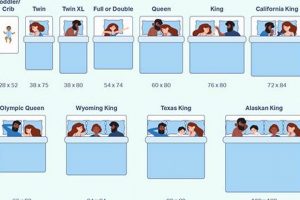
The variations in bed dimensions cater to diverse needs and spatial constraints. For example, a twin bed, typically measuring around 38 inches wide and 75 inches long, suits single sleepers in smaller rooms. Conversely, a king-size bed, approximately 76 inches wide and 80 inches long, offers ample space for couples desiring extra room to stretch out.
Understanding the scope of dimensional variance is crucial for optimizing sleep comfort, bedroom design, and overall well-being. Historically, standard dimensions evolved to accommodate the average human physique and available materials. Adhering to these established measurements allows for easy compatibility with bedding accessories, like sheets and comforters, purchased from a wide range of retailers.
Therefore, a thorough examination of available mattress options, considering individual requirements and spatial limitations, is essential prior to making a purchase. Factors such as the number of sleepers, room size, and desired level of comfort should inform the ultimate decision. The subsequent discussion will delve into specific mattress types and their corresponding measurements, providing a detailed guide for selecting the ideal sleeping surface.
Guidance on Mattress Dimension Selection
The subsequent points offer insights to consider when navigating the available range of mattress dimensions, ensuring an informed decision.
Tip 1: Measure the Bedroom: Before considering any mattress, accurately measure the room’s dimensions. This prevents selecting a mattress that overwhelms the space, hindering movement and aesthetics.
Tip 2: Consider Sleeper Count: A single sleeper may find a twin or twin XL mattress sufficient. Couples should evaluate queen, king, or California king sizes to ensure adequate personal space during sleep.
Tip 3: Factor in Sleep Style: Individuals who toss and turn require more space. A larger mattress mitigates the risk of disturbing a partner or falling off the bed.
Tip 4: Assess Bedding Availability: While standard dimensions offer readily available bedding options, less common sizes may require specialized orders. Factor in this potential cost and lead time.
Tip 5: Review Height Considerations: Mattress thickness, in conjunction with the bed frame, affects the overall bed height. This is crucial for individuals with mobility limitations.
Tip 6: Account for Future Needs: Anticipate potential lifestyle changes, such as co-sleeping with children or accommodating pets. Opting for a larger size now may prove beneficial in the long term.
Selecting the appropriate mattress dimensions contributes significantly to sleep quality, bedroom functionality, and long-term satisfaction. Careful consideration of these tips will guide a sound decision.
The concluding sections will consolidate key information and provide final recommendations for optimizing mattress selection based on individual circumstances.
1. Spatial Accommodation

Spatial accommodation, in the context of mattress selection, directly correlates with the physical dimensions of a bedroom and, consequently, dictates the permissible scope of mattress sizes. Insufficient spatial planning results in a room dominated by the bed, hindering movement and diminishing overall comfort. For instance, a king-sized mattress, ideally suited for a master bedroom, would be incongruous and impractical within a smaller guest room. Conversely, opting for a twin-sized mattress in a large master bedroom could lead to an inefficient utilization of available space. Therefore, careful measurement and assessment of the bedroom’s dimensions serve as a foundational step in determining the appropriate mattress dimensions.
The influence of spatial accommodation extends beyond mere physical fit. The placement and arrangement of other furniture, such as dressers, nightstands, and desks, must also be considered. A larger mattress necessitates increased clearance around the bed, potentially impacting the placement of these supplementary furnishings. An unsuitably large mattress, therefore, compromises the room’s functionality and aesthetic appeal. Practical applications of this understanding involve employing room planning software or utilizing scaled drawings to visualize the impact of different mattress sizes on the room’s layout.
In summary, spatial accommodation represents a critical constraint within the spectrum of mattress size options. Its significance lies in its direct impact on room functionality, aesthetics, and overall comfort. Neglecting this consideration results in a sub-optimal living environment. Future developments in space-saving furniture design and adaptable mattress configurations may mitigate these limitations, but the fundamental principle of aligning mattress size with available space remains paramount.
2. Sleep Style

Sleep style, defined as an individual’s typical movement patterns and preferred sleeping position during the night, exerts a direct influence on the optimal mattress dimensions. A restless sleeper, characterized by frequent turning and limb movement, necessitates a larger mattress surface to prevent self-disturbance and minimize the risk of accidentally displacing a sleep partner. Conversely, a more static sleeper, who maintains a relatively consistent position throughout the night, can comfortably occupy a smaller sleeping surface. The primary effect of sleep style on mattress selection resides in the required personal space; insufficient space leads to compromised sleep quality. For instance, an individual who habitually sprawls across the bed while sleeping would find a twin-sized mattress restrictive and uncomfortable, leading to fragmented sleep. Understanding sleep style constitutes a critical component of informed mattress size selection, as it directly addresses the need for sufficient space to facilitate natural sleep movements without constraint.
Practical applications of this understanding extend to mitigating sleep disturbances within couples. A significant variance in sleep styles between partners frequently results in disrupted sleep for one or both individuals. Selecting a larger mattress, such as a king or California king, provides additional personal space, diminishing the likelihood of one partner’s movements affecting the other. Furthermore, the prevalence of specific sleep positions, such as side-sleeping or back-sleeping, impacts the distribution of body weight and pressure points. Different mattress types and firmness levels are better suited to accommodate these variations, further highlighting the interrelation between sleep style and mattress properties. Analyzing sleep patterns, either through self-observation or professional sleep assessments, informs the selection of a mattress that aligns with individual needs.
In summary, sleep style functions as a pivotal determinant in selecting appropriate mattress dimensions. The correlation stems from the impact of movement and preferred position on the requirement for personal space and the distribution of body weight. Challenges arise in accurately assessing one’s own sleep style, often requiring external feedback or observation. Nevertheless, recognizing and accounting for sleep style significantly improves sleep quality and mitigates potential disturbances. Addressing this aspect links to the broader goal of optimizing sleep health through personalized mattress selection.
3. Number of Occupants

The quantity of individuals regularly occupying a bed is a primary determinant in selecting appropriate mattress dimensions. This factor directly impacts the available personal space and overall sleep comfort, necessitating a strategic consideration of available mattress sizes.
- Single Occupancy Requirements
For a single occupant, mattress selection often prioritizes spatial efficiency. Twin or Twin XL mattresses are commonly chosen for individuals in smaller living spaces, such as dormitories or compact apartments. These sizes provide adequate sleeping surface while minimizing floor space occupancy. A full-size mattress may also be suitable for single sleepers who prefer additional room to move.
- Dual Occupancy Considerations
When two individuals share a bed, a queen-size mattress typically serves as the minimum acceptable dimension. This size provides each occupant with a relatively comfortable sleeping space, albeit potentially limited. King or California King mattresses offer significantly greater surface area, allowing for more personal space and reducing the likelihood of sleep disturbance caused by a partner’s movements. The choice between these larger sizes often depends on the room’s dimensions and individual preferences for length versus width.
- Co-Sleeping and Family Beds
In situations involving co-sleeping with children or the desire for a family bed arrangement, a king or California king mattress may still prove insufficient. Custom-sized mattresses or the combination of multiple mattresses are viable options to accommodate the number of occupants comfortably. These arrangements require careful planning and consideration of the available space to ensure functionality and safety.
- Future Occupancy Projections
When selecting a mattress, anticipating potential changes in occupancy is prudent. Individuals planning to expand their family or expecting frequent overnight guests should consider opting for a larger mattress size to accommodate future needs. This proactive approach minimizes the need for premature mattress replacement and ensures long-term comfort and convenience.
Ultimately, the number of occupants directly dictates the required mattress surface area to facilitate comfortable and undisturbed sleep. While personal preferences and spatial limitations influence the final decision, prioritizing adequate space for each sleeper remains paramount. Careful consideration of these factors ensures that the selected mattress dimensions align with the occupants’ needs and promotes optimal sleep quality.
4. Frame Compatibility

The relationship between frame compatibility and mattress dimensions is fundamental to ensuring proper support, safety, and longevity of both the mattress and the bed frame. Mattress dimensions are standardized to align with commonly available bed frame sizes, creating a predictable system of support. Deviation from these standards, either through custom mattress sizes or mismatched frame components, can result in inadequate support, premature wear, and potential structural failure. For instance, placing a queen-size mattress on a full-size frame leaves portions of the mattress unsupported, leading to sagging and uneven weight distribution. Conversely, attempting to fit a king-size mattress onto a queen-size frame is physically impossible, and any makeshift attempts to force such an arrangement would compromise both the mattress and the frame.
The practical implications of incompatible frames and mattresses extend to user safety. An improperly supported mattress can shift or collapse during sleep, posing a risk of injury to the occupant. Furthermore, a mismatched setup can void warranties for both the mattress and the frame, leaving the consumer financially responsible for any resulting damage. Real-world examples include instances where individuals have sustained injuries from collapsing bed frames due to the use of an undersized or improperly designed support system for a larger mattress. Therefore, verifying frame compatibility prior to mattress purchase is not merely a matter of convenience but a crucial safety precaution. This involves accurately measuring both the interior dimensions of the bed frame and the corresponding dimensions of the intended mattress.
In summary, frame compatibility constitutes an integral aspect of informed mattress selection. Adherence to standardized dimensions ensures proper support, safety, and longevity. Neglecting this consideration can lead to structural damage, compromised comfort, and potential physical harm. The primary challenge lies in accurately assessing frame dimensions and matching them to the appropriate mattress size. This is best addressed through careful measurement and consultation with reputable retailers. The broader implication connects to the overall importance of understanding mattress specifications and their impact on sleep quality and well-being.
5. Bedding Availability

The correlation between mattress dimensions and bedding availability is a practical concern when selecting a sleeping surface. Standard mattress sizes such as twin, full, queen, king, and California king typically offer a wide assortment of readily available sheets, comforters, and other bedding accessories. Conversely, unconventional or custom mattress dimensions may necessitate specialized orders, which can entail increased costs and longer lead times. The impact of bedding availability on mattress selection stems from the need for appropriately sized coverings to ensure comfort, hygiene, and aesthetic appeal. Without readily available bedding, the functionality and enjoyment of the mattress are compromised. For example, an antique bed with non-standard dimensions may require custom-made sheets at a significant expense compared to purchasing standard queen-sized sheets for a modern mattress.
The implications of bedding limitations extend beyond mere cost. Ill-fitting sheets can bunch, tear, or slip off the mattress, disrupting sleep and creating an unkempt appearance. Furthermore, a limited selection of bedding designs and materials can restrict aesthetic choices, impacting the overall bedroom decor. An individual opting for a less common mattress size should proactively research bedding availability and consider the potential constraints before finalizing their purchase. This may involve contacting specialty bedding retailers or exploring online marketplaces that offer custom-sized options. Careful planning ensures that the chosen mattress dimensions align with the desired aesthetic and functional requirements of the bedding.
In summary, bedding availability constitutes a crucial factor in the holistic mattress selection process. While custom mattress dimensions offer unique advantages, the practical implications of limited bedding options should not be overlooked. Balancing the desire for a specific mattress size with the accessibility and affordability of appropriately sized bedding is essential for maximizing long-term satisfaction. Addressing this intersection promotes practicality and thoughtful decision-making within the broader context of sleep optimization.
Frequently Asked Questions Regarding Mattress Dimensions
This section addresses common inquiries pertaining to variations in mattress sizes, providing clarity on key aspects of selection and compatibility.
Question 1: Why do mattresses come in different sizes?
Mattress dimensions vary to accommodate diverse needs, ranging from single sleepers in compact spaces to couples requiring ample personal space, and to fit various bed frame dimensions.
Question 2: What is the standard size of a queen mattress?
A queen mattress typically measures approximately 60 inches in width and 80 inches in length, offering a balance between space efficiency and comfortable sleeping area for couples or single individuals who prefer extra room.
Question 3: How does a California King differ from a standard King mattress?
The California King is longer and narrower than a standard King, measuring approximately 72 inches in width and 84 inches in length. It is often preferred by taller individuals or those with longer bed frames.
Question 4: Is a Twin XL mattress the same size as two Twin mattresses side by side?
No, a Twin XL mattress is longer than a standard Twin. Two Twin XL mattresses placed side by side will equal the width of a King mattress but will be shorter in length.
Question 5: What should be considered when deciding between a King and a Queen mattress?
Factors to consider include the room size, the number of sleepers, and individual preferences for personal space. King mattresses offer greater width, while Queen mattresses are more space-efficient.
Question 6: Does the height of a mattress influence the appropriate size selection?
While mattress height does not directly dictate the required width or length, it affects the overall bed height and may influence the selection of bed frames and accessories to maintain comfortable access and aesthetic proportions.
Understanding these fundamental aspects of mattress dimensions allows for a more informed decision-making process, leading to improved sleep quality and satisfaction.
The next segment will synthesize the critical insights discussed and present final recommendations for optimizing mattress selection tailored to specific individual circumstances.
Conclusion
The preceding examination of mattress dimension variability has underscored its significance in achieving optimal sleep comfort, efficient space utilization, and long-term satisfaction. Key considerations include bedroom size, number of occupants, individual sleep style, frame compatibility, and bedding availability. Disregarding these factors can lead to compromised sleep quality, functional limitations, and unnecessary expenditure.
A comprehensive understanding of available mattress dimensions, coupled with a thorough assessment of individual needs and spatial constraints, is paramount. The commitment to informed selection yields tangible benefits, promoting restorative sleep and enhancing overall well-being. Continued advancements in sleep technology and ergonomic design will likely introduce further refinements in mattress dimensions, demanding ongoing awareness and adaptability from consumers.
![Best Queen Size Adjustable Mattress [Deals] | Organic & Natural Mattress Buyer’s Guide: Non-Toxic Sleep Solutions](https://mattressworldpa.com/wp-content/uploads/2025/07/th-2362-300x200.jpg "Best Queen Size Adjustable Mattress [Deals] Organic & Natural Mattress Buyer’s Guide: Non-Toxic Sleep Solutions")

![RV Comfort: Custom Size Mattress for RVs [Guide] | Organic & Natural Mattress Buyer’s Guide: Non-Toxic Sleep Solutions](https://mattressworldpa.com/wp-content/uploads/2025/07/th-2359-300x200.jpg "RV Comfort: Custom Size Mattress for RVs [Guide] Organic & Natural Mattress Buyer’s Guide: Non-Toxic Sleep Solutions")