The standard dimensions of a double bed, often considered optimal for single sleepers who desire extra space or couples who are comfortable with a smaller sleeping surface, are typically 54 inches in width and 75 inches in length. These proportions offer a balance between space efficiency and sleeping comfort, making it a versatile choice for various bedroom sizes and individual needs.
This size provides a practical solution for individuals seeking an upgrade from a twin bed without requiring the larger footprint of a queen or king. Its historical popularity stems from its ability to accommodate both adults and growing children, serving as a long-term sleeping solution for many households. Moreover, bedding and accessories designed for this dimension are widely available and generally more affordable than those for larger mattresses.
Understanding these specific dimensions is crucial when planning a bedroom layout, purchasing bedding, or comparing different mattress options. The subsequent discussion will delve into factors to consider when selecting a mattress and how these measurements impact the overall sleep experience.
Tips on Utilizing Standard Double Bed Dimensions
These tips offer practical guidance for making informed decisions related to double beds, focusing on space planning, mattress selection, and ensuring optimal comfort.
Tip 1: Measure Available Space: Accurately measure the bedroom to determine if the established dimensions of a double bed comfortably fit the room without overcrowding. Consider additional furniture and walking space.
Tip 2: Consider Room Occupancy: Evaluate whether the bed will primarily accommodate one person or two. A double bed may be sufficient for couples who prefer close proximity, while single occupants benefit from extra space.
Tip 3: Factor in Body Size: Assess the height and weight of the individual(s) who will use the bed. Taller individuals may find a longer mattress, such as a queen, more comfortable, while those with broader builds may appreciate the added width of a larger bed.
Tip 4: Explore Mattress Types: Understand how different mattress materials (e.g., memory foam, innerspring, latex) impact comfort and support. Select a mattress type that aligns with individual sleep preferences and physical needs.
Tip 5: Choose Bedding Appropriately: Purchase sheets, blankets, and comforters specifically designed for double beds to ensure a proper fit and avoid excess material or inadequate coverage.
Tip 6: Consider Frame Dimensions: Remember that the bed frame will add to the overall footprint of the bed. Account for the frame’s dimensions when planning the room layout.
Tip 7: Plan for Future Needs: Consider potential changes in living arrangements or sleeping habits. Choosing a versatile size allows for adaptability and minimizes the need for frequent replacements.
By carefully considering the specific dimensions and applying these recommendations, consumers can select a double bed that effectively meets their needs, optimizes space, and promotes restorative sleep.
The information presented here forms a foundation for more in-depth exploration of mattress selection, bed frame styles, and sleep optimization strategies, topics to be addressed in the conclusion.
1. Width (54 inches)

The designation of 54 inches as the standard width of a double bed mattress is a foundational element in determining its overall utility and suitability for various users and spatial contexts. This measurement dictates the available lateral space for sleep, influencing comfort and practicality.
- Single Occupancy Comfort
The 54-inch width offers a significant upgrade in space compared to a twin bed (typically 38 inches), providing ample room for a single sleeper to move and adjust positions throughout the night without feeling restricted. This is particularly beneficial for individuals who tend to toss and turn or prefer a more expansive sleep environment.
- Dual Occupancy Limitations
When shared by two individuals, the available sleeping space per person is effectively halved to 27 inches each. This reduced space can lead to discomfort, disturbed sleep patterns, and potential disruptions due to movement. Couples who prefer a larger sleeping surface may find a queen or king-size mattress more appropriate.
- Bedroom Space Considerations
The 54-inch width allows the bed to fit comfortably in smaller bedrooms where a queen or king-size mattress would be too large. This is a practical solution for apartments, guest rooms, or rooms with limited square footage, balancing sleep comfort with efficient space utilization.
- Bedding and Accessory Availability
As a standard size, bedding, bed frames, and other accessories are widely available for double mattresses, offering a broader range of style and price options compared to less common sizes. This ensures ease of purchase and replacement, simplifying the process of outfitting the bed.
The width dimension, a crucial component of the overall measurement, dictates the suitability of the mattress for different scenarios. Choosing a mattress with adequate width optimizes sleep quality and ensures compatibility with bedding and bedroom dimensions.
2. Length (75 inches)

The 75-inch length, a defining characteristic, contributes significantly to the overall functionality and suitability of this standardized mattress size. This dimension dictates the longitudinal space available to the sleeper, directly impacting comfort and physical accommodation.
- Accommodating Average Height Individuals
The 75-inch length is designed to comfortably accommodate individuals of average height, generally up to 5’10”. This dimension allows most adults to lie fully extended without their feet dangling off the edge, promoting proper spinal alignment and preventing discomfort. Taller individuals may find this length restrictive and should consider queen or king-sized options, which offer additional length.
- Impact on Sleep Posture and Comfort
Sufficient length enables individuals to maintain their preferred sleeping posture without physical constraints. Whether sleeping on one’s back, side, or stomach, adequate length ensures the body is fully supported, minimizing pressure points and promoting restful sleep. Inadequate length forces individuals to bend their knees or contort their bodies, leading to muscle strain and sleep disruption.
- Influence on Room Layout and Spatial Planning
The 75-inch length must be factored into bedroom layout plans. While shorter than queen or king-sized mattresses, the length still requires a dedicated space to avoid overcrowding the room. This dimension is particularly important in smaller bedrooms where space is limited, requiring careful consideration of furniture placement and traffic flow.
- Correlation with Bed Frame Compatibility
The 75-inch length necessitates compatibility with a similarly sized bed frame. Using an inappropriately sized frame can compromise support and stability, potentially damaging the mattress and reducing its lifespan. Ensuring that the frame precisely matches the mattress length is essential for optimal performance and durability.
The 75-inch length directly influences user comfort, spatial planning, and bed frame selection. It is a critical parameter when evaluating overall suitability, particularly for individuals nearing the upper limit of the height accommodation. Its correlation with other dimensions underscores its role in defining the overall functionality of the specified mattress size.
3. Surface Area (4050 sq inches)

The surface area, quantified as 4050 square inches, is a direct outcome of the established dimensions. It represents the total available sleeping space, derived from multiplying the width (54 inches) by the length (75 inches). This metric is essential for evaluating the bed’s suitability for individual sleepers or couples, influencing comfort levels and practicality.
- Single Sleeper Accommodation
For a single sleeper, 4050 square inches provides substantial room to move and adjust positions throughout the night. This generous space enhances comfort and reduces the feeling of confinement, especially beneficial for those who toss and turn or prefer sprawling sleep postures. This contrasts with smaller sizes, such as a twin, where movement may be restricted.
- Dual Sleeper Constraints
When occupied by two individuals, the surface area is effectively halved, allocating approximately 2025 square inches per person. This division may lead to compromised comfort and increased disturbance from partner movement. Couples who prioritize individual space often opt for larger mattresses, like queen or king, to mitigate these limitations.
- Comparison with Other Mattress Sizes
The surface area provides a direct comparative metric against other mattress sizes. For instance, a twin mattress has a significantly smaller surface area, rendering it less suitable for adults who desire ample space. Queen mattresses offer a larger surface area, providing increased comfort for both single and dual sleepers. Understanding the surface area allows consumers to make informed choices based on their spatial needs and preferences.
- Implications for Bedding Selection
The surface area directly informs the selection of appropriate bedding. Sheets, blankets, and comforters must adequately cover the entire sleeping surface to ensure comfort and prevent exposure to the bare mattress. Bedding designed for smaller mattresses will be insufficient, while oversized bedding may be cumbersome. Matching bedding to the specific surface area ensures a proper fit and optimized sleep experience.
The surface area, as a calculated value derived from the width and length, is a critical factor when assessing the suitability. It offers a quantifiable measure for evaluating sleeping space, directly influencing comfort, practicality, and bedding selection. Considering the surface area ensures that the chosen mattress size aligns with individual needs and preferences, optimizing overall sleep quality.
4. Thickness (Varies by Model)

The thickness of a double bed mattress, while not a fixed dimension like width and length, is a critical variable that significantly impacts overall comfort, support, and compatibility. This dimension, which varies across models, influences the bed’s profile and its ability to accommodate different body types and sleeping preferences. A mattress’s thickness directly affects its capacity to distribute weight, cushion pressure points, and isolate motion. For instance, a thicker mattress, often incorporating multiple layers of varying density foams or supportive coils, generally offers enhanced support and cushioning compared to a thinner model. Individuals with higher body weights or those seeking superior pressure relief often benefit from thicker mattresses, which provide greater resistance to compression and minimize the risk of “bottoming out.” Conversely, thinner mattresses may be suitable for children, lightweight individuals, or those preferring a firmer sleeping surface. Therefore, thickness should be carefully considered in conjunction with the standard width and length to ensure that the chosen mattress provides adequate support and comfort.
The varying thickness also affects the overall height of the bed, which can impact ease of entry and exit. A thicker mattress, combined with a standard bed frame, may result in a higher sleeping surface, which can be advantageous for individuals with mobility issues or those who prefer a taller bed. Conversely, a thinner mattress on the same frame will result in a lower sleeping surface, potentially more suitable for children or individuals who prefer a lower profile bed. Additionally, bedding dimensions must be considered in relation to mattress thickness. Deeper pocket sheets are often required for thicker mattresses to ensure a secure and comfortable fit, preventing slippage and maintaining a smooth sleeping surface. The choice of mattress thickness, therefore, necessitates careful consideration of personal needs, preferences, and existing bedroom furniture.
In summary, while the width and length define the sleeping area, the variable thickness dictates the mattress’s performance characteristics and its integration into the overall bedroom environment. Selecting an appropriate thickness is crucial for optimizing comfort, support, and accessibility. Its interplay with bed frame height and bedding dimensions underscores the importance of considering thickness as an integral component of the overall sleep system, ensuring compatibility and enhancing the overall sleep experience. The lack of a fixed measurement for thickness highlights the need for thorough product research and, ideally, in-person testing to ascertain the best option for individual needs.
5. Frame Compatibility
The dimensions are intrinsically linked to frame compatibility, representing a fundamental requirement for proper support and functionality. A correctly sized frame provides the necessary foundation to prevent mattress sagging, maintain its shape, and ensure optimal comfort. Incompatibility between the mattress measurements and the bed frame can lead to uneven weight distribution, accelerated wear, and a compromised sleep surface. The industry-standard dimensions dictate the precise interior measurements a bed frame must possess to accommodate a double mattress securely.
For example, if a frame is marginally smaller than the stated length or width, the mattress may be compressed, potentially damaging its internal components and reducing its lifespan. Conversely, a frame that is too large may allow the mattress to shift or slide, creating instability and increasing the risk of injury. Furthermore, proper frame support extends beyond dimensional matching; the presence of adequate center support, particularly for heavier mattresses or dual occupancy, is crucial for preventing sagging and maintaining structural integrity. Failure to consider these frame-related factors can negate the benefits of a high-quality mattress.
Therefore, verifying frame compatibility is an indispensable step in mattress selection and setup. Accurate measurement of both the mattress and the interior dimensions of the frame is essential. Manufacturers typically specify the required frame dimensions for each mattress size. Deviations from these specifications can result in compromised support, reduced mattress lifespan, and a diminished sleep experience. Ensuring a proper frame fit is a foundational investment in the longevity and performance of the sleep system.
6. Weight Capacity

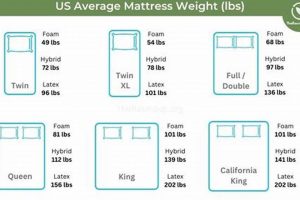
Weight capacity, though not a direct linear dimension of a double mattress, is intrinsically linked to its measured width and length due to the structural support required to maintain integrity. The dimensions define the surface area over which weight is distributed, directly influencing the mattress’s ability to withstand pressure without compromising its internal components. A mattress with standard width and length specifications necessitates a corresponding weight limit based on its materials and construction. Exceeding this limit can lead to sagging, uneven support, and reduced lifespan, irrespective of the dimensional accuracy. Therefore, manufacturers establish weight capacities based on the dimensions and materials used to ensure long-term performance. For instance, a double mattress with innerspring construction might have a lower weight capacity compared to a similarly sized memory foam or hybrid mattress, reflecting the differing structural properties of each material. Understanding this connection is crucial for ensuring that the chosen mattress adequately supports its intended users.
The practical significance of understanding the weight capacity becomes evident when considering scenarios involving multiple occupants or individuals with higher body weights. While the dimensions may seem adequate for two adults, exceeding the mattress’s weight limit can accelerate wear and tear, negating the benefits of its size. Similarly, for a single user with a substantial build, selecting a mattress with an appropriate weight capacity, corresponding to the standard dimensions, is paramount for maintaining comfort and preventing premature degradation. Real-world examples illustrate this point: a couple using a double mattress with a stated weight limit of 500 pounds may experience significant sagging and discomfort if their combined weight surpasses this value. Conversely, a single user weighing 250 pounds on the same mattress would likely experience better support and longevity, provided other factors such as frame support are also addressed. This highlights the necessity of aligning the mattress’s weight capacity with the intended use to maximize its performance and durability.
In conclusion, weight capacity is an essential, albeit non-dimensional, attribute connected to the measurable width and length. It influences the structural integrity and dictates the lifespan of the product. Ignoring this attribute relative to the dimensions can result in compromised support, accelerated wear, and a diminished sleep experience. By carefully considering the weight capacity in conjunction with the standard dimensions, consumers can make informed decisions that ensure optimal comfort, support, and longevity of their double mattress. Selecting a mattress with an appropriate weight rating ensures it can fulfill its intended purpose effectively, providing a worthwhile long-term investment in sleep quality.
7. Volume (Thickness dependent)

Volume, in the context of a mattress, is a derived property contingent upon its thickness and directly related to the standardized width and length. It quantifies the three-dimensional space occupied by the mattress, influencing factors ranging from shipping costs to storage requirements and perceived comfort. The dimensions of the mattress define its base surface area, while the variable thickness determines the extent of vertical space it occupies. Understanding this relationship is crucial for logistical planning and assessing the relative material density or “bulk” of different mattress models.
- Impact on Shipping and Handling
A mattress with a larger volume, resulting from increased thickness, inherently requires more space during shipping and handling. This increased volume translates directly into higher shipping costs due to dimensional weight calculations employed by logistics companies. Thicker mattresses also necessitate more robust packaging and handling procedures to prevent damage during transit. Therefore, volume serves as a key factor in determining the overall cost of ownership, influencing the final price paid by the consumer.
- Influence on Storage Space
Storage requirements are directly proportional to a mattress’s volume. A thicker mattress, even with standard length and width, occupies more vertical space, demanding larger storage areas. This is particularly relevant for retailers warehousing inventory and consumers storing spare mattresses. Efficient space utilization hinges on minimizing volume while maintaining desired levels of comfort and support. Optimizing the balance between volume and performance is a key consideration in mattress design and material selection.
- Correlation with Material Density and Weight
The volume of a mattress, in conjunction with its weight, reveals insights into material density. Two mattresses with identical dimensions but differing volumes (due to varied thickness) and weights will exhibit different densities. A higher density generally indicates the use of more robust materials, potentially translating into increased durability and enhanced support. However, higher density can also impact breathability and temperature regulation, requiring careful consideration of the overall material composition.
- Effect on Perceived Comfort and Support
Thickness, and thus volume, plays a significant role in the perceived comfort and support offered by a mattress. Thicker mattresses often incorporate multiple layers of varying materials, allowing for nuanced support profiles and enhanced pressure relief. The increased volume provides greater latitude for incorporating advanced comfort technologies, such as gel-infused memory foam or individually wrapped coils. However, excessive thickness without appropriate structural support can lead to instability and reduced motion isolation.
In summary, while the measurements define the sleeping surface, thickness and the derived volume impact shipping, storage, material density, and perceived comfort levels. Analyzing this interplay allows consumers to make informed decisions that align with their spatial constraints, budget considerations, and desired sleep experience. By considering both the fixed and variable aspects in relation to the overall volume, a better overall outcome is achieved.
Frequently Asked Questions
The following addresses prevalent inquiries related to the dimensions of double mattresses, providing precise information and addressing common misconceptions.
Question 1: What are the exact width and length of a standard double mattress?
A standard double mattress measures 54 inches in width and 75 inches in length. These dimensions are consistent across most manufacturers and represent the industry standard for this mattress size.
Question 2: How does the surface area compare to a queen-sized mattress?
A queen mattress offers a larger surface area compared to a double. A queen mattress typically measures 60 inches in width and 80 inches in length, providing more sleeping space, particularly beneficial for couples.
Question 3: Does mattress thickness affect the stated width and length?
Mattress thickness does not alter the stated width and length. Thickness primarily influences the overall height and support characteristics of the mattress but has no bearing on the dimensions of the sleeping surface.
Question 4: Are there variations in double mattress dimensions across different brands?
While minor variations may exist, reputable manufacturers adhere closely to the 54-inch by 75-inch standard. Significant deviations from these dimensions are uncommon and should be carefully evaluated.
Question 5: How do these dimensions influence the selection of appropriate bedding?
The 54-inch by 75-inch dimensions necessitate the use of bedding specifically designed for double mattresses. Using incorrectly sized bedding can result in poor fit, discomfort, and reduced durability of both the bedding and the mattress.
Question 6: What is the minimum recommended room size for a double mattress?
A minimum room size of 9 feet by 10 feet is generally recommended to comfortably accommodate a double mattress, allowing for adequate walking space and placement of other bedroom furniture.
In summary, a thorough understanding of standard mattress dimensions is crucial for informed decision-making, ensuring proper fit, optimal comfort, and maximizing the lifespan of the sleep system.
The subsequent section will explore considerations for selecting a bed frame that complements the specific dimensions.
Conclusion
This exploration has elucidated the crucial dimensions of what are the measurements of a full size mattress. The established standards of 54 inches in width and 75 inches in length provide a foundational understanding for consumers navigating mattress selection. Additionally, factors such as thickness, surface area, weight capacity, and volume have been examined, underscoring their impact on comfort, compatibility, and overall sleep experience.
A comprehensive grasp of these specifications empowers informed decision-making. Adherence to these guidelines ensures optimal integration within bedroom spaces, promotes proper frame support, and enhances long-term satisfaction. Prioritizing a dimensional understanding promotes better sleep health. Consumers are encouraged to leverage this knowledge to select mattresses that align with individual needs, promoting restful sleep and enhancing overall well-being.

![Best Simmons Full Mattress [Guide & Reviews] | Organic & Natural Mattress Buyer’s Guide: Non-Toxic Sleep Solutions](https://mattressworldpa.com/wp-content/uploads/2025/07/th-2917-300x200.jpg "Best Simmons Full Mattress [Guide & Reviews] Organic & Natural Mattress Buyer’s Guide: Non-Toxic Sleep Solutions")