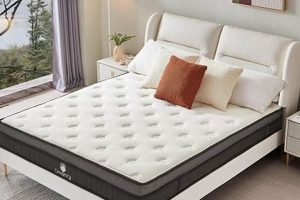
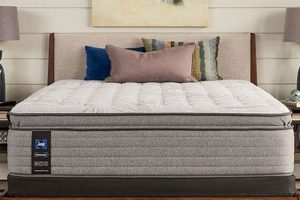
A standard bed dimension, commonly measuring approximately 54 inches wide by 75 inches long, when combined with temperature-regulating technology, creates a sleep surface designed to mitigate heat retention. Such a product aims to provide a more comfortable and restful sleep experience, particularly for individuals who tend to sleep hot. The bed provides ample space for a single sleeper while remaining compact enough to fit comfortably in smaller bedrooms.
The appeal of thermal regulation in bedding lies in its potential to improve sleep quality. Excess body heat can disrupt sleep cycles, leading to restlessness and fragmented sleep. Historically, individuals have sought ways to mitigate heat through natural fibers and ventilation. Modern advancements have introduced specialized materials and construction techniques that actively dissipate heat, contributing to a more consistent and restorative sleep environment. This can lead to benefits such as improved energy levels, enhanced cognitive function, and a general sense of well-being.
The subsequent sections will delve into the specific materials and technologies employed in the creation of thermally managed sleep surfaces, explore the various construction methods that enhance breathability and heat dissipation, and examine the factors consumers should consider when selecting a sleep solution designed for thermal comfort.
Considerations for Selecting a Thermally Regulated Sleep Surface
The following guidelines offer practical advice for individuals seeking a full size cooling mattress, ensuring an informed purchasing decision that aligns with specific needs and preferences.
Tip 1: Assess Material Composition: Prioritize materials known for breathability and heat dissipation. Open-cell foams, natural latex, and fabrics like Tencel or linen facilitate airflow and prevent heat buildup.
Tip 2: Evaluate Cooling Technology: Investigate the type of cooling technology integrated into the product. Phase change materials (PCMs) absorb and release heat, while gel infusions and copper particles enhance thermal conductivity.
Tip 3: Examine Construction and Airflow: Look for designs that promote airflow. Perforated foam layers, channeled surfaces, and breathable covers contribute to efficient heat exchange.
Tip 4: Determine Firmness Level: A surface that is too soft may inhibit airflow and trap heat. Select a firmness level that provides adequate support while allowing for ventilation.
Tip 5: Consider Edge Support: Insufficient edge support can restrict airflow around the perimeter. Reinforced edges maintain structure and prevent heat retention along the sides.
Tip 6: Read Customer Reviews: Consult independent reviews to gauge real-world performance and identify potential drawbacks. Pay attention to feedback regarding temperature regulation and overall comfort.
Tip 7: Inquire About Warranty and Trial Period: A comprehensive warranty and a generous trial period provide assurance and allow for thorough evaluation before committing to a purchase.
Adhering to these guidelines enhances the likelihood of selecting a sleep surface that effectively manages temperature, contributing to a more restful and restorative sleep experience.
The subsequent section will address common misconceptions surrounding thermally regulated sleep surfaces and provide clarity on their capabilities and limitations.
1. Dimensions

The dimensions of a temperature-regulating sleep surface are paramount to its functionality and consumer satisfaction. A “full size,” standardized at approximately 54 inches in width and 75 inches in length, must adhere to these parameters to properly fit standard bed frames and accommodate the average individual. A deviation from these dimensions, even a slight one, can lead to instability, compromised support, and an uneven distribution of weight, thereby negating the intended benefits of the cooling technology integrated within.
For example, if the width is less than 54 inches, the sleeper may experience a sensation of being confined, which counteracts the intended feeling of spaciousness associated with improved sleep quality. Conversely, if the length falls short of 75 inches, taller individuals may find their feet extending beyond the edge, disrupting sleep due to discomfort and inadequate support. These dimensional considerations directly affect the efficacy of cooling materials and construction. Adequate space allows for proper airflow and heat dissipation, essential for maintaining a comfortable sleeping temperature. A mattress too small relative to the sleepers body size will concentrate heat, negating the effects of cooling technologies.
In summary, precise adherence to standard dimensions is a non-negotiable aspect of a temperature-regulating sleep surface’s design. These dimensions directly influence the overall comfort, support, and thermal regulation properties, impacting the consumer’s ability to experience the intended benefits of the specialized materials and technologies employed. Failure to meet these dimensional requirements compromises both the product’s practical utility and its contribution to improved sleep quality.
2. Materials

The selection of constituent materials is paramount in determining the effectiveness of a full size cooling mattress. These materials directly influence heat dissipation, breathability, and overall thermal comfort, ultimately impacting the sleeper’s experience.
- Foam Density and Composition
Foam, a primary component, varies significantly in density and composition. High-density foams, while offering support, tend to retain heat. Conversely, open-cell foams, often infused with gel or phase change materials (PCMs), promote airflow and dissipate heat more effectively. For example, memory foam infused with gel particles enhances thermal conductivity, drawing heat away from the body.
- Fabric Selection
The fabric used for the mattress cover plays a crucial role in wicking away moisture and promoting ventilation. Natural fibers like Tencel, derived from eucalyptus, and linen are known for their breathability and moisture-wicking properties. These materials facilitate air circulation, preventing the buildup of heat and humidity against the skin. In contrast, synthetic fabrics may impede airflow, trapping heat and contributing to discomfort.
- Latex Integration
Natural latex, derived from rubber trees, offers a balance of support and breathability. Its open-cell structure allows for continuous airflow, regulating temperature and preventing overheating. Unlike synthetic latex, natural latex exhibits superior ventilation properties, making it a desirable component in cooling mattresses. For instance, a mattress incorporating a layer of perforated natural latex enhances airflow throughout the core.
- Phase Change Materials (PCMs)
PCMs are specialized compounds that absorb and release heat as they transition between solid and liquid states. Incorporated into foam or fabric layers, PCMs help regulate temperature by absorbing excess body heat when the sleeper is warm and releasing heat when the sleeper is cool. This dynamic temperature regulation ensures a more consistent and comfortable sleep environment.
The synergistic interaction of these materials determines the efficacy of a full size cooling mattress. By strategically selecting components with enhanced breathability, thermal conductivity, and moisture-wicking properties, manufacturers can create sleep surfaces that effectively mitigate heat retention and promote a more restful sleep experience. The careful consideration of material properties is, therefore, a critical factor in assessing the overall performance of cooling mattresses.
3. Construction
The construction methods employed in a full size cooling mattress are integral to its ability to effectively regulate temperature and provide a comfortable sleep environment. The arrangement and integration of various materials directly influence airflow, heat dissipation, and moisture management, all critical factors in mitigating heat retention during sleep.
- Layer Arrangement and Ventilation Channels
The strategic layering of materials, incorporating ventilation channels, can significantly enhance airflow within the mattress. For example, a top layer of open-cell foam, followed by a channeled layer of latex, creates pathways for heat to dissipate away from the sleeper. These channels allow for continuous air circulation, preventing the build-up of warm air within the mattress core, and thus enhancing the overall cooling effect.
- Zoning and Support Systems
Zoning refers to the varying levels of support provided in different areas of the mattress. In a cooling mattress, zoning can be strategically employed to enhance airflow in specific regions, such as the lumbar area, where heat tends to accumulate. Additionally, the support system, whether coil-based or foam-based, can be designed to promote ventilation. For instance, individually wrapped coils allow for greater airflow compared to a solid foam support core.
- Edge Support and Breathability
The edge support system, which reinforces the perimeter of the mattress, can either enhance or impede airflow. A well-designed edge support system will maintain structural integrity while allowing for ventilation. Some cooling mattresses incorporate perforated edge support systems, which maximize airflow around the perimeter and prevent the trapping of heat along the edges.
- Cover Design and Breathability
The design of the mattress cover significantly impacts airflow and moisture management. Breathable fabrics, such as Tencel or cotton, promote ventilation and wick away moisture, preventing the build-up of heat and humidity against the skin. The cover design may also incorporate quilted patterns or mesh panels to further enhance airflow and promote a cooler sleep surface.
In summary, the construction of a full size cooling mattress extends beyond the mere assembly of materials. It involves a deliberate and strategic approach to layering, zoning, and ventilation, with the aim of optimizing airflow and heat dissipation. These construction elements, when effectively integrated, contribute significantly to the mattress’s ability to regulate temperature and provide a more comfortable and restful sleep experience.
4. Technology
The integration of technology into full size cooling mattresses represents a significant advancement in sleep science and material engineering. Technologies employed directly affect the mattress’s capacity to regulate temperature, influencing sleep quality. Cause and effect are clearly delineated: the implementation of advanced cooling technologies results in reduced heat retention and improved thermal comfort. Without such technologies, mattresses would rely solely on traditional materials, often inadequate for dissipating heat generated during sleep. The presence of specific technologies is, therefore, a critical component of any mattress marketed as “cooling.” For example, phase change materials (PCMs), microencapsulated within the mattress fabric or foam, absorb and release heat to maintain a stable temperature range. Similarly, gel-infused memory foam draws heat away from the body, preventing overheating.
Practical application of these technologies extends to addressing specific sleep concerns. Individuals who experience night sweats or reside in warmer climates can benefit substantially from technologically enhanced mattresses. The practical significance lies in the alleviation of sleep disruptions caused by excessive heat, leading to improved sleep duration and quality. Furthermore, manufacturers are continually innovating, incorporating technologies such as active cooling systems, which circulate cool air through the mattress, providing a more controlled thermal environment. These active systems, though more complex, represent a further evolution in addressing thermal regulation.
In summary, technology forms the cornerstone of modern full size cooling mattresses. Its presence enables targeted temperature regulation, addressing a significant impediment to restorative sleep. While challenges remain in optimizing the balance between cost, durability, and effectiveness of these technologies, their continued development signifies a commitment to enhancing sleep comfort and overall well-being. Understanding the role of technology is essential for consumers seeking a solution to overheating during sleep, allowing them to make informed purchasing decisions.
5. Firmness

The firmness of a full size cooling mattress significantly impacts its ability to regulate temperature and provide optimal sleep comfort. Firmness affects airflow, pressure distribution, and overall sleep surface contact, all of which influence heat retention and dissipation. Selecting an appropriate firmness level is, therefore, critical for maximizing the effectiveness of a cooling mattress.
- Airflow and Ventilation
A sleep surface that is too soft may compress excessively under body weight, restricting airflow and impeding ventilation within the mattress core. This compression can trap heat, counteracting the cooling properties of specialized materials and technologies. Conversely, a firmer surface maintains better airflow, allowing heat to dissipate more effectively. For instance, a medium-firm mattress with open-cell foam and ventilation channels will generally exhibit superior cooling performance compared to a plush mattress of similar construction.
- Pressure Distribution and Surface Contact
Firmness influences pressure distribution and the degree of contact between the sleeper’s body and the mattress surface. A too-soft mattress may cause excessive sinking, increasing surface contact area and reducing airflow. This increased contact traps heat and moisture, leading to discomfort. A firmer mattress, however, distributes weight more evenly, minimizing surface contact and allowing for better air circulation. Consider an individual with back pain: a too-soft mattress may exacerbate the pain and retain heat, while a firmer mattress can provide support and promote a cooler sleep environment.
- Spinal Alignment and Sleep Position
Appropriate firmness is essential for maintaining proper spinal alignment, which indirectly affects temperature regulation. A mattress that is either too soft or too firm can cause spinal misalignment, leading to discomfort and restless sleep. Restless sleep increases body movement, generating more heat. Selecting the correct firmness level, based on sleep position and body weight, promotes proper spinal alignment and reduces unnecessary movement, contributing to a more stable and cooler sleep environment. For example, side sleepers typically require a softer surface than back sleepers to maintain spinal alignment.
- Material Performance and Longevity
The firmness level can also influence the longevity and performance of cooling materials. Excessive compression, as may occur with a too-soft mattress, can degrade foam structures and reduce their ability to dissipate heat over time. A firmer mattress, on the other hand, provides better support and prevents excessive compression, prolonging the lifespan of cooling materials and maintaining their effectiveness. Therefore, the appropriate firmness not only enhances immediate comfort but also contributes to the long-term performance of a cooling mattress.
In conclusion, firmness is a critical factor in the overall performance of a full size cooling mattress. It directly affects airflow, pressure distribution, spinal alignment, and material longevity, all of which influence the mattress’s ability to regulate temperature and provide a comfortable sleep experience. Selecting the appropriate firmness level, tailored to individual needs and preferences, is essential for maximizing the benefits of a cooling mattress and achieving restorative sleep.
Frequently Asked Questions
The following addresses common inquiries regarding full size cooling mattresses, providing clarity and dispelling potential misconceptions.
Question 1: What constitutes a “cooling” mattress and how does it differ from a standard mattress?
A cooling mattress incorporates specialized materials and construction techniques designed to dissipate heat and regulate temperature, aiming to mitigate heat retention experienced during sleep. Standard mattresses primarily focus on support and comfort without specific thermal management features.
Question 2: Are cooling mattresses effective for all individuals, or are they beneficial only for specific sleepers?
While cooling mattresses can benefit most sleepers by promoting a more comfortable sleep environment, they are particularly advantageous for individuals who tend to sleep hot, experience night sweats, or reside in warmer climates.
Question 3: What are the primary materials used in the construction of full size cooling mattresses?
Common materials include open-cell foams (often gel-infused), natural latex, phase change materials (PCMs), and breathable fabrics such as Tencel or cotton. These materials are selected for their ability to enhance airflow, dissipate heat, and wick away moisture.
Question 4: How does the firmness level of a cooling mattress impact its temperature regulation capabilities?
Firmness influences airflow and pressure distribution. A mattress that is too soft may compress excessively, restricting airflow and trapping heat. A firmer mattress generally promotes better ventilation and more effective heat dissipation.
Question 5: What is the expected lifespan of a full size cooling mattress, and how can its longevity be maximized?
The lifespan varies depending on the quality of materials and construction, but typically ranges from 7 to 10 years. Regular rotation, the use of a mattress protector, and adherence to the manufacturer’s care instructions can help prolong its lifespan.
Question 6: Are cooling mattresses significantly more expensive than standard mattresses, and what factors contribute to the cost difference?
Cooling mattresses often carry a higher price point due to the integration of specialized materials and advanced technologies. The cost reflects the enhanced thermal regulation capabilities and potential improvements in sleep quality.
In summary, full size cooling mattresses represent an investment in sleep comfort and quality, particularly for individuals prone to overheating during sleep. Understanding the materials, construction, and technologies employed in these mattresses is crucial for making an informed purchasing decision.
The subsequent section will address potential drawbacks or limitations associated with cooling mattresses, providing a balanced perspective.
Conclusion
This exploration has detailed the essential components of a full size cooling mattress, encompassing dimensions, materials, construction techniques, integrated technologies, and firmness considerations. The interplay of these elements dictates the efficacy of the product in regulating temperature and enhancing sleep quality. Specific materials like open-cell foams, phase change materials, and breathable fabrics contribute to heat dissipation. Construction methods such as ventilation channels and strategic layering further facilitate airflow. Ultimately, these design features aim to mitigate heat retention, a common impediment to restorative sleep.
The significance of a properly designed full size cooling mattress lies in its potential to improve sleep quality, particularly for individuals susceptible to overheating. Future advancements will likely focus on optimizing these technologies and materials to further enhance thermal regulation and durability. Continued research and development in this area will undoubtedly lead to even more effective solutions for promoting comfortable and restful sleep.
![Best Simmons Full Mattress [Guide & Reviews] | Organic & Natural Mattress Buyer’s Guide: Non-Toxic Sleep Solutions](https://mattressworldpa.com/wp-content/uploads/2025/07/th-2917-300x200.jpg "Best Simmons Full Mattress [Guide & Reviews] Organic & Natural Mattress Buyer’s Guide: Non-Toxic Sleep Solutions")