



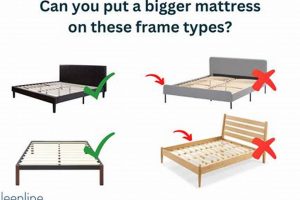
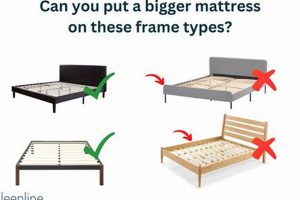
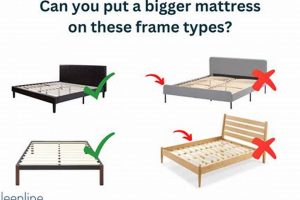
A standard-sized mattress measuring approximately 54 inches wide by 75 inches long is designated as a “full” size. A larger mattress, typically 60 inches wide by 80 inches long, is known as a “queen.” Attempting to place the former within the support structure designed for the latter results in a noticeable gap around the perimeter. This dimensional difference is significant enough to compromise support and potentially damage both the mattress and the frame over time.
Understanding the distinctions between standard mattress dimensions is crucial for ensuring proper sleep support and maximizing the lifespan of bedding investments. Historically, these standard sizes evolved to accommodate varying sleeping preferences and room dimensions. Proper fit ensures optimal comfort, prevents premature wear and tear, and contributes to a more aesthetically pleasing bedroom environment. Investing in correctly sized components ultimately offers long-term value.
Therefore, understanding the impact of mismatched dimensions on support, aesthetics, and long-term durability is paramount when considering mattress and frame compatibility. The following sections will delve deeper into the ramifications of using undersized mattresses within larger frames, focusing on practical solutions and preventative measures.
Tips Regarding Mattress and Frame Compatibility
Ensuring the proper fit between a mattress and its corresponding frame is essential for optimal support, comfort, and longevity. When facing dimensional discrepancies, such as inquiring whether a smaller mattress is suitable for a larger frame, several factors warrant careful consideration.
Tip 1: Assess the Gap. Before attempting any modifications, thoroughly measure the space differential between the mattress and the frame. Note both the width and length discrepancies to determine the extent of the issue.
Tip 2: Employ Filler Solutions. Consider utilizing strategically placed fillers to occupy the empty space. Options include dense foam inserts, rolled towels, or custom-made fabric cushions designed to conform to the frame’s perimeter.
Tip 3: Prioritize Support Integrity. While fillers can address aesthetic concerns, ensure they do not compromise the mattress’s support structure. Distribute filler material evenly to prevent uneven weight distribution and potential sagging.
Tip 4: Implement a Mattress Encasement. A properly sized mattress encasement can minimize shifting within the frame. Select an encasement that fits snugly to the full-size mattress, reducing movement and preserving its positioning.
Tip 5: Consider Frame Modification. For a more permanent solution, explore the possibility of modifying the existing frame. This may involve adding internal supports or adjusting the side rails to accommodate the smaller mattress dimensions. Seek professional assistance to ensure structural integrity.
Tip 6: Reevaluate Bedding Aesthetics. Understand that even with modifications, the visual aesthetics might remain imperfect. Adjust bedding arrangements, such as using larger comforters or decorative pillows, to minimize the visible gap.
Tip 7: Plan for Future Needs. Recognize that these modifications are temporary solutions. As future needs evolve, consider investing in a mattress and frame set that is properly matched in size to avoid recurring compatibility issues.
Adhering to these guidelines helps mitigate the challenges associated with dimensional mismatches, preserving both the comfort and the longevity of the bedding system. Addressing these concerns directly contributes to an improved sleep environment and a more sound investment.
The following sections will explore the long-term considerations of mattress and frame selection, emphasizing the importance of proper dimensional matching for sustained sleep quality and bedding integrity.
1. Dimensional Difference

The fundamental incompatibility of a full-size mattress with a queen-size frame stems directly from the inherent dimensional difference between the two. A full mattress, measuring approximately 54 inches in width and 75 inches in length, is significantly smaller than a queen mattress, which typically measures 60 inches in width and 80 inches in length. This discrepancy creates a substantial void when the former is placed within the latter, leading to several critical consequences. The lack of complete contact between the mattress and the frame compromises edge support, potentially causing the mattress to sag or shift during use. For example, individuals sleeping near the edge of the bed may experience a sensation of rolling off, impacting sleep quality and safety. The visual impact of this mismatch also detracts from the overall aesthetic appeal of the bedroom.
Further analysis reveals that the dimensional difference not only affects comfort and aesthetics but also the structural integrity of both the mattress and the frame. The unsupported edges of the mattress are subjected to increased stress, accelerating wear and tear. The frame, designed to distribute weight evenly across a larger surface area, may experience undue strain on specific points due to the concentrated load of the smaller mattress. Real-world examples include premature sagging of the mattress in the center and potential warping or cracking of the frame’s side rails. This accelerates depreciation and potentially necessitates earlier replacement of components.
In conclusion, the dimensional difference is not merely a matter of inches; it is a critical determinant of proper support, mattress longevity, frame stability, and overall aesthetic harmony. While temporary solutions, such as fillers, may mitigate some of the immediate effects, they do not address the underlying incompatibility. Recognizing the significance of this dimensional mismatch is paramount for making informed decisions regarding bedding investments and ensuring a comfortable and structurally sound sleep environment. Ignoring this aspect presents challenges including increased long-term costs and diminished sleep quality.
2. Compromised Support
The fundamental issue arising from the attempt to accommodate a smaller mattress within a larger frame is compromised support. The designed load distribution for a queen frame relies on a mattress of corresponding dimensions to evenly disperse weight. When a full mattress occupies this space, gaps emerge, negating the intended support structure. This results in an uneven sleep surface, where areas lacking direct frame contact offer diminished resistance to pressure. Consider a scenario where two individuals share the bed; the person sleeping closer to the unsupported edge will experience a distinct lack of firmness, potentially leading to discomfort, poor spinal alignment, and disturbed sleep.
The impact of diminished support extends beyond immediate discomfort. Over time, the uneven stress placed upon the mattress itself accelerates wear and tear. The unsupported edges are prone to sagging, leading to a distorted mattress shape and reduced lifespan. This effect is particularly pronounced with innerspring mattresses, where the coils along the perimeter lack adequate resistance and prematurely degrade. From a practical standpoint, this means a more frequent need for mattress replacement, resulting in increased expenditure. Furthermore, the lack of proper support can exacerbate existing musculoskeletal issues or contribute to the development of new ones, underscoring the importance of a correctly sized mattress and frame combination.
In summation, compromised support is a direct and significant consequence when a full mattress is placed within a queen frame. This issue not only degrades sleep quality and comfort but also accelerates mattress wear and potentially contributes to physical discomfort. Recognizing this connection is crucial for making informed decisions regarding bedding selection and prioritizing the long-term health and integrity of the sleep environment. Addressing this issue proactively prevents unnecessary costs and promotes restful, restorative sleep.
3. Aesthetic Concerns

The attempt to fit a smaller mattress within a larger frame inevitably raises aesthetic considerations that impact the overall visual harmony of the bedroom. The resulting gaps and disproportionate appearance disrupt the intended design and create an imbalance that can detract from the room’s intended style.
- Visual Gaps and Empty Space
The most immediately apparent aesthetic issue is the presence of noticeable gaps between the mattress and the frame. This empty space disrupts the clean lines and seamless integration expected in a well-designed bedroom. The eye is drawn to these voids, creating a sense of incompleteness and disharmony. For instance, a modern bedroom with minimalist dcor relies on precise proportions and clean lines; the presence of such gaps undermines the overall aesthetic.
- Disproportionate Bedding Display
Standard bedding sizes are designed to correspond with standard mattress sizes. When a full mattress sits within a queen frame, typical bedding sets appear oversized and ill-fitting. Bedskirts hang unevenly, comforters drape inappropriately, and pillow arrangements may seem unbalanced. This disrupts the intended visual presentation of the bed, creating a less inviting and aesthetically pleasing sleep environment.
- Compromised Room Harmony
The bed often serves as a focal point within a bedroom. A mismatched mattress and frame can disrupt the room’s overall harmony and sense of balance. The visual discord created by the undersized mattress can detract from other design elements, such as artwork, lighting, and furniture arrangements. This compromises the intended aesthetic impact of the room as a whole.
- Perception of Value and Quality
The visual appearance of a bed contributes significantly to the perceived value and quality of the bedroom. A properly fitted mattress and frame create an impression of care, attention to detail, and overall quality. Conversely, a mismatched setup can convey a sense of neglect or cost-cutting, detracting from the room’s perceived elegance and sophistication. This can influence the perception of the entire home and the occupant’s commitment to design and comfort.
In conclusion, aesthetic concerns represent a significant factor when considering mattress and frame compatibility. While functional solutions might address immediate support issues, they often fail to resolve the underlying aesthetic imbalance. Prioritizing proper mattress and frame sizing is crucial for achieving a visually appealing and harmonious bedroom environment, contributing to a sense of comfort, relaxation, and overall well-being. The visual impact is immediate and lasting, influencing both personal satisfaction and the perceived value of the sleep space.
4. Structural Damage

The attempt to accommodate a full-size mattress within a queen-size frame generates concerns regarding potential structural damage to both components. The dimensional mismatch introduces stress points and compromises the integrity of the intended support system, leading to long-term deterioration.
- Frame Rail Stress
Queen-size bed frames are engineered to distribute weight evenly across their entire surface area, assuming support from a mattress of corresponding dimensions. When a smaller full-size mattress is used, the frame rails particularly the side rails bear a disproportionate share of the load in the areas where the mattress makes contact. This concentrated stress can lead to warping, bending, or even cracking of the frame rails over time. Examples include observing a noticeable bow in the side rails or hearing creaking sounds indicative of material fatigue. This accelerated wear compromises the frame’s overall stability and reduces its lifespan.
- Center Support Failure
Many queen-size frames incorporate a central support system, often consisting of one or more legs and a longitudinal beam, designed to prevent sagging in the middle of the mattress. When a full mattress is used, this central support may not make adequate contact, rendering it ineffective. The unsupported area in the center of the frame then becomes prone to deflection under load, increasing the risk of structural failure. This can manifest as a broken support leg or a fractured center beam, further compromising the frame’s ability to provide adequate support.
- Mattress Sagging and Deformation
The lack of uniform support provided by an improperly sized frame can induce premature sagging and deformation of the mattress itself. The edges of the mattress, lacking proper support from the frame, are prone to compression and breakdown of internal components, such as springs or foam layers. This leads to an uneven sleeping surface and reduces the mattress’s overall comfort and lifespan. Observing dips or indentations in the mattress surface, particularly along the edges, is indicative of this type of structural damage. In severe cases, the mattress may develop permanent deformities, rendering it unusable.
- Joint Weakening
The stress induced by the dimensional mismatch can also weaken the joints connecting the various components of the bed frame. Over time, the screws, bolts, or other fasteners used to assemble the frame can loosen or strip, leading to instability and creaking. This compromises the structural integrity of the entire assembly and increases the risk of collapse. Regular inspection and tightening of fasteners can help mitigate this issue, but the underlying problem of uneven weight distribution remains a persistent source of stress on the frame’s joints. This can cause squeaking and overall instability of the frame.
In summation, the use of a full-size mattress within a queen-size frame introduces a range of potential structural issues, affecting both the frame and the mattress. The concentrated stress, lack of support, and joint weakening can accelerate wear and tear, reduce lifespan, and compromise safety. While temporary solutions may provide limited mitigation, the underlying problem of dimensional incompatibility persists, making the use of correctly sized components crucial for long-term structural integrity and overall sleeping comfort.
5. Filler Solutions

In the context of accommodating a full-size mattress within a queen-size frame, filler solutions represent attempts to bridge the dimensional gap and mitigate associated issues. These strategies aim to provide supplementary support, minimize movement, and improve the aesthetic presentation when a properly sized mattress is not utilized.
- Foam Inserts and Edge Fillers
Foam inserts, typically constructed from polyurethane or memory foam, are strategically placed along the perimeter of the mattress to fill the void between the mattress edge and the frame rail. These fillers offer lateral support, preventing the mattress from shifting and reducing the sensation of rolling off the edge. However, the effectiveness of foam inserts depends on their density and conformity to the frame; low-density fillers may compress over time, negating their support function. Real-world examples include custom-cut foam pieces precisely matching the gap dimensions, or commercially available edge supports designed to reinforce the mattress perimeter. The long-term durability and effectiveness of these fillers must be carefully considered.
- Rolled Textiles and Padding
Alternative filler solutions involve the use of rolled textiles, such as blankets, towels, or dedicated padding materials, to occupy the empty space. These materials are typically less rigid than foam inserts, providing a softer and more adaptable fill. Rolled textiles can be easily adjusted to accommodate minor dimensional variations, but they may also be prone to shifting or compression under sustained pressure. A practical application involves tightly rolling towels or blankets and securing them along the mattress perimeter to create a makeshift edge support. While this method offers a cost-effective and readily available solution, its long-term performance and aesthetic appeal may be limited.
- Custom-Fabricated Cushions and Bolsters
For a more tailored and aesthetically pleasing approach, custom-fabricated cushions or bolsters can be created to fill the space between the mattress and the frame. These cushions are typically constructed from durable fabrics and filled with materials such as fiberfill or shredded foam, offering a combination of support and visual appeal. Custom cushions can be designed to match the existing bedding ensemble, creating a more cohesive and integrated look. However, the cost of custom fabrication may be significantly higher than other filler solutions. Examples include upholstered bolsters precisely sized to fit the frame’s dimensions, providing both functional support and aesthetic enhancement.
- Mattress Encasements and Grip Pads
While not strictly fillers in the traditional sense, mattress encasements and grip pads can indirectly improve the fit and stability of a full-size mattress within a queen-size frame. A snug-fitting mattress encasement can reduce the mattress’s ability to shift within the frame, while grip pads placed between the mattress and the frame can minimize slippage. These solutions address the issue of mattress movement, but they do not fully resolve the problem of unsupported edges or dimensional gaps. An example involves using a zippered mattress encasement designed to compress and contain the full-size mattress, coupled with a non-slip pad to prevent sliding. These measures offer a practical approach to improving stability and reducing noise associated with mattress movement.
In summary, filler solutions represent a range of strategies employed to compensate for the dimensional incompatibility between a full-size mattress and a queen-size frame. While these solutions may offer temporary improvements in support, stability, and aesthetics, they do not address the underlying issue of improper sizing. The long-term effectiveness and durability of filler solutions vary depending on the materials used and the specific application. A comprehensive assessment of the trade-offs between cost, performance, and aesthetics is essential when considering these strategies.
6. Long-Term Costs

The financial implications of using a full-size mattress within a queen-size frame extend beyond the initial cost savings and warrant careful consideration. The long-term costs associated with this practice often outweigh any short-term economic benefits due to accelerated wear, compromised support, and potential health consequences.
- Accelerated Mattress Degradation
The unsupported edges of a smaller mattress within a larger frame experience concentrated stress, leading to premature sagging and breakdown of internal components such as springs or foam layers. This accelerated degradation shortens the mattress’s lifespan, necessitating earlier replacement compared to a properly supported mattress. For example, a mattress designed to last ten years might only provide five years of adequate support when used in an incompatible frame, effectively doubling the long-term cost of ownership.
- Frame Damage and Instability
The uneven weight distribution caused by the dimensional mismatch places undue stress on the bed frame, potentially leading to warping, bending, or breakage. Repairing or replacing a damaged frame incurs additional expenses that offset any initial savings from using a smaller mattress. Real-world scenarios include fractured side rails or broken center supports, requiring professional repair or complete frame replacement. Over time, the cumulative cost of frame maintenance and replacement can significantly exceed the price difference between a full-size and queen-size frame.
- Reduced Sleep Quality and Health Implications
Compromised support and uneven sleep surfaces can lead to discomfort, poor spinal alignment, and disrupted sleep patterns. Chronic sleep deprivation can negatively impact health, leading to reduced productivity, increased healthcare costs, and a diminished quality of life. Examples include increased reliance on pain medication, more frequent doctor visits, and decreased work performance due to fatigue. These indirect costs, though difficult to quantify precisely, represent a significant long-term financial burden.
- Ineffective Filler Solutions Expenditure
Attempts to mitigate the problems caused by a mismatched mattress and frame often involve purchasing filler solutions such as foam inserts, rolled textiles, or custom-fabricated cushions. While these solutions may offer temporary improvements, they do not address the underlying issue of dimensional incompatibility and may require frequent replacement or adjustment. The cumulative cost of these filler solutions, over the lifespan of the mattress and frame, can add up to a substantial expense, further eroding any initial cost savings. The investment in these stop-gap measures rarely yields the same benefit as simply buying the correct size to begin with.
In conclusion, while the initial appeal of using a smaller mattress within a larger frame might be cost savings, the long-term consequences present a compelling argument against this practice. Accelerated wear, frame damage, health implications, and the cost of ineffective filler solutions combine to create a significant financial burden that outweighs any short-term benefits. Prioritizing proper mattress and frame sizing is a sound investment in long-term comfort, health, and economic well-being.
Frequently Asked Questions
The following addresses frequently encountered inquiries regarding dimensional compatibility between mattresses and bed frames, focusing on the implications of attempting to use a full-size mattress within a queen-size frame.
Question 1: What are the precise dimensional differences between a full-size and a queen-size mattress?
A standard full-size mattress measures approximately 54 inches in width and 75 inches in length. A queen-size mattress, conversely, measures approximately 60 inches in width and 80 inches in length. These dimensional differences create significant gaps when a full-size mattress is placed within a queen-size frame.
Question 2: Does utilizing filler solutions, such as foam inserts, adequately compensate for the dimensional mismatch?
Filler solutions provide a degree of temporary support and can minimize mattress shifting. However, these solutions do not replicate the uniform support provided by a properly sized mattress. Moreover, the long-term durability and effectiveness of filler solutions are subject to material degradation and displacement.
Question 3: What are the potential long-term consequences of using an improperly sized mattress on the bed frame’s structural integrity?
The uneven weight distribution resulting from a dimensional mismatch can induce stress on the frame, potentially leading to warping, bending, or fracture of the frame rails and support structures. This accelerated wear compromises the frame’s stability and reduces its lifespan.
Question 4: Can the use of a full-size mattress within a queen-size frame impact sleep quality and physical well-being?
Compromised support and uneven sleep surfaces can lead to discomfort, poor spinal alignment, and disrupted sleep patterns. Chronic sleep deprivation can negatively affect health and overall quality of life. Proper mattress support is critical for maintaining a healthy sleep posture.
Question 5: Are there any circumstances where using a full-size mattress on a queen-size frame is a practical or recommended solution?
In general, using a full-size mattress on a queen-size frame is not recommended as a long-term solution. While it might serve as a temporary measure in certain emergency situations, the benefits are unlikely to outweigh the potential negative consequences. Investing in a correctly sized mattress and frame is advisable.
Question 6: What factors should be considered when selecting a new mattress and bed frame to ensure dimensional compatibility?
Prioritize accurate measurements of the intended sleep space and carefully review product specifications to ensure both the mattress and frame conform to standard dimensional guidelines. Consider consulting with bedding professionals to obtain expert advice and ensure a proper fit. Verify warranty terms regarding dimensional compatibility to preserve coverage.
In conclusion, utilizing a properly sized mattress with a corresponding frame offers the most effective means of ensuring optimal support, comfort, and long-term durability. Compromising on dimensional compatibility can lead to a range of negative consequences affecting both sleep quality and the lifespan of bedding investments.
The following sections will explore strategies for properly disposing of old mattresses and selecting sustainable bedding options that minimize environmental impact.
Can a Full Mattress Fit in a Queen Frame
This exploration has rigorously examined the question of whether a full mattress is suitable for a queen frame. Key points indicate dimensional incompatibility leading to compromised support, potential structural damage to both mattress and frame, aesthetic deficits, and the long-term cost inefficiencies of attempting to bridge the size discrepancy with filler solutions. While filler solutions may offer temporary mitigation, they fail to address the fundamental issue of improper fit, leading to accelerated wear and potential discomfort.
Therefore, adherence to dimensional matching is crucial for ensuring optimal sleep quality and the preservation of bedding investments. Prioritizing proper sizing when selecting mattresses and frames remains a fundamental principle for maintaining comfort, structural integrity, and long-term value. Consider the implications of mismatched dimensions before making purchasing decisions; proper fit ensures enduring quality and mitigates future complications.

![Ultimate King Size Bed Frame with Mattress [Deals] | Organic & Natural Mattress Buyer’s Guide: Non-Toxic Sleep Solutions](https://mattressworldpa.com/wp-content/uploads/2025/07/th-3215-300x200.jpg "Ultimate King Size Bed Frame with Mattress [Deals] Organic & Natural Mattress Buyer’s Guide: Non-Toxic Sleep Solutions")
![Best Queen Frame with Air Mattress [Deals!] | Organic & Natural Mattress Buyer’s Guide: Non-Toxic Sleep Solutions](https://mattressworldpa.com/wp-content/uploads/2025/07/th-3213-300x200.jpg "Best Queen Frame with Air Mattress [Deals!] Organic & Natural Mattress Buyer’s Guide: Non-Toxic Sleep Solutions")