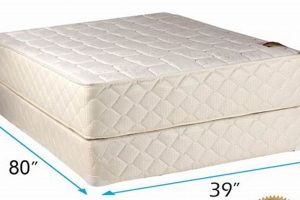
The dimensions of containers designed for transporting mattresses are a critical consideration in the logistics and retail sectors. These measurements, typically expressed as length, width, and height in inches or centimeters, dictate the efficiency of storage, shipping, and handling processes. For example, a queen mattress, once compressed and packaged, might require a container with internal dimensions of 65 inches in length, 20 inches in width, and 20 inches in height.
Appropriate container dimensions provide significant advantages. Efficient space utilization within warehouses and delivery vehicles reduces transportation costs and minimizes environmental impact. Historically, larger, uncompressed mattresses posed logistical challenges, requiring specialized handling and increased space. The advent of compression technology and precisely dimensioned containers has streamlined the distribution process, leading to cost savings and improved customer satisfaction through efficient delivery.
Understanding these logistical requirements allows for a more informed discussion of specific applications, including selecting the appropriate container for various mattress sizes, optimizing packing strategies, and exploring the impact on overall supply chain efficiency.
Optimizing Logistics with Standardized Dimensions
Employing effective strategies related to container dimensions is crucial for efficient mattress distribution. The following tips address key considerations for optimizing the process.
Tip 1: Select the Appropriate Container: Prioritize container selection based on the compressed mattress dimensions. Overly large containers waste space, increasing shipping costs. Ensure internal container dimensions accommodate the mattress without excessive void space.
Tip 2: Implement Standardized Container Sizes: Maintaining a limited range of standardized dimensions simplifies warehousing and loading processes. This approach reduces the need for specialized handling equipment and optimizes storage density.
Tip 3: Consider Container Material Strength: The container must adequately protect the mattress during transit. Selecting durable materials that resist compression and puncture is paramount, especially for long-distance shipments.
Tip 4: Optimize Packing Density: Maximizing the number of mattresses per container reduces the overall shipping cost per unit. Employ compression techniques to minimize the mattress volume without compromising its integrity.
Tip 5: Implement Proper Labeling Procedures: Clear and accurate labeling of each container, including dimensions and handling instructions, minimizes errors during handling and facilitates efficient tracking throughout the supply chain.
Tip 6: Account for Dimensional Weight: Shipping costs are often calculated based on dimensional weight (DIM weight). Understanding how this calculation impacts costs can influence container selection and packing strategies. Smaller, more compact containers may be more cost-effective, even if they hold fewer mattresses.
Effective container management strategies are essential for controlling costs and ensuring the safe and efficient transport of mattresses. By implementing the above tips, organizations can streamline their logistics operations and improve overall profitability.
The following section will address common challenges related to container specifications and potential solutions for mitigating risks.
1. External Dimensions

The external dimensions of a mattress box directly define its spatial footprint, influencing several aspects of logistics and storage. A larger external dimension, even if only slightly increased, can cumulatively impact storage capacity within a warehouse or the number of units that can be loaded onto a shipping container. For example, if a standard pallet can hold twenty mattress boxes with specific external dimensions, an increase in those dimensions, even by a few inches per box, could reduce the pallet capacity to eighteen or nineteen units. This reduction directly translates to increased shipping costs and storage overhead.
Conversely, carefully managed external dimensions, optimized to minimize waste space, can significantly improve efficiency. Many companies invest in packaging design to reduce external measurements to the absolute minimum necessary to protect the compressed mattress within. A prominent case is the shift towards more rectangular boxes with tighter tolerances around the mattress, as opposed to bulkier, less space-efficient designs. This optimization requires a balance between protective integrity and dimensional efficiency, often involving finite element analysis to ensure the box can withstand the stresses of shipping and handling. A poorly designed container, despite seemingly small dimensions, may lack structural strength, leading to damage and additional costs.
Understanding the correlation between external dimensions and overall logistical efficiency is paramount. The specification of these dimensions should not be arbitrary but rather a calculated decision based on maximizing space utilization, minimizing shipping costs, and ensuring product protection. Regular audits of packaging design and dimensions, along with analysis of shipping data, can identify opportunities for improvement and contribute to a more streamlined supply chain. Failure to prioritize this aspect of the mattress box size leads to avoidable inefficiencies and increased operational expenses.
2. Internal Volume

Internal volume, a critical element of mattress box specifications, dictates the capacity for accommodating a compressed mattress and associated packing materials. It directly impacts the efficiency of packaging operations, shipping density, and the overall cost-effectiveness of mattress distribution. Precise determination of internal volume is crucial to ensure both adequate protection for the mattress and optimized utilization of space throughout the supply chain.
- Mattress Compression Ratio
The degree to which a mattress is compressed significantly affects the required internal volume. Higher compression ratios result in smaller packed dimensions, necessitating smaller boxes. For instance, a memory foam mattress compressed to one-third of its original thickness demands a box with a substantially reduced internal volume compared to an innerspring mattress with less aggressive compression. Miscalculating compression can lead to either insufficient space, causing damage during packaging, or excessive space, increasing shipping costs.
- Void Fill and Protective Packaging
Internal volume must account for the space occupied by void fill and protective packaging materials. These materials, such as foam inserts, cardboard corner protectors, and plastic wrapping, cushion the mattress and prevent damage during transit. The choice and quantity of these materials directly influence the minimum required internal volume. Failure to adequately consider these factors can result in inadequate protection, leading to transit damage and increased return rates. For example, insufficient corner protection can result in damage to the corners of the mattress, a common source of customer complaints.
- Automated Packaging Systems
The use of automated packaging systems can impact the optimal internal volume. Automated systems often require consistent and predictable dimensions to operate efficiently. Boxes with variable or inconsistent internal volumes can lead to jams, misfeeds, and reduced throughput, impacting overall productivity. Therefore, precise control over internal volume is paramount for companies employing automated packaging processes. Standardization of internal dimensions is frequently a prerequisite for seamless integration with automated equipment.
- Dimensional Weight Considerations
Shipping costs are often calculated based on dimensional weight (DIM weight), which takes into account the volume of the package. A larger internal volume, even if the actual weight of the mattress is low, can result in higher shipping charges due to increased DIM weight. Optimizing the internal volume to the minimum required while still providing adequate protection is essential for minimizing shipping expenses. Companies frequently employ sophisticated software to calculate the optimal dimensions and packing strategies to reduce DIM weight without compromising product safety.
These interconnected aspects of internal volume underscore its significance in the context of mattress box specifications. A holistic approach, considering compression ratios, protective packaging, automation requirements, and dimensional weight, is crucial for optimizing mattress distribution and minimizing costs.
3. Material Thickness

Material thickness, a critical parameter in mattress box design, directly influences the structural integrity and protective capabilities of the packaging. The gauge, or thickness, of the material used for the box dictates its resistance to compression, puncture, and other forms of damage encountered during shipping and handling. Selecting an appropriate thickness is paramount for ensuring the safe and efficient transport of mattresses.
- Compression Strength and Stacking
Material thickness directly affects the box’s compression strength, which is crucial for withstanding stacking loads in warehouses and during transit. Thicker materials provide greater resistance to crushing, allowing boxes to be stacked higher without risk of collapse. Failure to account for stacking loads can result in box deformation, damage to the mattress, and potential safety hazards. For example, corrugated cardboard, a common mattress box material, is available in various thicknesses, each with a different compression rating, impacting the safe stacking height.
- Puncture Resistance and Edge Protection
The thickness of the box material also influences its resistance to punctures and tears, particularly along edges and corners. A thicker material provides enhanced protection against sharp objects or impacts encountered during handling. This is especially important for mattresses with protruding components, such as coils or reinforced edges. Inadequate puncture resistance can lead to damage to the mattress covering or internal components, compromising its structural integrity and customer satisfaction.
- Influence on Internal Dimensions
Material thickness directly affects the internal dimensions available within the mattress box. A thicker material reduces the usable internal space, requiring careful consideration of the mattress dimensions and compression ratio. Conversely, a thinner material, while maximizing internal space, may compromise the box’s structural integrity. A balance must be struck between maximizing the internal volume for efficient packaging and ensuring adequate material thickness for product protection. Packaging engineers often employ sophisticated modeling techniques to optimize this trade-off.
- Cost and Sustainability Considerations
Material thickness directly impacts the cost and environmental footprint of mattress boxes. Thicker materials generally increase the cost of the box, while also potentially increasing its weight and shipping costs. However, using recycled or sustainable materials can mitigate some of these environmental concerns. A comprehensive assessment of cost, performance, and sustainability is essential for selecting the optimal material thickness. Some companies prioritize durability to reduce damage and returns, while others focus on minimizing material usage to reduce costs and environmental impact. This trade-off requires careful consideration of business priorities and environmental responsibilities.
The interplay between material thickness and mattress box size highlights the importance of a holistic approach to packaging design. Optimizing the gauge of the material, considering compression strength, puncture resistance, internal dimensions, and sustainability, is crucial for creating effective and cost-efficient mattress packaging solutions. Careful consideration of these factors ensures the safe and efficient transport of mattresses, contributing to customer satisfaction and minimizing environmental impact.
4. Weight Capacity
Weight capacity, a primary determinant in mattress box specifications, defines the maximum load the container can withstand without structural failure. This factor is critically important during warehousing, transportation, and retail display, directly influencing the integrity of the mattress and the safety of personnel handling the packaged product. The relationship between weight capacity and mattress box dimensions is intertwined, requiring precise engineering considerations.
- Corrugated Board Grade and Construction
The weight capacity of a mattress box is directly proportional to the grade and construction of the corrugated board used in its manufacturing. Higher grade boards, characterized by increased fiber density and multi-layered construction, exhibit superior weight-bearing capabilities. For example, a double-walled corrugated box can support significantly more weight than a single-walled counterpart of comparable dimensions. The choice of board grade must align with the weight of the mattress to prevent box collapse during stacking or handling. Insufficient board grade can result in product damage and potential safety hazards for workers.
- Box Dimensions and Geometry
The dimensions and geometric design of the mattress box influence its load-bearing capacity. Larger boxes, especially those with expansive unsupported areas, require a higher weight capacity to prevent buckling or deformation under load. Conversely, smaller boxes, or those with internal supports or reinforced corners, can often support a greater weight relative to their size. The design must consider the distribution of weight within the box, accounting for potential stress points. For instance, a long, narrow box is more susceptible to bending than a cubical one of similar volume and material.
- Stacking Configuration and Load Distribution
The method of stacking mattress boxes directly impacts the weight distribution on each individual container. Improper stacking, resulting in uneven load distribution, can exceed the weight capacity of the lower boxes, leading to collapse. Factors such as stacking height, pallet configuration, and the presence of interlocking features between boxes influence the effective weight capacity. Palletized stacking, with uniform weight distribution, allows for greater stacking heights compared to unpalletized configurations. Clear labeling indicating the maximum stacking height is crucial for preventing overloads and ensuring safe handling practices.
- Environmental Factors and Material Degradation
Environmental conditions, such as humidity and temperature fluctuations, can affect the structural integrity of the mattress box and reduce its weight capacity over time. Moisture absorption weakens the corrugated board, diminishing its ability to withstand compressive forces. Similarly, prolonged exposure to extreme temperatures can cause material degradation, leading to a reduction in weight-bearing capacity. Storage facilities must maintain appropriate environmental controls to preserve the integrity of the packaging and prevent premature failure under load. Regular inspections of stored boxes can identify signs of degradation and prevent potential accidents.
The weight capacity of a mattress box is an inherent property contingent upon its dimensions, construction, and environmental conditions. It must be carefully specified to ensure the safe and efficient handling of mattresses throughout the supply chain, safeguarding the product from damage and minimizing the risk of accidents. Understanding the interplay between these factors is essential for designing robust and reliable packaging solutions.
5. Compressibility Factor
The compressibility factor, in the context of mattress packaging, represents the ratio of a mattress’s original volume to its compressed volume. This factor is a critical determinant in establishing appropriate mattress box dimensions. A higher compressibility factor indicates that a mattress can be significantly reduced in size, thereby requiring a smaller box. Conversely, a lower compressibility factor implies limited volume reduction, necessitating a larger container. For instance, memory foam mattresses typically exhibit a higher compressibility factor than traditional innerspring mattresses. This difference directly impacts the required mattress box dimensions, influencing shipping costs and storage efficiency. Ignoring this factor leads to suboptimal packaging, resulting in wasted space, increased transportation expenses, and potential product damage due to inadequate protection or excessive movement within the container.
The practical application of understanding the compressibility factor involves a multifaceted approach. Packaging engineers employ material science principles and testing methodologies to accurately determine the compressibility factor of different mattress types. These tests often involve subjecting mattresses to controlled compression forces and measuring the resulting volume reduction. The data obtained informs the design and specification of mattress boxes, ensuring they are appropriately sized for efficient packing and shipping. Furthermore, manufacturers leverage this understanding to optimize their supply chains. By accurately predicting the final dimensions of compressed mattresses, companies can reduce the size of shipping containers, thereby lowering transportation costs and minimizing their environmental impact. For example, a company shipping thousands of mattresses annually could realize substantial cost savings by implementing packaging solutions optimized for the specific compressibility factors of their products.
In summary, the compressibility factor is an indispensable element in determining mattress box size. Precise measurement and integration of this factor into packaging design are essential for optimizing space utilization, reducing transportation costs, and ensuring product protection. Challenges in accurately assessing compressibility, especially with hybrid mattress designs, necessitate ongoing research and refinement of testing methodologies. Proper consideration of the compressibility factor contributes to a more efficient and sustainable mattress industry.
Frequently Asked Questions About Mattress Box Size
The following section addresses common inquiries regarding dimensions of mattress containers. Information provided is intended to offer clarity on packaging requirements and logistical considerations.
Question 1: What are the typical dimensions for a queen mattress box?
Typical dimensions for a queen mattress box generally range from 60 to 65 inches in length, 15 to 20 inches in width, and 15 to 20 inches in height. However, actual measurements fluctuate based on the mattress thickness and compression method.
Question 2: How does mattress type affect the box size?
Mattress type significantly impacts required container dimensions. Memory foam and hybrid mattresses usually compress more effectively than traditional innerspring models, enabling the use of smaller containers.
Question 3: What factors determine the structural integrity of a mattress box?
Structural integrity is primarily determined by the grade of corrugated cardboard, material thickness, and box construction. Stacking requirements and shipping conditions also dictate appropriate specifications.
Question 4: How does dimensional weight influence shipping costs?
Dimensional weight, calculated from container length, width, and height, can significantly impact shipping costs. Larger containers incur higher charges, even if the actual product weight is relatively low. Optimizing box dimensions helps mitigate these costs.
Question 5: Are there standard industry guidelines for mattress box dimensions?
While specific standards do not exist, best practices emphasize minimizing container size while ensuring adequate product protection. Carriers often provide guidance on dimensional weight calculations and packaging requirements.
Question 6: What are the key considerations for sustainable mattress packaging?
Sustainable practices include using recycled content, minimizing material usage, and employing recyclable or biodegradable packaging materials. Optimizing dimensions also reduces the environmental impact of shipping.
In conclusion, understanding the key aspects of mattress container dimensions is critical for managing logistics effectively and minimizing costs. These considerations influence storage, transportation, and overall supply chain efficiency.
The subsequent section will elaborate on strategies for optimizing packaging materials to enhance protection and reduce environmental impact.
Conclusion
Comprehensive management of mattress box size is a critical element in the modern mattress industry. This examination has underscored the multifaceted nature of container dimensions, influencing logistical efficiency, transportation costs, product protection, and environmental impact. Strategic optimization of these dimensions, informed by a thorough understanding of mattress compressibility, material strength, and dimensional weight calculations, is paramount for success.
Given the dynamic nature of supply chains and increasing demands for sustainability, continued focus on refining mattress box size strategies remains imperative. Industry stakeholders must prioritize innovation in packaging materials, compression technologies, and logistical practices to achieve further efficiencies and minimize environmental footprint. Proactive engagement with these factors will ensure sustained competitiveness and responsible stewardship of resources within the evolving marketplace.



![Upgrade Your Sleep: Twin Mattress & Box Spring Set - [Year] | Organic & Natural Mattress Buyer’s Guide: Non-Toxic Sleep Solutions](https://mattressworldpa.com/wp-content/uploads/2025/07/th-3528-300x200.jpg "Upgrade Your Sleep: Twin Mattress & Box Spring Set - [Year] Organic & Natural Mattress Buyer’s Guide: Non-Toxic Sleep Solutions")