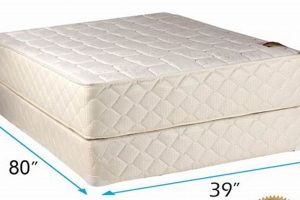
A bed delivered in compact packaging has reshaped the traditional mattress-buying experience. This product typically arrives compressed, rolled, and sealed within a box, ready for setup in the consumer’s home. For example, a queen-sized memory foam bed, once cumbersome to transport, can now be maneuvered through narrow doorways and stairwells with relative ease when packaged in this manner.
The emergence of this delivery method offers notable advantages, including reduced shipping costs and enhanced convenience for the customer. Historically, purchasing a new bed involved visiting brick-and-mortar stores, negotiating prices, and arranging for often-complicated delivery schedules. This innovative packaging approach streamlines the process, minimizing overhead and allowing for more competitive pricing. Furthermore, the convenience of direct-to-consumer shipping and easier handling appeals to modern consumer preferences.
Understanding the construction materials and interior design features are essential when choosing the right one. This article will further explore the various types available, their core components, and the factors to consider when making a purchase, ensuring an informed decision that aligns with individual comfort and support needs.
Purchasing Considerations
Selecting the correct product requires careful evaluation of several key factors to ensure optimal comfort and support.
Tip 1: Material Composition. Analyze the core materials. Memory foam offers pressure relief, while latex provides responsiveness. Hybrid models combine these, plus innersprings, for balanced support and airflow. A close look at material certifications (e.g., CertiPUR-US) is also highly advisable.
Tip 2: Density and Firmness. Consider personal preference. Higher density foams offer increased durability. Firmness levels range from plush to extra firm, each catering to different sleeping positions and body weights. Lighter individuals may prefer softer surfaces.
Tip 3: Edge Support. Evaluate edge support, particularly if sharing the bed. Reinforced edges prevent roll-off and maximize usable surface area. Stronger edge support improves overall structural integrity.
Tip 4: Temperature Regulation. For those who sleep hot, explore cooling technologies. Gel-infused foams, open-cell structures, and breathable covers can mitigate heat retention. Natural fibers, like wool, offer inherent temperature-regulating properties.
Tip 5: Trial Period and Warranty. Scrutinize the trial period and warranty offered. A generous trial period (typically 100 nights or more) permits home testing. A comprehensive warranty protects against manufacturing defects and premature wear.
Tip 6: Read Customer Reviews. Research the experiences of other consumers. While subjective, reviews often highlight potential issues related to durability, off-gassing, or customer service. Consider reviews on multiple independent platforms.
Careful consideration of these factors will contribute to a satisfactory purchase, optimizing sleep quality and overall well-being.
The following sections will address potential concerns related to setup and maintenance.
1. Compression Technology

Compression technology is integral to the viability of mattresses packaged for direct-to-consumer delivery. This process significantly reduces the volume of the product, facilitating cost-effective shipping and handling and is at the very core of “what is a mattress in a box”.
- Volume Reduction
The primary function of compression is to minimize the mattress’s dimensions for efficient packaging. Industrial presses apply uniform pressure to compress the bed, typically to a fraction of its original thickness. This reduction allows for boxing, which dramatically decreases shipping costs and simplifies logistics. Without this reduction, shipping would be significantly more expensive.
- Material Properties
Foam-based materials, such as memory foam and latex, are particularly amenable to compression due to their inherent elasticity. These materials can withstand significant pressure without permanent deformation. This characteristic is critical because the mattress must return to its original shape and size upon decompression. If materials cannot withstand compression, it fails as a “what is a mattress in a box.”
- Packaging Integrity
Compression is often coupled with rolling and sealing the mattress in airtight plastic. This further reduces volume and protects the product from moisture and damage during transit. The packaging must maintain its integrity throughout the shipping process to ensure the mattress arrives in optimal condition, ready for expansion.
- Decompression Process
Upon opening, the mattress gradually expands to its intended dimensions. The decompression process can take several hours, depending on the mattress’s composition and the duration of compression. Full expansion is crucial for achieving the desired firmness and support levels. Failures in decompression can result in uneven surfaces or compromised structural integrity, which is undesirable for the user.
The success of mattresses in a box hinges on the effective application of compression technology. This technique not only facilitates efficient delivery but also preserves the quality and integrity of the product, ultimately contributing to a positive consumer experience. As such, compression technology is a cornerstone for the current business model.
2. Direct-to-Consumer Model

The direct-to-consumer (DTC) model is inextricably linked to the rise of boxed mattresses. These compact and easily shippable beds leverage the advantages of online retail, bypassing traditional brick-and-mortar stores and their associated costs. This business strategy offers manufacturers greater control over branding, pricing, and customer experience. This direct access to the consumer reduces reliance on wholesale markups, potentially translating into more competitive pricing or enhanced product quality. An understanding of DTC is essential to grasp “what is a mattress in a box.” For example, companies such as Casper and Purple established their brands primarily through online channels, capitalizing on the convenience and accessibility that the DTC model provides.
The implications of the DTC approach extend beyond pricing. Manufacturers can gather direct consumer feedback, enabling rapid product iteration and customization. This data-driven approach allows for continuous improvement and the development of products tailored to specific customer needs. Moreover, DTC often includes robust customer support systems, fostering brand loyalty and repeat business. This contrasts with the often impersonal experience encountered in traditional retail settings, where sales associates may lack in-depth product knowledge or brand affiliation. The DTC model also allows brands to control their narrative and messaging, ensuring consistency across all customer touchpoints.
However, the DTC model also presents challenges. Building brand awareness and acquiring customers online requires significant investment in marketing and advertising. Competition in the online mattress market is intense, demanding innovative strategies to stand out from the crowd. Furthermore, managing logistics and fulfillment can be complex, requiring efficient supply chain management and reliable delivery partners. Despite these challenges, the direct-to-consumer model has proven to be a transformative force in the mattress industry, fundamentally changing how consumers shop for and purchase beds.
3. Foam Construction

The prevalence of foam construction is a defining characteristic of the “mattress in a box” category. This construction method is essential for the compression and rolling processes necessary for this distribution model. Foam materials, unlike traditional innerspring systems, possess the compressibility and flexibility required to withstand the rigors of packaging and shipping without sustaining permanent damage. The selection of specific foam types, such as memory foam, latex, or high-density polyfoam, directly influences the mattress’s comfort, support, and overall performance.
The link between foam construction and the product’s viability is evident in the numerous brands that have achieved market success through this model. For instance, many bed-in-a-box offerings utilize multiple layers of different foam densities to create a targeted comfort profile. A firm support layer at the base, often composed of high-density polyfoam, provides stability and prevents sagging. Above this, a comfort layer of memory foam or latex conforms to the sleeper’s body, alleviating pressure points. The practical implication of this layered construction is enhanced spinal alignment and reduced motion transfer. Without this construction, “what is a mattress in a box” would not be possible.
However, the exclusive reliance on foam also presents certain challenges. Foam materials can exhibit temperature sensitivity, potentially leading to heat retention and discomfort for some sleepers. Manufacturers address this issue through innovations such as gel-infused foams and open-cell structures designed to improve airflow. Furthermore, the long-term durability of foam mattresses is a subject of ongoing evaluation. While high-quality foams can maintain their integrity for many years, lower-density materials may degrade more rapidly, impacting the mattress’s lifespan and the overall cost-effectiveness of the “mattress in a box” purchase. Despite these challenges, foam remains the dominant material in this category, underlining its fundamental role in enabling the compression and delivery process.
4. Simplified Delivery

The concept of simplified delivery is not merely an added convenience but rather a fundamental component of the boxed mattress business model. Traditional mattress purchases involved scheduling delivery appointments, navigating bulky items through doorways, and often incurring additional fees. The bed-in-a-box design streamlines this process, enabling shipment via standard carriers directly to the consumer’s doorstep. The reduced size and weight of the packaged mattress eliminates the need for specialized delivery services, resulting in significant cost savings and increased flexibility for the buyer. Therefore, simplified delivery is indispensable to “what is a mattress in a box”.
The implications of this streamlined delivery extend beyond mere convenience. Consider the challenges faced by individuals living in apartments or remote locations. Traditional mattress delivery to such residences can be logistically complex and expensive. A boxed mattress circumvents these obstacles, allowing for easy transportation through elevators, stairwells, and down narrow corridors. Moreover, the elimination of scheduled delivery windows provides consumers with greater control over the receiving process, enabling them to accept the package at their convenience without disrupting their daily routines. Many companies offer tracking information, allowing consumers to monitor the package’s progress and plan accordingly. The accessibility afforded by this system expands the market reach of mattress manufacturers, enabling them to serve customers in areas previously underserved by traditional retail models.
Simplified delivery, therefore, represents a core value proposition and competitive advantage that enables “what is a mattress in a box” to succeed. It addresses consumer demand for convenience, cost-effectiveness, and control, while simultaneously reducing logistical complexities and expanding market access for manufacturers. The practical significance of this delivery approach lies in its ability to transform the mattress buying experience from a cumbersome undertaking to a seamless and efficient process. This is not merely an accessory but a functional necessity for “what is a mattress in a box”.
5. Trial Periods
Trial periods are a critical component of the “what is a mattress in a box” business model, serving as a mechanism to mitigate the inherent risks associated with purchasing a mattress online without prior physical interaction. The inability to test the product in a traditional retail setting necessitates an alternative assurance of satisfaction. These trial periods allow consumers to evaluate the comfort and suitability of the bed in their home environments, mirroring the experience typically gained through in-store testing. Without trial periods, many consumers would likely be hesitant to purchase a mattress online, severely limiting the market viability of “what is a mattress in a box”. For example, Nectar Sleep, offers a 365-night trial, an effort demonstrating the value in such a trial.
The prevalence and length of these trial periods have a direct effect on consumer confidence. Extended trial durations provide ample time to assess long-term comfort, support, and suitability across varying sleep patterns and conditions. A generous trial period reduces the perceived risk of online mattress purchases, encouraging greater adoption of “what is a mattress in a box”. Furthermore, the inclusion of a hassle-free return policy during the trial period reinforces the manufacturer’s commitment to customer satisfaction, further bolstering consumer trust. These extended return policies are only possible due to the product’s compact packaging, which eases reverse logistics. However, challenges remain in processing returned mattresses, as hygiene concerns often preclude resale, leading to disposal or donation. Thus, the effectiveness of trial periods is inextricably linked to efficient reverse logistics operations and responsible waste management practices.
In summary, trial periods are an indispensable element of the “what is a mattress in a box” ecosystem. These periods serve to bridge the gap between online purchasing and the tactile experience of traditional mattress shopping. By providing consumers with an opportunity to test the mattress in their home environment, trial periods cultivate trust and encourage adoption. The success of these programs hinges on the comprehensiveness of the trial, the ease of returns, and the ethical handling of returned products, thereby demonstrating the value trial periods have to “what is a mattress in a box”.
Frequently Asked Questions
The following addresses commonly asked questions concerning this product type, providing clarity on design, functionality, and consumer considerations.
Question 1: Are boxed beds equivalent in quality to traditional mattresses?
The quality depends on materials and construction. High-density foam, robust coil systems in hybrid models, and reputable brands can offer comparable or superior quality to traditional mattresses. Consumers should examine specifications rather than assuming inferiority.
Question 2: How long does it take for a bed in a box to fully expand?
Full expansion typically occurs within 24 to 72 hours. Environmental factors such as temperature and humidity can influence expansion time. While usable sooner, complete expansion ensures accurate firmness and support levels.
Question 3: What is the typical lifespan of a boxed bed?
Lifespan varies based on material quality and usage. A well-constructed model can last 7 to 10 years, similar to traditional mattresses. Proper support and rotation contribute to longevity.
Question 4: Are boxed beds suitable for all sleep positions?
Suitability is determined by firmness and support characteristics. Softer models accommodate side sleepers, while firmer options benefit back and stomach sleepers. Hybrid models often provide versatile support for various sleep positions.
Question 5: How does one dispose of a bed in a box?
Disposal methods include donation, recycling programs (where available), or standard waste disposal. Contacting local waste management authorities provides guidance on environmentally responsible disposal options.
Question 6: Do boxed beds have a noticeable odor upon unboxing?
A slight “off-gassing” odor is common due to volatile organic compounds (VOCs) released from foam materials. This odor typically dissipates within a few days. CertiPUR-US certified foams minimize VOC emissions.
Understanding these aspects of “what is a mattress in a box” can aid in making an informed purchase. Careful consideration of individual needs and product specifications remains crucial.
The succeeding section delves into the environmental impact of the boxed bed industry.
Conclusion
This examination of mattresses delivered in compact packaging has illuminated the key factors driving its prominence in the bedding market. From compression technology to simplified delivery, these innovations have reshaped consumer expectations and redefined industry standards. Understanding the specific features, benefits, and limitations of this model is crucial for informed purchasing decisions.
The ongoing evolution of “what is a mattress in a box” warrants continued scrutiny, particularly regarding sustainability and long-term performance. As consumer demand evolves, manufacturers must prioritize transparency and innovation to ensure the continued success and responsible growth of this transformative segment of the mattress industry. Further investigation into the environmental impact of material sourcing and disposal practices is essential for promoting a more sustainable future.
![Upgrade Your Sleep: Twin Mattress & Box Spring Set - [Year] | Organic & Natural Mattress Buyer’s Guide: Non-Toxic Sleep Solutions](https://mattressworldpa.com/wp-content/uploads/2025/07/th-3528-300x200.jpg "Upgrade Your Sleep: Twin Mattress & Box Spring Set - [Year] Organic & Natural Mattress Buyer’s Guide: Non-Toxic Sleep Solutions")