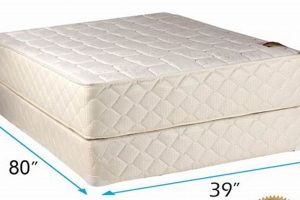
A foundational support system is essential for most mattresses to ensure proper weight distribution, longevity, and comfort. This support can take various forms, influencing the overall performance and lifespan of the mattress. The choice of support often depends on the specific mattress type and the manufacturer’s recommendations.
Proper support systems play a critical role in preventing mattress sagging and maintaining the correct spinal alignment for the sleeper. Historically, box springs were the standard, but contemporary alternatives such as platform beds and adjustable bases offer diverse functionalities and aesthetic options. Selecting the appropriate support enhances the sleep experience and protects the investment in the mattress itself.
This article will delve into the specifics of support requirements for Purple mattresses, examining acceptable foundations, the implications of using inadequate support, and alternative bed frame options compatible with the unique construction of a Purple mattress.
Considerations for Purple Mattress Foundation
Ensuring proper support for a Purple mattress is crucial for maximizing its lifespan and performance. Understanding the recommended foundation types prevents potential damage and maintains warranty validity.
Tip 1: Adhere to Manufacturer Guidelines: Consult Purple’s official website or product documentation for precise foundation requirements. Deviating from these recommendations may void the warranty.
Tip 2: Platform Beds as Viable Options: Platform beds with solid or closely spaced slats (no more than 2-3 inches apart) typically provide adequate support for Purple mattresses. Ensure the platform is sturdy and capable of handling the mattress’s weight.
Tip 3: Evaluate Existing Box Springs: Inspect the box spring for signs of wear or damage before use. If the box spring is old or sagging, it may compromise the support and comfort of the Purple mattress.
Tip 4: Prioritize Solid Support: Unlike traditional innerspring mattresses, Purple mattresses require consistent, even support across the entire surface. Avoid foundations with large gaps or uneven surfaces.
Tip 5: Adjustable Bases for Enhanced Functionality: Adjustable bases are compatible with Purple mattresses, offering customizable comfort and positioning. Verify the adjustable base’s weight capacity and compatibility with the mattress dimensions.
Tip 6: Inspect Slats Regularly: If using a slatted foundation, routinely check for broken or loose slats. Replace damaged slats promptly to maintain consistent support.
Tip 7: Confirm Weight Capacity: Ensure the chosen foundation can adequately support the combined weight of the mattress and sleepers. Exceeding the weight limit can lead to foundation failure and mattress damage.
Selecting a suitable foundation for the Purple mattress directly impacts its support, comfort, and longevity. Following manufacturer recommendations ensures optimal performance and warranty protection.
The subsequent sections will further explore alternative foundation options and the potential consequences of inadequate support.
1. Foundation Support Required

Foundation support is a primary consideration when determining the necessity of a box spring for a Purple mattress. The unique construction of Purple mattresses necessitates a stable, even surface to ensure proper weight distribution and prevent premature wear.
- Weight Distribution
Purple mattresses, due to their hyper-elastic polymer grid, require uniform support to prevent localized sagging or deformation. A box spring, or an alternative foundation, must effectively distribute weight across the entire mattress surface. If the existing support system fails to provide this even distribution, the mattress’s comfort and longevity are compromised, regardless of whether a box spring is used.
- Slatted Platform Considerations
If opting for a slatted platform instead of a box spring, the spacing between slats is critical. Excessive gaps between slats can lead to uneven support and mattress sagging in those areas. Manufacturers generally recommend a maximum slat spacing to maintain mattress integrity. This consideration directly impacts whether a box spring becomes a necessary addition to an existing bed frame.
- Warranty Implications
Purple, like many mattress manufacturers, stipulates specific foundation requirements within their warranty terms. Utilizing an unsuitable foundation, regardless of whether it’s a box spring or an alternative, can void the warranty if it contributes to mattress damage. Understanding these warranty requirements is essential in determining if the current foundation necessitates the addition of a compatible box spring.
- Alternative Foundation Compatibility
While a traditional box spring might suffice, modern alternatives like adjustable bases or solid platform beds can also fulfill the foundation support requirement. The key lies in ensuring these alternatives provide the same level of consistent support as a traditional box spring, without compromising the mattress’s structure or voiding the warranty. The choice between these options will influence whether a box spring is deemed necessary.
The decision of whether a Purple mattress requires a box spring is ultimately dictated by the need for adequate and even foundation support. While a traditional box spring can provide this support, alternative foundations can be equally effective, provided they meet the manufacturer’s specifications and warranty requirements. The primary goal remains ensuring the mattress receives the necessary structural support to maximize its lifespan and performance.
2. Platform Bed Alternatives

The relationship between platform bed alternatives and the question of a box spring’s necessity for Purple mattresses is central to understanding optimal mattress support. Platform beds, characterized by their inherent support system, often eliminate the need for a traditional box spring. The effectiveness of a platform bed as an alternative hinges on its construction and the level of support it provides. For instance, a solid-surface platform bed offers uniform support, minimizing the risk of sagging and ensuring proper weight distribution for the Purple mattress. This contrasts with a slatted platform, where the spacing between slats becomes critical. If the slats are too far apart, the Purple mattress may not receive adequate support, potentially leading to uneven wear and a diminished lifespan. A practical implication of this understanding is the need to carefully evaluate the platform bed’s design before placing a Purple mattress on it.
Several factors influence the suitability of platform bed alternatives. The material used in the platform’s construction affects its durability and weight-bearing capacity. Solid wood or metal platforms are generally more robust than those constructed from less durable materials. Moreover, the design of the platform should consider the Purple mattress’s specific requirements. For example, some platform beds feature recessed surfaces or raised edges that could interfere with the mattress’s intended performance. In real-world scenarios, individuals who switch from a box spring to a poorly designed platform bed may experience a decrease in sleep quality and an increase in mattress wear, ultimately undermining the benefits of the Purple mattress’s unique design.
In conclusion, platform bed alternatives can effectively replace a box spring for Purple mattresses, provided they offer sufficient and uniform support. The key lies in assessing the platform’s construction, material, and design in relation to the mattress’s specific requirements. Challenges arise when the platform bed’s support is inadequate, potentially leading to mattress damage and a reduced lifespan. Therefore, a thorough evaluation of the platform bed is essential to ensure it meets the necessary support criteria, thereby negating the need for a box spring and maximizing the Purple mattress’s benefits.
3. Slatted Frame Suitability

The suitability of a slatted frame directly impacts whether a Purple mattress necessitates a box spring. The effectiveness of a slatted frame hinges on the spacing between slats and the overall structural integrity of the frame itself. If slats are spaced too far apart, the Purple mattress may experience uneven support, potentially leading to sagging or premature wear. Conversely, a slatted frame with appropriately spaced and robust slats can provide adequate support, negating the need for a box spring. The cause-and-effect relationship is clear: inadequate slatted frame support causes mattress deformation, while sufficient support preserves mattress integrity. Real-life examples often involve consumers experiencing sagging issues with their Purple mattresses due to using frames with excessively wide slat gaps.
The importance of slatted frame suitability stems from the unique construction of Purple mattresses, which relies on consistent, even support across its entire surface. Traditional innerspring mattresses may tolerate some degree of unevenness, but Purple mattresses, with their hyper-elastic polymer grid, require a more uniform foundation. Practically, this means carefully measuring the gaps between slats and ensuring they do not exceed the manufacturer’s recommendations, typically around 2-3 inches. Moreover, the slats themselves must be strong enough to bear the combined weight of the mattress and sleepers. Frames made from flimsy materials or with insufficient center support can compromise the mattress’s performance, even if the slat spacing is adequate.
In conclusion, the suitability of a slatted frame is a critical factor in determining whether a Purple mattress requires a box spring. While a well-designed and properly constructed slatted frame can provide sufficient support, a poorly designed frame can lead to mattress damage and a voided warranty. Understanding this connection is of practical significance for consumers seeking to maximize the lifespan and comfort of their Purple mattress investment. The challenges lie in accurately assessing the existing frame’s capabilities and proactively addressing any deficiencies before placing the mattress on it.
4. Adjustable Base Compatibility

Adjustable base compatibility is a pivotal consideration when evaluating support options for Purple mattresses. These bases offer customizable positions, enhancing comfort and addressing specific health needs; however, ensuring compatibility is essential to prevent damage and maintain mattress integrity. The relevance of adjustable bases centers on their ability to provide dynamic support, potentially replacing the need for a traditional box spring if properly matched with the mattress.
- Weight Capacity and Support Structure
Adjustable bases possess specified weight capacities that must accommodate both the mattress and its occupants. Exceeding this limit can lead to base malfunction and inadequate mattress support, potentially causing sagging or deformation. A real-world example involves users experiencing premature mattress wear due to using an adjustable base with insufficient weight-bearing capacity. The implication is that selecting a base with an appropriate weight rating is paramount to prevent mattress damage, rendering a box spring superfluous if the adjustable base functions as intended.
- Flexibility and Mattress Material Compatibility
The flexibility of an adjustable base must align with the Purple mattress’s material properties. While Purple mattresses are designed to conform to various positions, excessive or unnatural bending could compromise the mattress’s internal structure. For instance, a base that creates sharp angles or extreme curves could damage the hyper-elastic polymer grid. Therefore, it is crucial to ensure the adjustable base provides smooth, gradual transitions to avoid undue stress on the mattress. In this scenario, the adjustable base effectively replaces the box spring, but its compatibility determines the mattress’s longevity.
- Platform Design and Breathability
The platform design of an adjustable base impacts airflow and mattress breathability. Some adjustable bases feature solid platforms, which may restrict airflow compared to slatted designs. Reduced airflow can lead to moisture buildup within the mattress, potentially affecting its comfort and hygiene. To mitigate this, it is advisable to choose bases with breathable designs or to utilize mattress protectors that promote airflow. This aspect highlights how the adjustable base can function as a complete support system, making a box spring unnecessary while necessitating careful consideration of design features affecting mattress breathability.
- Warranty Compliance
Utilizing an adjustable base must comply with the Purple mattress warranty guidelines. Non-compliant bases may void the warranty if they contribute to mattress damage. Manufacturers often specify acceptable base types and usage parameters to ensure optimal mattress performance and longevity. Before using an adjustable base, it is critical to verify its compatibility with the mattress warranty to avoid potential issues. This reinforces the idea that the adjustable base, when compliant with warranty stipulations, renders a box spring obsolete while maintaining warranty coverage.
In summary, adjustable base compatibility is a critical factor in determining whether a Purple mattress requires a box spring. A properly selected and utilized adjustable base can provide adequate support, negating the need for a traditional box spring while offering enhanced comfort and functionality. However, careful consideration must be given to weight capacity, flexibility, platform design, and warranty compliance to ensure the mattress’s integrity and longevity.
5. Warranty Compliance
Warranty compliance is a crucial factor when determining if a Purple mattress requires a box spring. Adhering to the manufacturer’s guidelines regarding foundation requirements is essential to maintain the warranty’s validity and ensure recourse in case of defects or premature wear. Non-compliance can void the warranty, leaving the owner responsible for repair or replacement costs.
- Approved Foundation Types
Purple specifies approved foundation types in its warranty documentation. Typically, these include solid platform beds, slatted bed frames with specific slat spacing, and adjustable bases that meet certain criteria. Using a foundation that does not meet these specifications, such as a box spring that is too old, damaged, or incompatible, can invalidate the warranty. This stipulation ensures the mattress receives adequate support, preventing issues that might be attributed to manufacturing defects rather than improper use.
- Impact of Improper Support
The warranty often outlines the consequences of using improper support. If the mattress sags or develops other issues due to inadequate or incompatible foundation support, the warranty may not cover the repair or replacement. The manufacturer’s rationale is that the foundation’s role in maintaining the mattress’s structural integrity is significant, and deviations from recommended support systems can directly contribute to premature wear or damage. Evidence of sagging attributable to an unapproved foundation is often grounds for warranty denial.
- Documentation and Proof of Compliance
In the event of a warranty claim, Purple may require documentation proving the use of an approved foundation. This could include photographs of the bed frame, purchase receipts for the foundation, or specifications from the manufacturer. Maintaining records of the foundation’s specifications and its compatibility with the Purple mattress is advisable to facilitate potential warranty claims. Lack of such documentation can complicate or negate the claim process.
- Consequences of Warranty Voidance
Voiding the warranty has several implications. The mattress owner assumes full financial responsibility for any repairs or replacements needed due to defects or premature wear. Furthermore, warranty voidance typically occurs if the mattress exhibits signs of damage caused by non-compliant support, such as excessive sagging or deformation. Thus, adhering to the warranty guidelines regarding foundation requirements is not merely a formality but a practical measure to protect the investment in the Purple mattress.
In summary, warranty compliance is intrinsically linked to the decision of whether a Purple mattress requires a box spring or an alternative foundation. By adhering to the manufacturer’s specifications regarding approved foundation types, documenting compliance, and understanding the consequences of warranty voidance, owners can ensure their investment is protected and the mattress receives the appropriate support for optimal performance and longevity.
6. Sagging Prevention

Sagging prevention is intrinsically linked to the determination of whether a Purple mattress benefits from a box spring or requires an alternative support system. The unique construction of Purple mattresses, characterized by its hyper-elastic polymer grid, necessitates consistent and even support to maintain its structural integrity and prevent premature sagging. An inadequate foundation leads to uneven weight distribution, concentrating stress on specific areas of the mattress and accelerating the degradation of the polymer grid. This, in turn, results in noticeable sagging, compromising both comfort and the mattress’s lifespan. Real-life examples often demonstrate users experiencing significant sagging issues after placing a Purple mattress on an old or poorly designed foundation, underscoring the importance of proper support from the outset. The practical significance of understanding this connection lies in proactively selecting a suitable foundation to prevent long-term damage and ensure the mattress performs as intended.
The impact of sagging extends beyond mere discomfort. As a mattress sags, it loses its ability to provide proper spinal alignment, potentially contributing to back pain, stiffness, and disrupted sleep patterns. This is particularly relevant for Purple mattresses, which are designed to contour to the body and provide targeted support. When sagging occurs, this contouring ability is diminished, negating the benefits of the mattress’s design. Furthermore, sagging can exacerbate existing pressure points, leading to increased discomfort during sleep. Preventative measures, such as using a solid platform bed or a slatted frame with closely spaced slats, are therefore crucial for maintaining the mattress’s ergonomic properties. Regular inspection of the foundation is also essential to identify and address any signs of weakness or instability that could contribute to sagging. This proactive approach ensures the mattress receives continuous, even support, maximizing its lifespan and preserving its ability to promote healthy sleep.
In conclusion, sagging prevention is a primary objective in determining the appropriate support system for a Purple mattress. While a traditional box spring may suffice, alternative foundations like platform beds and adjustable bases can also provide adequate support, provided they meet specific criteria regarding weight distribution and structural integrity. Challenges arise in accurately assessing the existing foundation’s capabilities and proactively addressing any deficiencies before they lead to sagging. Ultimately, prioritizing sagging prevention through the selection of a suitable foundation is essential for maximizing the Purple mattress’s lifespan, preserving its ergonomic benefits, and ensuring a comfortable and supportive sleep surface. The question of “does the Purple mattress need a box spring” is therefore inherently tied to the larger goal of preventing premature sagging and maintaining the mattress’s performance over time.
Frequently Asked Questions
This section addresses common inquiries regarding the necessity of a box spring or alternative support for Purple mattresses, providing clarity on optimal foundation choices and warranty considerations.
Question 1: Is a box spring strictly required for a Purple mattress?
A box spring is not strictly mandatory. However, adequate support is essential. Alternative foundations, such as platform beds with closely spaced slats or adjustable bases, can provide suitable support if they meet the manufacturer’s specifications.
Question 2: What are the risks of using an unsupported foundation with a Purple mattress?
Using an unsupported or inadequate foundation can lead to premature sagging, reduced comfort, and potential voidance of the mattress warranty. Uneven weight distribution compromises the hyper-elastic polymer grid’s integrity.
Question 3: How should a platform bed be configured for optimal Purple mattress support?
A platform bed should feature either a solid surface or slats spaced no more than 2-3 inches apart. The platform must be structurally sound and capable of supporting the combined weight of the mattress and sleepers.
Question 4: Are adjustable bases compatible with Purple mattresses?
Adjustable bases are generally compatible, provided they meet the manufacturer’s specifications for weight capacity and flexibility. The base should allow for smooth, gradual transitions to avoid damaging the mattress’s internal structure.
Question 5: What documentation is needed to prove foundation compliance for warranty claims?
Maintaining records of the foundation’s specifications, purchase receipts, and photographs of the setup is advisable. This documentation serves as proof of compliance with warranty requirements in the event of a claim.
Question 6: How does foundation choice impact the Purple mattress warranty?
Using an unapproved or inadequate foundation can void the mattress warranty. Manufacturers specify acceptable foundation types and usage parameters to ensure optimal mattress performance and longevity; deviations from these guidelines may invalidate warranty coverage.
In conclusion, proper support is paramount for Purple mattresses, regardless of whether a traditional box spring is employed. Adhering to manufacturer guidelines ensures optimal performance and maintains warranty validity.
The subsequent section will delve into common signs of inadequate support and remedial actions.
Does the Purple Mattress Need a Box Spring?
The preceding analysis has demonstrated that the question “does the purple mattress need a box spring” cannot be answered with a simple yes or no. The necessity of a box spring is contingent upon the existing bed frame’s construction and its ability to provide adequate, uniform support. While a traditional box spring can suffice, alternative foundations, such as platform beds with closely spaced slats and compatible adjustable bases, present viable options, provided they adhere to the manufacturer’s specifications and maintain warranty compliance. Inadequate support compromises the mattress’s lifespan, comfort, and ergonomic benefits, potentially voiding the warranty.
Therefore, consumers should carefully evaluate their existing bed frame or foundation, ensuring it meets Purple’s requirements for proper support. Prioritizing a stable and even surface not only safeguards the investment in the mattress but also contributes to improved sleep quality and long-term spinal health. Prudent evaluation and proactive measures are essential for optimizing the Purple mattress experience.
![Upgrade Your Sleep: Twin Mattress & Box Spring Set - [Year] | Organic & Natural Mattress Buyer’s Guide: Non-Toxic Sleep Solutions](https://mattressworldpa.com/wp-content/uploads/2025/07/th-3528-300x200.jpg "Upgrade Your Sleep: Twin Mattress & Box Spring Set - [Year] Organic & Natural Mattress Buyer’s Guide: Non-Toxic Sleep Solutions")