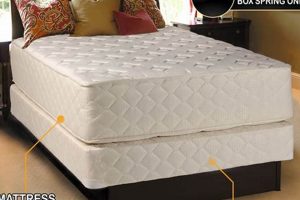
The dimensions of a full size mattress are typically 54 inches in width and 75 inches in length. This standard measurement distinguishes it from other mattress sizes, such as twin, queen, and king.
Understanding the specific measurements of a full size mattress is crucial for ensuring proper fit within a bed frame and adequate space within a bedroom. These dimensions dictate compatibility with bedding and influence overall comfort for sleepers, particularly those who require more space than a twin bed offers but find a queen size excessive.
The ensuing discussion will delve into related aspects, including the selection criteria for full size mattresses, considerations for different sleeping needs, and the advantages and disadvantages relative to alternative mattress dimensions.
Tips Regarding Full Size Mattress Dimensions
Selecting a mattress with appropriate dimensions is crucial for optimizing sleep quality and bedroom functionality. The following tips provide guidance on navigating considerations related to full size mattress measurements.
Tip 1: Measure the Available Space: Before purchasing, meticulously measure the intended space within the bedroom. This ensures the 54-inch by 75-inch mattress can be accommodated without overcrowding the room.
Tip 2: Consider Sleeper Size: Full size mattresses are generally suitable for single adults or teenagers. However, if a sleeper is particularly tall or broad, a larger mattress size may be more appropriate to avoid feeling cramped.
Tip 3: Evaluate Bed Frame Compatibility: Confirm the bed frame is designed to support a 54-inch by 75-inch mattress. Using an incompatible frame can lead to inadequate support and premature mattress wear.
Tip 4: Assess Room Layout: Consider the placement of other furniture within the room. The 54-inch width must allow for easy navigation and prevent obstruction of doorways or walkways.
Tip 5: Examine Sheet and Bedding Compatibility: Ensure that all purchased sheets, blankets, and comforters are specifically designed for a full size mattress (54 inches by 75 inches). Mismatched bedding can result in a poor fit and reduced comfort.
Tip 6: Factor in Partner Considerations: While occasionally suitable for couples, the 54-inch width may prove insufficient for comfortable sleep. Partners should carefully evaluate their personal space requirements before opting for a full size mattress.
Adhering to these tips will facilitate a well-informed decision, guaranteeing a mattress that optimally meets individual needs and space limitations.
The subsequent discussion will provide insights into alternative mattress sizes and their suitability for different sleeping arrangements.
1. Width

The 54-inch width constitutes a primary dimension defining a full size mattress. This measurement is a key differentiator and essential for categorizing and identifying this specific mattress configuration.
- Single Sleeper Accommodation
The 54-inch width is generally suited for a single adult sleeper. This dimension allows for adequate space to move freely during sleep without the constraints experienced on a narrower twin mattress. However, larger individuals may find the width restrictive, potentially impacting sleep quality.
- Limited Partner Accommodation
While a full size mattress can accommodate two adults, the 54-inch width provides limited personal space. Each sleeper has only 27 inches of space, less than a twin bed’s width. This restricted area can lead to discomfort, sleep disturbance, and is generally not recommended for long-term use by couples.
- Bedroom Space Optimization
The 54-inch width allows for efficient space utilization within smaller bedrooms. Compared to larger queen or king size mattresses, a full size mattress provides a less intrusive footprint, facilitating easier furniture placement and room navigation.
- Cost Considerations
The 54-inch width contributes to a generally lower price point compared to wider mattresses. This makes full size mattresses an economically viable option for individuals or situations where budget constraints are a primary concern. The smaller material requirement translates to reduced manufacturing costs.
The 54-inch width of a full size mattress impacts sleeper accommodation, space utilization, and cost-effectiveness. These factors are integral considerations when assessing if a full size mattress, defined by its dimensions, meets specific individual or spatial requirements, highlighting its crucial role in understanding the mattress’s overall suitability.
2. Length

The 75-inch length represents a crucial dimension determining the spatial requirements and suitability of a full size mattress. This measurement, coupled with the 54-inch width, defines the overall size and influences the mattress’s capacity to comfortably accommodate individuals of specific heights. A direct consequence of this dimension is its impact on the sleeper’s experience, particularly for individuals exceeding six feet in height. For example, a sleeper who is 6’2″ (74 inches) will find that the 75-inch length of the full-size mattress barely accommodates their height. This can lead to discomfort and potentially disrupt sleep as their feet might dangle off the edge, or they may be forced to sleep in a curled position. Therefore, the “Length: 75 inches” attribute constitutes a significant parameter when considering “how many inches in a full size mattress” for individual comfort and suitability.
The practical significance of understanding the 75-inch length becomes evident in scenarios involving space constraints. For instance, in smaller apartments or guest rooms, the 75-inch length combined with the 54-inch width may offer a balance between sleep space and room utilization. However, this benefit is contingent on the user’s height and sleep preferences. Furthermore, the standardized nature of this measurement facilitates ease of finding compatible bedding, such as fitted sheets and mattress protectors. This is because most bedding manufacturers adhere to these standardized dimensions. The length, as a component, impacts not just individual comfort but also affects the wider ecosystem of products associated with mattresses, thus demonstrating its practical implications.
In summary, the 75-inch length is not merely a dimensional attribute but a defining factor in the overall utility and suitability of the full size mattress. Its interaction with individual height, spatial limitations, and compatibility with ancillary products demonstrates its pivotal role within the broader context. A mismatch between a sleeper’s height and the 75-inch length introduces potential discomfort and compromised sleep quality. Comprehending this dimension is integral for making an informed decision, ensuring that the chosen mattress effectively addresses specific needs and preferences, therefore, an understanding of the ‘length 75 inches’ is integral in fully grasping how many inches in a full-size mattress.
3. Area

The area of a full size mattress, calculated as 4050 square inches, is a direct consequence of its 54-inch width and 75-inch length. This measurement provides a quantitative indication of the surface available for sleeping, influencing its suitability for different individuals and sleeping arrangements. The following points illustrate the significance of this area in relation to the overall characteristics of a full size mattress.
- Single Occupancy Comfort
The 4050 square inch area offers a balance between compactness and sufficient space for a single sleeper. This area allows for a degree of movement and comfort without being excessively large, making it appropriate for individuals who do not require the expansive space of a queen or king size mattress. For example, a single adult of average build will generally find this area adequate for comfortable sleep.
- Suitability for Smaller Rooms
The surface area is proportionally related to the overall footprint of the mattress within a room. The 4050 square inch area translates to a moderate physical presence, making the full size mattress a viable option for smaller bedrooms or guest rooms where space is limited. A larger area, such as that of a queen mattress, may overwhelm a smaller space, hindering maneuverability and aesthetic balance.
- Comparison with Other Sizes
Comparing the 4050 square inch area with that of other mattress sizes provides context for its relative dimensions. A twin mattress has a significantly smaller area, while a queen mattress offers a substantially larger one. This comparison highlights the position of the full size mattress as an intermediate option, suitable for situations where a twin is too small and a queen too large. For instance, a college dorm room might be better suited to the area of a full size than a queen due to space limitations.
- Implications for Co-Sleeping
While a full size mattress can technically accommodate two sleepers, the 4050 square inch area results in a limited amount of personal space for each individual. This can lead to discomfort, disrupted sleep, and is generally not recommended for couples on a regular basis. The relatively small area necessitates close proximity, which may not be conducive to restful sleep for both individuals. A larger area, such as that provided by a queen or king mattress, is generally more appropriate for co-sleeping arrangements.
The area of 4050 square inches, derived from the dimensions of a full size mattress, significantly influences its suitability for various users and room configurations. Understanding this area provides a valuable metric for assessing the mattress’s practical applications and limitations, facilitating informed decision-making in relation to space constraints, individual needs, and sleeping arrangements.
4. Frame Compatibility

Frame compatibility is intrinsically linked to the specified dimensions of a full size mattress. Adherence to these measurements ensures proper support, prevents damage, and maximizes the lifespan of both the mattress and the frame. Deviations from the established 54-inch by 75-inch standard can lead to instability and reduced comfort.
- Support Integrity
A frame designed for a full size mattress provides specific support structures aligned with the mattress’s dimensions. An undersized frame will leave sections of the mattress unsupported, leading to sagging and uneven wear. Conversely, an oversized frame may not provide adequate edge support, increasing the risk of collapse. For example, using a queen-sized frame with a full mattress will result in gaps and inadequate support, compromising the mattress’s structural integrity.
- Bedding Fit and Aesthetics
The frame’s dimensions influence the fit of bedding, such as sheets and comforters. A frame incompatible with the mattress size can result in ill-fitting bedding that either strains the fabric or appears visually unappealing. For instance, sheets designed for a queen mattress will be too large for a full size frame, creating excess material that can bunch up and become uncomfortable during sleep.
- Safety Considerations
Mismatched frame and mattress dimensions can pose safety risks. An unstable mattress can shift or slide off the frame, potentially causing injury to the sleeper. A secure and properly fitting frame ensures stability and minimizes the risk of accidents. Consider a scenario where a child climbs onto a mattress that is not securely fitted to the frame; the risk of the mattress tipping increases substantially.
- Longevity and Warranty
Manufacturers often specify that mattresses must be used with compatible frames to maintain warranty validity. Using an inappropriate frame can void the warranty if it contributes to premature wear or damage. Adhering to the recommended frame dimensions is therefore crucial for protecting the investment in the mattress. Many mattress warranties explicitly state that damage caused by improper support is not covered.
In summary, frame compatibility is not merely an aesthetic consideration but a functional imperative. The precise dimensions of a full size mattress necessitate a matching frame to ensure proper support, safety, and longevity, thereby highlighting the critical connection between “how many inches in a full size mattress” and its corresponding structural requirements.
5. Sheet Dimensions
The dimensions of sheets are inextricably linked to “how many inches in a full size mattress,” representing a critical aspect of functional compatibility. A full size mattress, standardized at 54 inches wide and 75 inches long, necessitates sheets engineered to conform precisely to these measurements. Deviations in sheet dimensions, such as insufficient depth or mismatched width and length, result in improper fit. This misalignment causes the sheet to either constrict the mattress, impeding comfort, or to loosen, creating wrinkles and slippage during sleep. The dimensional compatibility directly affects sleep quality and the lifespan of both the mattress and the bedding itself. For instance, consider a fitted sheet intended for a queen-sized mattress attempting to fit a full-sized one; the excess fabric will not only be aesthetically displeasing but will also fail to provide the necessary tension to keep the sheet securely in place.
Further, the practical significance of understanding the relationship between “how many inches in a full size mattress” and appropriate sheet dimensions extends to economic considerations. Purchasing sheet sets designed for incorrect mattress sizes leads to unnecessary expenses. Incompatible sheets often require replacement due to premature wear caused by improper fit or result in a lack of comfort and necessitate repeated purchases to achieve the desired standard. Moreover, sheet dimensions play a vital role in maintaining the integrity of the mattress. A correctly fitted sheet acts as a protective barrier, preventing direct contact with contaminants such as dust, sweat, and allergens. This barrier prolongs the lifespan of the mattress and reduces the frequency of cleaning or professional maintenance requirements.
In summary, the precise correlation between “how many inches in a full size mattress” and the corresponding sheet dimensions is paramount for comfort, hygiene, and economic efficiency. The standardized measurements serve as a crucial reference point, guiding consumers in selecting appropriate bedding that ensures optimal functionality and extends the lifespan of both the mattress and the sheets. Misunderstanding or neglecting this dimensional relationship introduces unnecessary challenges, leading to discomfort, increased costs, and potential compromise of sleep quality.
6. Vertical Thickness
Vertical thickness, while not a direct component of the “how many inches in a full size mattress” phrase that refers to width and length, significantly influences the overall functionality and perceived comfort of the mattress. This dimension, typically ranging from 8 to 14 inches, impacts factors such as support, ease of entry and exit, and compatibility with bedding. A proper understanding of vertical thickness is therefore crucial for optimizing the sleeping experience despite not being explicitly stated in the dimensional description.
- Support and Comfort Layers
Vertical thickness accommodates the internal layering of mattresses, including support cores (e.g., innersprings, foam) and comfort layers (e.g., memory foam, latex). Greater thickness often allows for more complex layering, potentially enhancing pressure relief and spinal alignment. For example, a thicker mattress may incorporate a high-density foam base for support, followed by multiple layers of varying firmness to contour to the body. Conversely, a thinner mattress may offer less nuanced support and may not adequately accommodate individuals with higher body weights.
- Bed Frame and Foundation Compatibility
The vertical thickness of a full size mattress influences its compatibility with bed frames and foundations. Some frames are designed to accommodate thicker mattresses, while others may require thinner profiles to maintain an appropriate bed height. A mattress that is too thick for a given frame can result in an excessively high sleeping surface, making it difficult to get in and out of bed. Conversely, a mattress that is too thin may not adequately fill the frame, potentially leading to instability or aesthetic issues. Consider platform beds, which often require lower-profile mattresses to avoid an uncomfortably high sleeping surface.
- Ease of Access and Egress
The vertical thickness affects the overall height of the sleeping surface, which in turn influences the ease with which individuals can get in and out of bed. A mattress that is too thick can be challenging for shorter individuals or those with mobility limitations. Conversely, a mattress that is too thin may require excessive bending or stooping, potentially exacerbating joint pain. The ideal vertical thickness promotes comfortable access and egress for the intended user. For instance, elderly individuals may benefit from a thinner mattress to minimize the distance they need to lower themselves when getting into bed.
- Sheet Depth Requirements
Vertical thickness dictates the required depth of fitted sheets. Sheets are typically labeled with a pocket depth indicating the maximum mattress thickness they can accommodate. Using sheets with insufficient pocket depth can result in the sheets pulling off the corners of the mattress, leading to discomfort and premature wear. Conversely, using sheets with excessive pocket depth can create a loose and wrinkled sleeping surface. The vertical thickness of a full size mattress must therefore be considered when selecting appropriate bedding. A mattress with a 12-inch vertical thickness will require sheets with a pocket depth of at least 12 inches, and preferably slightly more to ensure a secure fit.
Although vertical thickness is not directly part of the phrase “how many inches in a full size mattress” which defines the width and length, this dimension remains a significant factor in evaluating the appropriateness of that mattress size for a given individual. Proper vertical thickness ensures adequate support, facilitates comfortable access, and guarantees compatibility with bed frames and bedding, collectively contributing to a satisfying sleep experience. Understanding this dimension is, therefore, vital for making a comprehensive assessment of a full size mattress.
Frequently Asked Questions
This section addresses common inquiries regarding the dimensions of a full size mattress, providing clarity and precision for informed decision-making.
Question 1: What are the precise dimensions defining a full size mattress?
A full size mattress measures 54 inches in width and 75 inches in length. These standardized measurements distinguish it from other mattress sizes, such as twin, queen, and king.
Question 2: Is a full size mattress suitable for two adults?
While it can accommodate two adults, the 54-inch width provides limited personal space. This configuration is generally not recommended for regular co-sleeping due to potential discomfort and sleep disruption.
Question 3: How do the dimensions of a full size mattress compare to those of a queen size mattress?
A queen size mattress is significantly larger, measuring 60 inches in width and 80 inches in length. This provides greater space for single sleepers or couples compared to a full size mattress.
Question 4: What size sheets are required for a full size mattress?
Sheets specifically designed for a full size mattress, measuring 54 inches by 75 inches, are required. Using incorrectly sized sheets can result in a poor fit and reduced comfort.
Question 5: Will a full size mattress fit in a standard full size bed frame?
Yes, a full size mattress is designed to fit standard full size bed frames. It is crucial to verify that the frame is specifically intended for a full size mattress to ensure proper support and stability.
Question 6: What factors should be considered when choosing a full size mattress based on dimensions?
Factors to consider include the sleeper’s size, the available space within the bedroom, and whether the mattress will be used for single or dual occupancy. Personal preferences regarding sleeping space should also be taken into account.
Understanding these dimensions is fundamental to selecting a mattress that optimally meets individual needs and spatial constraints.
The subsequent discussion will explore the long-term benefits of choosing a mattress with appropriate dimensions.
Conclusion
This exploration has elucidated the precise dimensions constituting a full size mattress 54 inches in width and 75 inches in length and their ramifications on comfort, space utilization, and compatibility with ancillary products. The standardized nature of these measurements is paramount for ensuring proper fit within bed frames, selection of appropriately sized bedding, and overall optimization of the sleep environment. The area dictated by these dimensions influences the suitability for single or dual occupancy and dictates the constraints of available space. The vertical thickness, while separate from the base dimensions, equally contributes to overall comfort and compatibility.
Therefore, understanding “how many inches in a full size mattress” is not merely an academic exercise, but a practical necessity for informed decision-making. Accurate assessment of these dimensions, considered in conjunction with individual needs and spatial limitations, contributes directly to improved sleep quality and long-term satisfaction. Failure to account for these dimensional factors invites potential discomfort, compromised support, and unnecessary expenditure. Future developments in sleep technology should continue to prioritize dimensional standardization to ensure continued compatibility and optimize the consumer experience.