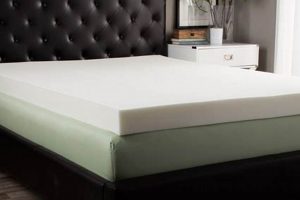
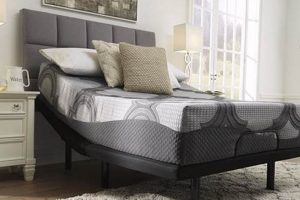
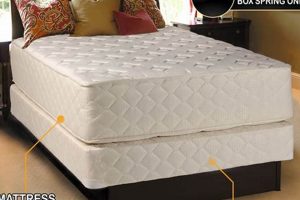
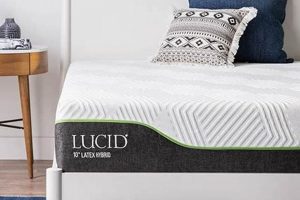
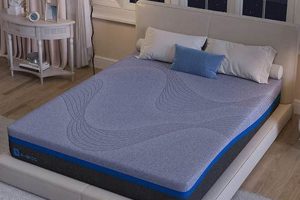
The subject of optimal sleep surfaces often leads individuals to consider various mattress dimensions. One particular size, offering a balance of comfort and support, features a thickness of twelve inches. This measurement typically indicates a multi-layered construction, often incorporating materials such as memory foam, latex, and high-density support foam to provide a comfortable and supportive sleep experience. As an example, a mattress featuring a top layer of gel-infused memory foam over a core of individually wrapped coils, reaching a total thickness of twelve inches, could offer pressure relief and motion isolation.
The selection of a specific mattress thickness is relevant due to its impact on factors such as spinal alignment, pressure point relief, and overall support. Mattresses of this depth frequently offer enhanced durability and can accommodate a wider range of body types and sleeping positions. Historically, thicker mattresses have been associated with a more luxurious and comfortable sleeping experience, leading to their increased popularity in recent years.
The subsequent sections will examine the key characteristics and selection criteria to consider when evaluating mattresses of this particular dimension. Further topics will include a discussion of various material compositions, construction methods, and performance attributes that contribute to an individual’s sleep quality and overall satisfaction.
Guidance for Selecting a Twelve-Inch Mattress
The following recommendations offer guidance on evaluating mattresses possessing a twelve-inch profile, assisting in the selection of a sleep surface that meets individual needs and preferences.
Tip 1: Assess Material Composition: Evaluate the types of materials used in the construction. Options include memory foam, latex, innerspring coils, and hybrid combinations. Each material offers unique properties regarding support, pressure relief, and temperature regulation. For instance, memory foam conforms to the body’s contours, while latex provides a more responsive feel.
Tip 2: Examine Layer Construction: Investigate the layering of materials within the mattress. A well-designed mattress typically incorporates multiple layers to optimize comfort and support. Example: a combination of a comfort layer, transition layer, and a supportive base layer.
Tip 3: Consider Support System: Determine the type of support system provided. Innerspring coils offer traditional support, while pocketed coils provide enhanced motion isolation. Solid foam cores offer uniform support and can be suitable for individuals with specific needs.
Tip 4: Evaluate Edge Support: Check the edge support provided by the mattress. Strong edge support prevents sagging and allows for full use of the sleeping surface. Reinforced edges can extend the lifespan of the mattress.
Tip 5: Prioritize Temperature Regulation: Assess the mattress’s ability to regulate temperature. Materials like gel-infused memory foam and breathable latex can help dissipate heat and maintain a comfortable sleeping temperature.
Tip 6: Consider Sleeping Position: Factor in individual sleeping position preferences. Side sleepers may benefit from mattresses with enhanced pressure relief, while back and stomach sleepers may require firmer support.
Tip 7: Review Certification Standards: Look for certifications such as CertiPUR-US, which indicates that the foam used in the mattress has been tested for harmful substances and emissions.
Selecting a suitable mattress requires careful consideration of various factors. The information provided above facilitates informed decision-making and improved sleep quality.
The subsequent section will explore common challenges and frequently asked questions associated with selecting the best twelve-inch mattress.
1. Material Composition

Material composition constitutes a foundational aspect in determining the overall performance and suitability of a twelve-inch mattress. The specific materials employed directly influence factors such as comfort, support, temperature regulation, and durability, thereby impacting the sleep experience.
- Memory Foam Density and Formulation
Memory foam, a common component, varies significantly in density and formulation. Higher-density memory foam generally offers greater support and longevity but may retain more heat. Gel-infused or open-cell memory foam formulations attempt to mitigate heat retention. The specific density and formulation significantly impact the pressure-relieving capabilities and overall comfort of the mattress.
- Latex Type (Natural vs. Synthetic)
Latex, derived from rubber trees or produced synthetically, provides a responsive and durable alternative to memory foam. Natural latex exhibits inherent breathability and antimicrobial properties. Synthetic latex, while typically more affordable, may lack the same degree of breathability and durability. The choice between natural and synthetic latex influences the mattress’s environmental impact and performance characteristics.
- Innerspring Coil Gauge and Configuration
In innerspring or hybrid mattresses, the gauge and configuration of the coils determine the level of support and motion isolation. Lower-gauge coils offer firmer support, while higher-gauge coils provide a softer feel. Pocketed coils, individually wrapped in fabric, minimize motion transfer. The coil system’s characteristics directly affect the mattress’s ability to provide adequate support and minimize disturbances from partner movement.
- Support Foam Density and ILD Rating
The density and Indentation Load Deflection (ILD) rating of the support foam base contribute significantly to the mattress’s overall support and durability. Higher-density support foam provides greater resistance to compression and prevents sagging. The ILD rating indicates the firmness of the foam. The selection of appropriate support foam ensures proper spinal alignment and extends the lifespan of the mattress.
The interplay between these materials dictates the performance characteristics of a twelve-inch mattress. Understanding the properties and implications of each material component is crucial for selecting a mattress that aligns with individual needs and preferences, thereby maximizing sleep quality and overall satisfaction.
2. Firmness Level

The firmness level of a twelve-inch mattress significantly influences its suitability for individual sleepers. Firmness dictates the degree to which the mattress yields to pressure, directly impacting spinal alignment and pressure point relief. A too-soft mattress may result in spinal misalignment, leading to back pain, while an overly firm mattress can create pressure points, particularly at the shoulders and hips. The “best 12 inch mattress” for a given individual directly correlates to a firmness level appropriate for their body weight, sleeping position, and personal preferences. For example, a lightweight side sleeper generally benefits from a softer mattress that allows for greater contouring and pressure relief, while a heavier individual who sleeps on their stomach typically requires a firmer mattress to prevent excessive sinking and maintain spinal alignment.
Selecting the correct firmness level involves considering the interplay between body weight and sleeping position. Individuals should evaluate descriptions such as “plush,” “medium,” or “firm,” often found in product specifications, in relation to their own physical characteristics. Online resources provide firmness charts that offer general guidelines, but individual preference plays a crucial role. Trial periods, offered by many mattress retailers, allow consumers to test the firmness in their own sleep environment. Hybrid mattresses, incorporating features of both innerspring and foam constructions, often provide a range of firmness options, catering to diverse sleeper needs. Furthermore, adjustable firmness mattresses, using air chambers or other mechanisms, enable customization of the sleep surface to suit individual preferences, offering a potential solution for couples with differing firmness requirements.
Ultimately, determining the ideal firmness level constitutes a critical step in selecting an optimal twelve-inch mattress. Ignoring this aspect can lead to discomfort, disrupted sleep, and potential long-term health consequences. While generalized recommendations provide a starting point, personal experimentation and a thorough understanding of one’s own sleep needs remain paramount. The “best 12 inch mattress” is, therefore, not a universal standard, but rather a personalized choice predicated on achieving proper spinal alignment and pressure relief for the individual.
3. Support System

The support system within a twelve-inch mattress constitutes a critical determinant of its overall performance, directly affecting spinal alignment, pressure distribution, and long-term durability. A deficient support system can lead to sagging, uneven weight distribution, and ultimately, discomfort and potential musculoskeletal issues. Conversely, a well-engineered support system ensures proper posture maintenance throughout the sleep cycle, minimizing pressure points and promoting restful sleep. For instance, a coil-based support system utilizing individually wrapped coils effectively isolates motion, preventing disturbances caused by a sleeping partner. The density and arrangement of the coils are specifically engineered to provide targeted support to different areas of the body, such as the lumbar region, which requires greater reinforcement to maintain proper spinal curvature.
Alternative support systems, such as those employing high-density foam cores, offer uniform support across the entire mattress surface. These foam cores are often layered with varying densities to provide both cushioning and structural integrity. The thickness and density of the foam layers are carefully calibrated to ensure adequate support and prevent premature sagging, a common issue in lower-quality mattresses. Hybrid mattresses, combining coil-based and foam-based support systems, aim to deliver the benefits of both technologies. They integrate the motion isolation and targeted support of individually wrapped coils with the contouring and pressure relief of memory foam or latex. The effectiveness of a hybrid support system depends on the quality and arrangement of both the coil and foam components.
In summary, the support system forms the structural foundation of a twelve-inch mattress, profoundly influencing its performance and longevity. Selection of a mattress with an appropriate support system necessitates careful consideration of individual needs, sleeping preferences, and body weight. Overlooking this fundamental aspect can lead to dissatisfaction and potential health complications. The ideal support system provides a balance of firmness, pressure relief, and motion isolation, ensuring a comfortable and supportive sleep environment. Evaluating the support system is paramount when searching for the best twelve-inch mattress.
4. Temperature Regulation

Temperature regulation is a critical performance aspect directly impacting the perceived quality of any sleep surface, including a twelve-inch mattress. The inability of a mattress to effectively dissipate heat can lead to discomfort, disrupted sleep cycles, and diminished rest quality. A mattress retaining excessive body heat often results in night sweats, restlessness, and ultimately, a less restorative sleep experience. Consequently, in the context of mattress selection, a primary attribute of a “best 12 inch mattress” is its capacity to maintain a comfortable sleeping temperature throughout the night. This requires careful consideration of the materials and construction techniques employed.
The materials comprising a mattress play a crucial role in its temperature regulation capabilities. For example, traditional memory foam, known for its conforming properties, tends to trap heat due to its dense, closed-cell structure. In response, manufacturers have introduced modifications such as gel-infused memory foam or open-cell foam structures designed to enhance airflow and reduce heat retention. Similarly, natural latex, derived from rubber trees, possesses inherent breathability, allowing for greater air circulation compared to synthetic latex or traditional memory foam. Innerspring mattresses, by virtue of their open coil structure, generally exhibit superior airflow compared to all-foam models. The selection of breathable materials, coupled with strategic design elements like ventilated layers or quilted covers, significantly contributes to the mattress’s ability to regulate temperature. Therefore, a mattress incorporating breathable materials and a design promoting airflow is more likely to provide a cooler and more comfortable sleep environment.
In conclusion, effective temperature regulation is an indispensable characteristic of a high-quality twelve-inch mattress. The selection of appropriate materials, coupled with thoughtful design considerations, directly influences the mattress’s ability to dissipate heat and maintain a comfortable sleeping temperature. Mattresses failing to adequately address temperature regulation often lead to sleep disturbances and diminished rest quality. Thus, when evaluating a “best 12 inch mattress”, prioritizing temperature regulation is essential for achieving a restful and restorative sleep experience. Consumers should carefully examine product specifications and seek independent reviews to assess a mattress’s temperature regulation capabilities before making a purchase decision.
5. Motion Isolation
Motion isolation, or the capacity of a mattress to minimize the transfer of movement across its surface, represents a critical performance parameter in the selection of a sleep surface, particularly when considering the attributes of a “best 12 inch mattress.” The relevance of motion isolation becomes especially pronounced for individuals sharing a bed, as it directly influences the degree to which one partner’s movements disturb the other’s sleep.
- Material Composition and Damping Properties
The inherent damping properties of materials significantly influence motion isolation. Memory foam and latex, due to their viscoelastic characteristics, excel at absorbing energy and minimizing the propagation of movement. In contrast, traditional innerspring mattresses, with their interconnected coil systems, tend to transmit motion more readily. The composition and density of the comfort layers directly impact the mattress’s ability to dampen movement. For example, a mattress incorporating a thick layer of high-density memory foam will generally exhibit superior motion isolation compared to one with a thin layer of low-density foam.
- Coil System Configuration
In hybrid or innerspring mattresses, the configuration of the coil system plays a crucial role in motion isolation. Individually pocketed coils, where each coil is encased in fabric, minimize the transfer of motion between coils. This design allows each coil to respond independently to pressure, preventing widespread disturbance. Conversely, interconnected coil systems, where coils are linked together, tend to transmit motion more broadly across the mattress surface. The gauge and pre-compression of the coils also influence motion isolation; firmer coils, designed to provide greater support, may transmit more motion than softer coils.
- Layer Construction and Decoupling Mechanisms
The layering of different materials within a mattress can enhance motion isolation. Transition layers, positioned between the comfort layers and the support core, can act as buffers, further dampening movement. Some mattresses incorporate specific decoupling mechanisms, such as perimeter reinforcement or strategically placed foam inserts, to minimize motion transfer at the edges of the mattress. The arrangement and properties of these layers and decoupling mechanisms contribute to the overall effectiveness of motion isolation.
- Mattress Height and Density
While not the sole determinant, mattress height, particularly in the context of a “best 12 inch mattress,” can influence motion isolation. Generally, thicker mattresses with denser materials tend to exhibit superior motion isolation compared to thinner, less dense mattresses. The increased mass and internal damping contribute to the absorption and dissipation of energy, reducing the transmission of movement across the surface. However, the quality and properties of the materials used are more important than height alone.
The interplay of these factorsmaterial composition, coil system configuration, layer construction, and mattress heightcollectively determines the motion isolation performance of a mattress. When evaluating a “best 12 inch mattress” for couples, a thorough assessment of these attributes is essential to ensure minimal sleep disruption caused by partner movement. Mattresses specifically designed for motion isolation often incorporate a combination of high-density memory foam, individually pocketed coils, and strategically placed decoupling mechanisms to optimize sleep quality for both partners.
6. Edge Support

Edge support, defined as the structural reinforcement along the perimeter of a mattress, constitutes a significant factor influencing the overall performance and perceived quality of a twelve-inch mattress. Its absence can lead to premature sagging, a reduction in usable sleep surface, and a compromised sense of stability, thereby diminishing the value proposition of a mattress.
- Foam Encasement and Perimeter Reinforcement
Foam encasement involves surrounding the mattress core with high-density foam rails. This provides a firm edge that resists compression, preventing the “roll-off” sensation often experienced on mattresses lacking such support. Perimeter reinforcement, alternatively, utilizes steel rods or other structural elements to achieve a similar effect. The implementation of either foam encasement or perimeter reinforcement directly influences the longevity and usable sleep area of the mattress, particularly for those who sleep near the edge.
- Impact on Usable Sleep Surface
Adequate edge support maximizes the usable sleep surface of a mattress. Without it, the edges may compress significantly under weight, reducing the area available for comfortable sleep. This is particularly relevant for couples sharing a smaller-sized mattress. A well-supported edge allows individuals to utilize the entire mattress width without fear of rolling off or experiencing a feeling of instability.
- Influence on Mattress Longevity
The presence of robust edge support contributes to the overall durability and lifespan of a mattress. By preventing edge sagging, the structural integrity of the entire mattress is maintained, resisting deformation over time. This is especially important for heavier individuals or those who frequently sit on the edge of the bed.
- Sitting Support and Ease of Entry/Exit
Effective edge support provides a stable surface for sitting on the edge of the bed, facilitating tasks such as dressing or reading. It also aids in ease of entry and exit, especially beneficial for individuals with mobility limitations. A collapsing edge can pose a safety hazard and diminish the overall user experience.
Therefore, when evaluating a twelve-inch mattress, assessing the quality and effectiveness of its edge support is paramount. A well-designed edge not only enhances comfort and usability but also contributes significantly to the mattress’s long-term value and structural integrity, ensuring it meets the expectations associated with a high-quality sleep surface.
7. Durability
The durability of a twelve-inch mattress represents a crucial determinant of its long-term value and overall satisfaction. A mattress deemed “best” in its class must exhibit resilience against deformation, degradation, and loss of support over an extended period. Material composition, construction techniques, and intended usage patterns all contribute to a mattress’s longevity. The correlation between these factors and the sustained performance of the mattress directly impacts its perceived value. For example, a mattress utilizing high-density foam layers and robust coil systems is inherently more resistant to sagging and compression compared to one constructed with lower-quality materials. This resistance translates to consistent support and comfort throughout the product’s lifespan.
Examining real-life usage patterns further underscores the importance of durability. Mattresses subjected to daily use by heavier individuals or couples may experience accelerated wear and tear compared to those used less frequently or by lighter individuals. Similarly, exposure to moisture, improper cleaning, or lack of proper support from the bed frame can negatively impact a mattress’s durability. Understanding these factors allows consumers to make informed purchasing decisions, selecting mattresses designed to withstand their specific needs and usage patterns. Furthermore, warranties offered by manufacturers provide a tangible indicator of their confidence in a product’s durability, although the fine print and specific conditions of the warranty should be carefully reviewed.
In conclusion, the connection between durability and the concept of a “best 12 inch mattress” is inextricably linked. A mattress lacking inherent resilience and resistance to wear will ultimately fail to deliver sustained comfort and support, diminishing its value and leading to dissatisfaction. Therefore, when evaluating mattress options, careful consideration must be given to material quality, construction methods, and anticipated usage patterns to ensure a product that provides long-term performance and lasting satisfaction. The “best” option must not only offer initial comfort but also retain its structural integrity and support characteristics over an extended period.
Frequently Asked Questions
The following section addresses common inquiries and misconceptions regarding twelve-inch mattresses. The intent is to provide concise, factual information to aid informed decision-making.
Question 1: Does a twelve-inch mattress always equate to superior quality?
Thickness alone does not guarantee quality. While twelve-inch mattresses often incorporate multiple layers of various materials, the quality of those materials and the overall construction are more critical determinants of performance and longevity.
Question 2: Is a twelve-inch mattress suitable for all body types and sleeping positions?
Suitability depends on individual preferences and physiological needs. While twelve-inch mattresses offer versatility, factors such as firmness level and support system should be carefully considered in relation to body weight and preferred sleeping position.
Question 3: How does the material composition of a twelve-inch mattress affect its performance?
The constituent materials significantly impact factors such as pressure relief, temperature regulation, and motion isolation. For example, memory foam conforms to the body’s contours but may retain heat, while latex offers a more responsive feel and better breathability. The choice of materials dictates the overall sleep experience.
Question 4: What role does edge support play in a twelve-inch mattress?
Edge support provides stability along the perimeter of the mattress, preventing sagging and maximizing usable sleep surface. Adequate edge support is particularly important for couples and individuals who frequently sit on the edge of the bed.
Question 5: How can the durability of a twelve-inch mattress be assessed prior to purchase?
Examining the material specifications, construction methods, and warranty terms can provide insights into a mattress’s potential durability. Independent reviews and customer feedback can also offer valuable information regarding long-term performance.
Question 6: Does a higher price point invariably indicate a better twelve-inch mattress?
Price does not always correlate directly with quality. While premium materials and advanced construction techniques often command a higher price, it is essential to assess the specific features and benefits offered in relation to individual needs and budget constraints.
This FAQ section underscores the importance of considering various factors beyond mere thickness when evaluating a twelve-inch mattress. Informed decision-making requires a comprehensive understanding of material properties, construction methods, and individual sleeping preferences.
The subsequent section will provide a summary of key considerations when selecting a twelve-inch mattress, consolidating the information presented throughout this article.
Conclusion
The preceding sections have presented a detailed examination of factors influencing the selection of a “best 12 inch mattress.” Key considerations encompass material composition, firmness level, support system, temperature regulation, motion isolation, edge support, and overall durability. Each aspect contributes significantly to the mattress’s performance and long-term suitability, impacting spinal alignment, sleep quality, and user satisfaction.
The pursuit of an optimal sleep experience necessitates a thorough evaluation of individual needs and a careful assessment of available options. This examination should extend beyond superficial attributes, focusing on the underlying construction and material properties that determine sustained comfort and support. Ultimately, the selection of a “best 12 inch mattress” represents a critical investment in individual well-being, demanding diligent research and informed decision-making. Future developments in materials science and manufacturing techniques may further refine mattress design, potentially leading to even more advanced sleep solutions.