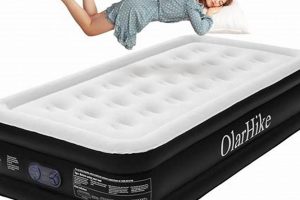
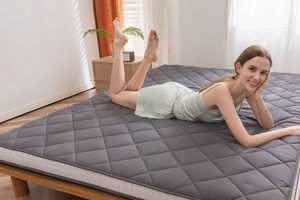
This type of sleep surface is designed for a single occupant and incorporates coil support. These mattresses are commonly found in smaller bedrooms, guest rooms, and children’s spaces. They offer a balance of support and comfort, relying on the resilience of the internal spring system for structure and responsiveness.
Their popularity stems from affordability and widespread availability. The design has evolved over decades, offering a range of firmness options and construction methods to suit varying sleep preferences. Benefits include adequate support for proper spinal alignment and relatively good airflow, contributing to a cooler sleep environment.
The subsequent sections will delve into the different types of coil systems utilized, factors to consider when selecting one, and how it compares to alternative mattress technologies available in the market.
Selecting the Appropriate Coil Mattress
Careful consideration of several factors is crucial when choosing a coil-based mattress for a twin bed. The following tips outline essential elements for making an informed decision.
Tip 1: Gauge the Coil Count. A higher coil count generally indicates better support and durability. More coils distribute weight more evenly, reducing pressure points.
Tip 2: Evaluate Coil Type. Options include Bonnell coils (durable but less contouring), offset coils (conform better to the body), and pocketed coils (minimize motion transfer). The preferred type depends on individual needs.
Tip 3: Assess Edge Support. Strong edge support prevents sagging and increases the usable sleep surface. Look for reinforced edges or edge-to-edge coil systems.
Tip 4: Consider the Comfort Layer. The comfort layer, often made of foam or fiber, determines the initial feel of the mattress. Choose a material density and thickness that aligns with desired comfort levels.
Tip 5: Verify the Warranty. A comprehensive warranty protects against manufacturing defects and premature sagging. Review the terms carefully before purchasing.
Tip 6: Check for Certifications. Look for certifications such as CertiPUR-US, which indicates that the foam used meets standards for content, emissions, and durability.
Tip 7: Measure the Bed Frame. Ensure the dimensions of the spring mattress are compatible with the twin bed frame to prevent instability or damage.
By prioritizing coil count, type, edge support, comfort layer, warranty, certifications, and size compatibility, the selection process becomes more focused and effective, increasing the likelihood of a satisfactory sleep experience.
The subsequent conclusion will summarize the key advantages and potential drawbacks of this mattress type compared to other options.
1. Coil Gauge

Coil gauge is a critical determinant of support and durability within a twin bed spring mattress. It refers to the thickness of the wire used to construct the coils, directly influencing the firmness and longevity of the mattress.
- Definition and Measurement
Coil gauge is expressed as a numerical value; lower numbers signify thicker wires. A 12-gauge coil, for example, is thicker and firmer than a 14-gauge coil. This measurement provides an objective metric for comparing mattress support levels.
- Impact on Firmness and Support
Thicker coils offer increased resistance to compression, resulting in a firmer sleep surface. Individuals requiring substantial back support often benefit from mattresses with lower-gauge coils. Conversely, thinner coils provide a softer, more yielding feel.
- Influence on Durability
Lower-gauge coils exhibit greater resistance to deformation over time, contributing to extended mattress lifespan. Thicker coils are less prone to sagging or developing impressions, particularly under consistent pressure points.
- Relationship to Weight Distribution
Coil gauge affects the mattress’s ability to distribute weight effectively. Firmer, lower-gauge coils provide enhanced support for heavier individuals, preventing excessive sinking and maintaining proper spinal alignment. Appropriate weight distribution is vital for long-term comfort and orthopedic health.
The selection of an appropriate coil gauge in a twin bed spring mattress involves a trade-off between firmness, support, and durability. Understanding this relationship empowers consumers to choose a mattress aligned with their specific comfort preferences and physical requirements. The gauge selection should correlate with the intended sleeper’s body weight, sleeping style, and any specific orthopedic considerations.
2. Edge Support
Edge support is a critical structural element in a twin bed spring mattress, directly influencing its usability and longevity. In mattresses incorporating coil systems, the perimeter is often reinforced to counteract the natural tendency of springs to compress towards the center under pressure. Without adequate edge support, the mattress surface collapses near the borders, reducing the usable sleep area and potentially creating a feeling of instability. For example, a person sitting on the edge of a twin mattress lacking sufficient edge support may experience a significant sinking sensation, making activities like getting dressed or reading in bed uncomfortable. The effectiveness of edge support systems significantly impacts the overall satisfaction and functional lifespan of the twin mattress.
Varied techniques are employed to enhance edge support in a twin bed spring mattress. Encasing the perimeter with high-density foam is a common practice, providing a firmer boundary that resists compression. Some manufacturers integrate additional coils along the edges, strategically positioned to provide increased resistance to weight. Hybrid designs may utilize both foam encasement and reinforced coils for optimal support. The choice of method significantly affects the cost and overall performance of the mattress. A higher-quality edge support system typically translates to a more durable and comfortable mattress, particularly for individuals who utilize the full surface area or require assistance getting in and out of bed. The practical application of effective edge support extends to improved weight distribution and reduced likelihood of mattress sagging over time.
In summary, adequate edge support is a non-negotiable feature for a quality twin bed spring mattress. Its presence ensures a consistent sleep surface, prolongs the mattress’s lifespan, and enhances user comfort. The specific method of edge support implementation will vary depending on construction and price point, but the underlying principle remains the same: to prevent edge collapse and maintain a stable and usable sleep area. The absence of edge support, or its ineffective implementation, poses a significa
nt challenge to the long-term performance and user satisfaction with the mattress.
3. Comfort Layer Density

Comfort layer density, measured in pounds per cubic foot (PCF), is a critical determinant of the performance of a twin bed spring mattress. Within this context, density dictates how the mattress conforms to the sleeper’s body, mitigates pressure points, and resists long-term degradation. A low-density comfort layer, for instance, in a twin spring mattress, might offer initial softness but is prone to premature compression and sagging, resulting in diminished support and potential discomfort. Conversely, a high-density comfort layer provides enhanced support, increased resistance to body impressions, and a longer lifespan for the mattress. The density of the comfort layer is not merely a superficial attribute; it fundamentally influences the overall support and comfort characteristics of the mattress.
The practical implication of comfort layer density is readily apparent in the context of different sleeping positions. A side sleeper, for example, requires a comfort layer with sufficient density to contour to the shoulders and hips, alleviating pressure on these bony prominences. A back sleeper benefits from a comfort layer density that provides even support across the lumbar region, preventing spinal misalignment. Inadequate density may lead to pressure buildup and discomfort, potentially disrupting sleep quality. The interplay between spring support and the characteristics of the comfort layer necessitates a balanced design to achieve optimal ergonomic performance. The understanding of comfort layer density facilitates informed mattress selection based on individual needs and preferences.
In summary, comfort layer density represents a key consideration in the overall performance and longevity of a twin bed spring mattress. High density typically correlates with enhanced support, durability, and pressure relief, although it may also result in a firmer initial feel. Low density comfort layers generally offer a softer initial feel, but may not provide the same level of long-term support and durability. Balancing comfort layer density with spring system design and individual sleeper needs is crucial for ensuring optimal sleep quality and mattress performance. The long term durability must be a primary consideration for the users.
4. Motion Isolation
Motion isolation is a pertinent characteristic to consider when evaluating twin bed spring mattresses, particularly in scenarios where the bed may be subject to movement from external sources or shared occupancy. The degree to which a mattress minimizes the transmission of movement impacts sleep quality and overall user satisfaction.
- Coil Type and Motion Transfer
Traditional interconnected coil systems, such as Bonnell coils, tend to transmit motion readily across the mattress surface. Conversely, pocketed coil systems, wherein each coil is individually wrapped, exhibit superior motion isolation capabilities. The independent movement of each pocketed coil minimizes the disturbance felt by a sleeping partner.
- Comfort Layer Composition and Damping
The composition and density of the comfort layer contribute to motion isolation. Memory foam and high-density latex possess inherent damping properties, absorbing and dissipating motion energy. Thicker and denser comfort layers generally provide more effective motion isolation compared to thinner, less dense materials.
- Mattress Construction and Layer Integration
The overall construction and integration of mattress layers influence motion transfer. A well-constructed mattress with seamless transitions between layers minimizes the propagation of movement. Conversely, poorly integrated layers can amplify motion, leading to greater disturbance.
- Edge Support and Perimeter Stability
While primarily focused on edge support, the construction of the mattress perimeter can indirectly impact motion isolation. A robust edge support system can help contain motion within a localized area, preventing its transmission across the entire mattress surface.
The selection of a twin bed spring mattress with enhanced motion isolation is particularly relevant for individuals sharing a sleep surface or those susceptible to disturbances caused by movement within the surrounding environment. Consideration of coil type, comfort layer composition, mattress construction, and edge support contributes to informed decision-making and improved sleep quality. The absence of motion isolation contributes to poor user experience.
5. Mattress Height

Mattress height, or thickness, plays a significant role in the overall functionality and comfort of a twin bed spring mattress. It influences accessibility, aesthetics, and compatibility with bed frames and bedding accessories. The selection of an appropriate mattress height requires careful consideration of these interrelated factors.
- Bed Frame Compatibility
Mattress height directly affects the exposed height of the bed frame. A thinner mattress may result in an excessive gap between the top of the mattress and the headboard, aesthetically unappealing and potentially compromising support. Conversely, an excessively thick mattress may obscure the headboard and create difficulty getting into or out of bed. Proper measurement and consideration of bed frame dimensions are crucial.
- Accessibility and Ease of Entry/Exit
Mattress height impacts the ease of getting into and out of bed, particularly relevant for children, the elderly, or individuals with mobility limitations. A low-profile mattress may pose challenges for those with joint pain or weakness. An excessively high mattress could require the use of a step stool. The ideal height facilitates comfortable and safe access.
- Aesthetic Considerations
Mattress height contributes to the overall visual balance of the bedroom. A low-profile mattress in a room with high ceilings may appear diminutive, while an overly thick mattress in a small space could feel overwhelming. Balancing mattress height with room proportions and furniture scale is essential for achieving a cohesive aesthetic.
- Bedding Fit and Functionality
Mattress height influences the fit of sheets, comforters, and bed skirts. Standard-sized bedding may not adequately accommodate unusually thick or thin mattresses. Adjustable straps or deep-pocket sheets are often necessary for thicker mattresses. Bed skirts require appropriate length to achieve the desired appearance without dragging on the floor or exposing the bed frame.
In summary, mattress height is not merely a superficial attribute but a fundamental design element with practical and aesthetic implications. Proper selection ensures compatibility with the bed frame, facilitates ease of access, contributes to visual harmony, and accommodates bedding requirements. Neglecting this consideration can result in discomfort, inconvenience, and an aesthetically unappealing sleeping environment.
Frequently Asked Questions
T
his section addresses common inquiries regarding twin bed spring mattresses, providing factual information to aid in informed decision-making.
Question 1: What is the typical lifespan of a twin bed spring mattress?
The lifespan of a twin bed spring mattress generally ranges from 5 to 10 years, depending on factors such as coil quality, usage frequency, and weight of the occupant. Mattresses with higher coil counts and reinforced construction tend to exhibit greater longevity.
Question 2: How does the coil count affect the performance of a twin bed spring mattress?
A higher coil count typically indicates improved support and durability. More coils distribute weight more evenly, reducing pressure points and minimizing sagging over time. However, coil quality and gauge also play significant roles.
Question 3: What are the different types of coil systems used in twin bed spring mattresses?
Common coil systems include Bonnell coils (interconnected), offset coils (hinged for contouring), and pocketed coils (individually wrapped). Pocketed coils generally offer superior motion isolation compared to interconnected systems.
Question 4: How does one address concerns about mattress sagging?
Sagging can often be mitigated by rotating the mattress regularly (every 3-6 months) to distribute wear evenly. Ensure the bed frame provides adequate support, particularly in the center. If sagging persists, it may indicate the need for a mattress replacement.
Question 5: Are twin bed spring mattresses suitable for all body types and sleeping positions?
While twin bed spring mattresses can accommodate a variety of body types and sleeping positions, specific preferences and needs vary. Side sleepers may benefit from a softer comfort layer to alleviate pressure on hips and shoulders, while back sleepers may prefer a firmer support system for spinal alignment. Larger individuals might require a mattress with a higher coil count and reinforced construction.
Question 6: How does the cost of a twin bed spring mattress compare to other mattress types?
Twin bed spring mattresses are often more affordable than memory foam or latex mattresses. However, price points vary significantly depending on coil type, comfort layer materials, and construction quality. Weighing cost against features and durability is recommended.
The information provided offers a concise overview of key considerations pertaining to twin bed spring mattresses. Prioritizing individual needs and preferences is paramount when selecting a mattress.
The next section will explore potential issues and troubleshooting tips related to twin bed spring mattresses.
Conclusion
This analysis has explored various facets of the twin bed spring mattress, from its constructional elements to considerations for selection and maintenance. Key aspects, including coil gauge, edge support, comfort layer density, motion isolation, and mattress height, significantly influence performance and user satisfaction. Understanding these factors is essential for making informed purchasing decisions and ensuring long-term value.
Selecting the appropriate sleep surface is an important investment in individual well-being. Continued research and careful evaluation of evolving technologies in sleep solutions are encouraged to optimize the benefits derived from this fundamental element of personal health.

![Best Bunk Bed Twin Mattress: Safe & Comfy [Guide] | Organic & Natural Mattress Buyer’s Guide: Non-Toxic Sleep Solutions](https://mattressworldpa.com/wp-content/uploads/2025/07/th-5279-300x200.jpg "Best Bunk Bed Twin Mattress: Safe & Comfy [Guide] Organic & Natural Mattress Buyer’s Guide: Non-Toxic Sleep Solutions")