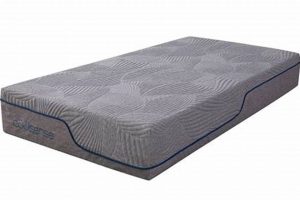
The combination of a stowaway bed frame that slides under another bed, paired with a specific size of bedding designed for single occupancy, offers a space-saving sleeping solution. This arrangement commonly involves a smaller, secondary bed fitting neatly beneath a primary bed frame, utilizing specialized mattresses.
This setup provides numerous advantages, particularly in rooms with limited square footage. It allows for accommodating overnight guests without permanently occupying valuable floor space. Historically, such designs have been employed in settings ranging from children’s rooms to guest rooms, proving to be a versatile and practical furnishing option.
The subsequent sections will delve into the specifics of choosing a compatible mattress size, considering factors such as thickness and material, and exploring the diverse range of frames designed to accommodate this space-efficient bedding system.
Important Considerations for Selection and Use
Selecting and properly utilizing a mattress and frame combination requires careful attention to detail to ensure functionality, comfort, and safety.
Tip 1: Measure Available Space: Accurately determine the dimensions of the room and the primary bed frame to ensure the secondary unit fits appropriately when stowed and deployed.
Tip 2: Verify Mattress Thickness Compatibility: Confirm the maximum acceptable mattress height for the stowaway frame. Exceeding this limit can prevent proper closure and storage.
Tip 3: Assess Support Mechanism Quality: Evaluate the stowing and deploying mechanism of the frame. A robust and smooth-operating mechanism ensures ease of use and longevity.
Tip 4: Consider Mattress Material and Firmness: Select a mattress material and firmness level appropriate for the intended user, balancing comfort with space constraints. Options include foam, innerspring, and hybrid constructions.
Tip 5: Prioritize Safety Features: Inspect the frame for safety features such as locking mechanisms to prevent accidental deployment and smooth edges to minimize injury risk.
Tip 6: Review Weight Capacity: Ascertain the maximum weight capacity of the stowaway frame to ensure it can safely support the intended occupant.
Tip 7: Evaluate Frame Material: Consider the durability and aesthetic appeal of the frame material. Options include metal, wood, and composite materials.
Adhering to these guidelines will facilitate the selection of a safe, comfortable, and functional stowaway bed setup, optimizing space utilization without compromising sleep quality.
The concluding section will provide a summary of key points and offer final recommendations for optimizing the use of space-saving bedding solutions.
1. Size standardization

Size standardization plays a pivotal role in ensuring the functionality and compatibility of a mattress intended for use within a stowaway bed frame. Precise dimensions are critical for seamless integration and optimal space utilization.
- National Mattress Size Standards
Established standards dictate the specific width and length dimensions associated with a mattress designed for single occupancy. Adherence to these national standards ensures that mattresses are readily interchangeable with compatible frames, promoting ease of purchase and use. For example, a standard mattress typically measures approximately 38 inches wide by 75 inches long. Deviation from these dimensions can lead to fitting issues and compromised functionality.
- Frame Cavity Dimensions
Stowaway bed frames are engineered with specific cavity dimensions to accommodate a single-occupancy mattress. These dimensions are designed to correspond precisely with established size standards. If a mattress exceeds the designated height or deviates in width or length, it may not fit properly within the frame, preventing the bed from stowing correctly. Discrepancies can also damage the frame or mattress over time.
- Thickness and Vertical Clearance
In addition to width and length, thickness is a crucial dimension that must adhere to standardization. Stowaway bed frames often have limited vertical clearance when stowed. A mattress that is too thick will prevent the frame from closing completely, hindering its space-saving capability. Manufacturers typically specify a maximum thickness to ensure proper functionality.
- Impact on User Safety
Non-standard mattress sizes can pose safety risks. An ill-fitting mattress may shift or slide within the frame, creating an unstable sleeping surface. This can lead to discomfort, potential injury, and compromised sleep quality. Compliance with size standards ensures a secure and stable sleeping platform, minimizing these risks.
The integration of standardized dimensions is paramount for the effective utilization of stowaway bed frames. Adherence to established guidelines guarantees compatibility, maximizes space-saving capabilities, and promotes user safety and comfort. Failure to recognize and respect these standardized measurements can result in functional impairments and potential hazards.
2. Thickness limitations

Thickness limitations are a primary design consideration when selecting bedding intended for a stowaway bed frame. The vertical space available beneath the primary bed dictates the maximum acceptable height of the mattress to ensure proper storage and functionality.
- Frame Closure and Stowage
The primary role of thickness limitations is to enable the complete closure and seamless stowage of the secondary bed. Stowaway bed frames are engineered with a finite amount of vertical clearance beneath the main bed. If the combined height of the mattress and frame exceeds this clearance, the secondary bed cannot be fully retracted, compromising the space-saving benefit. Example: If a frame allows for a maximum of 8 inches and the chosen mattress is 10 inches thick, the frame will not fully close.
- Weight Distribution and Support
Excessive mattress thickness can negatively impact the weight distribution and structural integrity of the stowaway frame. Frames are designed to support a specific weight range within defined dimensional parameters. An overly thick mattress may concentrate weight unevenly, potentially leading to premature wear, bending, or even structural failure of the frame components.
- Accessibility and Ease of Use
Thickness directly affects the ease of deploying and retracting the secondary bed. An overly thick mattress can make it difficult to maneuver the frame, requiring excessive force to slide it in and out. This can be particularly problematic for users with limited strength or mobility. This directly negates the purpo
se of this type of bed. - Ventilation and Airflow
In some designs, an overly thick mattress can impede proper ventilation within the stowed compartment. Limited airflow can lead to moisture buildup, creating a breeding ground for mold and mildew. This can compromise the hygiene and longevity of both the mattress and the frame. Adequate ventilation is essential to maintain a healthy sleeping environment.
These factors highlight the critical interplay between mattress thickness and the functional requirements of a stowaway bed frame. The careful selection of a mattress that adheres to the specified thickness limitations is essential for ensuring the long-term performance, safety, and hygiene of this space-saving sleeping solution.
3. Support mechanism
The support mechanism is a critical component of any stowaway bed configuration. It directly influences the usability, durability, and safety of the entire assembly. In the context of a frame designed for a single-occupancy mattress, the support mechanism must facilitate smooth and reliable deployment and retraction of the secondary sleeping surface. Failure of this mechanism renders the space-saving design ineffective. An example of a robust support mechanism is a set of heavy-duty, ball-bearing slides that allow for easy gliding, even with a fully-weighted mattress. Conversely, a poorly designed mechanism using flimsy materials can buckle under pressure or seize up entirely, making it difficult or impossible to extend the bed.
Different types of support mechanisms are employed, each with its own advantages and disadvantages. Some use simple roller systems, while others utilize more complex linkage systems for added stability. The choice of mechanism often depends on the overall design of the bed frame and the intended weight capacity. Regularly inspecting and maintaining the support mechanism is crucial for ensuring its continued functionality. Lubricating moving parts and tightening any loose fasteners can prevent premature wear and tear. In instances where the support mechanism is irreparably damaged, replacement may be necessary to restore the full functionality of the space-saving bed.
In summary, the support mechanism is integral to the effective operation of a stowaway bed frame. A well-designed and properly maintained mechanism ensures ease of use, prolongs the lifespan of the bed, and contributes to the overall safety and satisfaction of the user. Understanding the nuances of different support systems and prioritizing regular maintenance are key to maximizing the benefits of a space-saving sleeping arrangement.
4. Material composition

The materials used in construction directly influence comfort, durability, and suitability for use in a stowaway configuration. Understanding material properties is therefore crucial when selecting bedding intended for this application.
- Foam Density and Type
Foam-based mattresses utilize various densities and types of foam, including polyurethane, memory foam, and latex. Higher density foams offer improved support and longevity, while memory foam conforms to the body, providing pressure relief. Latex offers a balance of support and responsiveness. The chosen foam type impacts overall comfort, heat retention, and resistance to compression, all relevant considerations within the limited space of a stowaway setup.
- Innerspring Coil Count and Gauge
Innerspring mattresses rely on a network of coils to provide support. Coil count and gauge (thickness) influence firmness and durability. A higher coil count typically corresponds to enhanced support and reduced motion transfer. Thicker gauge coils offer increased resistance to deformation. The appropriateness of an innerspring design hinges on available vertical space within the frame; thicker innerspring mattresses may not be suitable due to thickness limitations.
- Fabric Cover Construction
The fabric cover affects breathability, moisture wicking, and overall surface feel. Materials such as cotton, polyester, and blends are commonly used. Tightly woven fabrics offer increased durability and resistance to wear. Breathable fabrics promote airflow, reducing heat buildup during sleep, a pertinent concern within the often-enclosed environment of a stowaway bed.
- Fire Retardant Barriers
Federal regulations mandate the inclusion of fire retardant barriers within mattresses. These barriers are typically composed of materials such as fiberglass, silica, or treated cotton. The choice of fire retardant material impacts weight, breathability, and potential allergenicity. Compliance with fire safety standards is a non-negotiable requirement when selecting bedding, regardless of its intended use.
These compositional elements, when appropriately selected and combined, determine the overall suitability of bedding for use in a stowaway frame. Considerations such as space constraints, weight limitations, and intended user preferences should guide material selection to ensure both comfort and functionality within this space-optimized sleeping solution.
5. Frame compatibility
The concept of frame compatibility is paramount to the successful implementation of a stowaway bed system designed for single-occupancy bedding. The interplay between the frame and the mattress dictates the functionality, safety, and overall usability of the configuration.
- Dimensional Alignment
Precise dimensional alignment between the frame’s internal cavity and the mattress is essential. Standard single-occupancy mattresses adhere to specified width and length measurements. The frame must be engineered to accommodate these dimensions exactly. Discrepancies can lead to an unstable sleeping surface or prevent the frame from closing properly, negating the space-saving benefits. For example, a frame designed for a 38″ x 75″ mattress will not function correctly with a 39″ x 74″ mattress.
- Weight Capacity Synchronization
Frame structures possess specific weight capacities that must correspond with the weight of the mattress and the intended user. Exceeding the frame’s weight limit can lead to structural failure, compromising safety. Matching the weight of the mattress to the frame’s load-bearing capacity is crucial to prevent damage and ensure long-term stability. A frame designed to support 200lbs should not be used with a 75lbs mattress and a 200lbs person.
- Thickness Accommodation
Stowaway bed frames have a finite amount of vertical space to accommodate the mattress when stowed. Mattress thickness must be compatible with this space. An overly thick mattress will prevent the frame from closing fully, rendering the stowaway function inoperable. Frame manufacturers typically specify a maximum mattress thickness to ensure proper functionality. Ignoring these specifications will defeat the purpose of this configuration.
- Support System Integration
The frame’s support system, whether it be slats, springs, or a solid platform, must be compatible with the chosen mattress type. Ce
rtain mattresses, such as foam models, require a solid, even surface for optimal support, while others function well with slatted supports. Mismatched support systems can lead to uneven weight distribution and premature mattress wear. If a mattress is placed on a slatted support when a solid support is needed, it could sag prematurely.
The convergence of these compatibility factors is essential for the safe and effective operation of stowaway bed systems. By meticulously considering dimensional alignment, weight capacity synchronization, thickness accommodation, and support system integration, one can ensure a stable, comfortable, and space-efficient sleeping solution that adheres to safety standards and user expectations.
6. Storage efficiency

Storage efficiency is a primary design consideration for systems incorporating a single-occupancy stowaway bed. The ability to minimize the footprint of a sleeping arrangement when not in use is a key driver in the selection and implementation of such systems. Maximizing usable space within a given area necessitates a design that integrates seamlessly into the surrounding environment.
- Vertical Space Optimization
Stowaway beds capitalize on vertical space by retracting the secondary mattress beneath the primary bed frame. This approach conserves floor area that would otherwise be occupied by a permanently deployed bed. For example, a child’s room can benefit from this feature, allowing for more play area during the day while providing a sleeping surface at night.
- Dual-Purpose Functionality
The integration of a stowaway bed system allows a single room to serve multiple functions. A guest room can be transformed into a home office or recreational space when the secondary bed is stowed. This adaptability enhances the overall utility of the room and provides flexibility in space allocation.
- Furniture Integration
Stowaway beds can be integrated into existing furniture designs, such as daybeds or platform beds. This approach allows the sleeping surface to blend seamlessly with other furnishings, minimizing its visual impact on the room. An example of this is a daybed that functions as a seating area during the day and converts to a sleeping space when needed.
- Seasonal Storage
When the secondary bed is not in regular use, the space beneath the frame can be utilized for seasonal storage. Items such as extra bedding, clothing, or holiday decorations can be stored within this compartment, further enhancing space utilization. This functionality provides a discreet and accessible storage solution within the sleeping arrangement.
The combination of these storage efficiency strategies underscores the value of stowaway bed systems in space-constrained environments. By optimizing vertical space, providing dual-purpose functionality, integrating into existing furniture, and facilitating seasonal storage, these systems offer a comprehensive solution for maximizing usable space while accommodating occasional sleeping needs.
Frequently Asked Questions
The following section addresses common inquiries and misconceptions pertaining to bedding configurations incorporating a stowaway bed frame and single-occupancy mattresses. Clarification on dimensions, compatibility, and usage guidelines are provided for informational purposes.
Question 1: What are the standard dimensions for a mattress intended for use with a stowaway bed frame?
The standard dimensions are typically 38 inches in width by 75 inches in length. However, variations may exist, and verification of specific frame requirements is essential.
Question 2: What is the maximum permissible thickness for a stowaway bed mattress?
Maximum permissible thickness is dictated by the design of the stowaway bed frame. Exceeding the specified limit can impede proper closure and storage, often ranging between 6 and 8 inches.
Question 3: Can any type of mattress be used with a stowaway bed frame?
No. Compatibility hinges on dimensions, weight, and support requirements. Innerspring, foam, and hybrid models may be suitable, provided they adhere to frame specifications. Exceeding weight limits can damage the frame.
Question 4: What maintenance is required for a stowaway bed frame and mattress?
Periodic inspection of the frame mechanism is recommended, including lubrication of moving parts and tightening of fasteners. The mattress should be rotated or flipped regularly to promote even wear.
Question 5: Are there specific safety considerations when using a stowaway bed?
Weight limits must be observed to prevent structural failure. The frame should be equipped with locking mechanisms to prevent accidental deployment. Sharp edges or protrusions should be minimized to prevent injury.
Question 6: How does the material composition of the mattress affect its suitability for a stowaway bed?
Material composition influences comfort, support, and breathability. High-density foams or innerspring designs are typically preferred for their durability and resistance to compression within the confined space of a stowaway configuration. Breathable fabrics are preferable to reduce moisture build-up.
Adherence to these guidelines will contribute to the safe and effective utilization of stowaway bed systems, optimizing space utilization without compromising comfort or structural integrity.
The concluding section will provide a summary of key considerations and offer final recommendations for those considering or currently using a stowaway bed configuration.
Concluding Remarks on Single-Occupancy Stowaway Bedding Solutions
This exploration of the trundle mattress twin system has underscored the importance of careful consideration regarding dimensions, weight capacities, material composition, and frame compatibility. Adherence to established guidelines is paramount for ensuring the functionality, safety, and longevity of space-saving bedding arrangements. Furthermore, proper maintenance and adherence to safety protocols are critical for optimal utilization.
The prudent selection and implementation of a trundle mattress twin configuration represent a viable strategy for maximizing space efficiency in residential and institutional settings. Continued awareness of evolving industry standards and safety recommendations will be essential for maintaining the integrity and practicality of these systems in the future. Individuals are encouraged to diligently assess their specific needs and constraints before adopting this space-saving solution.
![Best BJ's Twin Mattress [Deals & Reviews] | Organic & Natural Mattress Buyer’s Guide: Non-Toxic Sleep Solutions](https://mattressworldpa.com/wp-content/uploads/2025/07/th-5259-300x200.jpg "Best BJ's Twin Mattress [Deals & Reviews] Organic & Natural Mattress Buyer’s Guide: Non-Toxic Sleep Solutions")
![Best Tuft & Needle Twin Mattress: [Year] Review & Guide | Organic & Natural Mattress Buyer’s Guide: Non-Toxic Sleep Solutions](https://mattressworldpa.com/wp-content/uploads/2025/07/th-5258-300x200.jpg "Best Tuft & Needle Twin Mattress: [Year] Review & Guide Organic & Natural Mattress Buyer’s Guide: Non-Toxic Sleep Solutions")