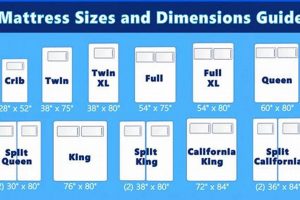
A standard single sleeping platform, often called a twin, measures approximately 38 inches in width and 75 inches in length. These dimensions provide a compact sleeping area suitable for children, teenagers, or single adults in smaller spaces. As an example, consider a child transitioning from a crib; a bed of these measurements offers an appropriate increase in size.
The bed’s space-saving design makes it beneficial for rooms with limited square footage, such as dormitories or shared bedrooms. Its affordability also contributes to its popularity. Historically, the standardization of these measurements allowed for ease in manufacturing bedding and frames, ensuring consistent compatibility across different brands and models.
Understanding these measurements is essential when purchasing linens, bed frames, and mattress protectors. Selecting appropriately sized accessories guarantees a proper fit and optimal comfort. The following sections will further elaborate on variations, alternatives, and considerations for different needs.
Essential Guidance on Twin Bed Mattress Dimensions
This section provides pertinent advice regarding the consideration of dimensions when selecting a twin-size sleeping surface.
Tip 1: Measurement Verification: Prior to purchase, confirm the listed dimensions of the sleeping surface with the retailer. Slight manufacturing variations can occur, necessitating accurate measurements to ensure compatibility with existing bed frames and bedding.
Tip 2: Space Assessment: Measure the available floor space in the intended room. Account for any obstructions, such as doorways or furniture, to determine the optimal placement and ensure sufficient maneuverability around the bed.
Tip 3: Bed Frame Compatibility: Verify that the inner dimensions of the bed frame precisely match the established mattress measurements. An ill-fitting frame can compromise the structural integrity of the bed and affect comfort.
Tip 4: Bedding Procurement: Obtain sheets, blankets, and comforters specifically designed for twin-size beds. Over- or undersized bedding can result in discomfort and aesthetic issues.
Tip 5: Consideration of Height: Evaluate the thickness of the mattress in relation to the bed frame. An excessively thick mattress may result in a bed that is too high, posing challenges for smaller individuals or children.
Tip 6: Weight Capacity Assessment: Ascertain the weight capacity of both the mattress and the bed frame. Exceeding these limits can lead to structural damage and potential safety hazards.
The diligent application of these recommendations facilitates a well-informed selection, resulting in a comfortable and appropriately sized sleeping arrangement.
The subsequent sections will explore related topics and additional factors for comprehensive consideration.
1. Standard Width
The measurement of 38 inches constitutes the standardized width for a twin bed sleeping surface. This dimension is fundamental to understanding the overall scale and application of a twin-size sleeping arrangement.
- Spatial Efficiency
The 38-inch width is deliberately designed for optimizing space in smaller bedrooms, dormitories, or shared living environments. This dimension allows for the accommodation of a functional sleeping area without overwhelming the room. For example, in a room shared by two individuals, two twin beds can be positioned side-by-side, each occupying a minimal footprint.
- Individual Accommodation
The 38-inch width provides sufficient space for a single sleeper. While compact, it offers adequate room for comfortable rest. Consider a growing child or teenager; the dimensions provide the necessary space to rest comfortably without requiring the expanse of a larger sleeping surface.
- Bedding Standardization
The standardized width simplifies the manufacturing and purchasing of bedding accessories. Fitted sheets, blankets, and comforters are readily available in sizes designed to fit the 38-inch width, ensuring proper fit and aesthetic consistency. This standardization reduces the likelihood of purchasing incompatible bedding.
- Frame Compatibility
The 38-inch width is a crucial factor in selecting a compatible bed frame. Bed frames specifically designed for twin beds are engineered to precisely accommodate this width, ensuring stability and structural integrity. Using a frame designed for a different width can lead to instability and potential damage.
The 38-inch width is not merely an arbitrary measurement; it is a carefully considered dimension that influences spatial efficiency, individual comfort, bedding compatibility, and bed frame selection. It is integral to the design and functionality of this size bed.
2. Standard Length
The measurement of 75 inches defines the standardized length of a twin bed sleeping surface. This dimension is integral to the bed’s utility, particularly in relation to the user’s height and comfort. The following points elucidate key considerations regarding this length.
- Accommodation of Height
The 75-inch length is generally suitable for accommodating individuals up to approximately 5 feet 10 inches (178 cm) in height. This makes it a suitable option for children, teenagers, and many adults. For taller individuals, the length may prove insufficient, potentially leading to discomfort due to restricted legroom. For example, a person exceeding this height may experience their feet extending beyond the edge of the sleeping surface.
- Space Optimization
The standardized length contributes to space efficiency in bedrooms and other living spaces. By maintaining a relatively compact length, the bed allows for greater maneuverability within the room. This is particularly relevant in smaller rooms, dormitories, or apartments where space is limited. This enables strategic furniture arrangement while preserving functionality.
- Bed Frame Considerations
Bed frames designed for twin beds are manufactured to precisely accommodate the 75-inch length. This ensures a secure and stable fit, preventing the mattress from shifting or sliding during use. Selecting a frame designed for a different length can compromise the bed’s structural integrity and potentially lead to safety hazards. For example, a frame designed for a full-size mattress would not properly support a twin mattress.
- Bedding Compatibility
Bedding manufacturers produce sheets, blankets, and comforters specifically tailored to the 75-inch length of twin beds. These products ensure a proper fit and prevent excessive overhang or inadequate coverage. Util
izing correctly sized bedding contributes to both comfort and aesthetic appeal. Improperly sized bedding may result in discomfort or detract from the overall appearance of the bed.
In summary, the 75-inch length is a crucial dimension defining a standard twin bed sleeping surface. Its suitability is directly tied to the user’s height, space considerations, bed frame compatibility, and bedding selection. Understanding this length is essential for choosing a comfortable and appropriately sized bed.
3. Surface Area

The surface area of 2,850 square inches is a direct consequence of the standardized dimensions that define the twin bed. This measurement, derived by multiplying the width of 38 inches by the length of 75 inches, represents the total sleeping space afforded by the mattress. As such, it is an intrinsic component of the twin bed definition. The value provides a quantifiable metric for comparing it to other mattress sizes.
The practical significance of understanding this surface area lies in its influence on sleep quality and comfort. This area dictates the amount of room available for movement during sleep. A surface area of 2,850 square inches may be adequate for a child, a teenager, or a smaller adult who does not require extensive space to turn or stretch. However, an individual accustomed to a larger sleeping platform may find the confines restrictive. For instance, if the intention is to co-sleep with a pet, the available space may be too constrained.
The surface area of 2,850 square inches, therefore, is more than merely a mathematical calculation. It is a tangible representation of the sleeping space offered by a twin bed. It informs purchase decisions by providing potential buyers with a clear understanding of the available area relative to their personal needs and preferences. Discrepancies in actual surface area, even slight variations, can impact the overall suitability of the mattress; precise knowledge of what is being acquired remains crucial.
4. Common Thickness

The thickness of a twin bed sleeping surface, typically ranging from 8 to 12 inches, represents a crucial dimension supplementing the established width and length in determining the overall structure and comfort profile. This measurement exerts a significant influence on several aspects of the bed, directly impacting its functional application.
- Support and Comfort Levels
The mattress depth directly correlates with the quantity and arrangement of internal materials, which determines the level of support and cushioning. A thicker profile, approaching 12 inches, commonly incorporates multiple layers of foam, coils, or other materials designed to enhance comfort and pressure relief. For example, a mattress incorporating a memory foam comfort layer benefits from additional depth to provide better contouring and alleviate pressure points. Conversely, a thinner mattress, closer to 8 inches, may offer firmer support and may be suitable for individuals who prefer a more rigid sleeping surface.
- Bed Frame Compatibility and Aesthetics
The thickness of the mattress must be considered in relation to the height of the bed frame. An excessively thick mattress may result in an overall bed height that is disproportionately high, potentially posing challenges for smaller individuals or children to easily access. Alternatively, a very thin mattress on a high bed frame may appear aesthetically unappealing. For instance, a platform bed benefits from a balanced mattress thickness to maintain a streamlined aesthetic. Similarly, a traditional bed frame with a headboard should consider the mattress height to ensure the headboard remains visible and functional.
- Weight and Handling Considerations
The thickness of the mattress inevitably influences its overall weight. A thicker mattress with more internal materials will generally be heavier and more difficult to handle during transportation, installation, or rotation. This is a practical consideration, especially for individuals who may need to move the mattress frequently. A greater density of materials within the construction leads directly to increased mass and, subsequently, increased difficulty in maneuverability. Choosing a mattress is easier when weight is considered.
- Cost Implications
The thickness often correlates with the overall cost of the mattress. Thicker mattresses typically require more materials and complex construction processes, leading to a higher price point. While a thicker mattress may offer enhanced comfort and support, a thinner, more economical option may suffice for individuals with less demanding requirements. The correlation between thickness and price necessitates a careful evaluation of budget constraints against desired comfort levels.
In conclusion, the mattress thickness is a crucial component in the comprehensive consideration of “what is the size of a twin bed mattress.” It directly affects comfort, aesthetics, handling, and cost, thus underscoring the importance of evaluating this aspect in relation to individual needs and practical limitations.
5. Weight Variability

The weight of a twin bed mattress, while not a fixed dimension, exhibits significant variability contingent upon its constituent materials and construction. This variability is a critical factor influencing transport, installation, and compatibility with bed frames, thereby meriting careful consideration alongside standard size measurements.
- Material Composition and Density
The primary determinant of a mattress’s weight is the materials used in its construction. Mattresses incorporating innerspring systems tend to be heavier due to the steel coil components. Conversely, those constructed primarily of foam, such as memory foam or latex, can exhibit a broader weight range depending on the density of the foam. For example, a high-density memory foam mattress will be considerably heavier than one constructed from lower-density polyurethane foam, given equal dimensions. This is a significant factor for assessing portability and maneuverability.
- Layer Configuration and Thickness
The number and thickness of layers within the sleeping surface also contribute substantially to its overall weight. Multi-layered mattresses, designed to provide enhanced comfort and support, will invariably weigh more than simpler, single-layer designs. The inclusion of additional comfort layers, transition layers, or support cores directly increases the mass. As an example, a pillow-top sleeping surface, which adds an extra upholstered layer, will add weight compared to a standard flat-top model of the same dimension.
- Impact on Bed Frame Selection
The weight of the mattress is a critical factor when selecting an appropriate bed frame. Bed frames possess specific weight capacities, and exceeding these limits can compromise the frame’s structural integrity, potentially leading to damage or failure. Prior to purchasing a mattress, it is essential to ascertain the weight limit of the intended bed frame to ensure compatibility. A cast iron or solid wood frame is likely to susta
in more weight than a lighter metal or composite wood frame. The overall dimensions contribute to the fit, but the weight governs the longevity of the bed frame. - Handling and Transportation Implications
The weight of a twin-size sleeping surface significantly impacts ease of handling and transportation. A heavier mattress necessitates greater physical effort and may require multiple individuals for safe maneuvering, particularly in confined spaces or up stairwells. This is relevant not only during initial installation but also during routine tasks such as flipping or rotating the mattress to promote even wear. A heavier sleeping surface also translates to increased shipping costs and may present challenges for individuals with limited physical strength or mobility.
In summary, while the specified length and width are fixed parameters, understanding the variable weight associated with twin bed sleeping surfaces is crucial for making informed decisions regarding bed frame compatibility, ease of handling, and long-term maintenance. The compositional factors driving this variability should be carefully considered to ensure optimal functionality and longevity of both the mattress and its supporting structure.
Frequently Asked Questions
The following addresses common inquiries and misconceptions pertaining to the dimensions of twin bed mattresses.
Question 1: What are the precise measurements of a standard twin bed mattress?
The established measurements for a standard twin bed mattress are 38 inches in width and 75 inches in length. Deviations from these measurements should be verified with the manufacturer.
Question 2: How does the size of a twin bed mattress compare to a twin XL?
While both share the same width (38 inches), a twin XL mattress provides an additional 5 inches in length, measuring 80 inches, thereby accommodating taller individuals.
Question 3: Is a twin bed mattress suitable for adults?
A twin bed mattress may be suitable for single adults, particularly in space-constrained environments. However, taller or individuals who desire more sleeping space may find the dimensions restrictive.
Question 4: What is the optimal thickness for a twin bed mattress?
Thickness varies based on construction and material. A range of 8 to 12 inches is commonly observed, though personal preference and bed frame compatibility should guide selection.
Question 5: How much weight can a typical twin bed mattress support?
Weight capacity depends on the construction. It is essential to consult the manufacturer’s specifications to avoid compromising the integrity of both the mattress and the bed frame.
Question 6: Are twin bed mattress sizes standardized across all manufacturers?
While standards exist, slight variations may occur. Verification of dimensions is recommended prior to purchasing bed frames or bedding accessories.
The presented information clarifies key aspects of twin bed dimensions, addressing common concerns and promoting informed decision-making.
The subsequent section will delve into related topics, furnishing additional insights for a comprehensive understanding.
What is the Size of a Twin Bed Mattress
This exposition has thoroughly examined the critical dimensions of a standard twin bed mattress. The analysis included defining the standard width of 38 inches and the standard length of 75 inches. Additionally, the discussion encompassed the resulting surface area, the common thickness range, and the variability in weight dictated by material composition. Each aspect influences suitability for specific users and spatial contexts. A comprehensive understanding of these dimensional characteristics is paramount when making informed purchasing decisions regarding mattresses, frames, and bedding.
The information presented provides a basis for evaluating sleeping solutions according to individual needs and constraints. Diligent consideration of these factors ensures optimal comfort, efficient space utilization, and long-term value. Continued adherence to standardization and precise measurement will remain crucial as bedding technology evolves, safeguarding consumer satisfaction and structural integrity in sleeping arrangements.


![Shop Compact Short Twin Bed Mattresses Now - [Brand] | Organic & Natural Mattress Buyer’s Guide: Non-Toxic Sleep Solutions](https://mattressworldpa.com/wp-content/uploads/2025/07/th-5267-300x200.jpg "Shop Compact Short Twin Bed Mattresses Now - [Brand] Organic & Natural Mattress Buyer’s Guide: Non-Toxic Sleep Solutions")