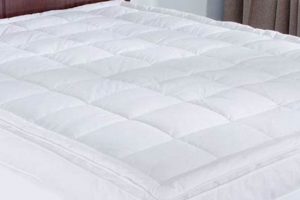
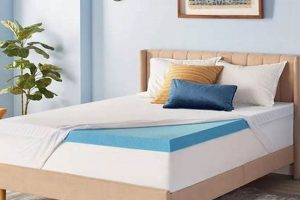
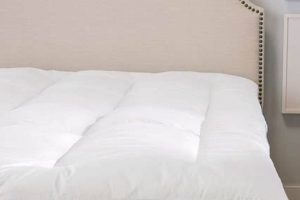
A sleeping surface addition designed to increase the hardness of a large-sized bed, typically measuring 76 inches wide and 80 inches long, represents an attempt to modify sleep characteristics. These products, available in a variety of materials and construction methods, aim to provide enhanced support and reduce sinking into the underlying mattress. For example, individuals finding their existing mattress too soft may seek such a solution to alleviate back pain and promote spinal alignment.
The prevalence of devices intended to modify sleep surfaces reflects an increasing awareness of the importance of proper spinal support for overall health. The selection of appropriate bedding can influence sleep quality, potentially impacting daytime productivity and long-term physical well-being. Historically, adjustments to bed firmness involved more rudimentary methods. Modern iterations represent a significant advancement, offering customizable and readily available solutions for a wide range of comfort preferences and orthopedic needs.
The subsequent sections will delve into the specific materials commonly employed in their construction, explore the diverse range of benefits attributed to their usage, and provide guidance on selecting an appropriate model to align with individual sleep requirements. Furthermore, considerations regarding the care and maintenance of such sleep surface enhancements will be addressed.
Guidance on Firm King Mattress Topper Utilization
The following recommendations are intended to optimize the selection and integration of a firm mattress topper specifically designed for a king-sized bed. Proper application and informed selection contribute to maximized benefits and prolonged product lifespan.
Tip 1: Material Evaluation: Prioritize materials known for their density and resilience. High-density memory foam or latex are frequently associated with enhanced firmness. Investigate the density specifications to ensure they align with the desired degree of support.
Tip 2: Thickness Considerations: The thickness directly influences the firmness level. A thicker topper generally provides a more substantial alteration to the existing mattress’s characteristics. Assess the existing mattress and select a thickness that compensates for its deficiencies without creating an overly rigid surface.
Tip 3: Support Core Assessment: Some incorporate a support core, often constructed from a different material than the comfort layer. Evaluate the core’s density and structure to determine its contribution to overall support and firmness. A robust core enhances longevity and prevents premature sagging.
Tip 4: Secure Attachment Mechanisms: Ensure the chosen model includes a reliable attachment system to prevent slippage during sleep. Elastic straps or fitted sheet designs are common methods for securing the topper to the underlying mattress. Secure attachment maximizes the intended support and minimizes disruption.
Tip 5: Air Circulation Provisions: While firmness is paramount, ventilation should not be disregarded. Seek models with features promoting airflow, such as open-cell foam or ventilated designs. Adequate ventilation mitigates heat retention and contributes to a more comfortable sleep environment.
Tip 6: Compatibility Assessment: Before purchase, confirm compatibility with existing bedding, particularly fitted sheets. The added height may necessitate deeper pocket sheets. Account for this increased height to ensure proper fit and prevent sheet detachment.
Tip 7: Rotation Protocol: To promote even wear and prevent localized compression, implement a regular rotation schedule. Rotating the topper every few months can extend its lifespan and maintain a consistent level of support across the entire sleeping surface.
Adhering to these guidelines enhances the likelihood of a successful purchase and maximizes the potential benefits of a firm king-sized mattress addition, contributing to improved sleep quality and orthopedic support.
The concluding section will summarize the key considerations outlined throughout this document.
1. Support and alignment
The primary function of a firm king mattress topper lies in its ability to modify the existing sleep surface to promote improved spinal support and alignment. The existing mattress may lack the necessary firmness to adequately support the sleeper’s body weight, leading to spinal misalignment and subsequent discomfort or pain. The addition of a firm topper aims to counteract this deficiency. It achieves this by providing a more resistant surface, preventing excessive sinking and maintaining the spine in a neutral posture. For instance, an individual experiencing lower back pain due to a sagging mattress may find relief through the enhanced support offered by a firm topper, which helps to distribute weight more evenly and reduce pressure points. Inadequate support can exacerbate pre-existing conditions, while proper alignment contributes to muscle relaxation and reduced strain on the musculoskeletal system.
The effectiveness of a firm king mattress topper in achieving optimal support and alignment is contingent upon several factors, including the topper’s material composition, thickness, and the sleeper’s individual body weight and sleeping position. High-density materials, such as latex or dense memory foam, generally provide superior support compared to less dense alternatives. Thicker toppers offer a more significant alteration to the existing mattress’s firmness level. Side sleepers may require a different degree of firmness compared to back sleepers to maintain proper spinal alignment. Therefore, selecting an appropriate firmness level that accounts for these individual variables is crucial. Furthermore, the underlying mattress’s condition significantly impacts the topper’s overall performance. A severely worn or damaged mattress may compromise the topper’s ability to deliver the intended support.
In conclusion, the link between support and alignment and a firm king mattress topper is fundamental to its intended purpose. The topper acts as a corrective layer, mitigating deficiencies in the existing mattress and facilitating a more ergonomically sound sleep environment. However, achieving the desired outcome necessitates careful consideration of material properties, thickness, individual body characteristics, and the condition of the underlying mattress. While a firm topper can be a beneficial solution for improving spinal support, it is not a universal remedy, and individual results may vary. Furthermore, it serves as a solution for a too-soft existing mattress, not as a replacement for mattresses whose inner springs or materials have broken or separated.
2. Material Density

The density of the material constituting a firm king mattress topper directly influences its capacity to provide adequate support and ma
intain its structural integrity over time. Density, typically measured in pounds per cubic foot (lbs/ft), reflects the mass of material packed into a given volume. Higher density indicates a greater mass within the same volume, resulting in a more robust and resilient material. This is particularly significant in the context of a firm mattress topper, as it must withstand the compressive forces exerted by the sleeper’s body weight. For example, a high-density latex topper (e.g., 5 lbs/ft or higher) will offer superior resistance to compression compared to a low-density memory foam topper (e.g., 3 lbs/ft or lower), translating to a firmer and more supportive sleep surface.
The relationship between material density and long-term durability is also critical. Toppers constructed from low-density materials are more susceptible to premature sagging and indentation, diminishing their ability to provide consistent support over extended periods. This degradation arises from the material’s inability to effectively rebound from repeated compression cycles. Conversely, higher-density materials exhibit greater resistance to deformation, preserving the topper’s firmness and supportive qualities for a longer duration. Consider two identical toppers, one made of high-density memory foam and the other of low-density memory foam; the high-density variant would demonstrably maintain its shape and support characteristics for a significantly longer period under similar usage conditions.
In summary, material density stands as a crucial determinant of a firm king mattress topper’s performance and longevity. Choosing a topper with insufficient density compromises its capacity to deliver sustained support and resist premature wear. Selecting a topper constructed from materials characterized by high density, such as high-density latex or memory foam, is therefore essential for individuals seeking a durable and effective solution for enhancing the firmness of their existing king-sized mattress. Neglecting this factor increases the likelihood of premature product failure and suboptimal sleep quality, necessitating earlier replacement and undermining the intended benefits of the purchase.
3. Thickness and profile

The thickness and profile of a firm king mattress topper are integral design parameters that dictate its impact on the sleep surface. Thickness, measured in inches, determines the extent to which the topper alters the firmness and feel of the underlying mattress. A thicker topper provides a more substantial change, effectively creating a new sleep surface with characteristics distinct from the original mattress. Profile refers to the topper’s shape and construction, influencing its ability to distribute weight evenly and minimize pressure points. The interplay between these two factors defines the topper’s effectiveness in achieving its intended function: enhancing firmness and providing orthopedic support. For example, a thin, low-profile topper may only slightly increase firmness, suitable for minor adjustments, whereas a thick, high-profile topper can significantly transform a soft mattress into a firmer one.
The selection of appropriate thickness and profile depends on several considerations, including the existing mattress’s properties and the sleeper’s individual needs. An overly soft mattress may necessitate a thicker topper to provide adequate support, while a slightly soft mattress might only require a thinner option. The sleeper’s weight and sleeping position also play a role. Heavier individuals may benefit from thicker toppers to prevent excessive sinking, while side sleepers may require a contoured profile to accommodate shoulder and hip pressure. Furthermore, compatibility with existing bedding must be considered; a thicker topper may necessitate deeper-pocketed sheets. The objective is to achieve a harmonious balance between firmness, comfort, and practicality.
In conclusion, thickness and profile are essential components of a firm king mattress topper, influencing its ability to modify the sleep surface and provide targeted support. The appropriate selection necessitates careful evaluation of the existing mattress, individual needs, and practical considerations. While a thicker topper generally provides greater firmness, a well-designed profile ensures even weight distribution and pressure relief. Therefore, a holistic approach that considers both thickness and profile is paramount to optimizing sleep quality and overall satisfaction. Ignoring these factors can lead to discomfort, inadequate support, and a diminished return on investment.
4. Durability expectations

The lifespan and sustained performance of a firm king mattress topper represent critical considerations for consumers. The long-term value proposition hinges on the product’s ability to maintain its firmness and support characteristics over an extended period, resisting degradation and compression.
- Material Resilience and Compression Resistance
The inherent resilience of the materials directly impacts the topper’s durability. Materials with high compression resistance, such as high-density latex or specific formulations of memory foam, exhibit a greater ability to recover their original shape after repeated compression cycles. For example, a topper comprised of low-density polyurethane foam will likely exhibit premature sagging and indentation compared to a high-density latex counterpart, leading to a reduced lifespan and diminished support. This factor dictates the period over which the topper effectively provides the intended level of firmness.
- Construction Quality and Manufacturing Processes
The methods employed during manufacturing significantly influence overall durability. Reinforced seams, consistent material distribution, and adherence to rigorous quality control standards contribute to a more robust and longer-lasting product. Inconsistent foam densities or poorly constructed seams can lead to uneven wear and premature failure. Instances of delamination (separation of layers) or seam rupture are indicative of substandard manufacturing processes, reducing the expected lifespan. The choice of adhesives and their resistance to degradation over time also plays a crucial role.
- Maintenance and Care Practices
Proper care and maintenance practices directly impact the topper’s durability. Regular rotation, as well as protecting from excessive moisture, prevents uneven compression and minimizes material degradation. Spills or exposure to harsh chemicals can accelerate deterioration and shorten the lifespan. A topper consistently exposed to direct sunlight may experience accelerated breakdown of its constituent materials. Following manufacturer-recommended cleaning and care guidelines is therefore essential to maximizing the product’s lifespan.
- Warranty Coverage and Consumer Protections
Warranty terms and conditions provide an indication of the manufacturer’s confidence in the product’s durability. Extended warranty periods often reflect a higher level of expected performance and resistance to defects. A comprehensive warranty should cover premature sagging, material defects, and workmanship errors. Examining the warranty provisions offers insight into the manufacturer’s commitment to addressing potential durability issues and providing consumer recourse. While not a direct measure of durability, the terms can serve as a proxy for the expecte
d lifespan and performance.
Ultimately, durability expectations for a firm king mattress topper are intertwined with material selection, manufacturing quality, and consumer care practices. A durable topper represents a long-term investment in sleep quality and orthopedic support, justifying a higher initial cost compared to less robust alternatives. Conversely, neglecting these durability considerations can result in premature product failure and the need for frequent replacements, negating any initial cost savings.
5. Maintenance requirements

The longevity and continued performance of a firm king mattress topper are inextricably linked to adherence to appropriate maintenance protocols. Neglecting proper care can accelerate material degradation, diminish support characteristics, and shorten the overall lifespan of the product. Regular maintenance serves to preserve the investment and ensure consistent sleep quality.
- Regular Rotation and Flipping
Periodic rotation (typically every 3-6 months) is crucial to distribute wear evenly across the surface. This practice prevents localized compression and sagging that can occur from prolonged use in a single position. Flipping, if the topper is designed to be reversible, further contributes to uniform wear. Failure to rotate and flip results in uneven support, potentially leading to discomfort and accelerated material fatigue. For example, consistent sleeping in the center of the bed without rotation will cause the central area to compress more rapidly than the edges.
- Spot Cleaning and Stain Removal
Promptly addressing spills and stains prevents permanent discoloration and material damage. Gentle spot cleaning with mild detergent and water is recommended. Harsh chemicals and abrasive cleaners should be avoided as they can degrade the foam or fabric. Allowing stains to linger can lead to the growth of mold or mildew, compromising hygiene and accelerating material breakdown. Applying a stain-resistant treatment can proactively minimize stain absorption.
- Protection from Moisture and Sunlight
Excessive moisture exposure can promote the growth of mold and mildew, particularly within foam materials. Using a waterproof mattress protector safeguards the topper against spills and perspiration. Direct sunlight can cause the foam to deteriorate and lose its elasticity. Storing or using the topper in a well-ventilated area away from direct sunlight prolongs its lifespan. For example, avoiding placement near a window with prolonged sun exposure will help prevent premature degradation.
- Proper Storage Practices
When not in use, the topper should be stored in a clean, dry environment, ideally flat to prevent deformation. Folding or compressing the topper for extended periods can permanently damage the foam structure. Using a breathable storage bag protects against dust and pests. Neglecting proper storage practices can lead to irreversible damage and render the topper unusable. For example, storing a foam topper folded in a hot attic will accelerate degradation and deformation.
In conclusion, consistent adherence to recommended maintenance protocols is essential for preserving the integrity and extending the lifespan of a firm king mattress topper. Regular rotation, prompt stain removal, protection from moisture and sunlight, and proper storage practices collectively contribute to sustained performance and continued support. Neglecting these aspects diminishes the investment’s value and compromises the intended benefits of enhanced firmness and improved sleep quality. The cost of preventative maintenance is significantly less than the cost of premature replacement.
Frequently Asked Questions Regarding Firm King Mattress Toppers
The following inquiries address common misconceptions and provide clarifying information concerning firm mattress toppers designed for king-sized beds. These responses aim to enhance comprehension and inform purchasing decisions.
Question 1: Will a firm king mattress topper completely resolve issues with an excessively soft mattress?
A firm topper can significantly improve support; however, severely degraded mattresses may necessitate replacement rather than supplementation. The topper’s effectiveness depends on the existing mattress’s condition.
Question 2: How does topper thickness correlate with firmness enhancement?
Generally, increased thickness corresponds to greater firmness modification. However, material density also significantly influences the resulting feel. A thinner, high-density topper may be firmer than a thicker, low-density one.
Question 3: What materials are most suitable for achieving maximum firmness in a king mattress topper?
High-density latex and certain specialized high-density memory foam formulations are typically associated with the firmest sleep surfaces. Material specifications should be scrutinized prior to purchase.
Question 4: Is ventilation a critical factor in the selection of a firm king mattress topper?
Adequate ventilation mitigates heat retention and promotes a more comfortable sleep environment. Opting for materials with open-cell structures or integrated ventilation channels is advisable.
Question 5: How frequently should a firm king mattress topper be rotated to ensure even wear?
Rotation frequency depends on usage patterns and material properties; however, a rotation schedule of every 3-6 months is generally recommended to prevent localized compression.
Question 6: Does a firm king mattress topper eliminate the need for a supportive pillow?
A firm topper addresses spinal alignment; however, a supportive pillow remains crucial for maintaining proper neck alignment. The topper and pillow serve distinct but complementary functions.
These clarifications provide a foundational understanding of firm king mattress topper functionality and selection. Understanding the specific requirements of an individual can vary the selection choice.
The next section will present a comparison of common materials used in the construction of these sleeping surface enhancements.
Firm King Mattress Topper
This document has presented a comprehensive exploration of the firm king mattress topper, examining its properties, benefits, selection criteria, and maintenance requirements. The assessment underscores the importance of material density, thickness, construction quality, and individual needs when evaluating potential purchases. Proper implementation, coupled with consistent care, can yield enhanced spinal support and improved sleep quality, while neglecting these factors may lead to suboptimal results.
The information presented serves as a foundation for informed decision-making. Individuals are encouraged to critically assess their specific requirements and carefully evaluate available options to ensure the selected firm king mattress topper aligns with their needs, thereby maximizing the potential for long-term satisfaction and improved well-being. This detailed analysis will assist any individual to choose the perfect topper for them.