



![Top Topper Tips: How to Keep Mattress Topper From Sliding [Guide]](data:image/svg+xml;base64,PHN2ZyB4bWxucz0iaHR0cDovL3d3dy53My5vcmcvMjAwMC9zdmciIHdpZHRoPSI0NzQiIGhlaWdodD0iNjEiIHZpZXdCb3g9IjAgMCA0NzQgNjEiPjxyZWN0IHdpZHRoPSIxMDAlIiBoZWlnaHQ9IjEwMCUiIHN0eWxlPSJmaWxsOiNjZmQ0ZGI7ZmlsbC1vcGFjaXR5OiAwLjE7Ii8+PC9zdmc+ "Top Topper Tips: How to Keep Mattress Topper From Sliding [Guide] Organic & Natural Mattress Buyer’s Guide: Non-Toxic Sleep Solutions")
The subject concerns methods and techniques to prevent a supplemental layer, typically made of foam or fiber, placed atop a mattress, from shifting or moving out of position during use. This addresses the common issue of topper displacement on a bed.
Addressing this issue is crucial for maintaining sleep quality and maximizing the intended benefits of the topper, such as enhanced comfort and pressure relief. Historically, simple solutions like tightening fitted sheets were the primary recourse; however, advancements in materials and design have led to more effective solutions.
The following sections will outline various practical approaches, from readily available household items to specialized products, designed to ensure a secure and stable topper placement. These solutions aim to mitigate movement and provide uninterrupted sleep.
Strategies to Secure a Mattress Topper
The following suggestions provide effective means of stabilizing a mattress topper, minimizing movement and maintaining its intended position on the underlying mattress.
Tip 1: Utilize Fitted Sheets with Deep Pockets: Employing fitted sheets designed for thicker mattresses can create a snug fit, encompassing both the mattress and topper. This added tension helps to restrict lateral movement.
Tip 2: Implement Mattress Grippers or Non-Slip Pads: Place rubberized or textured pads between the mattress and topper. These materials increase friction, inhibiting slippage. Several commercially available options cater specifically to this purpose.
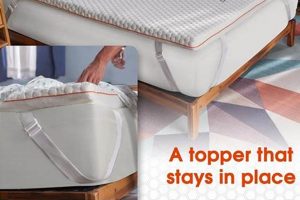
Tip 3: Secure with Elastic Straps or Bands: Employ adjustable elastic straps, similar to those used for securing fitted sheets, to anchor the topper to the mattress. Position these straps around the perimeter of the bed for optimal stability.
Tip 4: Apply Hook and Loop Fasteners: Affix adhesive-backed hook and loop fasteners to both the mattress and topper. Ensure a secure bond by thoroughly cleaning the surfaces before application. This method provides a robust and adjustable restraint.
Tip 5: Consider a Mattress Encasement: A zippered mattress encasement can encompass both the mattress and topper, providing a unified and secure sleeping surface. This option offers comprehensive protection against allergens and bed bugs, in addition to slippage prevention.
Tip 6: Regularly Readjust the Topper: Periodic inspection and adjustment of the topper can help maintain its optimal position. Even with preventative measures in place, minor shifting may occur over time.
Tip 7: Evaluate Topper Material and Mattress Surface: The inherent properties of the topper material and the mattress surface can influence slippage. Rougher surfaces tend to offer greater friction, while smoother materials may require more aggressive stabilization methods.
Implementing these techniques contributes to a more stable and comfortable sleep environment by minimizing disruptive movement of the mattress topper.
The subsequent sections will explore alternative solutions and considerations for maintaining optimal topper placement over the long term.
1. Friction Enhancement

Friction enhancement directly addresses the problem of mattress topper slippage by increasing the resistance between the topper’s surface and the underlying mattress. Without sufficient friction, the topper, subjected to the weight and movement of a sleeper, will inevitably migrate from its intended position. This displacement negates the benefits the topper provides, such as improved spinal alignment or enhanced pressure relief. The cause-and-effect relationship is straightforward: low friction leads to sliding; increased friction reduces sliding.
The importance of friction enhancement lies in its ability to passively restrain the topper. For example, a simple rubberized mat placed between the mattress and topper creates significantly more friction than smooth fabric alone. This passive restraint minimizes the need for active methods like straps or fasteners, which may be less comfortable or convenient. The textured surface of the mat interlocks with the materials of both the mattress and topper, preventing relative motion. Another example is the use of a tightly woven cotton sheet, which provides more grip compared to a silky satin sheet. Understanding this connection allows individuals to make informed decisions about materials and accessories.
In summary, friction enhancement is a critical component in maintaining the position of a mattress topper. While other methods offer additional security, increasing friction at the interface between the mattress and topper provides a foundational level of stability. The challenge lies in selecting materials that offer both high friction and comfort. By focusing on friction enhancement, individuals can significantly improve the stability of their mattress topper and enjoy its intended benefits without constant readjustment.
2. Secure anchoring

Secure anchoring represents a direct approach to maintaining a mattress topper’s position. By physically connecting the topper to the underlying mattress, the potential for movement is significantly reduced. This method is particularly relevant when friction-based solutions prove insufficient, such as with smooth mattress surfaces or lightweight toppers.
- Perimeter Straps
Elastic straps, often adjustable, are positioned around the perimeter of the bed to secure the topper to the mattress. These straps exert constant pressure, preventing the topper from shifting laterally. Examples include straps with buckle closures or elastic bands with integrated clips. Improper tensioning can result in discomfort or damage to the topper; therefore, careful adjustment is critical.
- Corner Anchors
Corner anchors consist of fabric or elastic loops that attach to the corners of both the topper and the mattress. These anchors provide targeted restraint at the points most susceptible to movement. Their effectiveness depends on the strength of the attachment points and the quality of the materials used. A weak anchor point can tear under stress, rendering the system ineffective.
- Hook and Loop Fasteners
Adhesive-backed hook and loop fasteners offer a customizable anchoring solution. Strips of the material are attached to both the mattress and topper, allowing for a strong, adjustable bond. The long-term effectiveness depends on the adhesive’s strength and the cleanliness of the surfaces prior to application. Over time, the adhesive may weaken, requiring replacement.
- Mattress Encasements
A zippered mattress encasement fully encloses both the mattress and topper, creating a unified unit. This provides comprehensive protection against mov
ement, allergens, and bed bugs. The encasement’s effectiveness depends on a snug fit and durable zipper construction. A loose fit can compromise the restraint, while a faulty zipper can render the entire system unusable.
These anchoring methods, when properly implemented, contribute significantly to stabilizing a mattress topper. The selection of an appropriate method depends on individual preferences, the specific characteristics of the mattress and topper, and the desired level of security. While secure anchoring provides robust restraint, it is essential to consider potential drawbacks, such as discomfort or damage, and to choose a system that aligns with individual needs.
3. Sheet tightness
Sheet tightness is intrinsically linked to maintaining the position of a mattress topper. The degree of tension exerted by the fitted sheet directly influences the extent to which the topper remains stationary on the underlying mattress. Insufficient tension allows the topper to shift and slide due to the sleeper’s movements, diminishing the intended comfort and support. Conversely, adequate sheet tightness compresses the topper against the mattress, increasing friction and restricting movement. The cause-and-effect relationship is demonstrable; looser sheets beget topper displacement, while taut sheets inhibit it.
The significance of sheet tightness resides in its role as a readily accessible and often overlooked component of effective topper stabilization. A fitted sheet with deep pockets, designed to accommodate both the mattress and topper, provides a simple yet potent means of restraint. For instance, a standard fitted sheet on a thick mattress and topper combination will likely be inadequate, resulting in constant slippage. However, a fitted sheet with a deeper pocket, specifically designed for thicker bedding, will provide the necessary tension to hold the topper in place. The practical application of this understanding is evident in the selection of appropriately sized and well-fitted sheets.
In summary, sheet tightness contributes significantly to preventing topper displacement. While not a singular solution in all cases, its importance should not be underestimated. Challenges arise when matching sheet size to varying mattress and topper thicknesses, necessitating careful measurement and selection. Understanding the connection between sheet tightness and topper stability allows individuals to optimize their bedding configuration, leading to improved sleep quality and minimized topper readjustment.
4. Material compatibility

Material compatibility plays a critical role in the effectiveness of methods used to prevent mattress topper slippage. The interaction between the materials of the mattress, topper, and any intervening layers significantly influences the degree of friction and adhesion achieved, thereby affecting the topper’s stability.
- Surface Texture Interaction
The surface texture of both the mattress and topper directly impacts the coefficient of friction. Rougher surfaces, such as those found on some quilted mattresses, offer increased resistance to sliding compared to smoother surfaces like those on certain memory foam mattresses. Combining two smooth surfaces exacerbates the problem of slippage, while pairing a rough surface with a smooth one can provide some degree of inherent stabilization. The selection of topper materials should, therefore, consider the existing surface properties of the mattress to optimize friction.
- Material Composition and Porosity
The composition of the materials, including their porosity and density, influences their ability to grip one another. Highly porous materials, like some open-cell foam toppers, can conform to the underlying mattress surface, creating a degree of mechanical interlock. Denser, less porous materials, such as latex, tend to slide more easily unless paired with a compatible surface or additional friction-enhancing measures. Material selection impacts the efficacy of friction-based stabilization techniques.
- Electrostatic Properties
Certain synthetic materials can generate static electricity, which may either promote or inhibit slippage. In some cases, static cling can create a temporary bond between the topper and mattress, reducing movement. However, this effect is often inconsistent and influenced by humidity levels. In other cases, static repulsion can increase slippage, particularly between two synthetic surfaces. Considering these electrostatic properties can inform material selection and the need for anti-static treatments.
- Thermal Properties and Conformability
Materials with high thermal sensitivity, such as memory foam, conform more readily to the shape of the underlying mattress, creating a more secure fit. This enhanced conformability reduces the likelihood of slippage, particularly when combined with a fitted sheet. Conversely, materials with low thermal sensitivity, such as certain types of fiberfill, maintain their shape and are more prone to sliding. The thermal properties of the materials, therefore, influence the effectiveness of conformability-based stabilization methods.
In conclusion, a thorough understanding of material compatibility is essential for effectively addressing mattress topper slippage. By considering the surface texture, composition, electrostatic properties, and thermal behavior of the mattress and topper materials, individuals can make informed decisions about topper selection and stabilization techniques, ultimately improving sleep quality and comfort.
5. Regular adjustment

Regular adjustment serves as a critical maintenance component in strategies to mitigate mattress topper slippage. Even with the implementation of preventative measures such as friction enhancement, secure anchoring, and properly sized sheets, gradual displacement of the topper can occur over time due to the cumulative effects of movement and pressure. The underlying cause is the continuous application of force, however minimal, on the toppers surface. The effect is a slow but steady migration from its intended position.
The importance of regular adjustment stems from its ability to counteract these incremental shifts. For example, consider a scenario where elastic straps are initially effective in securing a topper. Over several weeks, the straps may stretch slightly or the topper material may compress, reducing the tension and allowing for increased movement. Periodic readjustment of the straps restores the necessary tension, maintaining the topper’s position. Similarly, even with a well-fitting sheet, localized stretching or bunching can create areas of reduced friction. Re-centering the topper and smoothing the sheet can address these issues before they escalate into significant displacement. The practical application of this principle is evident in the need for routine inspection and correction of bedding arrangements.
In conclusion, regular adjustment is an essential supplementary practice in the multifaceted approach to preventing mattress topper slippage. While proactive measures aim to minimize initial movement, routine maintenance addresses the i
nevitable consequences of prolonged use. The challenge lies in establishing a consistent schedule for adjustment and recognizing the subtle signs of displacement before they impact sleep quality or compromise the toppers intended benefits. Understanding the necessity of regular adjustment and integrating it into bedding maintenance routines ensures a more stable and comfortable sleep environment.
Frequently Asked Questions
This section addresses common inquiries regarding methods and best practices for preventing mattress topper slippage. The information provided aims to clarify concerns and offer practical solutions.
Question 1: Why does a mattress topper tend to slide despite the presence of a fitted sheet?
The primary reason for topper slippage, even with a fitted sheet, stems from insufficient friction between the topper and the mattress. Smooth surfaces combined with movement during sleep can overcome the limited restraint provided by a standard fitted sheet. The sheet may not be tight enough, or may itself be slipping. Deep pocket sheets are generally recommended.
Question 2: Are specialized products, such as mattress grippers, more effective than household items in preventing slippage?
Specialized products are often designed with materials and construction that maximize friction and secure anchoring. While household items can offer a degree of improvement, dedicated mattress grippers or non-slip pads are typically more effective and durable over the long term. These materials provide enhanced performance.
Question 3: How often should a mattress topper be readjusted to maintain its position?
The frequency of readjustment depends on individual sleeping habits and the effectiveness of preventative measures. As a general guideline, a topper should be inspected and readjusted at least once a month. More frequent adjustments may be necessary if significant slippage is observed. Careful inspection is recommended.
Question 4: Can the material of the mattress itself influence the likelihood of topper slippage?
Yes, the mattress material significantly impacts topper stability. Mattresses with smooth or slick surfaces, such as some memory foam models, provide less friction than those with textured surfaces. This necessitates more robust stabilization methods when pairing a topper with a smooth mattress.
Question 5: Is it possible to completely eliminate mattress topper slippage, or is some degree of movement inevitable?
While complete elimination of movement may not be achievable in all cases, implementing a combination of appropriate stabilization techniques can significantly minimize slippage. Factors such as sleeping habits and topper material will influence the degree of movement. A significant degree of movement however, can be mitigated.
Question 6: Does the weight of the sleeper have a significant impact on the amount of topper slippage?
The weight of the sleeper contributes to the forces acting on the topper, increasing the likelihood of movement. Heavier individuals may require more robust stabilization methods to counteract these forces. Consider this variable in your implementation.
Consistent application of these techniques provides a more stable and comfortable sleep environment. Periodic reevaluation may be needed based on personal preferences.
The following section provides a summary of the techniques.
Conclusion
This exploration of “how to keep mattress topper from sliding” has presented various strategies, ranging from friction enhancement and secure anchoring to sheet tightness, material compatibility considerations, and the importance of regular adjustment. These methods, when applied appropriately and in combination, contribute significantly to mitigating the pervasive issue of topper migration during sleep. The efficacy of each technique is contingent on individual circumstances, including mattress and topper materials, sleeping habits, and the desired level of stability.
The consistent application of these principles fosters a more restful and supportive sleep environment. While achieving absolute immobility may prove challenging, a diligent approach to topper stabilization ensures optimal comfort and longevity of bedding investments. Consider these guidelines to enhance sleep quality and preserve the intended benefits of mattress toppers.

![Best Mattress Firm Topper: [Material] Comfort & Support! | Organic & Natural Mattress Buyer’s Guide: Non-Toxic Sleep Solutions](https://mattressworldpa.com/wp-content/uploads/2025/07/th-6080-300x200.jpg "Best Mattress Firm Topper: [Material] Comfort & Support! Organic & Natural Mattress Buyer’s Guide: Non-Toxic Sleep Solutions")