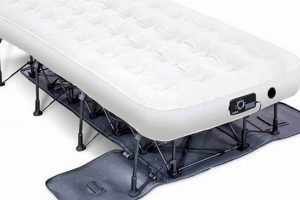
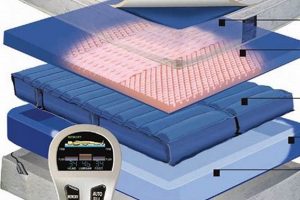
Adhesives formulated for polyvinyl chloride (PVC) are essential for repairing inflatable mattresses. These specialized solutions create a strong, airtight bond on the flexible, plasticized PVC material commonly used in their construction. The chemical makeup of these adhesives allows them to meld with the mattress material, forming a durable seal that prevents air leakage. Applying this type of adhesive typically involves cleaning the damaged area, applying the product, and allowing sufficient time for curing to ensure a proper repair.
The utilization of appropriate adhesives in inflatable mattress repair offers several significant advantages. It extends the lifespan of the mattress, reducing the need for replacements and consequently minimizing waste. Furthermore, it provides a cost-effective alternative to purchasing new inflatables. Historically, finding effective repair solutions for these mattresses presented a challenge, often leading to premature disposal. The development of specialized bonding agents has significantly improved the practicality and sustainability of inflatable products.
The following sections will delve into the specific characteristics of effective adhesives for inflatable PVC mattresses, detailing application techniques, addressing common repair challenges, and outlining preventative measures to minimize future damage.
Essential Application Guidance
The following guidance outlines best practices for using specialized adhesives on inflatable polyvinyl chloride mattresses to ensure durable and effective repairs.
Tip 1: Surface Preparation: Prior to applying the adhesive, thoroughly clean the area surrounding the puncture or tear. Use a suitable solvent, such as isopropyl alcohol, to remove any dirt, grease, or residue. A clean surface is critical for optimal bonding.
Tip 2: Application Technique: Apply a thin, even layer of the adhesive to both surfaces being joined. Avoid excessive application, as this can weaken the bond and prolong drying time. Follow the manufacturer’s instructions regarding recommended application thickness.
Tip 3: Controlled Curing: Allow the adhesive to partially cure, as directed by the manufacturer, before joining the surfaces. This “tack time” allows the solvents to evaporate, increasing the bond strength. Premature joining can result in a weaker, less durable repair.
Tip 4: Pressure Application: After joining the surfaces, apply firm, even pressure to the repaired area. Use a roller or clamp to ensure complete contact and eliminate air pockets. Consistent pressure promotes maximum adhesion during the final curing process.
Tip 5: Environmental Considerations: Conduct the repair in a well-ventilated area to minimize exposure to adhesive fumes. Avoid extreme temperatures or humidity, as these conditions can negatively impact the curing process and the ultimate bond strength.
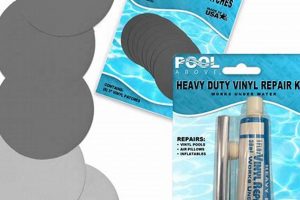
Tip 6: Patch Reinforcement: For larger tears, consider using a PVC patch in conjunction with the adhesive. Cut the patch slightly larger than the damaged area, round the corners to prevent peeling, and apply the adhesive to both the patch and the mattress surface before bonding.
Following these guidelines ensures a robust and reliable repair, maximizing the longevity of the inflatable mattress and preventing future air leaks.
The final section will cover preventative maintenance techniques to further extend the lifespan of inflatable polyvinyl chloride mattresses.
1. Composition
The composition of an adhesive specifically formulated for polyvinyl chloride inflatable mattresses is a crucial determinant of its performance and durability. The chemical constituents dictate the adhesive’s ability to form a robust, airtight seal with the mattress material.
- PVC Resin Base
The foundation of these adhesives typically includes a PVC resin, chosen for its inherent compatibility with the mattress material. This resin provides the primary bonding matrix. The specific type and molecular weight of the resin influence the adhesive’s viscosity, flexibility, and resistance to degradation. Improper resin selection can result in a brittle or chemically reactive bond, leading to premature failure.
- Solvents
Solvents are integral to the adhesive’s workability and application characteristics. They dissolve the PVC resin and other components, allowing for smooth and even application. The choice of solvent significantly impacts drying time, viscosity, and environmental considerations. Aggressive solvents can damage the mattress material, while slow-evaporating solvents can prolong curing time and weaken the bond.
- Plasticizers
Plasticizers are added to enhance the flexibility of the cured adhesive. Because PVC is a rigid polymer, incorporating plasticizers makes the adhesive more compliant and less prone to cracking or peeling under stress. The type and concentration of plasticizer influence the long-term durability and performance of the repair. Incompatible plasticizers can leach out over time, resulting in a hardened, brittle adhesive.
- Stabilizers and Additives
Various stabilizers and additives are included to improve the adhesive’s resistance to environmental factors, such as UV radiation and temperature fluctuations. These additives also contribute to the adhesive’s overall stability and shelf life. Without proper stabilization, the adhesive can degrade over time, leading to bond failure. Examples include UV absorbers, antioxidants, and thermal stabilizers.
Understanding the interplay of these compositional elements is essential for selecting the appropriate adhesive. A balanced formulation ensures optimal adhesion, flexibility, durability, and resistance to environmental stresses, ultimately prolonging the lifespan of the inflatable mattress repair.
2. Flexibility

Flexibility is a critical characteristic of adhesives designed for repairing inflatable polyvinyl chloride mattresses. The inherent pliability of the mattress material necessitates an equally flexible adhesive to ensure a durable and lasting bond. An adhesive lacking sufficient flexibility is prone to cracking or separating under the stresses of inflation, deflation, and general use. This brittleness negates the purpose of the repair, leading to recurring air leaks and ultimately reducing the lifespan of the mattress. For instance, a rigid epoxy adhesive, while exhibiting strong initial bonding, would likely fail quickly due to its inability to accommodate the constant flexing of the PVC material.
The flexibility of the adhesive is typically achieved through the inclusion of plasticizers within its formulation. These additives impart a degree of elasticity, allowing the adhesive to stretch and deform without fracturing. The correct balance of plasticizers is crucial; excessive amou
nts can weaken the adhesive’s overall strength, while insufficient quantities result in a brittle bond. Furthermore, the type of plasticizer is also important, as some may degrade over time, leading to a loss of flexibility and eventual bond failure. Consider a scenario where an adhesive marketed for general plastic repair is used. It might initially seem effective, but if its flexibility doesn’t match the specific needs of the mattress, the repair will likely fail sooner than expected.
In summary, the flexibility of adhesives used on inflatable PVC mattresses is not merely a desirable attribute, but a fundamental requirement for a successful and durable repair. The adhesive must be capable of withstanding the constant stresses of use without cracking or separating. Understanding this connection is crucial for selecting the appropriate adhesive and ensuring the extended lifespan of the repaired mattress. Challenges remain in formulating adhesives that maintain optimal flexibility over prolonged periods and under varying environmental conditions. Future advancements may focus on novel plasticizers or polymer blends to further enhance the durability and performance of these specialized adhesives.
3. Adhesion Strength

Adhesion strength is a pivotal performance characteristic of any adhesive intended for repairing inflatable polyvinyl chloride (PVC) mattresses. It quantifies the force required to separate the bonded surfaces, directly reflecting the durability and longevity of the repair. In the context of PVC mattress repair, insufficient adhesion strength translates to premature bond failure, resulting in air leaks and rendering the mattress unusable. The weight exerted by a sleeping individual, coupled with the constant flexing of the PVC material, places significant stress on the adhesive bond. If the adhesive cannot withstand these forces, the repair will inevitably fail.
The formulation of effective PVC adhesives necessitates a careful balance of chemical constituents that promote strong adhesion to the plasticized PVC. This often involves the use of solvents that partially dissolve the surface of the PVC, creating a mechanical interlock as the adhesive cures. Consider, for example, two scenarios: one using a general-purpose adhesive with low adhesion strength and another using a PVC-specific adhesive with high adhesion strength. The former may initially appear to hold, but under normal usage, the bond will quickly weaken and fail. The latter, designed with superior adhesion properties, will maintain a robust seal, preventing air leakage and extending the lifespan of the repair. Factors such as surface preparation, application technique, and curing conditions also significantly influence the achieved adhesion strength. Proper cleaning and roughening of the PVC surface enhance mechanical bonding, while correct application and curing procedures ensure optimal cross-linking of the adhesive polymer chains.
In summary, adhesion strength is an indispensable attribute of adhesives employed for inflatable PVC mattress repair. It dictates the resilience and durability of the bond under continuous stress. The selection of an appropriate adhesive with demonstrably high adhesion strength, coupled with meticulous application techniques, is paramount for achieving a long-lasting and reliable repair. Overcoming the challenge of maintaining adhesion strength under diverse environmental conditions and prolonged use remains a key focus for ongoing research and development in adhesive technology.
4. Curing Time

Curing time is a critical parameter influencing the success of repairs involving polyvinyl chloride (PVC) adhesives on inflatable mattresses. This duration, required for the adhesive to achieve its optimal bond strength and structural integrity, directly impacts the long-term performance and reliability of the repair.
- Definition and Chemical Process
Curing time refers to the period during which the adhesive undergoes chemical cross-linking, transitioning from a liquid or semi-liquid state to a solid, durable material. The adhesive solvents evaporate, and the polymer chains within the adhesive bond to both each other and the PVC material. This process creates a strong, interlocking network that provides the necessary adhesion and airtight seal. Insufficient curing compromises this network, resulting in a weaker bond susceptible to failure under stress.
- Influence of Environmental Factors
Environmental conditions, such as temperature and humidity, significantly affect the curing process. Higher temperatures generally accelerate curing, while lower temperatures slow it down. Elevated humidity levels can impede solvent evaporation, potentially prolonging curing time and weakening the final bond. Adhesives may require adjusted curing times based on these conditions to achieve optimal results. Failure to account for these factors can lead to premature bond failure or compromised airtight seals.
- Impact of Adhesive Formulation
The specific formulation of the PVC adhesive influences its required curing time. Different adhesives employ various solvents, resins, and additives, each with unique evaporation rates and cross-linking properties. Manufacturers provide specific curing time recommendations based on their adhesive’s composition. Deviating from these recommendations can lead to suboptimal bond strength or an incomplete seal, resulting in air leakage from the repaired mattress.
- Consequences of Premature Use
Using an inflatable mattress before the adhesive has fully cured can severely compromise the repair. The applied stress disrupts the still-forming chemical bonds, weakening the overall adhesive network and potentially causing complete bond failure. This can lead to a recurrence of the original air leak, necessitating a complete re-application of the adhesive and a renewed curing period. Allowing sufficient curing time is therefore essential for achieving a durable and reliable repair.
The correlation between curing time and the effectiveness of PVC adhesive repairs on inflatable mattresses cannot be overstated. Adherence to the manufacturer’s recommended curing time, while accounting for environmental conditions and the specific adhesive formulation, is crucial for ensuring a robust and long-lasting repair, thus extending the lifespan of the inflatable mattress.
5. Water resistance

Water resistance is a critical attribute of adhesives used for repairing inflatable polyvinyl chloride (PVC) mattresses, primarily due to the potential for exposure to moisture during use or cleaning. The structural integrity of the adhesive bond must remain uncompromised when subjected to water or humidity to ensure a lasting repair and prevent air leakage. If the adhesive lacks adequate water resistance, it can degrade over time, leading to bond weakening and eventual failure. This is especially pertinent given that inflatable mattresses are often used in environments where spills or condensation are likely.
The inclusion of water-resistant polymers and additives within the adhesive’s formulation is essential to achieving this property. These components create a barrier that prevents water molecules from
penetrating the adhesive bond and disrupting the chemical interactions between the adhesive and the PVC material. Consider, for instance, two repaired mattresses: one utilizing a standard adhesive and another employing a specialized, water-resistant PVC adhesive. The former, when exposed to moisture, will exhibit gradual bond degradation, resulting in air leakage. The latter, however, will maintain its structural integrity, ensuring a prolonged and effective repair. This attribute extends the use case scenarios of these mattresses from indoor camping to outdoor use.
In summary, water resistance is not merely a desirable characteristic of adhesives used in inflatable PVC mattress repair but a fundamental requirement for ensuring long-term durability and reliability. The ability of the adhesive to withstand exposure to moisture is paramount for preventing bond degradation and maintaining an airtight seal. The selection of adhesives specifically formulated with water-resistant properties is therefore crucial for achieving successful and lasting repairs. Ongoing research and development continue to focus on enhancing the water resistance of these adhesives to further extend the lifespan and usability of repaired inflatable mattresses.
6. PVC Compatibility

The effectiveness of any adhesive used in repairing inflatable polyvinyl chloride (PVC) mattresses is intrinsically linked to its PVC compatibility. This compatibility dictates the adhesive’s ability to form a robust and lasting bond with the mattress material, preventing air leakage and ensuring the repaired area can withstand repeated use.
- Chemical Compatibility
Chemical compatibility refers to the adhesive’s ability to interact favorably with the PVC at a molecular level. The adhesive’s solvents and resins must be able to slightly dissolve the PVC surface to create a mechanical interlock upon curing. Conversely, incompatible solvents can degrade or distort the PVC, weakening the bond. An example would be using a solvent-based adhesive formulated for ABS plastic on a PVC mattress. The solvents may be too aggressive, causing the PVC to become brittle and ultimately leading to bond failure.
- Plasticizer Compatibility
PVC is often plasticized to increase its flexibility. The adhesive must be compatible with these plasticizers to prevent them from migrating out of the PVC and weakening the bond over time. Incompatible adhesives can leach out plasticizers, causing the PVC to become stiff and prone to cracking around the repair area. Specialized PVC adhesives are formulated to maintain the plasticizer balance within the mattress material.
- Adhesion Mechanism
The adhesion mechanism describes how the adhesive physically bonds to the PVC. Effective PVC adhesives create a combination of mechanical interlocking and chemical bonding. The adhesive’s molecules must interact with the PVC at a surface level to form a strong, cohesive bond. Poor compatibility can lead to weak surface adhesion, where the adhesive peels away easily from the PVC, rendering the repair ineffective.
- Long-Term Stability
Long-term stability refers to the adhesive’s ability to maintain its bond strength and flexibility over time, under various environmental conditions. A compatible adhesive will resist degradation from UV exposure, temperature fluctuations, and humidity. Incompatible adhesives may become brittle, crack, or lose adhesion over time, requiring repeated repairs or mattress replacement. Specifically, adhesives that become rigid with age lose the vital flexibility needed to bond with the flexing nature of the mattress.
These facets of PVC compatibility are paramount when selecting an adhesive for inflatable mattress repair. The adhesive must be chemically compatible, maintain plasticizer balance, create a robust adhesion mechanism, and exhibit long-term stability to ensure a lasting and effective repair, thus extending the lifespan of the PVC air mattress. The failure to prioritize PVC compatibility often results in premature bond failure and recurring air leaks, negating the benefits of the repair.
7. Patch Application
The effective application of a patch, in conjunction with polyvinyl chloride adhesives, is crucial for achieving durable repairs on inflatable mattresses. The patch serves as a reinforcing element, distributing stress and preventing further tearing of the mattress material. The quality of the adhesive and the technique used in applying the patch significantly impact the long-term success of the repair.
- Surface Preparation
Proper surface preparation is paramount before applying any adhesive or patch. The area surrounding the damage must be thoroughly cleaned and roughened to ensure optimal adhesion. Contaminants such as dirt, oil, or moisture can impede the adhesive’s ability to bond effectively with the PVC material. Similarly, the patch itself should be cleaned to remove any residue. Inadequate surface preparation is a primary cause of patch failure, regardless of the adhesive’s inherent strength. Sanding the surface is usually required.
- Adhesive Application Technique
The method of applying the adhesive is a critical determinant of bond strength. A thin, even layer of adhesive should be applied to both the mattress surface and the patch. Excess adhesive can weaken the bond, while insufficient adhesive may result in incomplete coverage and air leaks. The manufacturer’s instructions regarding application thickness and drying time must be strictly followed. Many adhesives require a ‘tack time’ before the patch is applied, allowing the solvents to partially evaporate and increase the initial bond strength. Some techniques require heat to activate the adhesive.
- Patch Material Selection
The material composition of the patch itself plays a significant role in the repair’s durability. Ideally, the patch should be made of PVC material that is compatible with the mattress and the adhesive. Patches made of incompatible materials may not bond effectively and can lead to premature failure. The patch should also be of sufficient thickness to provide adequate reinforcement without adding excessive bulk or stiffness to the repaired area. Furthermore, consider its flexibility to match the air mattress.
- Pressure and Curing
Applying consistent pressure during the curing process is essential for ensuring a strong and uniform bond. This pressure forces the adhesive into intimate contact with both surfaces, maximizing the adhesion area and minimizing air pockets. Clamps, weights, or rollers can be used to apply pressure, depending on the size and location of the repair. Allowing the adhesive to cure completely, as per the manufacturer’s instructions, is equally crucial. Premature use of the mattress can disrupt the curing process and weaken the bond. Sometimes, using a vacuum bag over patch is required
In summary, successful patch application requires a meticulous approach, encompassing proper surface preparation, precise adhesive application, appropriate patch material selection, and adequate pressure during curing. These factors, when combined with a high-quality polyvinyl chloride adhesive, contribute to a durable and long-lasting repair of inflatable mattresses, extending their useful life and minimizing waste.
Frequently Asked Questio
ns
The following questions address common concerns regarding the application, performance, and selection of adhesives used for repairing inflatable polyvinyl chloride mattresses.
Question 1: What type of adhesive is best suited for repairing a PVC air mattress?
Specialized polyvinyl chloride adhesives are recommended. These adhesives are formulated to bond effectively with the plasticized PVC material commonly used in air mattress construction. General-purpose adhesives may not provide a durable or airtight seal.
Question 2: How should the surface be prepared prior to applying the adhesive?
The surface must be thoroughly cleaned and roughened. Remove any dirt, oil, or debris with a suitable solvent, such as isopropyl alcohol. Lightly sanding the area around the puncture or tear can enhance adhesion.
Question 3: How long should the adhesive cure before the mattress is used?
The adhesive must fully cure according to the manufacturer’s instructions. Curing times vary depending on the specific adhesive and environmental conditions. Premature use can compromise the bond and lead to air leaks.
Question 4: Can a patch be used in conjunction with the adhesive?
A patch is recommended for larger tears or punctures. The patch should be made of PVC material compatible with the mattress and adhesive. Apply the adhesive to both the patch and the mattress surface, ensuring complete coverage.
Question 5: Is water resistance a critical factor for PVC adhesives used in air mattress repair?
Water resistance is highly desirable. Exposure to moisture can degrade the adhesive bond over time. Opt for adhesives specifically formulated to resist water damage for extended durability.
Question 6: What factors can affect the bond strength of a PVC adhesive repair?
Several factors influence bond strength, including surface preparation, adhesive application technique, curing time, environmental conditions, and the compatibility of the adhesive with the PVC material.
Understanding these considerations is essential for achieving a successful and long-lasting repair of inflatable mattresses.
The subsequent section addresses preventative maintenance techniques to prolong the lifespan of inflatable PVC mattresses.
PVC Glue for Air Mattress
This exploration has underscored the necessity of specialized adhesives for the effective repair of inflatable polyvinyl chloride mattresses. Key considerations, including composition, flexibility, adhesion strength, curing time, water resistance, and PVC compatibility, have been highlighted as critical factors influencing the longevity and durability of any repair. The proper application of these adhesives, often in conjunction with a reinforcing patch, demands meticulous attention to surface preparation, application technique, and environmental conditions.
Given the prevalence of inflatable PVC mattresses and the economic and environmental benefits of repair over replacement, a comprehensive understanding of appropriate adhesive selection and application remains paramount. Continued adherence to best practices and advancements in adhesive technology are crucial for ensuring the continued viability of inflatable mattress repair, minimizing waste, and maximizing product lifespan.