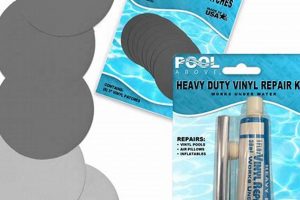
The process of mending punctures or leaks in inflatable sleeping pads, commonly used for camping or temporary bedding, ensures continued functionality. Successful repair restores the ability of the item to retain air, providing a stable and comfortable sleeping surface. For instance, a hole caused by a sharp object can be sealed with an adhesive patch, preventing further air loss.
Maintaining the integrity of inflatable mattresses extends their lifespan and reduces the need for replacement, offering cost savings. The ability to readily repair minor damage enhances convenience during travel or when accommodating guests. Historically, repair methods have evolved from simple tape solutions to sophisticated adhesive technologies that create durable, airtight seals.
This article will detail the necessary materials, preparation steps, and patching techniques that contribute to a successful and long-lasting repair. It will also cover preventive measures that can minimize the likelihood of future damage.
Essential Guidance for Air Mattress Repair
The following tips are designed to optimize the effectiveness and longevity of air mattress repairs. Adherence to these guidelines will enhance the likelihood of a successful and durable patch.
Tip 1: Precise Leak Identification: Immerse the inflated mattress section by section in water. Bubbles indicate the precise location of the leak, which should be marked clearly with a permanent marker for accurate patch placement.
Tip 2: Surface Preparation is Paramount: Thoroughly clean the area surrounding the puncture with isopropyl alcohol to remove dirt, oil, or any residue that could impede adhesive bonding. Allow the area to dry completely before proceeding.
Tip 3: Patch Size Matters: Select a patch that extends at least one inch beyond the perimeter of the leak. This ensures ample surface area for adhesion and distributes stress effectively.
Tip 4: Round Patch Corners for Durability: Trim the corners of the patch into a rounded shape. This prevents the corners from lifting or peeling over time, which can compromise the seal.
Tip 5: Apply Consistent Pressure: After applying the patch, exert firm, even pressure across its entire surface for the manufacturer-recommended duration. This promotes a strong and uniform bond.
Tip 6: Allow Adequate Curing Time: Refer to the adhesive instructions for the recommended curing time before reinflating the mattress. Premature inflation can weaken the bond and lead to patch failure.
Tip 7: Reinforce High-Stress Areas: For leaks located near seams or areas subject to significant stress, consider applying a second patch for added reinforcement.
By diligently implementing these tips, one can significantly improve the success rate and durability of air mattress repairs, thereby extending the life of the product.
The subsequent sections will delve into preventative maintenance strategies to further minimize the occurrence of punctures and leaks in air mattresses.
1. Locate the leak

The initial and arguably most critical step in the process of mending an air mattress is the precise identification of the leak’s location. This step dictates the effectiveness of any subsequent repair efforts. Failure to accurately pinpoint the source of air egress renders patching attempts futile, as the adhesive patch will not address the actual point of failure.
The process of leak detection typically involves inflating the mattress and systematically inspecting its surface for escaping air. A common method involves applying a solution of soapy water to sections of the inflated mattress. The presence of bubbles indicates the leak’s location. Marking the precise point with a pen or marker is essential for accurate patch placement. Without this initial localization, the effort to seal the mattress becomes a generalized and inefficient endeavor, potentially wasting time and resources on ineffective patching.
In summary, locating the leak serves as the foundational element of a successful repair. Accurate identification enables targeted application of repair materials, ensuring an airtight seal and restoring the mattress to its intended functionality. The absence of this step invariably leads to a failed repair, underscoring its indispensable role in the overall process of mending an inflatable sleeping surface.
2. Surface preparation critical
Surface preparation forms a foundational element in the successful execution of an inflatable mattress repair. It directly influences the adhesive bond between the patch and the mattress material, consequently affecting the durability and longevity of the repair. Without adequate surface preparation, the adhesive’s ability to properly adhere to the mattress is compromised, irrespective of the quality of the patch or adhesive used. For instance, residual dirt, oils, or moisture on the mattress surface creates a barrier, preventing the adhesive from forming a strong molecular link with the mattress material. This weakened bond inevitably leads to patch failure, resulting in renewed air leakage.
Effective surface preparation typically involves cleaning the area surrounding the puncture with a suitable solvent, such as isopropyl alcohol. This solvent removes surface contaminants that could impede adhesion. The cleaned area must then be thoroughly dried to eliminate any residual moisture, as moisture can also interfere with the bonding process. A slightly roughened surface, achieved through gentle abrasion, can further enhance adhesion by increasing the surface area available for bonding. Neglecting these preparation steps transforms a potentially straightforward repair into a futile exercise. An example would be attempting to patch an air mattress used outdoors without first meticulously cleaning the surface; the patch will likely fail within a short period due to the presence of environmental contaminants.
In conclusion, the criticality of surface preparation cannot be overstated in the context of mending air mattresses. It serves as the indispensable first step, ensuring optimal adhesion and ultimately determining the success or failure of the repair. Ignoring this element undermines the entire process, highlighting the fundamental connection between meticulous surface preparation and a durable, airtight patch.
3. Adhesive type impacts strength

The selection of adhesive is a critical determinant in the overall success and durability of inflatable mattress repairs. The inherent strength of the adhesive bond directly correlates with the ability of the patch
to withstand internal pressure and external forces, consequently influencing the longevity of the repair. An inappropriate adhesive, lacking the necessary bonding properties or compatibility with the mattress material, will result in a compromised seal and premature failure, necessitating repeated repair attempts. For example, utilizing a standard household glue on a vinyl air mattress patch is highly unlikely to yield a long-lasting repair, as such adhesives are not formulated to bond effectively with flexible vinyl materials under pressure.
The optimal adhesive for air mattress repair typically possesses properties such as flexibility, water resistance, and strong bonding capabilities with materials like vinyl or rubber. Specialized vinyl adhesives or rubber cements are frequently recommended, as their chemical composition is designed to create a durable, airtight seal that can withstand the constant stress exerted by inflation and deflation cycles. Conversely, cyanoacrylate adhesives (super glues), while offering rapid bonding, often lack the flexibility required to accommodate the expansion and contraction of the air mattress, leading to brittle fractures and eventual patch detachment. The use of an adhesive specifically designed for inflatable repairs significantly increases the likelihood of a robust and enduring solution, minimizing the risk of future leaks.
In summary, the relationship between adhesive type and repair strength is fundamental to the process of mending inflatable mattresses. The adhesive acts as the critical interface between the patch and the mattress, and its properties directly dictate the integrity of the seal. Choosing the appropriate adhesive, tailored to the specific material of the mattress, is therefore an essential step in achieving a reliable and long-lasting repair. Failure to do so will invariably result in a weak bond and a compromised seal, highlighting the profound impact of adhesive selection on the success of any patching endeavor.
4. Patch application matters

The manner in which a patch is applied directly determines the effectiveness and longevity of any inflatable mattress repair. The act of patching is not merely affixing a piece of material; it is the creation of a cohesive bond capable of withstanding pressure and stress. The quality of this bond hinges on the execution of specific techniques during application. Improper technique will lead to a compromised seal, regardless of the quality of the patch or adhesive used. For instance, air pockets trapped between the patch and the mattress surface create weak points prone to failure under pressure. Similarly, uneven pressure distribution during application results in inconsistent adhesion across the patch area, leading to potential leaks along the edges.
A key element in proper application involves ensuring the patch lies flat against the prepared surface, free of wrinkles or creases. Consistent and uniform pressure, often achieved using a roller or a smooth, hard object, is then applied across the entire surface of the patch. This promotes intimate contact between the adhesive and both the patch and the mattress material, maximizing the bonding surface area. Failing to apply sufficient pressure or doing so unevenly will leave portions of the patch poorly adhered, creating pathways for air to escape. An example of this is seen when a patch is hastily applied without adequate pressure; the edges lift quickly, rendering the repair ineffective. This highlights patch placement and technique as important steps of how to patch a air mattress.
In summary, the successful execution of how to patch a air mattress is critically dependent on meticulous patch application. Proper technique mitigates the risk of air pockets, ensures uniform adhesion, and maximizes the strength of the seal. While materials are important, the skill and care with which the patch is applied are paramount in achieving a durable and reliable repair. Understanding this aspect is essential for anyone seeking to effectively mend inflatable mattresses, enabling them to extend the life of the product and avoid recurring issues with leaks.
5. Curing time essential

The designated curing period following patch application to an inflatable mattress constitutes a critical phase in the repair process. This time frame allows the adhesive to fully solidify and achieve its maximum bonding strength, ultimately dictating the long-term success of the repair. Premature use of the patched mattress, before the adhesive has properly cured, can compromise the integrity of the seal and lead to patch failure.
- Adhesive Polymerization
Curing time facilitates the complete polymerization of the adhesive. During this process, the adhesive molecules cross-link, forming a robust and durable network. Insufficient curing time hinders this process, resulting in a weaker, less resilient bond. For example, if the instructions specify a 24-hour curing time, and the mattress is inflated after only 12 hours, the adhesive may not have reached its full strength, increasing the risk of separation under pressure.
- Stress Distribution
Allowing the adhesive to cure fully enables optimal stress distribution across the patched area. As the adhesive hardens, it effectively transfers the forces exerted by the inflated mattress onto the surrounding material. Premature inflation concentrates stress on the still-pliable adhesive, potentially causing it to stretch or tear. A fully cured adhesive disperses this stress evenly, minimizing the risk of concentrated pressure points that could lead to patch failure.
- Environmental Factors
Curing time can be influenced by environmental factors such as temperature and humidity. Lower temperatures and higher humidity may prolong the required curing period. Ignoring these environmental considerations can result in an under-cured adhesive, even if the recommended time has elapsed. For instance, a patch applied in a cold, damp basement may require a longer curing time than one applied in a warm, dry environment.
- Manufacturer Specifications
Adherence to the manufacturer’s specifications regarding curing time is paramount. Different adhesives possess varying chemical compositions and, therefore, require different curing durations to achieve optimal bonding. Deviating from these recommendations, even slightly, can significantly reduce the effectiveness of the repair. For example, failing to consult the adhesive instructions and relying on a generic “rule of thumb” may lead to an improperly cured patch and subsequent air leakage.
The multifaceted nature of curing time underscores its essential role in the context of how to patch a air mattress. Its influence on adhesive polymerization, stress distribution, and environmental considerations highlights the importance of patient adherence to manufacturer guidelines. Proper curing ensures a durable and reliable seal, maximizing the lifespan of the repaired inflatable mattress and minimizing the need for future interventions.
Frequently Asked Questions Regarding Inflatable Mattress Repair
The following section addresses common inquiries and misconceptions related to the effective repair of inflatable mattresses. These questions aim to clarify best practices and provide guidance for achieving durable, long-lasting results.
Question 1: Is patching an inflatable ma
ttress a viable long-term solution?
Patching can provide a durable, long-term solution if the repair is executed correctly, utilizing appropriate materials and techniques. The location and size of the puncture also influence the longevity of the repair. Small punctures in non-stress areas are more likely to yield successful, enduring results.
Question 2: What are the most common causes of air mattress punctures?
The majority of punctures are caused by sharp objects, such as small stones, thorns, or debris. Overinflation can also weaken the material, making it more susceptible to punctures or seam failure. Improper storage, where the mattress is folded tightly or stored in a location with extreme temperatures, can also contribute to damage.
Question 3: Can all types of adhesives be used to patch an inflatable mattress?
No. The adhesive must be compatible with the mattress material (typically vinyl or rubber) and possess sufficient flexibility to accommodate the mattress’s expansion and contraction. General-purpose glues often lack these properties and are unsuitable for air mattress repair. Specialized vinyl adhesives or rubber cements are recommended.
Question 4: How can one ensure a completely airtight seal when patching?
An airtight seal is best achieved through meticulous surface preparation, including thorough cleaning and drying, the use of a compatible adhesive, the application of consistent and uniform pressure during patching, and adherence to the recommended curing time. Thorough inspection of the repair after inflation is also crucial to identify and address any remaining leaks.
Question 5: Is it possible to patch an air mattress that has a puncture near a seam?
Patching near a seam presents a greater challenge due to the increased stress concentration in that area. Success is more likely if a flexible adhesive is used, and the patch extends well beyond the puncture, distributing the stress. Multiple layers of patching material may also provide added reinforcement. In some cases, seam punctures may be beyond effective repair.
Question 6: Are there any preventative measures that can reduce the risk of air mattress punctures?
Preventative measures include using a protective barrier (such as a tarp or blanket) beneath the mattress, avoiding overinflation, storing the mattress properly when not in use, and keeping the surrounding area free of sharp objects. Regular inspection for wear and tear can also help identify potential problems before they lead to punctures.
Effective repair of inflatable mattresses hinges on a combination of appropriate techniques, compatible materials, and diligent execution. Adherence to these guidelines significantly increases the likelihood of a successful and durable repair.
The subsequent section will address advanced repair techniques for more complex or challenging punctures and tears.
Conclusion
The preceding examination of “how to patch a air mattress” has elucidated critical elements impacting repair efficacy. From meticulous leak detection to appropriate adhesive selection and careful application techniques, each stage significantly contributes to the restoration of a functional sleeping surface. Surface preparation, adhesive curing time, and patch placement are similarly crucial to ensure a durable, airtight seal. Ignoring these fundamental principles undermines the repair effort, potentially leading to repeated failures and ultimately negating any cost savings.
While patching provides a viable means of extending the lifespan of inflatable mattresses, it is not a universally applicable solution. The extent and location of damage, coupled with the inherent limitations of repair materials, may render certain mattresses irreparable. Prudent assessment of damage severity, adherence to established repair protocols, and a realistic expectation of repair longevity are essential for informed decision-making. Should repair prove impractical or unsustainable, replacement remains the responsible recourse.