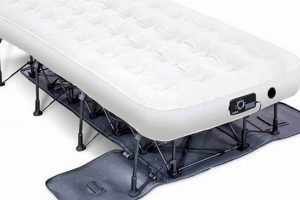
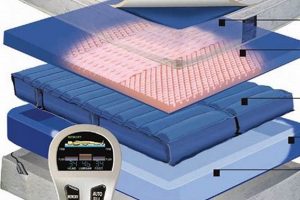
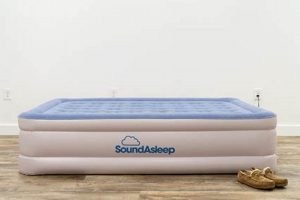
A self-contained inflation system within an inflatable sleeping surface facilitates convenient and rapid deployment. This integrated component eliminates the need for external inflation devices, such as separate pumps or manual bellows. Typically powered by electricity, these systems employ an electric motor to drive an impeller or piston, forcing air into the mattress chambers until the desired firmness is achieved. An example is a camping bed that can be inflated with the press of a button.
The inclusion of this feature significantly enhances portability and ease of use. By removing the reliance on external inflation mechanisms, setup time is minimized, providing immediate sleeping arrangements. This design simplifies storage and transportation, as there is no additional equipment to manage. Early iterations were manually powered; advancements have seen the integration of increasingly sophisticated electric and rechargeable systems, enhancing user experience and convenience.
The following sections will detail various aspects of these integrated inflation systems, including operational principles, maintenance considerations, common issues, and selection criteria when purchasing a new inflatable sleeping solution. These considerations are important for ensuring longevity and optimal performance.
Optimizing the Longevity of Self-Inflating Mattresses
Maximizing the lifespan of a mattress with an integrated inflation system requires adherence to specific usage and maintenance protocols. Careful attention to these details will ensure continued functionality and prevent premature failure.
Tip 1: Regulate Inflation Pressure: Over-inflation places undue stress on the seams and internal components. Adhere strictly to the manufacturer’s recommended pressure levels to prevent ruptures and system failures. Example: Inflate to the point where the surface is firm but still yields slightly to pressure.
Tip 2: Employ Surge Protection: Power surges can damage the electrical components of the integrated system. Utilize a surge protector to shield the motor and circuitry from voltage spikes during operation. Example: Plug the mattress into a surge protector outlet, especially during thunderstorms.
Tip 3: Ensure Proper Storage: Store the mattress fully deflated and in a cool, dry environment to prevent degradation of the material and potential damage to the internal system. Example: Fold the mattress according to manufacturer instructions and store it in its carrying bag in a closet.
Tip 4: Avoid Sharp Objects: Punctures are a primary cause of mattress failure. Clear the surrounding area of any sharp objects before inflating the mattress. Example: Inspect the floor or tent area for rocks, twigs, or other debris.
Tip 5: Perform Periodic Cleaning: Clean the exterior of the mattress regularly with a mild soap and water solution to prevent the accumulation of dirt and grime. Example: Wipe down the surface with a damp cloth and mild detergent after each use.
Tip 6: Prevent Overheating: Do not operate the integrated system for extended periods. Allow the motor to cool down between inflation cycles to prevent overheating and potential damage. Example: If the motor feels hot to the touch, allow it to rest for 15-20 minutes before continuing inflation.
Consistent adherence to these guidelines will contribute significantly to the extended operational life of the mattress, providing sustained comfort and convenience.
The subsequent sections will address troubleshooting common issues and providing detailed guidance on selecting appropriate replacement parts or new mattresses.
1. Inflation Speed

Inflation speed represents a critical performance metric for inflatable mattresses equipped with integrated systems. It directly influences user satisfaction by determining the time required to achieve a usable sleeping surface. Faster inflation times contribute to convenience and reduce the overall setup burden.
- Motor Power and Efficiency
The power output and efficiency of the electric motor are primary determinants of inflation speed. Higher wattage motors generally provide faster inflation, but efficiency dictates how effectively that power is converted into airflow. An inefficient motor wastes energy as heat, resulting in slower inflation and potential overheating. For example, a 150W motor with 80% efficiency will inflate faster than a 200W motor with 60% efficiency.
- Pump Design and Airflow
The design of the pump mechanism, whether it is a piston, impeller, or diaphragm type, significantly impacts airflow volume. A well-designed pump maximizes air displacement with each cycle, resulting in faster inflation. Factors such as valve design, chamber size, and seal integrity contribute to the overall efficiency of the pump. Mattresses using dual pumps, designed to move even larger volumes of air, will inflate quicker.
- Mattress Volume and Internal Structure
The overall volume of the mattress and its internal compartmentalization influence the duration required for complete inflation. Larger mattresses require more air to reach the desired firmness. Complex internal structures with multiple chambers may impede airflow and prolong inflation time. A simple, single-chamber design inflates faster than a mattress with numerous baffles or separate zones.
- Power Source Limitations
The available power from the source can limit inflation speed. AC-powered systems generally provide the highest performance, while DC-powered systems running on batteries may have reduced power output and slower inflation. Rechargeable systems may offer varying inflation speeds depending on the battery charge level. Operating from a wall outlet offers peak performance.
In summary, inflation speed is a multifaceted characteristic of inflatable mattresses with integrated inflation, depending on a combination of motor capabilities, pump design efficiency, mattress size and the selected source of power. Achieving a balance between these elements yields a convenient and efficient inflation process, enhancing the product’s usability.
2. Noise Level

The operational noise generated by an integrated system is a significant factor influencing user experience. Elevated noise levels can disrupt sleep and diminish the convenience afforded by the self-inflating design. A quieter system contributes to a more restful and unobtrusive inflation process.
- Motor Type and Design
The type of motor employed directly impacts the acoustic signature of the mattress system. Brushless motors, for instance, tend to operate more quietly than brushed motors due to the absence of friction-generating brushes. Design considerations such as vibration damping and motor housing also play a crucial role i
n mitigating noise transmission. A motor mounted with rubber bushings, as opposed to directly attached to the frame, will produce less noise. - Pump Mechanism
The design and materials of the pump mechanism contribute significantly to the overall noise output. Piston pumps, while often powerful, can generate more noise than diaphragm or impeller pumps due to their reciprocating motion. The use of noise-dampening materials in the pump housing and valve components can reduce the acoustic signature. A pump constructed with tighter tolerances between moving parts will produce less friction, resulting in less noise.
- Airflow Dynamics
The velocity and turbulence of airflow within the system contribute to the audible noise. Restrictions in airflow pathways, such as narrow valves or improperly sized tubing, can create turbulent flow, resulting in increased noise levels. Optimizing airflow pathways and minimizing restrictions reduces turbulence and minimizes noise. A larger diameter air hose between the pump and mattress reduces airflow restriction and can lower noise.
- Housing and Vibration
The design and materials of the mattress housing play a critical role in dampening and containing noise. A rigid housing with effective vibration isolation can minimize the transmission of noise to the surrounding environment. The placement of the is key, as resonance of the overall unit is important. A housing constructed from dense, sound-absorbing materials will reduce external noise propagation.
In conclusion, managing the operational noise necessitates a comprehensive approach that addresses motor design, pump mechanisms, airflow dynamics, and the acoustic properties of the mattress housing. Engineering efforts focused on these elements yield a more discreet system, promoting a more satisfying user experience and minimizing sleep disruption.
3. Power Source

The energy source powering an integrated system is a defining characteristic, influencing its portability, convenience, and suitability for diverse applications. The chosen source dictates operational limitations and opportunities for its usability.
- AC Power (Mains)
Direct connection to a standard AC power outlet provides a consistent and high-power source, enabling rapid and efficient inflation. These systems are typically found in home settings where access to wall outlets is readily available. However, AC-powered units limit portability, restricting use to locations with available electricity. For instance, a guest bed designed for occasional use is likely to be AC-powered.
- DC Power (Battery)
Employing batteries, either disposable or rechargeable, offers enhanced portability, allowing operation in locations lacking AC power. Battery-powered systems are commonly utilized in camping scenarios or temporary lodging situations. However, runtime is limited by battery capacity, and performance may degrade as the battery discharges. A camping mattress would be a typical application for a battery power source.
- Rechargeable Internal Battery
Integrating a rechargeable battery into the mattress provides a balance between portability and convenience. These systems can be charged from AC outlets or DC sources, offering flexibility in various environments. Battery capacity dictates runtime, and the charging time must be considered. Many modern mattress types use internal batteries for convenience.
- External DC Power (Automotive)
Some systems can be powered via a 12V DC outlet, commonly found in vehicles. This allows for inflation while traveling or camping, leveraging the vehicle’s electrical system. However, continuous use can drain the vehicle’s battery, and the power output may be lower than AC-powered systems. This is often seen in mattresses designed for use in trucks or SUVs.
The selection of a particular type of power source for an integrated feature involves tradeoffs between power, portability, and convenience. A system designed for home use may prioritize AC power for rapid inflation, while a system intended for camping may emphasize battery power for off-grid operation. Understanding these considerations is critical for selecting a mattress suited to specific needs.
4. Durability
Durability in an inflatable mattress featuring an integrated inflation system is paramount to its long-term utility and cost-effectiveness. The integration of the inflation system introduces several points of potential failure that compromise overall mattress longevity if not adequately addressed in the design and manufacturing phases. For example, a mattress constructed with thin, easily punctured material will quickly become unusable regardless of the inflation system’s functionality. Similarly, a pump encased in brittle plastic is susceptible to damage from impacts, rendering the entire mattress useless.
The endurance of the integrated system directly affects the mattress’s ability to maintain consistent firmness over extended periods. A robust system, featuring high-quality components and sturdy construction, is less prone to leaks and mechanical failures. This ensures reliable inflation and deflation, essential for user comfort and convenience. For instance, mattresses intended for frequent use, such as those employed in temporary housing or camping, require more durable pumps and materials to withstand the rigors of repeated setup and takedown. The system should also be protected within the unit and protected for longetivity. Regular maintenance is vital, so following provided guidelines for the product is crucial.
In summation, the durability of an integrated system is integral to the mattress’s overall lifespan and usability. Selecting a mattress constructed from durable materials and featuring a robust system provides long-term value and minimizes the risk of premature failure. While price is a consideration, investing in a more durable model often proves more economical in the long run. Prioritizing construction and quality during selection ensures sustained performance.
5. Compact design
The integration of an inflation mechanism within the structure of an air mattress necessitates a design optimized for space efficiency. The pursuit of a smaller overall footprint directly influences the design and selection of components, impacting portability and storage convenience.
- Miniaturization of Pump Components
The internal dimensions dictate the miniaturization of the pump. Compactness is achieved through design and material innovations, which enable efficient air compression within limited confines. For instance, utilizing micro-pumps or specialized motor designs reduces size, but may impact inflation speed and durability. The internal components affect the overall mattress portability.
- Optimized Air Channel Routing
Effective distribution of air throughout the mattress relies on streamlined air channels. Careful consideration of the routing and diameter of these channels ensures efficient inflation while minimizing the overall volume occupied. Example: Integrating flattened or fle
xible tubing within the mattress layers reduces bulk compared to rigid, larger-diameter hoses. The internal features should be small to enable folding of the mattress when deflated. - Integrated Component Placement
The strategic placement of the system’s individual componentsmotor, pump, battery (if applicable), and control circuitrywithin the mattress structure directly affects the final dimensions. Efficient spatial arrangement minimizes wasted space and maintains a streamlined profile. For example, locating the pump within a recessed area of the mattress or utilizing a foldable design contributes to compactness and ease of storage. Design affects the final product.
- Material Selection for Volume Reduction
The materials used in both the mattress and its internal system influence bulk when deflated. Lightweight, flexible materials enable tighter folding and compression, resulting in a smaller packed size. Utilizing thin, high-strength fabrics for the mattress and compact polymers for the air system parts contributes to improved portability. Materials must have minimal volume.
The design contributes to a reduced overall size, improving both storage and transport. Achieving an optimal balance between efficiency, durability, and compactness is a critical engineering consideration for products with internal systems.
Frequently Asked Questions
This section addresses common inquiries regarding inflatable mattresses with integrated inflation features. The information provided aims to clarify functionality, maintenance, and selection considerations.
Question 1: How does an integrated pump mechanism operate?
The integrated unit utilizes an electric motor to drive a pump, which forces air into the mattress chambers. The motor is typically powered by AC electricity, DC batteries, or a rechargeable internal battery. Air pressure is regulated by an internal sensor or a manual control.
Question 2: What are the primary advantages of a mattress with an internal system?
Key benefits include simplified setup, elimination of external inflation devices, and enhanced portability. The mattress can be inflated and deflated quickly and easily without the need for separate pumps or manual labor.
Question 3: What maintenance procedures are recommended for maximizing the lifespan?
Avoid over-inflation, use surge protection, store the mattress in a cool, dry place, and clean the exterior regularly with a mild soap and water solution. Following these steps will help prevent damage and prolong the systems operational life.
Question 4: What are common signs that the integrated feature requires repair or replacement?
Symptoms of a malfunctioning system include slow or incomplete inflation, unusual noises during operation, and failure to activate. Internal failure often is irreparable, so it may need to be replaced. If these issues persist, seek a professional assessment.
Question 5: Can the integrated electrical component be replaced separately from the mattress?
In some models, the component can be replaced; however, this is highly dependent on the manufacturer and model. Replacement parts can be sourced. Consult the manufacturer’s documentation or a qualified repair technician for guidance.
Question 6: What factors should be considered when purchasing a new inflatable mattress with an integrated inflation system?
Assess inflation speed, noise level, power source options, durability, and compact size. Consider the intended use case and prioritize features accordingly. Evaluate motor type and speed.
These FAQs provide a foundational understanding. Proper usage and care will enhance the durability and overall experience with an inflatable sleeping surface with an integrated feature.
The following section will address detailed troubleshooting steps for common problems.
Air Mattress Internal Pump
The preceding analysis has explored the multifaceted aspects of the feature, encompassing operational principles, maintenance practices, design considerations, and troubleshooting strategies. Key points have underscored the importance of inflation speed, noise level, power source selection, durability, and compact design in determining overall user satisfaction. Understanding these elements is crucial for informed purchasing decisions and proper product stewardship.
The future of inflatable sleeping solutions with integrated inflation hinges on continued advancements in materials science, motor technology, and design optimization. As consumer demand for convenience and portability grows, manufacturers must prioritize robust construction, efficient energy consumption, and user-friendly operation. The ongoing refinement of these will ensure its continued relevance and value in the evolving landscape of portable comfort solutions.