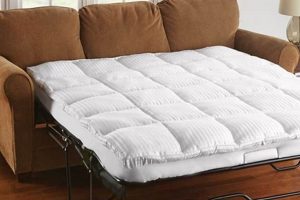
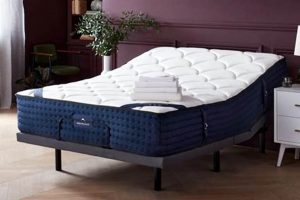
A space-saving sleeping solution featuring a bed frame designed to collapse and store vertically or horizontally, often within a cabinet or against a wall. These units invariably include a conforming mattress, ensuring a complete and ready-to-use bedding arrangement. This setup allows for easy transformation of a room from living space to bedroom and back again.
These adaptable beds are invaluable in settings with limited square footage, such as apartments, studios, and guest rooms. They optimize available space and provide comfortable accommodations without the permanent footprint of a traditional bed. Historically, similar concepts have been utilized to address housing constraints and maximize the utility of confined living environments.
The ensuing discussion will delve into the various types available, examine essential considerations for selection, detail proper installation techniques, and offer maintenance advice to ensure longevity and sustained functionality.
Essential Considerations for Deploying Space-Saving Sleep Solutions
Optimizing the utility and longevity of a vertically storable bed requires careful attention to several key factors. Prior planning and execution are paramount to ensuring a secure and functional installation.
Tip 1: Assess Structural Integrity: Before installation, rigorously evaluate the wall’s load-bearing capacity. These beds, with their included mattresses, are substantial in weight. Inadequate support may lead to structural damage or hazardous conditions.
Tip 2: Measure Dimensions Accurately: Precise measurements of both the installation area and the unit itself are essential. Account for the bed’s extended dimensions when deployed, ensuring adequate clearance from surrounding furniture or fixtures.
Tip 3: Prioritize Safety Mechanisms: Verify the presence and proper functionality of locking mechanisms and safety latches. These features prevent unintended deployment or collapse, minimizing the risk of injury.
Tip 4: Choose a Suitable Mattress: Consider the mattress’s density and construction. Thinner mattresses are generally preferred for storage, but comfort should not be entirely sacrificed. A balance between space efficiency and ergonomic support is crucial.
Tip 5: Follow Installation Instructions Meticulously: Adhere strictly to the manufacturer’s installation guide. Deviations from recommended procedures can compromise the unit’s stability and functionality. Professional installation is advisable for complex systems.
Tip 6: Regular Maintenance is Critical: Inspect all moving parts, hinges, and fasteners periodically. Lubricate hinges and tighten screws as needed to ensure smooth operation and prevent premature wear.
Adhering to these guidelines ensures the safe, efficient, and long-term utilization of a vertically storable bed, maximizing its benefits for space optimization and guest accommodation.
The following sections will explore further aspects of selection, maintenance, and troubleshooting potential issues associated with these innovative sleeping solutions.
1. Space Optimization
Space optimization, in the context of retractable sleeping platforms, represents a strategic approach to maximizing usable area within a given environment. Its relevance is particularly acute in densely populated urban centers and smaller living spaces, where every square foot holds significant value.
- Multifunctional Room Utilization
This facet focuses on enabling a single room to serve multiple purposes. During daytime hours, the room functions as a living area, office, or recreational space. At night, it is transformed into a bedroom with the deployment of the storable bed. The efficiency of a studio apartment or a compact guest room is fundamentally enhanced through this adaptability.
- Minimized Footprint
The core advantage lies in the bed’s reduced footprint when not in use. Traditional beds occupy a substantial amount of floor space, which remains idle during non-sleeping hours. A retractable bed effectively eliminates this wasted space, allowing for unimpeded movement and improved room functionality.
- Vertical Storage Efficiency
Retracting the bed often involves storing it vertically against a wall or within a cabinet. This vertical storage approach leverages unused vertical space, which is typically underutilized in conventional room layouts. Maximizing vertical space is a hallmark of efficient space management.
- Enhanced Room Aesthetics
Beyond functional benefits, retractables contribute to a cleaner and more organized aesthetic. By concealing the bed when not required, the room appears less cluttered and more spacious. This visual impact enhances the overall ambience and improves the perceived quality of the living environment.
These facets collectively illustrate how retractable beds significantly contribute to space optimization. They transform confined living spaces into flexible and multi-functional environments. As urban populations continue to grow and housing costs rise, the importance of such space-saving solutions will only increase, making retractable beds a vital element in modern interior design and living arrangements.
2. Mattress Comfort
Mattress comfort is a critical determinant of the overall utility and satisfaction derived from a stowable bedding system. While space-saving design is paramount, neglecting the quality and suitability of the sleep surface undermines the primary function of the unit: providing restful sleep. Therefore, a nuanced understanding of the factors influencing mattress comfort within this context is essential.
- Thickness and Density Considerations
The mattress used in a stowable system often faces constraints on thickness to facilitate smooth folding and storage. This necessitates careful selection of materials with high density to compensate for the reduced profile. High-density foams or innerspring designs optimized for thinner profiles are frequently employed to provide adequate support and pressure relief despite the dimensional limitations.
- Material Selection and Breathability
The enclosed nature of some stowable bed storage configurations can restrict airflow, potentially leading to increased heat retention within the mattress. Material selection becomes crucial in mitigating this issue. Breathable materials, such as open-cell foams or mattresses incorporating ventilation channels, are preferred to promote airflow and regulate temperature, thereby enhancing comfort and preventing overheating during sleep.
- Support and Spinal Alignment
Maintaining proper spinal alignment is paramount for ensuring restful sleep and preventing muscu
loskeletal discomfort. The mattress must provide adequate support to the user’s body weight and conform to its natural contours. Zoning technologies, which vary the firmness of different mattress sections, are sometimes incorporated to optimize support for different body areas and promote proper spinal alignment. - Durability and Compression Resistance
The frequent folding and unfolding inherent in the operation of a stowable bed place significant stress on the mattress. Materials must exhibit high durability and resistance to compression to withstand these repeated stresses without premature degradation or loss of support. Reinforced edges and robust construction techniques are often employed to enhance the mattress’s longevity and maintain its comfort characteristics over time.
These facets underscore the complex interplay between space-saving design and ergonomic comfort. The selection of a mattress for a stowable system necessitates careful consideration of thickness limitations, breathability requirements, support needs, and durability demands. Prioritizing these factors ensures that the stowable bedding system delivers both spatial efficiency and restful sleep, thereby maximizing its overall value.
3. Mechanism Durability

Mechanism durability is a cardinal attribute of fold away bed with mattress systems, directly influencing their longevity, safety, and overall user satisfaction. The folding mechanism, encompassing hinges, springs, pistons, and locking devices, is subjected to repetitive stress during operation, demanding robust design and high-quality materials to withstand prolonged use.
- Material Composition and Fatigue Resistance
The materials used in the construction of the folding mechanism significantly impact its ability to withstand fatigue and maintain structural integrity over time. High-strength steel alloys, precisely engineered polymers, and corrosion-resistant coatings are employed to minimize wear, prevent failure, and ensure consistent performance. The choice of materials directly dictates the mechanism’s ability to endure repeated stress cycles without compromising its functional integrity.
- Engineering Design and Stress Distribution
The engineering design of the folding mechanism plays a crucial role in distributing stress evenly across its components, mitigating localized stress concentrations that could lead to premature failure. Optimized hinge designs, strategically placed reinforcement elements, and precisely calibrated spring or piston systems contribute to a more durable and reliable mechanism. Finite element analysis and other advanced engineering techniques are often employed to identify and address potential weak points in the design.
- Load Capacity and Safety Margins
The load capacity of the folding mechanism must be sufficient to support the weight of the mattress and anticipated user loads while maintaining a substantial safety margin. Exceeding the mechanism’s load capacity can result in catastrophic failure, posing a significant safety hazard. Rigorous testing and certification procedures are employed to verify the mechanism’s load-bearing capabilities and ensure compliance with relevant safety standards.
- Maintenance Requirements and Component Accessibility
The ease of maintenance and accessibility of key components within the folding mechanism influence its long-term durability. Mechanisms designed for easy lubrication, adjustment, and component replacement are more likely to receive regular maintenance, thereby extending their lifespan. Clear and comprehensive maintenance instructions, coupled with readily available spare parts, facilitate proactive upkeep and minimize the risk of unexpected failures.
These facets collectively underscore the critical importance of mechanism durability in fold away bed with mattress systems. A robust and well-engineered mechanism, constructed from high-quality materials and designed for ease of maintenance, ensures the long-term functionality, safety, and user satisfaction of these space-saving sleep solutions. Conversely, a poorly designed or inadequately maintained mechanism can compromise the system’s integrity and pose a significant risk to its users.
4. Installation Complexity
Installation complexity represents a significant consideration in the adoption of a fold away bed with mattress. The intricacy of the installation process can influence the overall cost, time investment, and potential need for professional assistance. A comprehensive understanding of the factors contributing to installation complexity is therefore crucial.
- Structural Reinforcement Requirements
Many fold away bed with mattress systems necessitate secure anchoring to wall structures. The need for structural reinforcement arises when existing wall framing is insufficient to support the weight and dynamic forces exerted during bed operation. Determining the adequacy of existing framing, potentially requiring the addition of studs or reinforcement beams, introduces a layer of complexity. Failure to properly address structural requirements can compromise safety and the long-term stability of the installation.
- Precision Alignment and Leveling
Precise alignment and leveling are essential for the smooth and safe operation of a fold away bed with mattress. Misalignment can lead to binding, difficulty in opening and closing the bed, and increased stress on the folding mechanism. Achieving proper alignment often requires specialized tools, such as levels and laser measuring devices, as well as meticulous attention to detail. Even slight deviations from perfect alignment can have cumulative effects, ultimately impacting the bed’s functionality.
- Mechanical Assembly Intricacies
The mechanical assembly of a fold away bed with mattress involves numerous components, including hinges, springs, pistons, and locking mechanisms. Each component must be correctly positioned and secured to ensure proper operation. The complexity of the assembly process can vary significantly depending on the design of the bed, with some systems requiring specialized tools and techniques. Improper assembly can result in malfunctions, safety hazards, and premature wear of the moving parts.
- Integration with Existing Infrastructure
The installation of a fold away bed with mattress may require integration with existing electrical or plumbing infrastructure, particularly if the system incorporates lighting or other features. This integration adds a layer of complexity, potentially requiring the services of qualified electricians or plumbers. Careful planning and coordination are essential to avoid conflicts with existing systems and ensure compliance with relevant building codes.
Collectively, these facets illustrate the range of challenges associated with the installation of a fold away bed with mattress. Addressing these complexities effectively, whether through careful planning, professional assistance, or meticulous attention to detail, is crucial for ensuring a safe, functional, and long-lasting installation.
5. Cost-Effectiveness

The cost-effectiveness of a fold away bed with mattress is determined by a complex interplay of initial investment, long-term operational expenses, and the economic value derived from space optimization. A lower initial purchase price does not automatically equate to greater cost-effectiveness; durability, maintenance requirements, and the degree of space saved must also be considered. For instance, a less expensive unit constructed with inferior materials may necessitate more frequent repairs or replacement, thereby diminishing its long-term economic advantage. Conversely, a higher-priced model with robust construction and a reliable folding mechanism can offer a superior return on investment through extended lifespan and reduced maintenance costs.
Furthermore, the value of the space reclaimed by a fold away bed with mattress directly impacts its cost-effectiveness. In densely populated urban areas where real estate prices are high, the ability to convert a room from a living area to a bedroom instantaneously translates to tangible economic benefits. Consider a studio apartment: a traditional bed permanently occupies a significant portion of the limited floor space. A fold away bed with mattress, when stowed, frees up this area for other activities, effectively expanding the usable living space without incurring the expense of renting a larger apartment. This space savings can also be leveraged in commercial settings, such as emergency service facilities where rapid accommodation for personnel is required.
In conclusion, assessing the cost-effectiveness of a fold away bed with mattress requires a holistic approach encompassing initial cost, durability, maintenance, and the economic value of the space it saves. While the initial purchase price is a primary consideration, the long-term operational benefits and the potential for space optimization are equally important factors that must be weighed to determine the true cost-effectiveness of this space-saving sleeping solution. Overlooking these elements can lead to a misjudgment of the product’s overall economic value and undermine its intended purpose.
Frequently Asked Questions About Fold Away Bed with Mattress
This section addresses common inquiries regarding fold away bed with mattress systems, providing factual and objective answers to enhance understanding.
Question 1: What are the primary weight limitations associated with fold away bed with mattress systems?
Weight limitations vary based on the specific model and construction. Manufacturer specifications should be consulted to determine the maximum weight capacity for both the mattress and occupants. Exceeding these limits may compromise the integrity of the folding mechanism and pose safety hazards.
Question 2: How often should the mechanical components of a fold away bed with mattress be inspected?
A thorough inspection of all mechanical components, including hinges, springs, and locking mechanisms, is recommended at least every six months. More frequent inspections may be necessary in high-usage environments. Regular maintenance, such as lubrication and tightening of fasteners, can prevent premature wear and ensure optimal functionality.
Question 3: Are specialized mattresses required for fold away bed with mattress systems?
While standard mattresses may be compatible with certain systems, specialized mattresses designed for fold away configurations often offer advantages in terms of thickness, flexibility, and weight. Consulting the manufacturer’s recommendations regarding mattress specifications is crucial for ensuring proper fit and optimal performance.
Question 4: Can fold away bed with mattress systems be installed on any type of wall?
Installation requirements depend on the wall’s structural integrity. Load-bearing walls constructed of solid materials, such as concrete or reinforced masonry, are generally suitable. Walls with lightweight framing may require additional reinforcement to ensure secure anchoring. Professional assessment of the wall structure is advisable prior to installation.
Question 5: What safety features are typically incorporated into fold away bed with mattress systems?
Common safety features include locking mechanisms to prevent unintended deployment or collapse, counterbalancing systems to facilitate smooth and controlled operation, and safety latches to secure the bed in both the open and closed positions. Verification of the presence and proper function of these features is paramount before each use.
Question 6: How does humidity affect the long-term performance of a fold away bed with mattress?
Elevated humidity levels can promote the growth of mold and mildew within the mattress and compromise the integrity of the folding mechanism, particularly if it contains wooden components. Adequate ventilation and humidity control are essential for preserving the long-term performance and hygiene of the system.
These FAQs provide a foundation for understanding essential aspects. Further inquiries should be directed to product manuals or qualified professionals.
The subsequent section will outline common issues and proposed resolutions.
Fold Away Bed with Mattress
This exposition has traversed the multifaceted dimensions of the fold away bed with mattress, underscoring its utility in space optimization, the criticality of mattress comfort, the significance of mechanism durability, the complexities inherent in installation, and the nuances of evaluating cost-effectiveness. Each facet contributes to a comprehensive understanding of this space-saving solution.
The fold away bed with mattress represents more than just a piece of furniture; it embodies an adaptive approach to modern living. Its successful implementation demands careful consideration of structural integrity, safety protocols, and ongoing maintenance. Diligence in these areas will ensure that this investment yields long-term benefits, optimizing living spaces and providing functional sleeping solutions for years to come. Proper knowledge and execution is a must to guarantee efficiency.