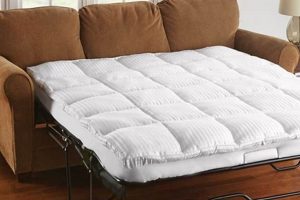
A crucial component of convertible furniture, these sleeping surfaces are designed to fit within the folding mechanism of a sofa bed. They provide a place to rest when the sofa is converted into a bed. Available in various constructions, from innerspring to memory foam, these surfaces prioritize both comfort and foldability to ensure easy storage and conversion.
The presence of a quality sleeping surface can greatly enhance the versatility and value of convertible furniture, transforming it from occasional seating to a practical guest bed. A comfortable and supportive surface ensures a restful experience for users. Historically, their development has paralleled the advancements in both mattress technology and furniture design, evolving from basic padding to sophisticated, space-saving solutions.
The ensuing discussion will delve into the different types of constructions available, factors to consider when selecting a suitable option, common size specifications, and maintenance guidelines to prolong the lifespan of this essential convertible furniture accessory.
Selection and Care Recommendations
Maximizing the lifespan and ensuring optimal comfort requires careful consideration during the selection process and adherence to proper maintenance practices. The following tips are provided to guide owners and prospective buyers.
Tip 1: Measure Dimensions Accurately: Prior to purchase, meticulously measure the inner dimensions of the sofa bed frame. Ensure the chosen surface precisely matches these dimensions to avoid folding issues or damage to the convertible mechanism.
Tip 2: Prioritize Density and Support: Regardless of the type chosen (innerspring, memory foam, latex), prioritize density. Higher density materials generally offer better support and resist sagging over time, contributing to longevity.
Tip 3: Evaluate Thickness Appropriately: The thickness of the material should be considered in relation to the folding mechanism of the sofa bed. Excessively thick surfaces may hinder smooth operation and potentially damage the internal structure.
Tip 4: Rotate Regularly: Consistent rotation, ideally every three to six months, distributes wear evenly across the surface. This practice helps prevent localized sagging and prolongs the lifespan of the component.
Tip 5: Use a Protective Cover: Employing a protective cover shields the surface from spills, stains, and dust accumulation. This simple measure significantly reduces the frequency of cleaning and maintains a hygienic sleeping environment.
Tip 6: Adhere to Cleaning Instructions: Always consult the manufacturer’s cleaning instructions. Avoid using harsh chemicals or excessive moisture, as these can degrade the materials and compromise structural integrity.
By implementing these strategies, one can optimize the comfort and durability of the convertible furniture’s most crucial component.
The ensuing paragraphs will provide an overview of common size specifications and address frequently asked questions regarding maintenance and replacement.
1. Dimensions

The correct dimensions are paramount to ensure a compatible and functional sleeping surface for a sofa bed. Precise measurement and adherence to specified sizes are critical for both comfort and the proper operation of the convertible furniture.
- Length and Width Conformity
The length and width must precisely match the internal frame of the sofa bed. Deviations can result in bunching, folding obstructions, or an incomplete sleeping surface, significantly reducing comfort and usability.
- Thickness Compatibility
Thickness impacts the ability of the sofa bed to fold and unfold smoothly. An overly thick sleeping surface may strain the folding mechanism or prevent the sofa from closing completely, leading to potential damage and reduced lifespan.
- Impact on Folding Mechanism
Inaccurate dimension measurements can compromise the integrity of the folding mechanism. Excess stress on hinges and supporting structures can lead to premature wear and tear, necessitating costly repairs or replacements.
- Standard vs. Custom Sizes
While standard sofa bed sizes exist, variations are common. Understanding whether a standard size will suffice or if a custom order is required based on precise frame measurements is essential for a seamless fit and optimal performance.
Accurate dimensional assessment is thus not merely a preliminary step but a fundamental requirement for ensuring both the comfort provided by a sofa bed’s mattress and the longevity of the furniture’s convertible mechanism. Failure to prioritize dimensional accuracy can lead to dissatisfaction and costly repairs.
2. Material
Material selection profoundly influences the performance and lifespan of convertible furniture’s sleeping surface. The chosen composition dictates factors such as comfort, support, durability, and ease of maintenance, all of which are crucial for the functionality and user satisfaction associated with sofa beds.
- Memory Foam Composition
Memory foam adapts to the user’s body, providing pressure relief and conforming support. Its density and responsiveness determine its ability to distribute weight evenly. For example, higher-density memory foam offers greater support and resists sagging, but may retain more heat compared to open-cell variations. In the context of sofa beds, memory foam’s ability to compress for folding and expand for sleeping is advantageous.
- Innerspring Construction
Innerspring units utilize coiled springs to provide support. The gauge and arrangement of the coils influence firmness and responsiveness. Bonnell coils are common, offering a balance of support and affordability, while pocketed coils provide individualized support and reduce motion transfer. The durability of the innerspring unit determines its ability to withstand repeated folding and unfolding, a critical factor for sofa beds.
- Latex Variants
Latex, derived from rubber trees, offers resilience and responsiveness. Natural latex is hypoallergenic and breathable, while synthetic latex provides a more affordable alternative. Its inherent elasticity allows it to quickly recover its shape after compression, making it well-suited for sofa bed applications where repeated folding and unfolding occur.
- Hybrid Combinations
Hybrid constructions blend multiple materials to optimize performance. For instance, a combination of memory foam and innerspring offers the pressure relief of memory foam with the support and airflow of innerspring coils. The layering and arrangement of these materials determine the overall comfort and support profile. In sofa beds, hybrid designs aim to balance comf
ort and foldability.
The choice of material or material combination is a critical determinant of the overall quality and suitability of the sleeping surface for convertible furniture. Careful consideration of material properties, construction techniques, and intended usage patterns is essential for selecting a surface that provides lasting comfort, support, and durability within the constraints of a folding sofa bed design.
3. Support
Adequate support is a fundamental attribute of any sleeping surface, and its importance is amplified in the context of convertible furniture. The structural design and material composition of a sleeping surface significantly influence spinal alignment, pressure distribution, and overall sleep quality. Insufficient support can lead to discomfort, exacerbate existing musculoskeletal issues, and negatively impact the restfulness of the sleep experience. For example, a sleeping surface that lacks sufficient rigidity may cause excessive sinking, misaligning the spine and creating pressure points. In the context of convertible furniture, ensuring adequate support is challenging due to the necessary constraints on thickness and the inherent folding mechanism.
The level of support is intrinsically linked to the materials used. High-density memory foam or innerspring systems with a firm coil gauge typically provide greater support compared to lower-density foams or thinner innerspring designs. The practical application of this understanding is evident in the design of higher-quality options for convertible furniture. These models often incorporate zoned support systems, where different areas of the sleeping surface are engineered to provide varying levels of firmness, accommodating the different weight distribution patterns of the human body. Furthermore, the support structure should also withstand repeated folding and unfolding without degradation, a factor particularly relevant for sofa beds that are frequently converted between seating and sleeping modes.
In summary, the relationship between support and a sleeping surface designed for convertible furniture is critical for ensuring both comfort and long-term usability. Selecting a surface that offers adequate support, tailored to individual needs and preferences, is paramount for maximizing the benefits of convertible furniture as a functional and comfortable sleeping solution. Overcoming the design challenges associated with integrating robust support within the constraints of a folding mechanism remains a key area of innovation and differentiation in the convertible furniture market.
4. Thickness
The thickness of a sleeping surface for convertible furniture directly dictates its suitability for folding and unfolding within the sofa bed mechanism. A dimensionally excessive material may hinder the smooth conversion between seating and sleeping configurations, potentially damaging the internal structure or preventing complete closure. Conversely, an insufficient dimension may compromise comfort and support, negating the intended function as a sleeping surface. An optimal thickness strikes a balance between these conflicting requirements.
Material composition influences the relationship between thickness and performance. For example, a high-density memory foam construction may provide adequate support with a relatively modest dimension, while a traditional innerspring design might necessitate a greater dimension to achieve a comparable level of comfort. The folding mechanism itself also constrains the viable range of dimensions; some sofa bed designs can accommodate thicker sleeping surfaces than others. For instance, a trifold sofa bed typically allows for a thinner surface compared to a bifold design. Failure to account for these factors can lead to operational difficulties and reduced lifespan of the convertible furniture.
In summary, thickness is a critical parameter in the design and selection of a sleeping surface for convertible furniture. Understanding the interplay between this dimension, material composition, and the specific folding mechanism is essential for ensuring both functionality and comfort. Optimizing thickness is thus a key consideration for manufacturers and consumers seeking to maximize the utility and longevity of sofa beds.
5. Foldability

Foldability is a defining characteristic of sleeping surfaces intended for convertible furniture. The capacity of the material to compress and conform without permanent deformation is crucial for the seamless transformation between seating and sleeping configurations. This inherent property dictates the usability and longevity of a sleeping surface within a sofa bed system.
- Material Elasticity and Recovery
Material elasticity determines the extent to which a sleeping surface can compress during folding and recover its original shape upon unfolding. Materials with high elasticity, such as latex or certain memory foams, exhibit superior foldability compared to rigid or low-density materials. In practical terms, a highly elastic material allows for a smoother folding action and minimizes the risk of creasing or permanent indentations. For instance, a latex exhibits minimal compression set even after repeated folding, ensuring consistent comfort over time.
- Construction and Layering Techniques
The construction of the sleeping surface, including layering techniques, significantly impacts foldability. Multilayer designs with strategically placed flexible materials facilitate easier bending and minimize stress on the core support structure. Segmented designs, where the surface is divided into hinged sections, further enhance foldability. For example, a segmented design with flexible connectors between sections allows the surface to conform more readily to the folding mechanism, reducing strain and improving the overall folding process.
- Thickness and Compression Ratio
The relationship between thickness and compression ratio governs the degree to which a sleeping surface can compress during folding. Thinner surfaces generally exhibit better foldability, but may compromise support. Materials with a high compression ratio, meaning they can compress significantly without losing structural integrity, are ideal for folding applications. For example, high-density foams can achieve a high compression ratio, providing both adequate support and efficient foldability within a limited space.
- Long-Term Deformation Resistance
Repeated folding and unfolding cycles place stress on the material, potentially leading to long-term deformation. A foldable surface should exhibit excellent resistance to compression set and permanent creasing. Materials that retain their original shape and thickness after repeated folding cycles are essential for maintaining long-term comfort and support. For example, durable materials with good compression set properties minimize sagging or indentations that can develop over time, ensuring a consistent and comfortable sleeping experience.
The multifaceted nature of foldability, encompassing material properties, construction techniques, and long-term performance, underscores its critical importance in the design and selection of a sleeping surface for converti
ble furniture. Prioritizing foldability ensures not only ease of use but also the sustained comfort and functionality of the sofa bed system, ultimately enhancing its value as a versatile seating and sleeping solution.
6. Durability
Durability is a paramount attribute in sleeping surfaces for convertible furniture, directly impacting lifespan and overall value. The unique stresses imposed by the dual functionality of a sofa bed, involving repeated folding, unfolding, and compression, necessitate robust construction and resilient materials. The effects of compromised durability are significant. Premature sagging, deformation, and material breakdown reduce comfort and functionality, rendering the furniture unsuitable for its intended purpose. For example, an innerspring unit with low-gauge coils may quickly lose its support and shape after numerous folding cycles, or a memory foam material with poor density can develop permanent indentations, resulting in uneven support and diminished sleep quality.
The selection of materials and construction methods are critical determinants of a sleeping surface’s durability. High-density foams, reinforced innerspring systems, and resilient fabrics contribute to enhanced resistance against wear and tear. Practical applications of this understanding are evident in the design of premium sofa beds, where reinforced edges, high-tensile stitching, and durable internal support structures extend the surface’s lifespan. Moreover, proper maintenance, including regular rotation and the use of protective covers, can mitigate wear and prolong durability.
Ultimately, the durability of a sleeping surface for convertible furniture is a fundamental factor in its long-term economic and functional viability. While initial cost may be a consideration, prioritizing durability ensures a lasting return on investment by minimizing the need for frequent replacement. Addressing the challenges of maintaining durability within the constraints of a folding design remains a central focus for manufacturers and a key point of consideration for consumers seeking a reliable and long-lasting convertible furniture solution.
Frequently Asked Questions
The subsequent section addresses common inquiries regarding sleeping surfaces for convertible furniture, providing clarification and guidance.
Question 1: What differentiates sleeping surfaces designed for convertible furniture from standard mattresses?
Surfaces tailored for sofa beds are engineered to withstand frequent folding and unfolding, a characteristic absent in traditional mattress designs. Specialized construction and material selection prioritize flexibility and compression resistance.
Question 2: How is the appropriate thickness determined?
Thickness is contingent upon the specific folding mechanism and overall sofa bed design. Exceeding the recommended thickness may impede proper closure and potentially damage the internal structure. Consultation of the manufacturers guidelines is advised.
Question 3: Are all materials suitable?
No. Materials lacking sufficient elasticity and resilience are prone to premature wear and deformation. High-density foams, latex, and reinforced innerspring systems are generally preferred due to their superior durability.
Question 4: How often should the sleeping surface be replaced?
Replacement frequency depends on usage patterns and material quality. Signs of wear, such as sagging or persistent indentations, indicate a need for replacement. As a general guideline, consider replacement every five to seven years with regular use.
Question 5: What cleaning protocols are recommended?
Adherence to the manufacturer’s cleaning instructions is paramount. Spot cleaning with mild detergents is generally suitable for localized stains. Avoid harsh chemicals and excessive moisture, which can degrade the materials.
Question 6: Are custom sizes readily available?
The availability of custom sizes varies by manufacturer. Standard sizes are commonly available, but specialized dimensions may require custom orders, potentially incurring additional costs and lead times.
Proper selection and maintenance are crucial for maximizing the lifespan and comfort of these essential components of convertible furniture. Prioritizing quality materials and adhering to recommended practices ensures a satisfactory seating and sleeping experience.
The ensuing segment will focus on specific models and emerging trends in the realm of sleeping surfaces for convertible furniture.
Conclusion
This exploration has underscored the critical role of a high-quality mattress for sofa beds in ensuring the functionality and comfort of convertible furniture. The interplay between dimensions, materials, support, thickness, foldability, and durability directly influences user satisfaction and the long-term value of sofa beds. Careful consideration of these factors, coupled with adherence to proper maintenance protocols, is essential for optimizing performance and longevity.
As convertible furniture continues to evolve, prioritizing informed selection and proactive care of the mattress for sofa beds remains paramount. By understanding the nuances of these components, consumers can ensure a comfortable and reliable sleeping solution, while manufacturers can focus on innovation to meet the demands of a dynamic market.