![Best Split Queen Mattress for Adjustable Beds [Guide]](data:image/svg+xml;base64,PHN2ZyB4bWxucz0iaHR0cDovL3d3dy53My5vcmcvMjAwMC9zdmciIHdpZHRoPSI0NzQiIGhlaWdodD0iNjYiIHZpZXdCb3g9IjAgMCA0NzQgNjYiPjxyZWN0IHdpZHRoPSIxMDAlIiBoZWlnaHQ9IjEwMCUiIHN0eWxlPSJmaWxsOiNjZmQ0ZGI7ZmlsbC1vcGFjaXR5OiAwLjE7Ii8+PC9zdmc+ "Best Split Queen Mattress for Adjustable Beds [Guide] Organic & Natural Mattress Buyer’s Guide: Non-Toxic Sleep Solutions")
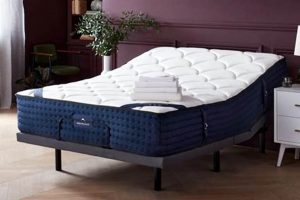
A mattress configuration designed for use with adjustable bed frames, specifically in the queen size, features a split at the top. This split construction allows each side of the mattress to articulate independently. As an illustration, one individual can elevate their head while the other remains supine.
The primary advantage of this design lies in its accommodation of differing comfort preferences and medical needs within a shared bed. It facilitates individualized sleep positions, potentially alleviating pressure points, reducing snoring, and enhancing overall sleep quality for both occupants. Historically, adjustable beds were predominantly found in healthcare settings; however, their adoption in residential environments has increased due to the growing awareness of their ergonomic and therapeutic benefits.
The subsequent sections will delve into specific considerations such as material composition, ideal bed frame compatibility, optimal mattress thickness, and the range of available features to maximize the utility and comfort derived from such a sleep system.
Considerations for Selecting a Split Queen Mattress for Adjustable Beds
Selecting a compatible mattress for an adjustable bed frame necessitates careful evaluation. The split queen design introduces unique requirements regarding material flexibility, mattress height, and overall support.
Tip 1: Prioritize Material Flexibility: Opt for materials such as latex or memory foam known for their ability to conform to the contours of an adjustable base. Innerspring mattresses with encased coils can also function well, provided the coil system is designed to allow articulation.
Tip 2: Evaluate Mattress Height: Consider the height of the mattress in relation to the adjustable bed frame. An excessively thick mattress may hinder the frame’s articulation, while a mattress that is too thin might lack sufficient support. Balance height with functionality and personal comfort preferences.
Tip 3: Assess Edge Support: Ensure adequate edge support to prevent roll-off, especially at the split point. Reinforced edges contribute to stability and maximize the usable sleep surface.
Tip 4: Verify Split Depth: Confirm the depth of the split matches the adjustable base’s articulation points. An insufficient split depth negates the independent adjustability feature.
Tip 5: Consider Motion Isolation: Given the separate adjustability, motion isolation becomes paramount. Materials that effectively absorb movement, such as memory foam, can minimize disturbances for the sleeping partner.
Tip 6: Research Warranty and Return Policies: Scrutinize the manufacturer’s warranty and return policies specifically related to use with adjustable bases. Ensure coverage addresses potential issues arising from the mattress’s articulation.
Tip 7: Check for Compatibility Certifications: Look for certifications or statements from the mattress manufacturer indicating compatibility with adjustable bed frames. These certifications often signify rigorous testing and adherence to industry standards.
These guidelines emphasize critical aspects that impact the long-term performance and comfort. Careful assessment ensures the selected mattress enhances the benefits offered by the adjustable bed.
The subsequent discussion will address common misconceptions associated with this type of bed system and explore advanced features that enhance user experience.
1. Independent adjustability

Independent adjustability constitutes the core functional advantage conferred by a split queen mattress when paired with an adjustable bed frame. This feature allows each side of the mattress to be positioned independently of the other, enabling individualized comfort settings. The division of the mattress at the top directly enables this capability. Without the split, the adjustable base would manipulate the entire mattress as a single unit, negating the possibility of personalized sleep positions.
The importance of independent adjustability is exemplified in situations where individuals possess differing health needs or comfort preferences. One partner might require an elevated head position to alleviate sleep apnea or acid reflux, while the other prefers a flat sleeping surface. Similarly, one individual might enjoy reading in bed with an elevated back, while their partner wishes to sleep. The split queen design facilitates both activities simultaneously, promoting harmonious co-sleeping. Consider a scenario where one partner is recovering from surgery and needs to sleep in a reclined position to reduce pressure on their back; independent adjustability allows this without compromising the other partner’s sleep.
The practical significance of understanding the link between independent adjustability and the split queen design lies in making informed purchasing decisions. Consumers must verify the depth of the split matches the range of motion offered by the adjustable base to fully realize the benefits. Furthermore, awareness of this connection allows for effective communication of needs to sales representatives and ensures the selected sleep system genuinely caters to individual requirements. Ultimately, independent adjustability, enabled by the split design, promotes personalized comfort and improved sleep quality within a shared bed.
2. Material Flexibility

Material flexibility is a crucial determinant of performance within a split queen mattress designed for an adjustable bed frame. The adjustable base causes the mattress to conform to varied angles and contours. Inflexible materials impede this articulation, potentially causing damage to both the mattress and the adjustable base. For instance, a traditional innerspring mattress, lacking substantial flexibility, may experience coil distortion or fabric tearing when repeatedly bent at the split point. Conversely, materials like latex or memory foam readily adapt to the changing shape of the adjustable base, minimizing stress and maximizing the range of motion.
The impact of material selection extends to user comfort. A flexible mattress evenly distributes weight across the surface, regardless of the bed’s position. This prevents pressure points from forming, particularly in areas such as the hips and shoulders. In contrast, a rigid mattress may create concentrated pressure zones when the bed is inclined, leading to discomfort and potential sleep disruption. A real-world example would be a user suffering from back pain experiencing relief with a flexible memory foam mattress on an adjustable base, whereas the same user might experience increased pain with a less flexible innerspring model.
In summary, material flexibility is not merely a desirable attribute, but a fundamental requirement for optimal functionality and comfort in a split queen mattress inten
ded for adjustable bed usage. The selection of appropriately flexible materials directly influences the durability, performance, and overall user satisfaction of the sleep system. The practical implication lies in prioritizing material composition during purchase, acknowledging its direct correlation with long-term comfort and the preservation of the adjustable bed’s intended functionality.
3. Motion isolation
Motion isolation is a critical performance characteristic, particularly relevant to the design and functionality of a split queen mattress intended for use with an adjustable bed frame. The ability of a mattress to minimize the transfer of movement between sleeping partners directly influences sleep quality and overall user satisfaction, especially when independent adjustability is a primary feature.
- Material Composition and Dampening Properties
The inherent properties of mattress materials significantly dictate the degree of motion isolation. Memory foam and latex, for example, exhibit superior dampening characteristics compared to traditional innerspring systems. These materials absorb and dissipate kinetic energy, limiting the propagation of movement across the mattress surface. Consequently, when one partner adjusts their side of the bed, the other partner experiences minimal disturbance. This is crucial, as the independent adjustability feature could otherwise exacerbate motion transfer.
- Independent Coil Systems and Zonal Construction
Some mattress designs incorporate individually encased coil systems or zonal construction to enhance motion isolation. In these configurations, each coil or section of the mattress responds independently to pressure, minimizing the ripple effect caused by movement. This is particularly advantageous in split queen models, as it reduces the likelihood of one partner’s adjustments affecting the other’s sleep surface. For example, a mattress with enhanced zonal support in the lumbar region can minimize motion transfer when one partner shifts positions in that area.
- The Role of the Split in Motion Transfer
The split itself, while essential for independent adjustability, introduces a potential point of weakness regarding motion isolation. Without careful construction, the split can act as a channel for movement transmission. High-quality split queen mattresses address this issue through reinforced edges or specialized construction techniques that minimize the propagation of motion across the split line. The quality of the materials and the method of joining them are important factors.
- Impact on Sleep Disruption and Partner Disturbance
The effectiveness of motion isolation directly correlates with reduced sleep disruption and minimized partner disturbance. In a shared bed, movements such as tossing, turning, or getting in and out of bed can easily disrupt the other person’s sleep cycle. A split queen mattress with excellent motion isolation mitigates these disturbances, allowing both individuals to enjoy uninterrupted rest, even with differing sleep schedules or habits. The design aims to minimize sleep disturbances and provide better rest to both occupants.
In summation, motion isolation is a pivotal characteristic in the selection of a split queen mattress designed for use with an adjustable bed. Its effectiveness hinges on material composition, construction techniques, and the design’s ability to address potential weaknesses introduced by the split itself. The ultimate benefit of superior motion isolation lies in enhanced sleep quality and reduced partner disturbance, allowing both individuals to fully experience the advantages of independent adjustability without compromising each other’s rest.
4. Split depth

Split depth, in the context of a split queen mattress for an adjustable bed, refers to the distance from the head of the mattress to the point where the split begins. This dimension dictates the extent of independent articulation available to each side of the bed. Insufficient split depth restricts the adjustability of the head and upper torso, effectively negating the primary benefit of a split design. For instance, if the split extends only halfway down the mattress, the independent head elevation feature of the adjustable base will be limited to the uppermost portion of the bed, failing to adequately support the user’s back. Conversely, an excessively deep split may compromise the structural integrity and edge support of the mattress, leading to discomfort and premature wear.
The appropriateness of the split depth is contingent upon the articulation range of the adjustable bed frame. A frame with a wide range of head elevation necessitates a deeper split to allow for full articulation without resistance. Conversely, a frame with a more limited range may function optimally with a shallower split. The optimal measurement is found where the adjustable frame can articulate to its maximum intended positions without causing the mattress to bind or buckle at the unsplit section. Consider the case of a user with severe acid reflux who requires a near-vertical head elevation during sleep; a shallow split would render the adjustable bed functionally useless for their specific need. A deeper split, tailored to the frame’s range, facilitates effective elevation, alleviating symptoms and promoting restful sleep.
In summary, split depth is a critical, often overlooked, parameter that directly influences the effectiveness and utility of a split queen mattress on an adjustable bed. Its proper calibration ensures the adjustable base can achieve its full range of motion, delivering the intended comfort and therapeutic benefits. Selecting a mattress with an appropriate split depth requires careful consideration of the adjustable bed’s specifications and the user’s individual needs. Prioritizing this parameter guarantees the sleep system functions as a cohesive unit, maximizing its potential for personalized comfort and restorative sleep. The selection affects the durability, longevity, and efficacy of the mattress with the adjustable base.
5. Edge support

Edge support assumes heightened significance in a split queen mattress designed for an adjustable bed, extending beyond conventional considerations of mattress stability. The split configuration and dynamic movement capabilities of the adjustable base introduce unique challenges to edge integrity, influencing both comfort and longevity.
- Lateral Stability and Roll-Off Prevention
Adequate edge support prevents lateral instability, particularly near the split. Without it, occupants may experience a sensation of rolling off the mattress, especially when the adjustable base is inclined. Reinforced edges mitigate this risk, ensuring a stable and secure sleeping surface. This becomes critical when one user elevates their side of the bed, increasing the likelihood of gravitational pull towards the edge.
- Maximizing Usable Sleep Surface
Strong edge support maximizes the usable sleep surface, particularly for those who sleep near the perimeter of the bed. A collapsing edge reduces the effective sleeping area, potentially causing discomfort and restrictin
g movement. This is exacerbated in split queen mattresses, as the split already creates a perceived division of space. Robust edges compensate for this perceived limitation, providing a consistent level of support across the entire surface. - Durability and Resistance to Sagging
Edge support contributes to the overall durability of the mattress, resisting sagging and deformation over time. This is particularly important in split queen models, as the split introduces a potential point of structural weakness. Reinforced edges distribute weight more evenly, preventing premature wear and tear, especially along the vulnerable perimeter. Without it, the mattress may exhibit uneven settling, compromising long-term comfort and support.
- Facilitating Ease of Entry and Exit
Solid edge support facilitates ease of entry and exit from the bed, providing a stable platform for sitting and standing. This is especially beneficial for individuals with mobility limitations. A collapsing edge can create an unstable surface, increasing the risk of falls. Reinforced edges enhance stability, making it easier to get in and out of bed safely, regardless of the adjustable base’s position.
Collectively, these facets underscore the vital role of edge support in a split queen mattress intended for adjustable bed use. The combination of a split configuration and dynamic articulation necessitates a robust edge design to ensure stability, maximize the usable sleep surface, enhance durability, and promote ease of access. Neglecting edge support compromises these benefits, diminishing the overall value and performance of the sleep system.
Frequently Asked Questions
This section addresses common inquiries and misconceptions regarding split queen mattresses designed for adjustable bed frames. The objective is to provide clear, concise information to aid in informed decision-making.
Question 1: Are all split queen mattresses compatible with any adjustable bed frame?
No, compatibility is not universal. Split depth, mattress thickness, and material flexibility must align with the adjustable base’s specifications. Refer to both the mattress and bed frame manufacturers’ guidelines for compatibility assessments.
Question 2: Does a split queen mattress offer the same level of support as a standard queen mattress?
Yes, provided the mattress is constructed with adequate support features, such as reinforced edges and a robust core. The split itself should not compromise the overall support system when properly engineered.
Question 3: Is a higher price point indicative of superior quality in split queen mattresses for adjustable beds?
Price does not always equate to quality. While higher-priced models may incorporate premium materials or advanced features, thorough research into material composition, construction techniques, and user reviews is essential to determine true value.
Question 4: How does the split in the mattress affect motion isolation?
The split can potentially exacerbate motion transfer if the mattress lacks adequate motion isolation features. Look for mattresses with individually encased coils or specialized foam layers designed to minimize the propagation of movement across the split.
Question 5: What type of mattress material is best suited for a split queen adjustable bed?
Latex and memory foam are generally preferred due to their inherent flexibility and ability to conform to the adjustable base’s contours. Hybrid models with encased coils can also perform well, provided they offer sufficient flexibility and support.
Question 6: How should a split queen mattress be cleaned and maintained?
Cleaning and maintenance protocols generally align with those for standard mattresses. Regular vacuuming, spot cleaning with mild detergents, and the use of a mattress protector are recommended. Adherence to the manufacturer’s specific cleaning instructions is crucial.
The key takeaway is that careful consideration of specific features and construction is paramount when selecting this type of mattress, not just price or marketing claims.
The subsequent discussion will explore potential drawbacks and limitations associated with split queen mattresses designed for adjustable beds, offering a balanced perspective for prospective buyers.
Conclusion
This examination of the split queen mattress for adjustable bed frames has underscored the importance of material flexibility, motion isolation, split depth, and edge support. These design elements directly influence the overall comfort, functionality, and longevity. Selection criteria must extend beyond general mattress characteristics to encompass compatibility with the adjustable base’s specific range of motion and articulation points.
The ultimate decision regarding a split queen mattress necessitates a comprehensive assessment of individual needs, partner preferences, and specific adjustable bed frame capabilities. Careful consideration will yield a sleep system that maximizes personalized comfort and restorative sleep, while inadequate assessment risks compromising the intended benefits of both components. Further research and critical evaluation are strongly encouraged prior to purchase.