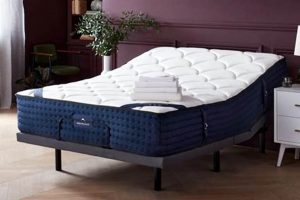
A sleep system designed for individualized comfort and convenience consists of two independently operable bases and corresponding mattresses, sized to match the overall dimensions of a standard queen bed. This configuration allows users on each side of the bed to adjust their incline and position without affecting their partner’s comfort. For example, one person may choose to elevate their head and upper body for reading, while the other prefers a flat sleeping surface.
The value of such a system lies in its capacity to address varying sleep preferences and medical needs. Individuals with conditions like acid reflux, sleep apnea, or back pain may find significant relief through adjustable positioning. Historically, adjustable beds were primarily found in medical settings, but advancements in technology and design have made them increasingly popular for residential use, offering personalized comfort and improved sleep quality.
The following sections will delve into the specific features, benefits, and considerations when selecting this type of bed, including factors such as motor quality, mattress compatibility, and available customization options. Understanding these elements is crucial for making an informed decision and optimizing the overall sleep experience.
Considerations for Optimal Use
Maximizing the benefits of a split queen adjustable bed and mattress requires careful attention to various factors. The following tips provide guidance for selecting and utilizing this specialized sleep system.
Tip 1: Assess Individual Sleep Needs: Before purchasing, thoroughly evaluate personal sleep preferences and any existing medical conditions that could benefit from adjustable positioning. Consider factors such as preferred sleeping positions, snoring, acid reflux, or back pain.
Tip 2: Evaluate Motor Quality and Noise Levels: The motor is a critical component. Research motor types, paying attention to their weight capacity, responsiveness, and noise output. A quieter motor promotes undisturbed sleep.
Tip 3: Research Mattress Compatibility: Not all mattresses are suitable for adjustable bases. Opt for mattresses specifically designed for use with adjustable beds. These mattresses typically offer greater flexibility and durability to withstand frequent adjustments.
Tip 4: Understand Adjustment Range and Features: Investigate the full range of motion offered by the adjustable base. Look for models with features such as head and foot articulation, massage functions, and preset positions. Evaluate if these features align with individual needs and preferences.
Tip 5: Account for Frame Construction and Support: Evaluate the overall frame construction of the adjustable base. A robust frame provides stability and prevents unwanted movement or noise. Check for reinforced corners and durable support legs.
Tip 6: Review Warranty and Return Policies: Carefully examine the manufacturer’s warranty for both the adjustable base and the mattress. Understand the terms and conditions, including coverage for motor failures, frame defects, and mattress sagging. Also, review the retailer’s return policy in case the system does not meet expectations.
Tip 7: Coordinate Bedding and Linens: Standard bedding may not fit properly on split queen systems or allow for ease of independent adjustment. Consider purchasing split queen sheets and bedding specifically designed for adjustable beds.
By addressing these key considerations, users can optimize their experience with a split queen adjustable bed and mattress, ensuring enhanced comfort, support, and personalized sleep. A well-chosen and properly utilized system can contribute significantly to improved sleep quality and overall well-being.
The subsequent sections will examine potential challenges and troubleshooting techniques associated with these systems, ensuring a long-lasting and satisfactory sleep solution.
1. Individualized Adjustability

Individualized adjustability is an intrinsic attribute of the split queen adjustable bed and mattress configuration. This design allows each occupant to independently control the angle and position of their respective side of the bed. The direct consequence is a highly customizable sleep surface that can accommodate differing comfort preferences or medical requirements. For example, one individual might require an elevated upper body to alleviate sleep apnea symptoms, while their partner prefers a flat sleeping surface. Without individualized adjustability, such contrasting needs would necessitate compromise, potentially impacting sleep quality for one or both individuals. The ability to fine-tune each side of the bed is a fundamental component that distinguishes this system from standard mattresses and adjustable beds.
The incorporation of individualized adjustability extends beyond mere preference. It allows for targeted therapeutic positioning. Consider a scenario where one partner experiences lower back pain. The ability to elevate the legs can reduce pressure on the spine, promoting relaxation and pain relief. Conversely, if the other partner suffers from acid reflux, elevating the head and upper body can minimize nighttime symptoms. The practical application of this feature is substantial, offering a non-pharmacological approach to managing common sleep-related ailments. Proper utilization, achieved through an understanding of the system’s capabilities and personal needs, can lead to marked improvements in sleep duration and overall well-being.
In summary, individualized adjustability is not merely an optional feature; it is a core characteristic that defines the functionality and value proposition of a split queen adjustable bed and mattress. The ability to independently control each side of the bed enables the accommodation of diverse sleep preferences and the management of specific health conditions. This precise control, while potentially complex in initial setup, ultimately contributes to a personalized sleep experience that fosters improved rest and health outcomes. Overlooking the significance of individualized adjustability undermines the potential benefits of this sleep system.
2. Independent Comfort Zones

The creation of independent comfort zones is a direct and defining consequence of the split queen adjustable bed and mattress design. By dividing the sleeping surface into two distinct and independently controllable sections, each occupant gains the ability to personalize their sleep environment without affecting their partner. This partitioning directly addresses the common issue of mismatched sleep preferences within a shared bed. One individual may prefer a firm mattress with a slight incline, while the other might require a softer surface and a flat position due to back pain. The split queen con
figuration facilitates the simultaneous accommodation of these divergent needs. For instance, consider a couple where one partner consistently snores. Elevating their head and upper body can alleviate snoring. Without independent comfort zones, the other partner would be forced to endure the snoring or compromise their own comfort by similarly adjusting their sleeping position. The existence of independent zones allows for targeted solutions without mutual sacrifice.
The practical significance of independent comfort zones extends beyond mere comfort. It can significantly impact sleep quality and overall well-being. In couples where one partner experiences restless leg syndrome, independent adjustability can mitigate the disruptive effects of leg movements. One partner can elevate their legs to alleviate discomfort, while the other remains unaffected due to the separation provided by the split queen design. Similarly, individuals recovering from surgery or managing chronic pain can utilize independent comfort zones to find optimal sleeping positions that minimize discomfort and promote healing. The ability to adjust each side of the bed independently becomes a valuable asset in managing various medical conditions and optimizing sleep quality during periods of recovery or chronic illness. Failing to acknowledge and utilize these independent zones negates a significant portion of the inherent benefits associated with this type of sleep system.
In conclusion, independent comfort zones are not merely an add-on feature of the split queen adjustable bed and mattress. Rather, they represent a fundamental design principle that directly enables personalized sleep environments. While setup and coordination of independent controls may require initial effort, the resulting benefits in terms of improved sleep quality, reduced partner disturbance, and enhanced comfort are substantial. The presence of these zones directly impacts the ability to address individual needs and optimize the sleeping experience for each occupant. Recognizing and leveraging the potential of independent comfort zones is essential for fully realizing the advantages offered by this specialized sleep configuration. The failure to do so reduces the sleep system to a merely adjustable bed, overlooking its core innovation and value.
3. Mattress Flexibility

Mattress flexibility constitutes a critical performance parameter for split queen adjustable beds. The design of these beds inherently involves articulation, requiring the mattress to conform to varying angles without compromising structural integrity or user comfort. A lack of appropriate mattress flexibility can lead to several detrimental outcomes. These include localized stress concentrations within the mattress material, accelerated wear and tear, and a reduction in the intended support provided to the sleeper. For instance, a traditional innerspring mattress, not designed for adjustable bases, may exhibit diminished contouring and increased pressure points when used on such a system. This can result in discomfort and potential interference with the therapeutic benefits of the adjustable bed. Selecting a mattress specifically engineered for adjustable bed compatibility becomes paramount to ensure optimal performance and longevity.
The relationship between mattress flexibility and the operational effectiveness of a split queen adjustable bed manifests in various practical scenarios. Consider an individual using the adjustable base to elevate their legs for improved circulation. A mattress lacking sufficient flexibility may resist conforming to the raised platform, creating an uneven sleeping surface. This unevenness not only diminishes comfort but can also negate the intended circulatory benefits by placing undue pressure on certain areas. Similarly, when adjusting the head elevation for reading or watching television, an inflexible mattress may create a gap between the sleeper’s back and the mattress surface, leading to discomfort and potential strain. Foam mattresses, particularly those with a multi-layered construction and designed for adjustable bases, typically exhibit superior flexibility, allowing for seamless articulation and consistent support across various angles.
In summary, mattress flexibility is not merely a desirable characteristic but rather an indispensable component of a properly functioning split queen adjustable bed system. Inadequate flexibility compromises the adjustable base’s ability to deliver targeted support and personalized comfort. The selection of a compatible mattress engineered to withstand the rigors of articulation is therefore essential to maximize the benefits of this specialized sleep solution. Ignoring this crucial aspect diminishes the overall value and effectiveness of the investment, potentially leading to discomfort, reduced lifespan of the components, and a suboptimal sleep experience. Prioritizing mattress flexibility ensures the intended functionality and longevity of the split queen adjustable bed system.
4. Motion Isolation
Motion isolation, in the context of a split queen adjustable bed and mattress, refers to the sleep system’s capacity to minimize the transfer of movement from one side of the bed to the other. This is particularly significant in shared sleeping arrangements where disturbances caused by one partner’s movements can negatively impact the other partner’s sleep quality. The split queen configuration inherently promotes motion isolation due to the separation of the mattress into two distinct units. Each mattress operates independently, limiting the transmission of vibrations and movements across the entire sleeping surface. Without effective motion isolation, activities such as one partner getting in or out of bed, tossing and turning, or adjusting the bed’s position could disrupt the other partner’s sleep, leading to reduced restfulness and potential long-term health consequences.
The effectiveness of motion isolation in a split queen adjustable bed and mattress is influenced by several factors, including the type of mattress materials used, the construction of the adjustable base, and the overall design of the sleep system. Mattresses made of memory foam or latex tend to offer superior motion isolation compared to traditional innerspring mattresses. The dense structure of these materials absorbs and dampens movement, preventing it from propagating across the mattress surface. The adjustable base’s construction also plays a role, with some models featuring vibration-dampening technologies or independent suspension systems that further reduce motion transfer. For example, a couple where one partner is a light sleeper and the other tends to move frequently during the night would benefit significantly from a split queen adjustable bed and mattress system with high motion isolation capabilities. This would allow the light sleeper to remain undisturbed, even if the other partner is restless.
In summary, motion isolation is a crucial attribute of a split queen adjustable bed and mattress, directly contributing to improved sleep quality for both occupants. The design inherently reduces motion transfer, and the selection of appropriate materials and construction techniques can further enhance this effect. Understanding the principles of motion isolation and its impact on sleep is essential for individuals seeking to minimize sleep disturbances and maximize the benefits of a shared sleeping arrangement. The absence of effective motion isolation undermines the potential advantages of a split queen adjusta
ble bed, negating the intended personalized comfort and individual adjustability.
5. Customized Support

Customized support is a primary benefit derived from a split queen adjustable bed and mattress configuration. This feature addresses individual physiological needs and preferences, promoting optimal spinal alignment and pressure relief. The segmented design allows for independent adjustment of each side, enabling users to tailor the support to their specific requirements.
- Independent Zone Adjustment
The division of the bed into two independently adjustable zones allows each user to customize the level of support for different body regions. For example, one individual may require lumbar support while the other prefers elevated leg support. This individualized approach accommodates varying spinal conditions and comfort preferences. The consequences of failing to provide this level of customization include discomfort, poor spinal alignment, and potential exacerbation of existing medical conditions.
- Mattress Material Differentiation
Split queen adjustable beds often accommodate mattresses with varying firmness levels on each side. This allows couples with differing support requirements to select mattresses that best suit their individual needs. For example, one partner may prefer a firmer mattress for back support, while the other prefers a softer mattress for pressure relief. The impact of this differentiation is improved sleep quality and reduced discomfort for both individuals. Conversely, using identical mattresses may result in compromised comfort for at least one partner.
- Targeted Pressure Relief
Adjustable bases, in conjunction with flexible mattresses, facilitate targeted pressure relief. Users can adjust the bed’s position to minimize pressure on sensitive areas such as the shoulders, hips, and lower back. This is particularly beneficial for individuals with arthritis, fibromyalgia, or other conditions that cause chronic pain. Without this customized support, individuals may experience increased pain and discomfort, leading to sleep disturbances and reduced overall well-being.
- Spinal Alignment Optimization
Proper spinal alignment is essential for comfortable and restorative sleep. Split queen adjustable beds enable users to fine-tune their sleeping position to achieve optimal spinal alignment, regardless of their preferred sleeping position. For example, back sleepers can elevate their knees to reduce pressure on the lower back, while side sleepers can adjust the bed to minimize pressure on their shoulders and hips. Maintaining proper spinal alignment reduces the risk of back pain, neck pain, and other musculoskeletal issues. A lack of customized support may result in poor spinal alignment, leading to discomfort and potential long-term health problems.
The multifaceted nature of customized support within the split queen adjustable bed and mattress system underscores its value in promoting individual comfort and well-being. The integration of independent zone adjustment, mattress material differentiation, targeted pressure relief, and spinal alignment optimization provides a holistic approach to personalized sleep. This contrasts sharply with conventional mattresses, which offer a one-size-fits-all approach that may not adequately address the unique needs of each individual. The result is a sleep experience that caters specifically to the user, fostering improved rest and a greater sense of overall health.
6. Space Optimization

The integration of space optimization within a split queen adjustable bed and mattress design addresses spatial constraints prevalent in many modern living environments. A standard queen-sized bed, while accommodating two individuals, often presents challenges in smaller bedrooms or apartments. A split queen configuration, however, does not inherently alter the overall footprint but introduces space-saving benefits through its adjustability. The elevation of the head or foot of the bed, for instance, can reduce the floor space required for activities such as reading or watching television, effectively reclaiming square footage within the room. The effect of this is not merely aesthetic; it directly impacts the usability and functionality of the bedroom space.
Consider a scenario involving an individual recovering from surgery who requires an elevated sleeping position. Without an adjustable bed, multiple pillows or specialized wedges might be necessary to achieve the desired angle. These additional items consume space and can create an unwieldy and uncomfortable sleeping arrangement. A split queen adjustable bed eliminates the need for these supplementary aids, streamlining the bedroom environment and maximizing available space. Furthermore, the ability to adjust the bed’s position allows for easier access to bedside tables and storage, enhancing the convenience and efficiency of the bedroom layout. The practical application extends to individuals with mobility issues who require assistance getting in and out of bed. The adjustable feature allows for precise positioning, minimizing strain and reducing the risk of falls, thus optimizing the available space for maneuverability.
In conclusion, space optimization is not a tangential benefit but an integral aspect of the split queen adjustable bed and mattress. The ability to customize the bed’s configuration not only enhances comfort and therapeutic value but also contributes to a more efficient and functional use of available space. This is particularly relevant in contemporary living spaces where square footage is often at a premium. Ignoring the spatial implications of adjustable bed design undervalues a key component of its overall utility. Understanding and leveraging the space-saving potential of a split queen adjustable bed is critical to maximizing its benefits and creating a more comfortable and accessible bedroom environment.
Frequently Asked Questions
The following addresses common inquiries regarding split queen adjustable bed and mattress systems, providing factual and objective information to aid in informed decision-making.
Question 1: What are the primary benefits of a split queen adjustable bed and mattress compared to a standard queen-sized bed?
The principal advantage lies in individualized adjustability. This configuration allows each occupant to independently control their side of the bed, accommodating differing sleep preferences or medical needs that a standard queen bed cannot address.
Question 2: Are special sheets required for a split queen adjustable bed and mattress?
Yes, split queen sheets are recommended. These sheet sets are designed with independent fitted sheets for each mattress, ensuring a proper fit and allowing for independent adjustment without dislodging the linens.
Question 3: What types of mattresses are compatible with a split queen adjustable base?
Mattresses specifically designed for adjustable bases are recommended. These typically include memory foam, latex, and hybrid models engineered for flexibility and durability to withstand frequent articulation.
Question 4: How does the split queen design affect motion transfer between partners?
The split construction inherently reduces motion transfer com
pared to a single queen mattress. The independent mattresses minimize the propagation of movement from one side of the bed to the other, minimizing sleep disturbance.
Question 5: What factors should be considered when evaluating the motor of an adjustable bed base?
Key considerations include weight capacity, noise level, responsiveness, and warranty coverage. A robust and quiet motor is essential for reliable operation and minimal sleep disruption.
Question 6: Are there any specific maintenance requirements for a split queen adjustable bed and mattress?
Maintenance typically involves periodic cleaning of the mattress and frame, as well as occasional inspection of the motor and electrical components. Following the manufacturer’s recommendations is crucial for ensuring longevity and optimal performance.
In summary, a split queen adjustable bed and mattress offers numerous advantages over traditional beds, provided that careful consideration is given to sheet compatibility, mattress selection, motion isolation, motor quality, and maintenance requirements. Understanding these aspects ensures a satisfactory and beneficial sleep experience.
The following section will explore potential drawbacks and limitations associated with split queen adjustable bed and mattress systems.
Conclusion
The preceding discussion has explored the multifaceted nature of the split queen adjustable bed and mattress, delineating its features, benefits, and considerations for optimal use. The analysis has encompassed aspects such as individualized adjustability, independent comfort zones, mattress flexibility, motion isolation, customized support, and space optimization. Each of these elements contributes to the overall value proposition of this specialized sleep system, offering a targeted solution for individuals with diverse needs and preferences.
The selection and utilization of a split queen adjustable bed and mattress represent a significant investment in sleep quality and overall well-being. A comprehensive understanding of the system’s capabilities and limitations is essential for maximizing its benefits. Continued innovation in materials and technology promises further refinements in comfort, durability, and functionality, solidifying its role as a prominent option for those seeking a personalized and restorative sleep experience. Future research and development may address current limitations and enhance integration with smart home technologies, further elevating the sleep experience.