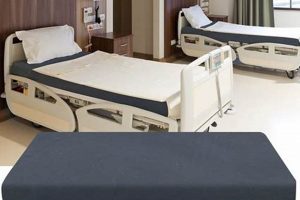
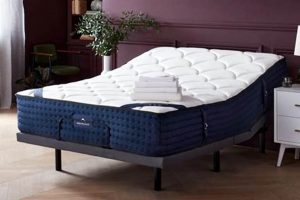
Support surfaces designed for use on medical facility beds are engineered to provide comfort and therapeutic benefits to patients. These specialized products commonly incorporate features such as pressure redistribution, fluid resistance, and ease of cleaning. An example includes a foam core model with a waterproof cover used to minimize pressure ulcers in immobile individuals.
The implementation of appropriate support surfaces in a healthcare setting contributes significantly to patient well-being and reduces the incidence of complications. These specialized products enhance comfort, aid in preventing skin breakdown, and support proper spinal alignment. Historically, advancements in materials and construction techniques have led to improved performance and durability, ultimately benefiting patient outcomes and reducing healthcare costs.
Subsequent sections will delve into the various types available, focusing on their specific features, benefits, and suitability for different patient populations and medical conditions. Factors to consider when selecting a suitable support surface, as well as maintenance and infection control protocols, will also be discussed.
Guidance on Medical Facility Bed Support Surfaces
Selecting the optimal support surface for a medical facility bed necessitates careful consideration. The following guidelines provide key insights for making informed decisions.
Tip 1: Assess Patient Needs: Evaluate the patient’s risk factors for pressure ulcers, mobility limitations, and specific medical conditions. This assessment informs the selection of an appropriate support surface type.
Tip 2: Prioritize Pressure Redistribution: Opt for surfaces that effectively redistribute pressure away from bony prominences to minimize the risk of skin breakdown. Consider products with zoned construction or specialized foam layering.
Tip 3: Evaluate Material Properties: Select materials that are fluid-resistant, antimicrobial, and easy to clean to maintain hygiene and prevent the spread of infection. Consider the durability and longevity of the chosen materials.
Tip 4: Consider Support Surface Type: Differentiate between foam, air, and alternating pressure surfaces based on their specific pressure redistribution capabilities and suitability for various patient needs. Air surfaces may be more appropriate for high-risk patients.
Tip 5: Ensure Proper Fit: Verify that the selected support surface fits the bed frame correctly to avoid gaps or overlaps that could compromise patient safety and pressure redistribution effectiveness.
Tip 6: Implement Regular Inspection: Establish a routine for inspecting support surfaces for signs of wear and tear, damage, or contamination. Replace damaged surfaces promptly to maintain patient safety and hygiene.
Tip 7: Adhere to Cleaning Protocols: Follow manufacturer-recommended cleaning protocols to ensure proper disinfection and prevent the spread of infection. Use appropriate cleaning agents and techniques.
Effective implementation of these guidelines promotes patient comfort, reduces the incidence of pressure ulcers, and contributes to overall positive patient outcomes.
The subsequent concluding section will summarize the key considerations for selecting and managing medical facility bed support surfaces.
1. Pressure Redistribution

Pressure redistribution is a core function of support surfaces utilized on medical facility beds. The design and material composition of these products directly influence their effectiveness in mitigating pressure concentration, thus impacting patient well-being.
- Support Surface Material
Materials such as viscoelastic foam, air bladders, and gel provide varying degrees of pressure redistribution. Viscoelastic foam conforms to body contours, increasing contact area and reducing peak pressures. Air bladders can be inflated to adjust pressure distribution according to individual needs. Gel provides a cushioning effect and minimizes shear forces. The choice of material directly impacts the support surface’s ability to offload pressure from bony prominences.
- Zoned Construction
Zoned construction involves varying the firmness or density of the support surface in specific areas to address differing pressure needs. For example, a firmer zone may be present beneath the torso, while softer zones are positioned under the heels and sacrum. This customized approach ensures targeted pressure relief and enhances comfort.
- Alternating Pressure Technology
Alternating pressure surfaces cyclically inflate and deflate air cells to periodically relieve pressure from specific areas. This dynamic redistribution prevents prolonged pressure exposure and promotes blood circulation, thus minimizing the risk of pressure ulcer development. The cycle time and pressure levels are adjustable to suit individual patient requirements.
- Shear Reduction Properties
Shear forces, which occur when skin moves in one direction while underlying bone remains stationary, contribute to pressure ulcer formation. Support surfaces with low-friction or shear-reducing covers minimize these forces, further protecting the skin. Proper bedding management and patient positioning also contribute to shear reduction.
The application of appropriate pressure redistribution principles in the design and selection of support surfaces for medical facility beds is critical for preventing pressure ulcers and enhancing patient comfort. By considering material properties, zoned construction, alternating pressure technology, and shear reduction properties, healthcare professionals can optimize patient outcomes and minimize the incidence of pressure-related complications.
2. Fluid Resistance

Fluid resistance is a critical characteristic of support surfaces designed for medical facility beds. The primary cause necessitating this attribute is the potential for exposure to bodily fluids, including blood, urine, and other contaminants, commonly encountered in healthcare settings. Without adequate fluid resistance, these substances can penetrate the support surface, leading to unsanitary conditions, bacterial growth, and potential infection risks for patients and healthcare personnel. An example illustrating the importance of this resistance is a patient experiencing incontinence; if the support surface lacks proper fluid resistance, the urine will saturate the material, fostering bacterial proliferation and potentially contributing to skin breakdown.
The implementation of fluid-resistant materials, such as coated fabrics and impermeable membranes, within the construction of support surfaces serves as a barrier against fluid penetration. This barrier not only prevents contamination of the internal component
s of the support surface but also facilitates effective cleaning and disinfection protocols. For instance, a support surface with a polyurethane-coated cover allows for easy wiping and sanitization, reducing the risk of cross-contamination between patients. This ease of cleaning minimizes the potential for healthcare-associated infections (HAIs), contributing to a safer environment.
In summary, fluid resistance is an indispensable component of support surfaces for medical facility beds. The consequences of inadequate fluid resistance are significant, ranging from hygiene concerns to heightened infection risks. By incorporating appropriate fluid-resistant materials and construction techniques, manufacturers and healthcare providers can ensure a safer and more hygienic environment for patients, thereby promoting positive outcomes and minimizing the potential for adverse events. The selection of support surfaces must prioritize fluid resistance as a fundamental requirement.
3. Infection Control

Infection control within healthcare settings relies significantly on the characteristics of equipment, including support surfaces used on medical facility beds. The design and maintenance of these surfaces directly impact the potential for pathogen transmission and subsequent infection risks.
- Material Permeability and Cleanability
The permeability of support surface materials dictates the ease with which pathogens can penetrate and persist within the structure. Impermeable materials, coupled with effective cleaning protocols, minimize the risk of contamination. Conversely, porous materials can harbor microorganisms, even after cleaning attempts. For instance, a vinyl-coated support surface, when properly cleaned with an appropriate disinfectant, presents a lower risk of pathogen transmission compared to a fabric-covered surface that is prone to fluid absorption.
- Antimicrobial Properties
The incorporation of antimicrobial agents into support surface materials can inhibit the growth of bacteria, fungi, and viruses. These agents, such as silver ions or quaternary ammonium compounds, provide an added layer of protection against microbial colonization. While antimicrobial properties do not replace the need for regular cleaning, they contribute to a reduction in the overall microbial burden on the support surface.
- Design Features Minimizing Fluid Accumulation
Design features, such as sealed seams and rounded corners, minimize the accumulation of fluids and debris that can serve as breeding grounds for pathogens. Surfaces with intricate textures or crevices are more difficult to clean thoroughly and may harbor microorganisms despite disinfection efforts. Support surfaces with a smooth, seamless design promote effective cleaning and reduce the risk of contamination.
- Cleaning and Disinfection Protocols
Adherence to established cleaning and disinfection protocols is crucial for maintaining the integrity of support surfaces and preventing the spread of infection. These protocols should specify the appropriate cleaning agents, contact times, and cleaning techniques to effectively eliminate pathogens without damaging the support surface material. Regular inspection and maintenance of support surfaces are also essential to identify and address any breaches in the material that could compromise infection control.
The multifaceted approach to infection control, encompassing material selection, design considerations, antimicrobial properties, and rigorous cleaning protocols, is essential for minimizing the risk of healthcare-associated infections linked to support surfaces used on medical facility beds. Failure to address any of these elements can compromise the effectiveness of infection control measures and potentially jeopardize patient safety. Therefore, the integration of robust infection control strategies into the selection and management of these support surfaces is imperative.
4. Patient Comfort

Patient comfort is inextricably linked to the design and selection of support surfaces for medical facility beds. Inadequate comfort can lead to agitation, sleep disturbances, and increased pain perception, hindering recovery and prolonging hospital stays. Conversely, a comfortable surface promotes relaxation, improves sleep quality, and contributes to an overall sense of well-being. A real-life example involves patients recovering from surgery; a pressure-redistributing, comfortable surface can significantly reduce post-operative pain and improve sleep, facilitating faster healing. The subjective experience of comfort is thus a crucial, measurable outcome directly influenced by the choice of support surface.
The relationship between patient comfort and support surfaces extends beyond simple cushioning. Features such as temperature regulation, moisture-wicking properties, and low-friction surfaces contribute significantly to the overall experience. Support surfaces that trap heat or moisture can lead to skin irritation and discomfort, particularly for patients with limited mobility. Low-friction surfaces minimize shear forces, reducing the risk of skin breakdown and further enhancing comfort. The practical application of this understanding leads to the development of specialized surfaces tailored to specific patient needs, such as bariatric patients requiring wider, more supportive surfaces, or patients with pressure ulcers requiring advanced pressure redistribution and shear reduction capabilities.
In summary, patient comfort is not merely a desirable attribute of support surfaces but a critical component impacting patient outcomes. While challenges exist in objectively measuring and quantifying comfort, ongoing research and technological advancements are leading to the development of increasingly sophisticated and patient-centered solutions. Recognizing the importance of comfort and integrating it into the selection process is essential for providing optimal care and promoting positive patient experiences within medical facilities.
5. Support Durability
The longevity and resilience of support surfaces designed for medical facility beds, termed “support durability,” directly impact their cost-effectiveness and ability to consistently deliver therapeutic benefits. Frequent replacement of inadequate or poorly constructed products incurs significant financial burdens on healthcare facilities. Diminished structural integrity can compromise pressure redistribution capabilities, increasing the risk of pressure ulcers. A real-world consequence of compromised durability is a support surface that sags prematurely, concentrating pressure on bony prominences and negating its intended function. The initial purchase price becomes inconsequential if the product fails to maintain its integrity over its expected lifespan.
Material selection and construction techniques are paramount in determining support durability. High-density foams, reinforced seams, and robust cover materials contribute to resistance against wear and tear from repeated use, cleaning cycles, and patient movement. Air cell-based systems require durable bladders and reliable inflation mechanisms to withstand continuous operation without
leaks or failures. Practical application of this understanding involves selecting support surfaces that meet or exceed industry standards for durability testing, such as cyclic compression tests and fluid resistance assessments. Adherence to recommended cleaning protocols further extends product life.
In summary, support durability is not merely a desirable feature but a fundamental requirement for support surfaces intended for medical facility beds. The long-term cost savings, consistent therapeutic performance, and reduced risk of pressure ulcers associated with durable products outweigh the potential for short-term cost reductions through the purchase of inferior alternatives. A comprehensive assessment of durability, encompassing material properties, construction methods, and adherence to maintenance protocols, is essential for informed decision-making within healthcare procurement processes.
6. Size Compatibility

The dimensional conformity between support surfaces and medical facility bed frames, referred to as “size compatibility,” is a fundamental requirement to ensure both patient safety and optimal functionality of the equipment. Misalignment or discrepancies in dimensions can compromise pressure redistribution, create entrapment hazards, and impede proper bed articulation.
- Standard Dimensions and Bed Frame Variations
Medical facility bed frames adhere to certain standard dimensions; however, variations exist among manufacturers and bed types (e.g., standard, bariatric, low beds). Support surfaces must be available in corresponding sizes to ensure a secure and appropriate fit. An ill-fitting support surface can shift during patient movement, leading to uneven pressure distribution and an increased risk of pressure ulcers. Consider, for instance, a bariatric bed requiring a wider surface to accommodate the patient safely and effectively.
- Impact on Bed Articulation
Medical facility beds often feature adjustable sections for head elevation, knee elevation, and overall height adjustment. A support surface that is too long or too short can impede the proper articulation of these sections. This can lead to discomfort for the patient and, in some cases, damage to the bed frame. For example, a surface extending beyond the foot of the bed may prevent the foot section from fully lowering.
- Entrapment Hazards
Gaps between the support surface and the bed frame create potential entrapment hazards for patients. Limbs or other body parts can become lodged in these spaces, leading to injury or even asphyxiation. Precise size compatibility minimizes these gaps, reducing the risk of entrapment. Regular inspection is recommended to identify and address any instances of size mismatch that could pose a safety risk.
- Weight Capacity Considerations
While not directly related to physical size, the weight capacity of the support surface must align with the specifications of the bed frame and the patient’s weight. Exceeding the weight capacity of either the support surface or the bed frame can lead to structural failure and compromise patient safety. Selecting a size-compatible support surface that also meets the weight requirements is crucial for safe and effective use.
In conclusion, the seemingly simple concept of size compatibility encompasses a range of critical factors impacting both the therapeutic effectiveness and safety of support surfaces used on medical facility beds. Attention to dimensional accuracy, bed articulation, entrapment hazards, and weight capacity considerations is essential for ensuring that these products function as intended and contribute to positive patient outcomes.
Frequently Asked Questions
The following addresses common inquiries regarding support surfaces utilized on medical facility beds. This information is intended to provide clarity and promote informed decision-making.
Question 1: What constitutes an appropriate cleaning protocol for a support surface?
Cleaning protocols must adhere to manufacturer recommendations and established infection control guidelines. Typically, this involves the use of approved disinfectants, appropriate contact times, and thorough wiping of all surfaces. Porous materials may require specialized cleaning techniques.
Question 2: How frequently should support surfaces be inspected for damage?
Support surfaces should undergo routine visual inspection at least once per shift, and ideally after each patient use. Any signs of tears, punctures, or fluid penetration necessitate immediate replacement or repair.
Question 3: Are all support surfaces appropriate for all patients?
No. Patient-specific factors, such as risk for pressure ulcers, mobility limitations, and body weight, dictate the suitability of a given support surface. A qualified healthcare professional should assess each patient’s needs to determine the optimal selection.
Question 4: What is the expected lifespan of a support surface?
The lifespan varies depending on the type of support surface, the quality of materials, and the frequency of use. However, most manufacturers provide estimated lifespans, which should be considered during procurement. Regular maintenance and proper cleaning practices can extend the lifespan.
Question 5: How does one dispose of a support surface that is no longer suitable for use?
Disposal procedures must comply with local and federal regulations pertaining to medical waste. Contaminated support surfaces should be treated as infectious waste and disposed of accordingly. Contact the facility’s infection control department for guidance.
Question 6: Do antimicrobial coatings eliminate the need for regular cleaning?
Antimicrobial coatings provide an adjunct to regular cleaning protocols but do not replace them. Routine cleaning and disinfection remain essential for preventing the spread of infection, regardless of the presence of antimicrobial agents.
Proper selection, utilization, and maintenance of support surfaces are crucial for promoting patient well-being and minimizing the risk of complications. These practices contribute significantly to a safe and effective healthcare environment.
Subsequent analyses will explore comparative analyses of different support surface types, detailing the pros and cons of each, and guiding selection based on budget and performance considerations.
Conclusion
This discourse has examined various facets of support surfaces designed for medical facility beds, emphasizing the interplay of pressure redistribution, fluid resistance, infection control, patient comfort, support durability, and size compatibility. It is demonstrated that the judicious selection and maintenance of these products are crucial for mitigating the risk of pressure ulcers, minimizing healthcare-associated infections, and promoting positive patient outcomes.
The acquisition and deployment of appropriate support surfaces represents a significant investment in patient care. Continued research, technological innovation, and adherence to best practices are essential to optimizing the performance and longevity of these products. The healthcare community must remain vigilant in its commitment to providing safe, comfortable, and effective support surfaces for all patients requiring medical facility beds.