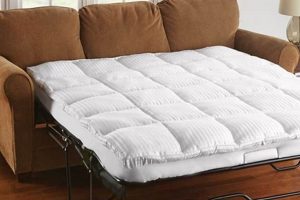
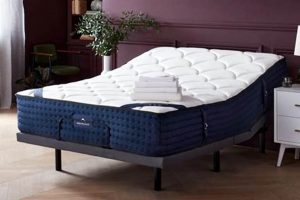
The sleeping surface incorporated within a convertible couch mechanism represents a critical component of dual-purpose furniture. This element provides a temporary bedding solution, often found folded within the frame of a seating unit, ready for deployment as needed. Its primary function is to offer a comfortable and convenient alternative to traditional beds for overnight guests or space-constrained living environments.
The advantages of this integrated bedding option are multifaceted. It allows for optimized utilization of available space, serving as both seating and sleeping accommodations. Historically, these solutions have addressed the need for versatile furnishings, particularly in smaller homes and apartments. Current designs emphasize improved comfort and durability, increasing their appeal as a practical and readily accessible rest arrangement.
The following sections will delve into the various types of these integrated sleep surfaces, examining their construction materials, common dimensions, and features that enhance user experience. Further discussion will explore factors relevant to selection, maintenance, and potential drawbacks associated with their use, enabling informed purchasing decisions.
Essential Considerations for the Integrated Sleeping Surface
Selecting an appropriate integrated sleeping surface requires careful evaluation of several factors. Prioritizing these considerations will ensure optimal comfort, longevity, and suitability for its intended use.
Tip 1: Evaluate Foam Density: The density of the foam core significantly impacts support and durability. Higher-density foam offers greater resistance to compression and a longer lifespan. Consider a minimum density of 1.8 pounds per cubic foot for adequate support.
Tip 2: Examine Coil Construction: Innerspring variations incorporate coil systems for enhanced support. Investigate coil gauge and configuration. Lower gauge numbers indicate thicker, more resilient coils. Pocketed coils minimize motion transfer, a crucial factor for shared sleeping arrangements.
Tip 3: Measure Available Space: Precisely measure the available floor space both in seating and deployed configurations. Ensure sufficient room for comfortable movement around the extended sleeping area. Account for potential obstructions such as furniture or doorways.
Tip 4: Assess Weight Capacity: Adhere strictly to the manufacturer’s stated weight capacity. Exceeding this limit can compromise the structural integrity of the frame and the integrity of the embedded sleeping surface, leading to premature wear and potential failure.
Tip 5: Inquire About Warranty Coverage: Thoroughly review the warranty terms and conditions. Pay close attention to the duration of coverage and the specific components included. A comprehensive warranty reflects the manufacturer’s confidence in the product’s quality and durability.
Tip 6: Consider the Cover Material: The cover material should be both durable and breathable. Look for fabrics that are stain-resistant and easy to clean. Natural fibers, such as cotton, offer good breathability and temperature regulation.
Tip 7: Test the Deployment Mechanism: Prior to purchase, operate the deployment mechanism to ensure smooth and effortless extension and retraction. Check for any signs of stiffness or binding, which could indicate potential problems in the future.
By carefully considering these factors, one can select an integrated sleeping surface that provides a comfortable and reliable sleeping solution for years to come. This thoughtful approach promotes both user satisfaction and the long-term value of the investment.
The subsequent analysis will examine common issues encountered with these integrated sleeping surfaces and provide practical solutions for addressing them, further enhancing the user’s understanding and prolonging the lifespan of the unit.
1. Dimensions and Thickness

Dimensions and thickness are critical parameters directly impacting the functionality and comfort of integrated sleeping surfaces within convertible couches. The overall dimensions dictate the usable sleeping area, influencing the suitability for different body sizes and sleeping preferences. Insufficient length or width compromises comfort, leading to restless sleep and potential physical discomfort. For example, a shorter person may find a standard size mattress comfortable, but a taller individual may require a queen or even king-sized integrated sleeping surface to ensure adequate legroom.
Thickness, on the other hand, primarily influences the level of support and cushioning provided. Inadequate thickness often results in a feeling of sleeping directly on the frame’s support structure, negating the benefits of the cushioning materials. Variations exist, with thinner options prioritizing space efficiency and thicker options emphasizing comfort. For instance, a thin, folding layer of foam may be sufficient for occasional use, but prolonged or nightly use necessitates a thicker, more substantial construction to maintain proper spinal alignment and pressure distribution. Different mattress type has own thickness.
Understanding the interplay between dimensions and thickness allows for informed decision-making. Selecting dimensions that accommodate the intended user’s size and choosing a thickness that provides adequate support are essential for a positive experience. Failure to consider these factors can lead to dissatisfaction and necessitate costly replacements. Thus, these considerations are vital components for user’s satisfaction of its primary purpose, the provision of sleeping space.
2. Foam Density Specifications

Foam density specifications represent a critical determinant of quality and performance in integrated sleeping surfaces for convertible couches. The density rating, typically measured in pounds per cubic foot (lbs/ft), directly correlates with the material’s durability, support characteristics, and resistance to compression over time. This specification profoundly impacts the overall comfort and longevity of the integrated sleep surface.
- Impact on Support and Comfort
Higher foam densities offer superior support for the sleeper. Denser foam distributes weight more effectively, minimizing pressure points and promoting proper spinal alignment. A low-density foam, conversely, compresses more readily, potentially leading to sagging and discomfort, particularly for heavier individuals. For example, a foam with a density of 1.5 lbs/ft may suffice for occasional use by a lightweight person, while a density of 2.5 lbs/ft or higher is generally recommended for regular use and heavier individuals to prevent premature degradation and maintain adequate support.
- Relationship to Durability and Longevity
Foam density significantly influences the lifespan of the integrated sleeping surface. Denser foams exhibit greater resistance to compression set, meaning they retain their original shape and supportiveness for a longer period. Lower-density foams are more susceptible to permanent deformation, leading to a loss of support and overall comfort over time. Selecting a higher density translates to a more durable and long-lasting product, reducing the need for frequent replacement. Imagine a high density memory foam which is designed to extend the durability of sofa bed mattress. - Influence on Cost and Value
Generally, foam density correlates directly with cost. Higher-density foams are typically more expensive due to the increased material and manufacturing requirements. However, the increased upfront cost often translates to greater long-term value due to the enhanced durability and extended lifespan. Opting for a lower-density foam to save money initially may result in more frequent replacements and diminished user satisfaction over time. It’s important to find a balance between cost and quality, considering the intended frequency of use and the expected lifespan of the convertible couch.
- Material Composition and Certifications
Foam density should be considered in conjunction with the material composition and any relevant certifications. The type of foam (e.g., polyurethane, memory foam, latex) also influences its performance characteristics. Certifications such as CertiPUR-US guarantee that the foam has been tested for harmful chemicals and volatile organic compounds (VOCs), ensuring a healthier sleeping environment. Therefore, the material composition has to be taken into account for density of foam of sofa bed mattress.
In conclusion, the foam density specification is a key factor in evaluating an integrated sleeping surface. It directly impacts comfort, durability, and overall value. Careful consideration of this specification, along with other factors such as material type and certifications, is essential for selecting a suitable and long-lasting solution.
3. Support Coil Systems

Support coil systems within the integrated sleeping surfaces of convertible couches represent a significant factor in determining overall comfort, support, and longevity. These systems, analogous to those found in traditional mattresses, provide a resilient and responsive sleeping surface that can mitigate the inherent limitations of foldable bedding.
- Coil Gauge and Firmness
Coil gauge, measured numerically, indicates the thickness of the wire used in the coil construction. Lower gauge numbers denote thicker wires, resulting in firmer support and increased durability. For integrated sleeping surfaces, a balance between firmness and pliability is desirable. For instance, a 13-gauge coil offers substantial support for heavier individuals, while a 14 or 15-gauge coil provides a more conforming feel suitable for lighter sleepers. Inadequate coil gauge can lead to premature sagging and reduced support, compromising the user’s sleeping experience.
- Coil Configuration and Motion Isolation
The arrangement of coils within the system influences motion transfer and overall stability. Bonnell coils, an older and more basic design, are interconnected, leading to greater motion transfer across the surface. Pocketed coils, individually wrapped in fabric, minimize motion transfer, making them suitable for couples or individuals sensitive to disturbance. The choice of coil configuration directly impacts the degree to which movement on one side of the bed affects the other.
- Coil Count and Support Distribution
Coil count refers to the number of individual coils within the integrated sleeping surface. A higher coil count generally translates to more uniform support and reduced pressure points. However, coil count alone is not a definitive indicator of quality. The type of coil and the gauge of the wire also contribute significantly to the overall support characteristics. Adequate coil count ensures even weight distribution, minimizing localized pressure and promoting spinal alignment.
- Edge Support Reinforcement
Edge support reinforcement is a critical feature that enhances stability and prevents edge sagging. Reinforced edges provide a more consistent sleeping surface across the entire bed, preventing the feeling of rolling off the edge. This feature is particularly important for individuals who tend to sleep near the edge of the bed or who require assistance getting in and out of bed. Robust edge support significantly improves the overall usability and longevity of the integrated sleeping surface.
In summary, the choice of support coil system significantly affects the performance and lifespan of integrated sleeping surfaces in convertible couches. Careful consideration of coil gauge, configuration, coil count, and edge support reinforcement is essential for selecting a product that provides adequate support, minimizes motion transfer, and maintains its shape over time. A well-designed coil system contributes significantly to a comfortable and restful sleeping experience.
4. Cover Material Durability
The durability of the cover material on a pull out sofa bed mattress significantly influences its lifespan and overall suitability for its intended function. The cover serves as the outermost layer, directly exposed to wear and tear, spills, and general use. Selection of a robust and resilient material directly affects the mattress’s ability to withstand these stresses, maintaining its integrity and aesthetic appeal over extended periods. For instance, a tightly woven, high-denier fabric demonstrates greater resistance to abrasion and tearing compared to a loosely woven, lower-denier alternative. Failure to prioritize cover material durability results in premature degradation, leading to visible damage, reduced hygiene, and ultimately, the need for replacement. Examples include: a polyester-cotton blend selected for its balance of strength and breathability provides adequate protection against routine use while a delicate, decorative fabric may quickly develop snags and tears with repeated folding and unfolding.
Further complicating matters, the deployment mechanism inherent in pull out sofa beds introduces additional stressors on the cover material. Constant folding and unfolding, friction against the frame, and compression within the folded state accelerate wear patterns. The cover must therefore possess sufficient elasticity and tear resistance to withstand these forces without succumbing to stress fractures or seam failures. Practical application dictates a focus on reinforced seams, durable zippers, and fabrics treated with stain-resistant and water-repellent finishes to mitigate common damage scenarios. Consideration should be given to fabrics like microfiber, known for its tight weave and resilience, which can prolong the cover’s serviceable life despite the demands of the mechanism.
In conclusion, cover material durability is not merely an aesthetic consideration but a functional imperative for pull out sofa bed mattresses. Its selection determines the mattress’s resistance to wear, its hygiene, and its overall longevity. The inherent stresses imposed by the deployment mechanism necessitate a durable, resilient material to maintain the mattre
ss’s integrity over time. Addressing the challenges of cover material selection requires careful consideration of fabric properties, construction techniques, and protective finishes, ultimately contributing to a more sustainable and cost-effective solution.
5. Foldable Mechanism Integrity
The operational lifespan and user satisfaction associated with a pull out sofa bed mattress are inextricably linked to the integrity of its foldable mechanism. This mechanism, typically constructed from metal alloys and incorporating hinges, levers, and support structures, is responsible for the seamless transformation of the sofa from a seating configuration to a sleeping surface. The mechanism’s structural soundness directly influences the ease of operation, the stability of the extended sleeping surface, and the long-term reliability of the entire unit. A poorly designed or constructed mechanism may exhibit stiffness, binding, or outright failure, rendering the sofa bed unusable. As a case in point, mechanisms employing low-grade steel components are prone to bending or fracturing under repeated stress, leading to misalignment and operational difficulties. In contrast, mechanisms utilizing high-strength alloys and robust hinge designs demonstrate superior resistance to deformation and maintain smooth functionality over extended periods of use. The foldable mechanism is a key factor to define sofa bed mattress is good or bad.
Beyond the immediate operational aspects, the integrity of the foldable mechanism also affects the comfort and longevity of the pull out sofa bed mattress itself. A stable and well-supported mechanism provides a consistent and even sleeping surface, minimizing pressure points and promoting proper spinal alignment. Conversely, a compromised mechanism can create uneven weight distribution, leading to discomfort and potential mattress damage. For instance, sagging or bowing of the support structure can cause localized compression of the mattress, resulting in permanent indentations and reduced cushioning. Moreover, a malfunctioning mechanism may exert undue stress on the mattress seams and internal components during folding and unfolding, accelerating wear and tear. Sofa bed mattress rely on the integrity of its mechanisms.
In conclusion, the foldable mechanism is a fundamental component of a pull out sofa bed. Its integrity directly influences the sofa bed’s functionality, comfort, and longevity. Prioritizing mechanisms constructed from durable materials, employing robust designs, and undergoing rigorous testing is essential for ensuring a reliable and satisfying user experience. Neglecting the integrity of the foldable mechanism represents a false economy, potentially leading to premature failure, reduced comfort, and ultimately, the need for costly repairs or replacements. As such, the mechanisms durability serves as the backbone of the sofa bed mattress.
Frequently Asked Questions
The following section addresses common inquiries and concerns regarding the selection, usage, and maintenance of the sleeping surface within a convertible couch. The information provided is intended to offer clear and concise guidance.
Question 1: What is the typical lifespan of a pull out sofa bed mattress?
The longevity of this integrated sleeping surface varies considerably based on factors such as usage frequency, construction materials, and maintenance practices. With moderate usage and proper care, a quality unit may last between five and seven years. More frequent use or neglect of recommended maintenance procedures may reduce its lifespan.
Question 2: How can the comfort of a pull out sofa bed mattress be improved?
Several strategies can enhance the comfort of this type of sleeping surface. Adding a mattress topper, typically made of memory foam or latex, can provide additional cushioning and support. Utilizing supportive pillows and ensuring proper ventilation can also contribute to a more restful sleeping experience. Also choosing right sofa bed can improve the mattress performance.
Question 3: Are there specific weight limits that must be observed?
Yes, exceeding the manufacturer’s stated weight limit can compromise the structural integrity of both the mattress and the supporting frame. This can lead to premature wear and potential failure. Always consult the product specifications to determine the maximum weight capacity.
Question 4: What are the recommended cleaning procedures?
Regular vacuuming is essential to remove dust and debris. For spills and stains, follow the manufacturer’s instructions for spot cleaning. Professional cleaning may be necessary for deep stains or persistent odors. Avoiding harsh chemicals and abrasive cleaning agents is crucial to prevent damage to the cover material.
Question 5: How does the thickness of a pull out sofa bed mattress affect its comfort?
Thickness directly influences the level of support and cushioning provided. Thicker units generally offer greater comfort and support, minimizing the sensation of sleeping directly on the frame. However, thicker options may also reduce the ease of folding and unfolding the sofa bed.
Question 6: What are the key factors to consider when selecting a replacement?
When purchasing a replacement, prioritize factors such as foam density, coil construction (if applicable), cover material durability, and compatibility with the existing sofa bed frame. Accurate measurements are essential to ensure a proper fit. Consider the frequency of use and the weight of the intended user when making your selection.
In summary, proper selection, usage, and maintenance are essential for maximizing the lifespan and comfort of an integrated sleeping surface within a convertible couch. Adhering to the guidelines provided can ensure a more satisfying and restful experience.
The concluding section will offer insights into potential upgrades and accessories that can further enhance the functionality and comfort of pull out sofa beds.
Conclusion
The preceding analysis has illuminated the multifaceted nature of integrated sleeping surfaces within convertible couches. Key determinants of performance, including dimensions, foam density, support systems, and cover material, have been thoroughly examined. Understanding these factors enables informed purchasing decisions and facilitates optimized usage.
The continued evolution of convertible furniture necessitates ongoing attention to design innovations and material advancements. A discerning approach to selection, coupled with diligent maintenance practices, will ensure that the inherent advantages of pull out sofa bed mattress systems namely, space efficiency and functional versatility are realized to their fullest potential. The ongoing pursuit of enhanced comfort and durability remains paramount in this domain.