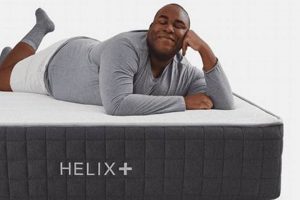
Selecting a suitable sleep surface is paramount for individuals carrying extra weight. Support, durability, and temperature regulation are key considerations when choosing a mattress. The ideal option provides adequate spinal alignment, prevents excessive sinking, and minimizes heat retention, promoting restful and restorative sleep. Factors such as coil count, foam density, and overall construction determine how well a mattress caters to the specific needs of a heavier individual.
The right mattress can significantly impact overall health and well-being. Proper support reduces pressure points, alleviating pain in the back, hips, and joints. A durable construction ensures the mattress maintains its integrity over time, preventing sagging and loss of support. Effective temperature regulation contributes to a more comfortable sleep environment, reducing nighttime disturbances. Historically, mattress design has not always adequately addressed the needs of this demographic, leading to discomfort and compromised sleep quality. However, advancements in materials and manufacturing techniques have led to the development of mattresses specifically engineered to provide optimal support and comfort.
The following sections will explore the specific types of mattresses, materials, and features that are most beneficial, along with considerations for firmness, thickness, and long-term maintenance to ensure the chosen mattress provides years of comfortable and supportive sleep.
Guidance on Selecting a Mattress for Individuals with Higher Body Weight
The following provides several crucial points to consider when evaluating mattress options to ensure suitability and longevity.
Tip 1: Prioritize Coil Count and Gauge. A higher coil count, particularly with individually wrapped coils, offers enhanced support and reduces motion transfer. Lower gauge (thicker) coils provide greater resistance and durability under increased weight.
Tip 2: Evaluate Foam Density. Higher-density foams, especially in support layers, resist compression and prevent premature sagging. Look for foam densities above 2.5 pounds per cubic foot for polyfoam and 4 pounds per cubic foot for memory foam.
Tip 3: Consider Hybrid Construction. Hybrid mattresses combine the support of innerspring coils with the comfort of foam layers, often providing a balanced solution for heavier individuals. Ensure the coil system is robust and the foam layers are sufficiently dense.
Tip 4: Assess Edge Support. Strong edge support prevents roll-off and provides a more usable sleep surface. Reinforced edges, using high-density foam or additional coils, are particularly important for those who sleep near the edge of the bed.
Tip 5: Determine Appropriate Firmness. While personal preference plays a role, a firmer mattress generally offers better support for individuals with higher body weight, preventing excessive sinking and maintaining spinal alignment. Medium-firm to firm options are typically recommended.
Tip 6: Investigate Mattress Thickness. Thicker mattresses, typically 12 inches or more, often incorporate additional support layers and contribute to greater overall durability and comfort. The increased height can also facilitate easier bed entry and exit.
Tip 7: Inquire About Weight Capacity. Check the manufacturer’s specified weight capacity to ensure the mattress is designed to withstand the intended load. Exceeding the weight limit can compromise support and shorten the lifespan of the mattress.
These considerations contribute to a more informed decision, ensuring a mattress purchase that aligns with specific needs and provides adequate support for long-term comfort and spinal health.
The subsequent section will address frequently asked questions regarding the selection and maintenance of appropriate sleep surfaces.
1. Reinforced Edge Support

Reinforced edge support is a critical component of a mattress designed for individuals with higher body weight. The perimeter of a mattress often experiences significant stress as individuals sit on the edge to dress or get in and out of bed. Without reinforcement, the edges can compress and break down more quickly than the center of the mattress, leading to an uneven sleep surface and reduced overall support. This is particularly problematic for those carrying extra weight, as the increased pressure accelerates edge degradation. Mattresses with inadequate edge support can also create a “roll-off” sensation, making the sleeper feel less secure and potentially disrupting sleep.
The inclusion of reinforced edge support systems, such as high-density foam encasements or the addition of extra coils around the perimeter, mitigates these issues. These systems distribute weight more evenly across the mattress, preventing excessive compression along the edges. For example, a mattress utilizing a high-density foam rail around its perimeter will maintain its shape and structural integrity for a longer period, even with frequent edge sitting and use. This enhanced stability not only prolongs the lifespan of the mattress but also ensures a consistent and supportive sleep surface from edge to edge. Mattresses that are lacking this feature have a far shorter life span and will experience the “roll-off” effect.
In conclusion, the presence of reinforced edge support is not merely a desirable feature, but rather a necessity for a mattress intended for heavier individuals. Its contribution to mattress longevity, uniform support, and sleep security underscores its importance in providing a comfortable and restorative sleep experience. The absence of this crucial element inevitably leads to compromised mattress performance and a reduced return on investment.
2. High-Density Foam Layers

High-density foam layers represent a critical component in mattress construction, particularly for individuals with higher body weight. The composition and density of these layers directly impact the mattress’s ability to provide adequate support, resist compression, and maintain structural integrity over time. A mattress lacking sufficient foam density is likely to exhibit premature sagging and reduced comfort, negating its effectiveness.
- Enhanced Support and Pressure Relief
High-density foam conforms to the body’s contours, distributing weight evenly and reducing pressure points. This is essential for minimizing discomfort and pain in areas such as the hips, shoulders, and back. Unlike lower-density foams that compress easily, high-density options provide consistent support, preventing the sleeper from sinking too deeply into the mattress. The result is improved spinal alignment and reduced risk of musculoskeletal strain.
- Increased Durability and Longevity
The inherent structure of high-density foam resists compression and deformation, contributing significantly to the mattress’s overall durability. A mattress constructed with high-density foam layers will maintain its shape and support characteristics for a longer period compared to mattresses with lower-density alternatives. This is especially important for heavier individuals, as their increased weight places greater stress on the mattress materials. Consider the difference between sitting on a high-density versus a low-density chair cushion the former maintains its shape and support far better.
- Improved Motion Isolation
High-density foam excels at absorbing and isolating motion. This is beneficial for couples, as it minimizes the transfer of movement from one side of the bed to the other. When one partner shifts or gets out of bed, the other is less likely to be disturbed. A mattress with high-density foam layers effectively dampens vibrations, promoting undisturbed sleep, a key factor for restful nights.
- Temperature Regulation Considerations
While high-density foam provides excellent support and durability, it can sometimes retain heat. To mitigate this, manufacturers often incorporate cooling technologies such as gel infusions, open-cell structures, or breathable fabrics in the foam layers. These features help dissipate heat and improve airflow, preventing the sleeper from overheating during the night. Therefore, when selecting a mattress with high-density foam, it’s important to consider any integrated cooling features to ensure a comfortable sleep temperature.
The strategic use of high-density foam layers is fundamental to constructing a mattress that effectively caters to the specific needs of individuals with higher body weight. By providing enhanced support, durability, motion isolation, and addressing temperature regulation, these layers contribute significantly to improved sleep quality and long-term satisfaction with the mattress purchase. The selection process should prioritize mattresses that incorporate high-density foam as a key component of their design and construction.
3. Robust Coil System

A robust coil system is a fundamental element in a mattress designed to provide optimal support and longevity for individuals carrying higher body weight. The coil system’s construction directly influences the mattress’s ability to distribute weight evenly, maintain spinal alignment, and resist sagging over time. A deficient coil system will inevitably lead to compromised support and premature mattress failure.
- Gauge and Coil Count
Gauge refers to the thickness of the steel used to construct the coils. Lower gauge numbers indicate thicker, sturdier coils capable of withstanding greater pressure. A higher coil count, particularly with individually wrapped or pocketed coils, provides more targeted support and minimizes motion transfer. The combination of a low gauge and high coil count ensures the mattress can effectively distribute weight and contour to the body’s shape, preventing pressure points and promoting proper spinal alignment. Example: A mattress with a 13-gauge coil system and over 800 coils in a queen size is better equipped to support a heavier individual than a mattress with a 15-gauge system and fewer coils.
- Coil Type and Distribution
Various coil types exist, including Bonnell coils (interconnected), offset coils (hinged for contouring), and pocketed coils (individually wrapped). Pocketed coils are often preferred as they conform independently to body weight, reducing motion transfer and providing more personalized support. The strategic distribution of coils, with reinforced support in the center third of the mattress, can further enhance durability and prevent sagging in areas that experience the most pressure. For instance, zoning that places firmer coils in the lumbar region offers better spinal support for heavier individuals.
- Edge Support Enhancement
Coil systems often incorporate reinforced edges, utilizing thicker gauge coils or foam encasements around the perimeter. This design prevents edge collapse, maximizing the usable sleep surface and facilitating easier entry and exit from the bed. Without adequate edge support, the edges of the mattress can sag over time, reducing overall support and creating a feeling of instability. Reinforced edges are particularly crucial for heavier individuals, as they tend to place more weight on the edges of the mattress.
- Foundation Compatibility
The performance of a robust coil system is contingent on the type of foundation it is paired with. A solid, supportive foundation, such as a platform bed or a box spring with a sturdy frame, provides a stable base for the mattress and prevents premature wear and tear. Using an inadequate or damaged foundation can compromise the coil system’s integrity and shorten the mattress’s lifespan. A weak foundation allows for uneven weight distribution, negating the coil system’s engineered support.
These elements collectively contribute to the functionality and longevity of the coil system in supporting the needs of individuals carrying higher body weight. The careful selection of a mattress with appropriate coil specifications, coupled with a compatible foundation, is essential for ensuring a comfortable, supportive, and durable sleep surface.
4. Firmness Level

Firmness level is a primary consideration when selecting a sleep surface. For individuals with a higher body mass, the appropriate firmness dictates the degree of support and comfort experienced throughout the night. Selection of an inappropriate firmness level can result in discomfort, improper spinal alignment, and disrupted sleep patterns.
- Support and Spinal Alignment
A firmer mattress generally provides better support for individuals with higher body weight, preventing excessive sinking and maintaining spinal alignment. A too-soft mattress allows the body to sink, leading to spinal curvature and potential back pain. Conversely, a mattress that is too firm may not provide sufficient contouring for pressure relief. The ideal firmness level promotes a neutral spine position, reducing stress on joints and muscles. For example, a person with a BMI over 30 often benefits from a medium-firm to firm mattress to maintain proper alignment.
- Pressure Point Relief
While firm support is crucial, adequate pressure relief is also necessary for comfortable sleep. A mattress should conform to the body’s shape, distributing weight evenly and minimizing pressure on sensitive areas such as the hips and shoulders. Medium-firm mattresses often strike a balance between support and pressure relief, providing a comfortable sleep surface without sacrificing spinal alignment. The type and density of the comfort layers play a significant role in pressure relief, working in conjunction with the overall firmness of the mattress.
- Weight Distribution and Sag Resistance
The firmness level affects how well a mattress distributes weight and resists sagging over time. A firmer mattress is generally more resistant to compression and deformation, maintaining its shape and support characteristics for a longer period. This is especially important for heavier individuals, as their increased weig
ht places greater stress on the mattress materials. Softer mattresses tend to sag more quickly, resulting in uneven support and reduced comfort. Mattresses with reinforced support systems and higher-density foams are better equipped to maintain their firmness and support over the long term. - Personal Preference and Sleep Position
While objective factors such as spinal alignment and weight distribution are important, personal preference also plays a role in determining the ideal firmness level. Sleep position can also influence the optimal firmness choice. Back sleepers typically benefit from a medium-firm mattress that provides adequate support for the spine while allowing for some contouring. Side sleepers may prefer a slightly softer mattress to relieve pressure on the hips and shoulders. Stomach sleepers often require a firmer mattress to prevent excessive sinking in the midsection.
Selecting the correct firmness level is critical to sleep surface satisfaction. The interplay between support, pressure relief, weight distribution, and individual sleeping habits guides the decision-making process. Ignoring these factors often results in discomfort, sleep disruption, and reduced mattress longevity. Therefore, careful consideration of these attributes is important when choosing “what is the best mattress for an overweight person”.
5. Adequate Thickness
The thickness of a mattress directly correlates with its ability to provide sufficient support and comfort, especially for individuals with higher body weight. Adequate mattress thickness typically translates to a greater volume of support materials, such as high-density foam and robust coil systems, both of which are essential for preventing excessive sinking and maintaining proper spinal alignment. A thinner mattress, conversely, may lack the necessary layers to effectively distribute weight, leading to pressure point build-up and discomfort. For instance, a standard 8-inch mattress may prove inadequate for an individual exceeding 250 pounds, potentially resulting in a compromised sleep experience and accelerated wear of the mattress.
Mattress thickness influences the durability and longevity of the product. Thicker mattresses often incorporate additional support layers and high-quality materials designed to withstand greater stress and compression over time. This is crucial for individuals with higher body weight, as their increased pressure on the mattress can quickly degrade thinner, less robust models. A mattress with a thickness of 12 inches or more frequently includes multiple layers of high-density foam or specialized coil systems, contributing to enhanced support, pressure relief, and overall durability. In practical terms, this translates to a longer lifespan for the mattress and sustained comfort for the user.
Ultimately, adequate thickness is a non-negotiable factor in selecting a mattress that effectively addresses the needs of heavier individuals. While specific thickness requirements may vary based on individual preferences and sleeping positions, prioritizing mattresses with a substantial profile ensures adequate support, enhanced durability, and a more comfortable and restorative sleep experience. Neglecting this aspect risks compromising sleep quality, accelerating mattress wear, and ultimately leading to dissatisfaction with the purchase.
6. Weight Capacity

Weight capacity serves as a critical, often overlooked, specification when selecting a mattress for individuals with higher body weight. This metric directly dictates the mattress’s ability to provide adequate support, resist premature wear, and ensure long-term comfort. Disregarding weight capacity can lead to compromised sleep quality, reduced mattress lifespan, and potential warranty voidance.
- Structural Integrity and Sag Prevention
Exceeding a mattress’s designated weight capacity places undue stress on its internal components, accelerating wear and increasing the likelihood of sagging. Sagging compromises spinal alignment and reduces overall support, leading to discomfort and potential back pain. A mattress designed with a higher weight capacity utilizes stronger materials and reinforced construction, better equipped to withstand the sustained pressure and maintain its structural integrity over time. For example, a mattress rated for 300 lbs per side will likely degrade more rapidly under a 350 lb sleeper compared to one rated for 500 lbs.
- Support System Performance
The support system, whether composed of innerspring coils, foam cores, or hybrid combinations, is directly impacted by exceeding weight limits. Coils can lose their resilience and deform, while foam layers can compress and lose their ability to provide contouring and pressure relief. This degradation of the support system diminishes the mattress’s ability to properly distribute weight and maintain a neutral spine position. A mattress with an insufficient weight rating may exhibit localized sinking, creating pressure points and disrupting sleep. This is most evident when comparing two mattresses with similar features but different stated weight maximums.
- Material Durability and Longevity
Weight capacity ratings are indicative of the quality and durability of the materials used in the mattress’s construction. Higher weight limits typically correspond to denser foams, thicker gauge coils, and reinforced edge support systems. These enhanced materials contribute to a longer mattress lifespan and sustained performance. Conversely, mattresses with lower weight capacities often employ less robust materials that are more susceptible to compression and wear, resulting in a shorter lifespan and compromised comfort. The price point often reflects this disparity, with higher capacity mattresses commanding a premium due to the superior materials and construction.
- Warranty Considerations
Most mattress manufacturers specify weight limits within their warranty terms. Exceeding the stated weight capacity can void the warranty, leaving the consumer responsible for any repairs or replacements resulting from sag or other weight-related damage. Therefore, understanding and adhering to the weight capacity is crucial for protecting the investment and ensuring long-term value. Before purchasing, thoroughly review the warranty documentation to confirm the weight limit and any related stipulations to prevent future issues.
The interplay between these elements underscores the importance of weight capacity when assessing a mattress’s suitability. Selecting a mattress that aligns with individual weight considerations ensures proper support, enhances durability, and safeguards the investment, contributing to a more comfortable and restorative sleep experience for heavier individuals. A mattress exceeding the required needs and weight limit will have a lasting effect on the individual.
Frequently Asked Questions
This section addresses common inquiries regarding mattresses designed for individuals with higher body weight, providing clarity on key considerations and dispelling misconceptions.
Question 1: Are all mattresses marketed as “firm” suitable for individuals with higher body weight?
No. While firmness is a crucial factor, not all “firm” mattresses offer adequate support. Mattress firmness is subjective, and marketing terminology can be misleading.
Evaluate the mattress’s coil count, foam density, and overall construction to determine its suitability. A truly supportive mattress for heavier individuals will combine firmness with robust materials and a reinforced design.
Question 2: Is memory foam always a good choice?
Memory foam can provide pressure relief, but high-density memory foam is crucial. Low-density memory foam tends to compress excessively under weight, losing support and potentially trapping heat. Opt for memory foam with a density of at least 4 pounds per cubic foot and consider gel infusions or open-cell structures to enhance breathability.
Question 3: How important is edge support, really?
Edge support is critically important, especially for those who share a bed or utilize the edge for sitting. Weak edge support leads to a “roll-off” sensation and reduces the usable sleep surface. Reinforced edges, using high-density foam or additional coils, provide a more stable and supportive perimeter.
Question 4: What is the ideal mattress thickness?
While personal preference plays a role, a mattress thickness of at least 12 inches is generally recommended. Thicker mattresses typically incorporate more support layers and higher-quality materials, contributing to enhanced comfort and durability. Individuals with higher body weight will want to examine mattresses that are at least 12″ in thickness or greater for added support and durability.
Question 5: Does mattress price always correlate with quality and support?
Not necessarily. While higher-priced mattresses often incorporate better materials and construction techniques, price alone is not a guarantee of quality. Research the mattress’s specifications, read reviews, and assess its suitability based on individual needs, rather than relying solely on the price tag. A higher price point doesn’t always mean a better experience, and you may pay for brand over substance.
Question 6: How can individuals assess a mattress before purchasing?
Whenever possible, test the mattress in person, spending at least 15 minutes lying in various sleep positions. Inquire about trial periods and return policies to ensure satisfaction. Read online reviews from individuals with similar body types to gain insights into real-world performance. If an in-person trial isn’t possible, check the company’s return policies carefully. A longer trial period makes more sense.
In summary, selecting an appropriate mattress requires careful consideration of firmness, materials, construction, and weight capacity. Relying on marketing claims alone can lead to disappointment. Thorough research and, when possible, in-person testing are essential for making an informed decision.
The following section will address strategies for extending the lifespan of a chosen sleep surface and maintaining its comfort.
The Optimal Sleep Solution
Determining “what is the best mattress for an overweight person” involves a meticulous evaluation of firmness, support structure, material density, and specified weight capacity. Robust coil systems, high-density foams, and reinforced edge support are paramount for ensuring adequate spinal alignment and preventing premature mattress degradation. Thickness serves as an additional factor contributing to overall support and durability. A selection process that prioritizes these elements increases the probability of securing a sleep surface conducive to long-term comfort and musculoskeletal health.
The integration of informed decision-making, grounded in an understanding of mattress specifications and personal needs, is essential for individuals seeking a sustainable sleep solution. A commitment to pre-purchase research and a thorough assessment of available options will ultimately lead to a choice that promotes restorative sleep and enhances overall well-being. Understanding and addressing these challenges is key to securing optimal sleep health.
![Top Best Affordable Mattress Companies of [Year] Reviewed | Organic & Natural Mattress Buyer’s Guide: Non-Toxic Sleep Solutions](https://mattressworldpa.com/wp-content/uploads/2025/07/th-7840-300x200.jpg "Top Best Affordable Mattress Companies of [Year] Reviewed Organic & Natural Mattress Buyer’s Guide: Non-Toxic Sleep Solutions")

![Top-Rated: Best Firm Innerspring Mattress [Guide & Reviews] | Organic & Natural Mattress Buyer’s Guide: Non-Toxic Sleep Solutions](https://mattressworldpa.com/wp-content/uploads/2025/07/th-7838-300x200.jpg "Top-Rated: Best Firm Innerspring Mattress [Guide & Reviews] Organic & Natural Mattress Buyer’s Guide: Non-Toxic Sleep Solutions")

![Top Spots: Best Place to Buy Twin Mattress [Guide] | Organic & Natural Mattress Buyer’s Guide: Non-Toxic Sleep Solutions](https://mattressworldpa.com/wp-content/uploads/2025/07/th-7836-300x200.jpg "Top Spots: Best Place to Buy Twin Mattress [Guide] Organic & Natural Mattress Buyer’s Guide: Non-Toxic Sleep Solutions")