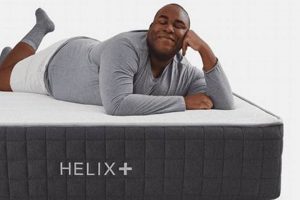
The structural integrity of a mattress’s perimeter, specifically its ability to resist compression and maintain its form when weight is applied near the edge, is a critical aspect of its overall design. A mattress with a robust border prevents the sensation of rolling off the bed and maximizes the usable sleep surface. For example, a mattress designed with reinforced coils or foam encasement along its sides will offer a firmer, more stable edge.
This feature provides numerous advantages to sleepers. Individuals can utilize the full width of the mattress without feeling unstable, which is particularly beneficial for couples sharing a bed. Enhanced perimeter support also facilitates easier sitting and getting in and out of bed, a significant benefit for those with mobility issues. Historically, manufacturers have experimented with various materials and construction techniques to improve this aspect of mattress performance, reflecting a growing awareness of its impact on sleep quality and overall satisfaction.
Understanding the nuances of perimeter construction is crucial when selecting a mattress. This analysis will delve into the various methods used to enhance this feature, examining the materials, technologies, and design considerations that contribute to a superior sleep experience by preventing edge sag and increasing overall mattress longevity.
Tips for Evaluating Mattress Perimeter Reinforcement
Assessing the firmness of a mattress’s perimeter before purchase ensures long-term satisfaction and maximizes the usable sleep surface. The following tips provide guidance on evaluating this crucial feature.
Tip 1: Examine the Mattress Construction: Investigate the specifications for details regarding edge support systems. Look for terms such as “reinforced edge,” “foam encasement,” or “coil perimeter.” These indicate specific design elements intended to improve edge stability.
Tip 2: Perform the “Sit Test”: Sit on the edge of the mattress as you would when getting in or out of bed. Observe the degree of compression. Minimal sinking or bowing suggests adequate support; excessive compression indicates a weaker perimeter.
Tip 3: Assess Perimeter Consistency: Apply pressure along the entire perimeter of the mattress. Check for any inconsistencies in firmness. Variations in support indicate potential weaknesses in the construction.
Tip 4: Consider Sleeping Position: Individuals who frequently sleep near the edge of the bed should prioritize mattresses with enhanced perimeter reinforcement. Side sleepers, in particular, may benefit from the increased stability and reduced likelihood of rolling off.
Tip 5: Read Customer Reviews: Analyze reviews from other customers, specifically focusing on comments regarding edge support and stability. These insights can provide valuable real-world feedback on the mattress’s performance.
Tip 6: Inquire About Warranty Coverage: Determine whether the warranty specifically addresses issues related to edge sagging. Comprehensive coverage provides protection against premature degradation of this critical structural element.
Tip 7: Compare Different Mattress Types: Innerspring, hybrid, and foam mattresses each offer varying levels of perimeter support. Compare different types to determine which best suits individual needs and preferences.
Prioritizing these evaluations allows for a more informed decision, ensuring that the chosen mattress will provide long-lasting support and maximize sleep surface area.
This evaluation ensures a better understanding of perimeter capabilities, leading to a more satisfactory and supportive sleep experience.
1. Reinforced perimeter

A reinforced perimeter is a critical component in achieving optimal mattress edge support. The absence of such reinforcement typically leads to premature sagging and a compromised usable sleep surface. This design feature directly addresses the tendency of mattresses to compress and deform near the edges under sustained weight. The causal relationship is clear: a lack of reinforcement causes poor perimeter stability; conversely, robust reinforcement contributes directly to enhanced stability. As such, it is crucial for maintaining quality. Consider the scenario of a couple sharing a queen-sized mattress; without a reinforced perimeter, both individuals may unconsciously avoid the edges, effectively reducing the available sleeping space and potentially disrupting sleep quality. This also impacts getting in and out of bed due to unstable edge support.
Reinforcement methods vary, encompassing high-density foam encasements, strategically placed coils, or vertical supports integrated into the mattress construction. High-density foam encasement, for instance, acts as a structural barrier, preventing the internal components from shifting and compressing outwards. Enhanced coil systems employ firmer coils around the mattress edge to resist deformation under load. Each technique aims to distribute weight evenly and maintain the mattress’s intended shape. The practical application of this understanding lies in the informed consumer’s ability to prioritize mattresses that incorporate these features, resulting in a more durable and comfortable sleep experience. This understanding also assists manufacturers in developing more robust designs, driving innovation in sleep technology.
In summary, a reinforced perimeter is integral to a mattress’s ability to provide consistent and reliable edge support. Its presence mitigates sagging, maximizes usable surface area, and enhances overall mattress longevity. Challenges remain in balancing the cost of reinforcement with consumer affordability, and further research into advanced materials and construction techniques is ongoing. The selection of a mattress with a well-designed perimeter directly contributes to a more restful and supportive sleep environment, aligning with the broader goal of improved sleep health.
2. Foam Encasement

Foam encasement is a common technique employed in mattress manufacturing to enhance perimeter stability, contributing significantly to overall edge support. The construction involves surrounding the inner components of the mattress, typically coils or foam layers, with a dense foam border. This acts as a structural support, preventing the mattress edges from collapsing or sagging under pressure. The causal relationship is direct: the presence of foam encasement improves edge firmness, thereby increasing the usable sleep surface. Without this feature, the edges of a mattress are more susceptible to compression, leading to a perceived reduction in sleeping space and an unstable feeling when sitting or lying near the perimeter. For example, an individual sharing a bed may find that, without foam encasement, they consistently roll towards the center due to the lack of support at the edge.
The effectiven
ess of foam encasement depends on several factors, including the density and thickness of the foam used. Higher-density foam provides greater resistance to compression, resulting in firmer and more durable edge support. Different manufacturers employ varying foam densities and encasement designs to achieve specific levels of perimeter reinforcement. In practice, mattresses with well-designed foam encasement offer advantages such as easier ingress and egress from the bed, reduced motion transfer across the sleep surface, and an extended lifespan due to minimized edge degradation. A practical application of this understanding involves consumers actively seeking mattresses with documented foam encasement when prioritizing perimeter stability. A foam encasement can be very effective if built to a specific thickness and density.
In summary, foam encasement plays a pivotal role in establishing optimal edge support in mattresses. It mitigates sagging, maximizes usable surface area, and contributes to overall mattress longevity. While effective, challenges exist in balancing cost-effectiveness with the performance of the foam encasement. The proper selection of a mattress with foam encasement should be based on individual needs and preferences, ultimately resulting in a more supportive and comfortable sleep environment.
3. Coil Density

Coil density, measured as the number of coils per unit area within a mattress, represents a crucial determinant of its edge support capability. Higher coil density translates directly to increased resistance against compression and deformation, factors vital for maintaining a consistent and supportive perimeter.
- Enhanced Weight Distribution
Increased coil density facilitates superior weight distribution across the mattress surface, particularly near the edges. A greater concentration of coils prevents localized sinking and provides uniform support, mitigating the common issue of edge sagging. A practical example is a mattress with high-density coils along its perimeter, which allows individuals to sit comfortably on the edge without experiencing significant compression or instability. This is particularly relevant for individuals with mobility challenges or those who frequently utilize the edge of the bed for sitting.
- Improved Structural Integrity
Higher coil counts contribute to the overall structural integrity of the mattress. A denser coil network offers greater resistance to wear and tear, prolonging the lifespan of the mattress and preventing premature degradation of the edge support. In contrast, mattresses with lower coil density are more susceptible to deformation and sagging over time, especially along the edges where stress is concentrated due to frequent use.
- Targeted Perimeter Reinforcement
Manufacturers often strategically increase coil density specifically around the perimeter of the mattress to reinforce edge support. This targeted approach maximizes the effectiveness of the coil system in preventing edge collapse and expanding the usable sleep surface. For example, a mattress may feature a border of high-gauge, densely packed coils to provide robust support and prevent the sensation of rolling off the bed.
- Compatibility with Other Support Systems
Coil density complements other edge support systems, such as foam encasement, to further enhance perimeter stability. A combination of high-density coils and foam encasement creates a synergistic effect, providing optimal support and minimizing edge sagging. The coils provide underlying support and resistance to compression, while the foam encasement adds a structural barrier that prevents lateral movement and deformation of the coils.
In conclusion, coil density serves as a critical factor influencing mattress edge support. Higher coil density improves weight distribution, enhances structural integrity, facilitates targeted perimeter reinforcement, and complements other support systems. Understanding the relationship between coil density and edge support empowers consumers to make informed decisions when selecting a mattress that provides optimal comfort, support, and longevity.
4. Edge firmness

Edge firmness is a direct and measurable indicator of the structural integrity and overall quality of mattress perimeter support. It represents the degree of resistance offered by the mattress edge to compression and deformation under applied weight. Insufficient edge firmness causes a reduction in the usable sleep surface and complicates ingress and egress, especially for individuals with mobility constraints. Thus, optimal edge firmness is not merely a comfort preference but a functional requirement for maximizing a mattress’s practical utility. A mattress possessing significant edge firmness demonstrates a robustness that translates directly into improved sleep quality and user satisfaction. The cause-and-effect is clear: adequate edge firmness directly leads to enhanced stability and usable surface area, whereas insufficient firmness results in an unstable perimeter and reduced sleep space.
The correlation between edge firmness and superior perimeter support is evident in numerous design features. Mattresses incorporating reinforced coils or high-density foam encasements exhibit demonstrably firmer edges compared to those lacking such features. For instance, a mattress with a multi-layered foam encasement will resist compression more effectively than one with a simple, unreinforced edge. A practical application of this understanding is the “sit test,” where potential buyers sit on the mattress edge to assess its firmness and stability. This test offers a tangible indication of the mattress’s ability to maintain its shape and prevent the sensation of rolling off the edge, directly reflecting the edge firmness quotient. It highlights that the mattress allows users to fully use the sleeping space, allowing for more room and a better rest.
In summary, edge firmness serves as a key indicator of quality in mattress construction and a critical component of optimal perimeter support. Its impact extends from maximizing the usable sleep surface to enhancing overall user safety and convenience. Though achieving consistent and durable edge firmness presents design and manufacturing challenges, prioritizing this feature remains essential for manufacturers seeking to deliver a superior sleep experience. Focusing on edge firmness is a key differentiator to make it the best mattress edge support.
5. Durability testing

Durability testing serves as a cornerstone in evaluating and validating the long-term performance of mattress edge support. These rigorous assessments simulate years of use, identifying potential weaknesses and ensuring that the mattress maintains its structural integrity and support capabilities over time. The results of durability testing directly correlate with the overall lifespan and customer satisfaction associated with mattress edge support.
- Simulated Edge Loading
This testing involves repeatedly applying weight to the mattress edges, mimicking the action of sitting or lying near the perimeter. Sensors measure the degree of compression and deformation over
thousands of cycles. Mattresses exhibiting minimal sagging or loss of support during this test are deemed to have superior edge durability. This directly indicates the mattress will provide consistent support along its edges for an extended period. - Rollator Testing
Rollator testing employs a weighted roller to simulate body movement across the mattress surface. This is accelerated wear that the mattress undergoes. The number of cycles of rollator are ran across each zone of a mattress. Durability is measured by how well it maintains height, firmness, and uniformity. Mattresses are often compared to one another to show levels of improvement from a baseline level.
- Compression Set Analysis
Compression set analysis measures the permanent deformation of the edge support materials after prolonged compression. Samples of foam or coil components are subjected to sustained pressure, and the degree to which they recover their original shape is assessed. Lower compression set values indicate greater resistance to deformation and superior long-term durability of the edge support system.
- Material Fatigue Testing
Individual components of the edge support system, such as foam encasements or perimeter coils, are subjected to cyclic loading and unloading to assess their resistance to fatigue and failure. This testing helps identify potential weaknesses in the materials or design that could lead to premature degradation of the edge support. Materials that exhibit high fatigue resistance contribute to a more durable and long-lasting edge support system.
These tests provide a complete understanding of how the mattress edge will perform under everyday use. Mattresses that undergo and pass more rigorous tests will offer consumers better edge support for longer. This is key to providing “best mattress edge support”.
6. Sag resistance

Sag resistance is an indispensable attribute of a mattress striving for optimal perimeter support, significantly impacting its longevity, comfort, and overall user satisfaction. The degree to which a mattress resists deformation and maintains its original shape under sustained weight and pressure directly correlates with the effectiveness and durability of its edge support system.
- Material Integrity and Durability
The composition and quality of materials used in the mattress construction directly influence its sag resistance. High-density foams, reinforced coils, and robust encasement systems contribute to a firmer and more resilient edge. A mattress employing low-quality materials will exhibit premature sagging, particularly along the edges, compromising its support capabilities and reducing the usable sleep surface. For instance, a mattress lacking sufficient coil density or foam reinforcement around the perimeter is more prone to sagging when subjected to prolonged sitting or lying near the edge.
- Design and Construction Techniques
The design and construction techniques employed by manufacturers significantly affect a mattress’s ability to resist sagging. Features such as reinforced edges, strategically placed support zones, and durable stitching contribute to enhanced structural integrity. A mattress with a well-engineered edge support system distributes weight evenly and prevents localized sinking, ensuring consistent support across the entire surface. Conversely, a poorly designed mattress lacks these features, leading to uneven support and accelerated sagging, especially along the edges.
- Impact on Sleep Quality and Comfort
A mattress with poor sag resistance compromises sleep quality and comfort. Sagging edges create an uneven sleep surface, leading to discomfort, restlessness, and potential back pain. Individuals may experience a sensation of rolling off the bed, disrupting their sleep and reducing the available sleeping space. A mattress with high sag resistance provides a consistent and supportive sleep surface, promoting proper spinal alignment and enhancing overall sleep comfort.
- Long-Term Performance and Value
A mattress exhibiting high sag resistance offers superior long-term performance and value. By maintaining its shape and support capabilities over time, the mattress provides consistent comfort and reduces the need for frequent replacements. A mattress with low sag resistance degrades rapidly, requiring premature replacement and resulting in increased costs and inconvenience. Therefore, selecting a mattress with proven sag resistance is a prudent investment that ensures long-term satisfaction and cost-effectiveness.
The relationship between sag resistance and superior perimeter support is undeniable. Mattresses engineered to withstand sagging offer improved comfort, longevity, and overall value. Therefore, durability tests that focus on this are key when testing for “best mattress edge support”.
7. Usable surface
Usable surface, defined as the area of a mattress that provides consistent and reliable support for sleep, is directly proportional to the quality of its edge support. A mattress with superior edge support maximizes its usable surface by preventing perimeter sagging and ensuring consistent firmness across the entire sleeping area. Conversely, a mattress lacking robust edge support experiences a reduction in its usable surface due to compression and deformation along the edges. The cause is clear: inadequate edge support diminishes usable surface, while effective support expands it. This is because the edges of a mattress act as a barrier between the sleeper and the floor, so those edges must remain firm.
The importance of usable surface becomes particularly evident when considering couples sharing a bed. A mattress with compromised edge support forces sleepers to gravitate towards the center, diminishing individual space and potentially disrupting sleep quality. For example, a queen-sized mattress may effectively function as a full-sized mattress if its edge support is insufficient. In practical terms, mattresses designed with reinforced edges and high-density foam encasements offer a demonstrable increase in usable surface, allowing sleepers to fully utilize the mattress width without experiencing instability or discomfort. The significance of this relationship is underscored by the increasing consumer demand for mattresses that prioritize edge support, reflecting a growing awareness of its impact on sleep quality and overall value.
In summary, the connection between usable surface and edge support is inseparable. A mattress that optimizes usable surface achieves higher levels of comfort, convenience, and overall satisfaction. While challenges remain in balancing cost-effectiveness with the implementation of advanced edge support technologies, prioritizing this aspect of mattress design remains essential for manufacturers seeking to deliver superior sleep experiences and maximize the functional value of their products. Therefore, increased surface area is an important part of the “best mattress edge support” goal.
Frequently Asked Questions
The following questions address common concerns and misconceptions regarding mattress perimeter reinforcement, often referred to as “best mattress edge support”. These responses aim to provide clear, factual information to assist in making informed purchasing decisions.
Question 1: Is p
erimeter reinforcement necessary for all mattress types?
Perimeter reinforcement is beneficial for most mattress types, particularly those with softer constructions like memory foam or hybrid models. While innerspring mattresses may inherently possess some edge support, additional reinforcement enhances stability and maximizes usable surface area.
Question 2: How does foam encasement contribute to perimeter support?
Foam encasement involves surrounding the inner core of a mattress with a dense foam border. This acts as a structural barrier, preventing edge sagging and providing a more stable perimeter for sitting and sleeping.
Question 3: What is the significance of coil density in perimeter reinforcement?
Coil density refers to the number of coils per unit area within the mattress. Higher coil density, particularly along the perimeter, provides increased resistance to compression and deformation, enhancing edge support.
Question 4: Can perimeter reinforcement prevent motion transfer?
While perimeter reinforcement primarily focuses on edge stability, it can indirectly contribute to reduced motion transfer. A firmer edge minimizes sinking and shifting, which can lessen the transmission of movement across the mattress surface.
Question 5: How can perimeter reinforcement affect the lifespan of a mattress?
Adequate perimeter reinforcement can extend the lifespan of a mattress by preventing premature edge sagging and maintaining its structural integrity over time. Mattresses with robust edge support tend to exhibit greater durability and resistance to wear and tear.
Question 6: Is perimeter reinforcement more important for certain sleeping positions?
Perimeter reinforcement is generally beneficial for all sleeping positions, but it is particularly important for individuals who sleep near the edge of the bed or those who frequently sit on the edge while getting in and out of bed. Side sleepers, in particular, may benefit from the added stability.
Prioritizing mattresses with proper “best mattress edge support” leads to extended sleep quality, more usable sleep surface, and increased overall mattress lifespan.
With these key points in mind, the next section will transition to summarizing the essential aspects of the discussed topic.
Best Mattress Edge Support
This exploration has underscored the critical role of “best mattress edge support” in maximizing sleep surface, promoting durability, and ensuring long-term user satisfaction. Key aspects such as reinforced perimeters, foam encasement, coil density, sag resistance, and rigorous durability testing contribute to a superior sleep experience. The presence of these features directly correlates with enhanced stability, reduced motion transfer, and extended mattress lifespan.
Investing in a mattress engineered with demonstrable perimeter reinforcement represents a commitment to sleep quality and long-term value. As technology and materials science continue to evolve, further advancements in edge support systems are anticipated, promising even greater levels of comfort, stability, and overall mattress performance. Prioritizing this essential design element ensures a more restful and supportive sleep environment, contributing to improved well-being.
![Top Best Affordable Mattress Companies of [Year] Reviewed | Organic & Natural Mattress Buyer’s Guide: Non-Toxic Sleep Solutions](https://mattressworldpa.com/wp-content/uploads/2025/07/th-7840-300x200.jpg "Top Best Affordable Mattress Companies of [Year] Reviewed Organic & Natural Mattress Buyer’s Guide: Non-Toxic Sleep Solutions")
![Top-Rated: Best Firm Innerspring Mattress [Guide & Reviews] | Organic & Natural Mattress Buyer’s Guide: Non-Toxic Sleep Solutions](https://mattressworldpa.com/wp-content/uploads/2025/07/th-7838-300x200.jpg "Top-Rated: Best Firm Innerspring Mattress [Guide & Reviews] Organic & Natural Mattress Buyer’s Guide: Non-Toxic Sleep Solutions")

![Top Spots: Best Place to Buy Twin Mattress [Guide] | Organic & Natural Mattress Buyer’s Guide: Non-Toxic Sleep Solutions](https://mattressworldpa.com/wp-content/uploads/2025/07/th-7836-300x200.jpg "Top Spots: Best Place to Buy Twin Mattress [Guide] Organic & Natural Mattress Buyer’s Guide: Non-Toxic Sleep Solutions")