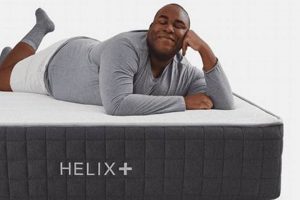
The selection of appropriate sleep surfaces for individuals with higher body weights requires specific considerations. These mattresses are engineered to provide adequate support, pressure relief, and durability to accommodate increased loads and prevent premature sagging or breakdown of materials. An example is a hybrid mattress with reinforced coil systems and high-density foam layers designed to maintain spinal alignment and prevent discomfort.
Proper sleep support is crucial for overall health and well-being. Individuals carrying more weight often experience increased pressure on joints and the spine, making mattress selection paramount for mitigating pain and promoting restorative sleep. Historically, standard mattresses lacked the necessary construction to adequately support heavier individuals, leading to discomfort and reduced sleep quality. This has driven the development of specialized mattresses designed with enhanced support systems and more resilient materials.
This discussion will explore the key features and materials to consider when selecting a mattress to ensure optimal comfort, support, and longevity for individuals requiring enhanced mattress performance.
Tips for Choosing an Appropriate Mattress
Selecting a suitable sleep surface requires careful consideration of several factors to ensure adequate support, pressure relief, and durability. The following tips provide guidance in making an informed decision.
Tip 1: Prioritize Innerspring or Hybrid Constructions: Mattresses incorporating innerspring systems, especially those with individually wrapped coils, often provide superior support compared to all-foam models. Hybrid mattresses, combining innerspring cores with foam comfort layers, can offer a balance of support and pressure relief.
Tip 2: Examine Coil Gauge and Density: A lower coil gauge indicates thicker, more durable coils, better equipped to handle increased weight. Additionally, a higher coil density provides more consistent support across the mattress surface.
Tip 3: Evaluate Foam Density and ILD Ratings: When assessing foam layers, focus on density rather than thickness. Higher density foams, typically exceeding 4 lbs/cubic foot for memory foam and 2 lbs/cubic foot for polyfoam, offer better support and resilience. ILD (Indentation Load Deflection) ratings indicate firmness; a higher ILD suggests a firmer feel.
Tip 4: Consider Edge Support: Reinforced edge support prevents sagging around the perimeter of the mattress, providing a stable and usable sleep surface across the entire bed.
Tip 5: Investigate Weight Capacity Specifications: Reputable mattress manufacturers often provide explicit weight capacity ratings for their products. Adhering to these specifications is crucial for maximizing mattress longevity and ensuring adequate support.
Tip 6: Read Reviews and Seek Recommendations: Research independent reviews and consult with retailers knowledgeable about mattress construction and performance characteristics for individuals with higher body weights.
By focusing on construction, materials, and weight capacity, one can improve their chances of selecting a mattress that delivers optimal comfort and durability, leading to improved sleep quality and overall well-being.
The following sections will delve deeper into specific mattress types and features that are particularly well-suited to address the support needs of individuals requiring robust and dependable sleep surfaces.
1. Reinforced Coil Systems
Reinforced coil systems are a critical component in mattress design, particularly for individuals weighing approximately 300 pounds. The core function of these systems is to provide robust and consistent support, counteracting the increased compression forces exerted on the mattress. Without adequate reinforcement, standard coil systems are prone to premature sagging and deformation, leading to compromised spinal alignment and discomfort. For example, a reinforced coil system might employ thicker gauge steel or a higher coil count per unit area, distributing weight more effectively. The increased resistance to compression translates directly to enhanced durability and a more supportive sleep surface, minimizing pressure points and promoting healthier sleep posture.
The practical significance of reinforced coil systems extends beyond mere comfort. Mattresses lacking sufficient support can exacerbate existing musculoskeletal issues and contribute to the development of new ones. The stable and even support offered by reinforced coils helps maintain proper spinal alignment throughout the night, reducing the risk of back pain, neck stiffness, and joint discomfort. In addition to individual coil reinforcement, features like zoned support, where specific areas of the mattress are engineered with varying degrees of firmness, further enhance the system’s ability to adapt to individual body contours and pressure distribution needs. This adaptability is paramount for individuals who may carry weight disproportionately in different areas of the body.
In summary, reinforced coil systems are not merely an optional upgrade but a fundamental necessity for individuals requiring enhanced mattress support. Their presence contributes significantly to the long-term durability and performance of the mattress, mitigating the risks associated with inadequate support and promoting healthier, more restorative sleep. The selection of a mattress with a properly engineered and reinforced coil system represents a proactive investment in physical well-being.
2. High-Density Foam Layers

High-density foam layers play a crucial role in a mattress designed for individuals around 300 pounds. Their increased density provides enhanced support, pressure relief, and durability compared to lower-density foams. The greater material concentration resists compression and deformation, maintaining the mattress’s structural integrity and preventing premature sagging under significant weight. For instance, a high-density memory foam layer conforms to the body’s contours, distributing weight evenly and minimizing pressure points, which is essential for comfort and preventing pain for heavier individuals. This also impacts spinal alignment by preventing excessive sinking into the mattress, a common issue with less supportive materials.
The long-term performance and lifespan of the mattress are directly linked to the density of its foam layers. Lower-density foams break down more quickly under consistent pressure, leading to a loss of support and the need for more frequent replacement. In contrast, high-density foams maintain their shape and supportive properties for a longer duration, representing a more cost-effective solution over time. The practical application extends to different types of foam, such as high-density polyurethane foam p
roviding a firm base layer or high-density latex foam offering a responsive and durable comfort layer. The strategic use of these materials in combination with other support systems, like innersprings, contributes to a balanced and supportive sleep environment.
In summary, high-density foam layers are indispensable for mattresses intended to support individuals around 300 pounds. Their contribution to support, pressure relief, and longevity directly impacts the sleep quality and overall health of the user. Choosing a mattress with appropriately dense foam layers is an investment in long-term comfort and well-being. The challenge lies in identifying mattresses that genuinely utilize high-density foams, as marketing claims may not always reflect the actual material properties. Independent reviews and verifiable specifications are essential for making an informed decision.
3. Enhanced Edge Support

Enhanced edge support is a critical feature that distinguishes a well-designed mattress from a merely adequate one, particularly for individuals weighing around 300 pounds. The perimeter of a mattress lacking robust edge support tends to compress excessively under weight, creating a sloping or unstable surface near the edges. This compression makes it difficult to sit or sleep comfortably near the edge, effectively reducing the usable surface area of the mattress. Consequently, individuals may experience a feeling of rolling off the bed, leading to disrupted sleep and potential safety concerns. The cause is insufficient reinforcement along the mattress edges, while the effect is a diminished sleep surface and compromised support. Examples of enhanced edge support include high-density foam encasements, reinforced coils along the perimeter, or steel rod supports. These features counteract the tendency of the mattress edges to collapse under pressure, providing a stable and consistent surface from edge to edge.
The importance of enhanced edge support extends beyond comfort and usable surface area. Strong edge support also contributes to the overall structural integrity of the mattress. By preventing excessive compression along the edges, it helps distribute weight more evenly across the entire mattress surface, reducing stress on other components and prolonging the mattress’s lifespan. For instance, without sufficient edge support, the central coils or foam layers may bear a disproportionate amount of weight, leading to premature sagging and degradation. Enhanced edge support therefore acts as a stabilizing element, promoting even wear and tear and maintaining the mattress’s shape and support characteristics over time. This is especially significant for heavier individuals, as their weight places greater demands on the mattress’s structural components.
In summary, enhanced edge support is an indispensable feature for a mattress designed to adequately support individuals weighing approximately 300 pounds. Its presence directly contributes to increased comfort, expanded usable sleep surface, improved mattress durability, and enhanced overall support. The absence of strong edge support compromises the mattress’s ability to provide consistent and reliable support, particularly near the perimeter, potentially leading to discomfort, disrupted sleep, and reduced mattress lifespan. Therefore, careful evaluation of edge support construction is paramount when selecting a mattress intended to meet the specific needs of heavier individuals.
4. Durable Construction Materials

Durable construction materials are fundamental to a mattress’s ability to provide adequate support and withstand the increased stress imposed by individuals weighing around 300 pounds. The selection of subpar materials can lead to premature degradation, sagging, and a compromised sleep surface. The connection stems from cause and effect: heavier individuals exert greater pressure, demanding materials that resist deformation and maintain their structural integrity over extended periods. A mattress constructed with high-density foams, reinforced coil systems using thicker gauge steel, and robust fabric covers represents a significant investment in longevity and sustained performance. For example, a low-density foam layer will compress rapidly under constant pressure, losing its support capabilities within a relatively short timeframe, while high-density alternatives maintain their resilience and contribute to a more durable and supportive sleep environment.
The practical significance lies in the mattress’s ability to provide consistent support and pressure relief throughout its lifespan. Mattresses made with durable materials are less likely to develop indentations or sagging, ensuring proper spinal alignment and minimizing discomfort. This, in turn, can reduce the risk of back pain and other musculoskeletal issues. Furthermore, the enhanced durability translates to a longer lifespan, reducing the frequency of mattress replacements and providing a better return on investment. For instance, mattresses utilizing high-quality latex or high-density memory foam, coupled with a tightly woven and resilient cover, demonstrate superior resistance to wear and tear compared to those using cheaper, less durable alternatives. The stitching and overall assembly quality also contribute significantly to the mattress’s structural integrity and resistance to seam failure under stress.
In summary, the selection of durable construction materials is paramount in designing a mattress suitable for individuals requiring robust support. The materials’ inherent resistance to compression and deformation directly influences the mattress’s ability to provide lasting comfort, promote proper spinal alignment, and withstand the demands of daily use. Neglecting this aspect compromises the mattress’s functionality and longevity, leading to premature replacement and potential discomfort for the user. Therefore, focusing on verifiable material specifications and construction techniques is essential for making an informed purchasing decision and securing a mattress that delivers consistent performance over time.
5. Adequate Firmness Levels

Adequate firmness levels are a key determinant of mattress suitability, especially for individuals weighing approximately 300 pounds. The relationship stems from the necessity of providing sufficient support to maintain proper spinal alignment and prevent excessive sinking into the mattress. Inadequate firmness leads to spinal misalignment, which can exacerbate back pain and disrupt sleep quality. The effect of incorrect firmness is magnified for heavier individuals due to the increased compression forces exerted on the mattress. A mattress that is too soft will not provide adequate support, while a mattress that is too firm may create pressure points and discomfort. Medium-firm to firm mattresses are generally recommended as they offer a balance of support and pressure relief, catering to the specific needs associated with greater body mass.
The practical application of understanding firmness levels manifests in the selection process. Manufacturers typically rate firmness on a scale, allowing consumers to gauge the relative feel of a mattress. However, this scale is often subjective and can vary between brands. Ther
efore, independent testing and reviews, particularly those focusing on the experiences of individuals with similar body weights, are invaluable resources. Considerations extend beyond the overall firmness rating to include the composition of the comfort layers. A mattress with a firm support core and a conforming comfort layer, for example, may provide the necessary support while still offering pressure relief. Trial periods and return policies also provide an opportunity to assess firmness levels in a real-world setting, ensuring the chosen mattress aligns with individual preferences and needs.
In summary, achieving adequate firmness is a critical component in selecting a mattress that effectively supports individuals weighing around 300 pounds. It contributes directly to spinal alignment, pressure relief, and overall sleep quality. Navigating the complexities of firmness ratings and relying on independent assessments are essential for making an informed decision. The ultimate goal is to identify a mattress that provides the necessary support to promote healthy sleep and minimize discomfort, contributing to long-term well-being. The challenge remains in accurately assessing firmness levels prior to purchase, emphasizing the importance of trial periods and access to reliable information.
6. Optimal Spinal Alignment

Optimal spinal alignment is a central component of a sleep system designed for individuals weighing approximately 300 pounds. The correlation between the two arises from the increased compressive forces exerted on the mattress and the resultant potential for spinal misalignment. The relationship is causal: insufficient support leads to spinal distortion, while adequate support maintains the natural curvature of the spine. Spinal misalignment, in turn, can exacerbate existing musculoskeletal conditions, contribute to chronic pain, and disrupt sleep patterns. For instance, a mattress lacking sufficient firmness may allow the pelvis to sink excessively, creating an unnatural curve in the lumbar region, which leads to lower back pain. In these situations, selecting a mattress with adequate firmness, appropriate contouring, and robust support is essential for achieving and maintaining correct spinal alignment.
The importance of optimal spinal alignment extends beyond mere comfort. Sustained misalignment during sleep can lead to long-term health consequences, impacting posture, mobility, and overall well-being. The understanding of this connection informs the selection criteria for a suitable mattress. This leads to prioritizing features that actively contribute to spinal alignment, such as zoned support systems that provide targeted reinforcement to different areas of the body, or adjustable bases that allow for customized positioning to alleviate pressure and promote proper spinal posture. Therefore, recognizing the role of the mattress in either promoting or hindering spinal alignment is crucial for individuals seeking a supportive and restorative sleep environment.
In summary, optimal spinal alignment is not merely a desirable feature but a fundamental requirement in a mattress designed for individuals around 300 pounds. The maintenance of the spine’s natural curvature during sleep is crucial for preventing pain, promoting healthy posture, and ensuring overall well-being. By understanding the interplay between body weight, mattress construction, and spinal alignment, individuals can make informed decisions to select a sleep surface that actively supports their health and promotes restful, restorative sleep.
Frequently Asked Questions
The following questions address common concerns regarding mattress selection for individuals requiring enhanced support due to higher body weight.
Question 1: Does mattress weight capacity truly matter?
Yes. Exceeding a mattress’s specified weight capacity can lead to premature wear, sagging, and a significant reduction in support, ultimately compromising comfort and potentially voiding the warranty.
Question 2: Are all innerspring mattresses suitable?
No. Standard innerspring mattresses may lack the necessary coil gauge and density to provide adequate support for heavier individuals. Reinforced coil systems, particularly those with individually wrapped coils, are preferable.
Question 3: Is memory foam a viable option?
High-density memory foam can offer pressure relief, but it should be used in conjunction with a supportive base layer. Mattresses composed entirely of low-density memory foam are generally not recommended due to their tendency to compress excessively.
Question 4: How important is edge support?
Enhanced edge support is crucial for maximizing the usable sleep surface and preventing the feeling of rolling off the bed, particularly for individuals who sleep near the edge or require assistance getting in and out of bed.
Question 5: What firmness level is most appropriate?
A medium-firm to firm mattress is generally recommended to provide adequate support and maintain proper spinal alignment. Personal preferences and sleeping positions should also be considered.
Question 6: How can one verify mattress durability claims?
Independent reviews and specifications from reputable sources can provide valuable insights into mattress performance and durability. Look for verifiable data on coil gauge, foam density, and weight capacity.
Prioritizing mattresses designed with robust construction, high-quality materials, and appropriate firmness levels is paramount for ensuring adequate support, comfort, and longevity.
The subsequent sections will summarize the key considerations discussed and offer concluding recommendations for selecting a suitable mattress.
Conclusion
The selection of the best mattress for 300 pound person requires careful consideration of factors beyond conventional mattress marketing. Construction materials, support systems, and specific features directly influence comfort, durability, and spinal health. This exploration has highlighted the significance of reinforced coil systems, high-density foam layers, enhanced edge support, and appropriate firmness levels in achieving optimal sleep support for individuals requiring greater load-bearing capacity from their sleep surface.
The decision to invest in a properly engineered mattress translates directly to long-term well-being and improved sleep quality. Continued research and awareness of mattress specifications are vital for consumers seeking to make informed choices. Further innovation in mattress technology is anticipated, potentially yielding even more tailored solutions to address the specific needs of individuals requiring enhanced support. Prioritizing verifiable features and consulting reliable sources are crucial steps toward securing a mattress that delivers consistent performance and contributes to sustained physical health.
![Top Best Affordable Mattress Companies of [Year] Reviewed | Organic & Natural Mattress Buyer’s Guide: Non-Toxic Sleep Solutions](https://mattressworldpa.com/wp-content/uploads/2025/07/th-7840-300x200.jpg "Top Best Affordable Mattress Companies of [Year] Reviewed Organic & Natural Mattress Buyer’s Guide: Non-Toxic Sleep Solutions")

![Top-Rated: Best Firm Innerspring Mattress [Guide & Reviews] | Organic & Natural Mattress Buyer’s Guide: Non-Toxic Sleep Solutions](https://mattressworldpa.com/wp-content/uploads/2025/07/th-7838-300x200.jpg "Top-Rated: Best Firm Innerspring Mattress [Guide & Reviews] Organic & Natural Mattress Buyer’s Guide: Non-Toxic Sleep Solutions")

![Top Spots: Best Place to Buy Twin Mattress [Guide] | Organic & Natural Mattress Buyer’s Guide: Non-Toxic Sleep Solutions](https://mattressworldpa.com/wp-content/uploads/2025/07/th-7836-300x200.jpg "Top Spots: Best Place to Buy Twin Mattress [Guide] Organic & Natural Mattress Buyer’s Guide: Non-Toxic Sleep Solutions")