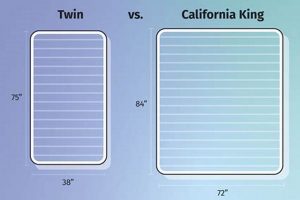
The innerspring system of a large-sized bed support structure typically utilizes a network of interconnected coils to provide resilience and weight distribution. These components, often made of steel, offer a foundational layer designed to promote comfort and durability. The coil count and gauge of the wire are factors that influence the firmness and overall support provided by this critical element of bedding.
The design contributes significantly to sleep quality and postural alignment. A well-constructed support system can alleviate pressure points and reduce motion transfer, leading to more restful sleep. Historically, the evolution of these support structures has focused on improving comfort, longevity, and affordability. Advances in metallurgy and manufacturing techniques have allowed for enhanced performance and wider accessibility.
This foundational element is a key consideration when selecting bedding. Understanding the characteristics of different coil types and their impact on overall performance is essential for making an informed purchase. The following sections will delve deeper into the various aspects of selecting, maintaining, and understanding the role of these essential bed components.
Selecting a Durable Bedding Support System
Proper selection and maintenance are crucial for maximizing the lifespan and performance of a large bedding support system. Consider the following guidelines to ensure optimal comfort and longevity.
Tip 1: Assess Individual Support Needs: Body weight and preferred sleeping position influence the appropriate coil gauge and coil count. Individuals with greater body mass generally require firmer support, while those who sleep on their side may prefer a more conforming surface.
Tip 2: Evaluate Coil Type: Different coil configurations offer varying levels of support and motion isolation. Bonnell coils are generally more affordable, while pocketed coils minimize motion transfer between sleeping partners.
Tip 3: Consider Edge Support: Reinforcement along the perimeter enhances stability and prevents sagging, particularly for those who sit on the edge of the bed frequently.
Tip 4: Inspect Material Quality: High-quality steel and durable construction materials contribute to a longer lifespan and sustained performance. Look for indications of tempered steel and reinforced seams.
Tip 5: Rotate Regularly: Periodic rotation can help distribute wear evenly across the surface, extending the lifespan of the support system and preventing localized sagging.
Tip 6: Use a Protective Cover: A waterproof mattress protector safeguards against spills, stains, and dust mites, preserving the integrity of the internal components.
Following these guidelines will promote the longevity and effectiveness of a large bedding support system, resulting in improved sleep quality and reduced wear.
The subsequent sections will address common issues and troubleshooting techniques to maintain optimal performance and address potential problems.
1. Coil Gauge and King Mattress Support Systems

Coil gauge, a critical specification in large mattress design, directly influences the support characteristics and overall feel. Its measurement, representing the thickness of the steel wire used to construct the innerspring unit, is pivotal in determining the firmness and durability of the support system. Therefore, selection warrants careful consideration.
- Gauge and Firmness
A lower gauge number indicates a thicker wire and, consequently, a firmer feel. For example, a 12-gauge coil provides significantly more support than a 14-gauge coil. Individuals requiring enhanced back support or those with higher body mass typically benefit from lower-gauge coils. However, preference is subjective.
- Gauge and Durability
Thicker coils, represented by a lower gauge, generally exhibit greater resistance to wear and tear. This increased durability is particularly relevant for large bedding, which experiences greater weight distribution. A robust coil gauge contributes to the longevity of the support system.
- Gauge and Motion Transfer
The gauge of the coils, in conjunction with spring type (e.g., pocketed vs. interconnected), affects motion transfer. While gauge primarily dictates firmness, a system employing a higher gauge in an interconnected configuration may transmit motion more readily than a lower gauge in a pocketed coil system. Design is multifaceted.
- Gauge and Cost
Lower-gauge (thicker) coils often correlate with higher manufacturing costs due to the increased material usage. However, the enhanced durability and support they provide can represent a long-term value. Budget and durability are both relevant for selection.
Understanding the implications of coil gauge is essential for selecting a support system that meets individual comfort and support needs. While a lower gauge generally indicates a firmer, more durable structure, the ideal choice depends on body weight, sleeping position, and personal preference, ultimately affecting the quality and longevity of the bedding’s support structure.
2. Coil Count

Coil count is a significant determinant of support and comfort within a large innerspring mattress. It refers to the number of individual coils present in the support core. This parameter influences weight distribution, pressure relief, and overall structural integrity.
- Distribution of Support
A higher coil count typically correlates with a more uniform distribution of support across the mattress surface. Greater coil density allows the mattress to conform more closely to the body’s contours, minimizing pressure points and promoting spinal alignment. Consider localized support when evaluating construction.
- Impact on Durability
While not the sole indicator of longevity, coil count can indirectly affect the lifespan of a mattress. Increased coil density can help distribute weight more evenly, potentially reducing localized wear and tear on individual coils. Material quality remains a primary determinant of long-term durability. The combination of these parameters ensures durability.
- Influence on Motion Isolation
Coil count plays a role, though often secondary to coil type (e.g., pocketed vs. interconnected), in motion isolation. Mattresses with higher coil counts, particularly those using individually wrapped coils, can minimize motion transfer between sleeping partners. Interconnected coils may transmit movement more readily, regardless of count. The type of coil configuration is key for motion isolation.
- Relationship to Mattress Firmness
Co
il count alone does not dictate mattress firmness. Firmness is primarily determined by coil gauge (thickness) and the type of materials used in the comfort layers. However, a higher coil count, in combination with specific coil gauge and comfort layer materials, can contribute to a more supportive and responsive sleep surface. Assess firmness in conjunction with these features.
In conclusion, coil count represents a critical factor to evaluate when selecting a large-sized innerspring mattress. While other factors, such as coil gauge, coil type, and comfort layer materials, also influence the overall performance, understanding the relationship between coil count and support, durability, motion isolation, and firmness is essential for making an informed purchase. Comprehensive evaluation ensures long-term satisfaction.
3. Spring Type

The spring type used in a large-sized mattress profoundly influences its comfort, support, and durability. Understanding the distinct characteristics of each spring type is crucial for selecting a mattress that meets individual needs and preferences.
- Bonnell Coils
Bonnell coils are the oldest and most basic type of innerspring system. They are characterized by their hourglass shape and interconnected design. While offering affordability and widespread availability, they generally provide less contouring and motion isolation compared to other spring types. In large mattresses, Bonnell coils can exhibit greater motion transfer, potentially disrupting sleep for co-sleepers.
- Offset Coils
Offset coils, also known as knotted offset coils, feature a flattened top and bottom. This design allows the coils to hinge, conforming more closely to the body’s shape. They offer improved contouring compared to Bonnell coils and often provide a firmer sleeping surface. In a large mattress, offset coils contribute to enhanced support and reduced motion transfer compared to Bonnell systems, though not as effectively as pocketed coils.
- Continuous Coils
Continuous coil systems are constructed from a single strand of wire that is formed into a series of interconnected coils. This design promotes durability and even weight distribution. However, continuous coil systems tend to transmit motion readily across the mattress surface. In a large bedding configuration, this increased motion transfer can be a significant drawback for couples or individuals sensitive to movement during sleep.
- Pocketed Coils (Marshall Coils)
Pocketed coils, also known as Marshall coils, are individually wrapped in fabric pockets. This design allows each coil to move independently, minimizing motion transfer and providing targeted support. Pocketed coils are considered superior for motion isolation and contouring. In a large mattress, pocketed coil systems are highly effective at reducing motion disturbance and conforming to individual body shapes, making them a popular choice for couples and those seeking personalized comfort.
The selection of spring type profoundly affects the overall performance of a large mattress. While Bonnell, offset, and continuous coil systems offer affordability and durability, pocketed coil systems excel in motion isolation and personalized support. Ultimately, the ideal spring type depends on individual preferences, sleeping habits, and the need for motion isolation.
4. Edge Support

Edge support is a critical design element in a large-sized innerspring mattress, directly impacting its usable surface area, stability, and overall longevity. Its presence or absence significantly influences the sleeper’s experience, particularly near the mattress perimeter. This design consideration mitigates sinkage, increases ease of ingress and egress, and extends the lifespan of the support structure.
- Expanded Usable Surface Area
Effective edge support maximizes the usable sleeping surface. Without adequate reinforcement, the edges of the mattress can compress, creating an unstable and uncomfortable sleeping area. This is especially relevant for those who share a bed, as it allows full utilization of the mattress width without the sensation of rolling off the edge. Reinforced edges prevent the perimeter from collapsing under weight, increasing the feeling of secureness while closer to the edge.
- Enhanced Stability and Support
Solid edge support enhances the overall stability of the support structure. It prevents the edges from sagging or collapsing over time, maintaining a consistent level of support across the entire surface. This is achieved through the implementation of high-density foam encasements or strategically placed, heavier-gauge coils along the perimeter. Stable edges facilitate greater comfort.
- Improved Ease of Ingress and Egress
Strong edge support simplifies the process of getting into and out of bed. A stable edge provides a secure surface for sitting, making it easier for individuals with mobility limitations or those who prefer to sit on the edge of the bed before standing. It provides greater stability. This is beneficial for the safety of users.
- Durability and Longevity of Spring Systems
Edge support contributes significantly to the overall durability of the mattress. By preventing edge collapse, it reduces stress on the innerspring unit, extending its lifespan. The added reinforcement distributes weight more evenly, mitigating localized wear and tear. A mattress with durable edges may last longer due to improved stabilization.
In summary, edge support represents a fundamental aspect of the design of support structures, affecting comfort, usability, and longevity. Its implementation ensures a more stable, supportive, and durable sleeping surface, maximizing the value and satisfaction derived from the investment. The correct design of these components has a ripple effect on the structure and quality of the sleep surface.
5. Material Durability

Material durability is paramount in the construction of the support systems of larger mattresses. The lifespan and performance of these innerspring systems are directly correlated with the quality and resilience of the materials used in their manufacture. The following points detail critical facets of material durability in this context.
- Steel Tempering and Corrosion Resistance
The steel utilized in the construction of coils undergoes a tempering process to enhance its strength and elasticity. This treatment increases resistance to deformation under prolonged pressure. Furthermore, corrosion resistance is critical to prevent degradation from moisture and humidity, which can compromise the structural integrity of the coil system. Examples include the use of high-carbon steel with protective coatings to inhibit rust formation.
- Fabric Encasement Strength in Pocketed Coils
For pocketed coil systems, the durability of the fabric encasing each individual spring is crucial. This fabric must withstand constant friction and stress as the coils compress and expand. High-quality, tear-resistant fa
brics, such as non-woven polypropylene, contribute to the longevity of the system by preventing coil displacement and maintaining uniform support. Fabric degradation can lead to spring migration and uneven weight distribution. - Foam Encasement Density and Resilience
Many innerspring units incorporate foam encasements to provide edge support and improve overall comfort. The density and resilience of this foam directly influence its ability to maintain its shape and structural integrity over time. High-density foam resists compression and sagging, contributing to consistent edge support and preventing the perimeter of the mattress from collapsing. Polyurethane foam with a high indentation load deflection (ILD) rating is often used for this purpose.
- Joint Integrity and Fastener Strength
The points where individual components of the innerspring system are joined or fastened together represent potential weak points. The strength and durability of these joints, whether welded or mechanically fastened, are critical for maintaining the overall structural integrity of the unit. High-quality welding techniques and robust fasteners ensure that the components remain securely connected, preventing premature failure and maintaining consistent support. Weak fasteners cause issues with stability, and therefore the materials have to be strong and durable.
In conclusion, the long-term performance and comfort of a large mattress depend significantly on the durability of its constituent materials. Selection of high-quality steel, resilient fabrics, and robust foams, coupled with strong joint construction, ensures that the innerspring unit can withstand prolonged use and maintain its structural integrity over time. This will lead to a product lasting for many years.
Frequently Asked Questions About King Mattress Spring Systems
The following section addresses common inquiries regarding innerspring systems used in king-sized mattresses. The information aims to provide clarity and assist in making informed purchasing decisions.
Question 1: What is the typical lifespan of a system used in a large-sized mattress?
The expected lifespan varies significantly based on construction quality, material durability, and usage patterns. Generally, a well-constructed system can last between 7 to 10 years. However, lower-quality systems may exhibit signs of wear and tear within 5 years.
Question 2: How does coil gauge affect the firmness and support of a large-sized mattress?
Coil gauge, measured in millimeters, dictates the thickness of the steel wire used in the coils. A lower gauge number indicates a thicker wire, resulting in a firmer and more supportive mattress. Conversely, a higher gauge number signifies a thinner wire, yielding a softer feel.
Question 3: What are the advantages and disadvantages of pocketed coil systems compared to interconnected coil systems?
Pocketed coil systems, where each spring is individually wrapped, offer superior motion isolation and targeted support. However, they can be more expensive than interconnected coil systems, which provide greater overall support but transmit motion more readily. Select the configuration that best suits individual requirements.
Question 4: How can premature sagging be prevented from affecting a support system?
Regular rotation of the mattress, typically every 3 to 6 months, helps distribute weight evenly and prevent localized sagging. Additionally, using a supportive bed frame and avoiding excessive weight concentration in specific areas can prolong the lifespan of the innerspring system.
Question 5: What role does edge support play in a system used in a large-sized mattress?
Edge support, often achieved through high-density foam encasements or reinforced coils along the perimeter, provides stability and prevents sagging near the edges. This maximizes the usable sleeping surface and facilitates easier ingress and egress.
Question 6: Are there specific coil count recommendations for individuals with different body weights or sleeping preferences?
While there is no universally accepted coil count standard, a higher coil count generally indicates better weight distribution and contouring. Individuals with higher body weights or those preferring firmer support may benefit from mattresses with coil counts exceeding 800 in size, though this depends on coil type and gauge.
Understanding these factors is critical when assessing the suitability of an innerspring system. Careful consideration of construction quality, coil specifications, and maintenance practices can significantly impact the lifespan and performance of these support structures.
The subsequent sections will delve into troubleshooting common issues and maintenance strategies.
Conclusion
This exploration into the realm of the support structure underpinning large mattresses has illuminated the critical role it plays in sleep quality and overall bed longevity. From coil gauge and count to spring type and edge support, the various components of this foundational element contribute significantly to comfort, durability, and motion isolation. Understanding these technical specifications enables discerning consumers to make informed decisions, aligning bedding purchases with individual needs and preferences.
The careful selection and diligent maintenance of a “king mattress spring” system represent a worthwhile investment in long-term sleep health and well-being. By prioritizing quality materials and adhering to recommended care practices, individuals can ensure optimal support, minimize wear and tear, and enjoy restful nights for years to come. The decision should not be taken lightly.
![Ultimate Tempur-Pedic King Size Mattress [Guide & Review] | Organic & Natural Mattress Buyer’s Guide: Non-Toxic Sleep Solutions](https://mattressworldpa.com/wp-content/uploads/2025/07/th-8395-300x200.jpg "Ultimate Tempur-Pedic King Size Mattress [Guide & Review] Organic & Natural Mattress Buyer’s Guide: Non-Toxic Sleep Solutions")