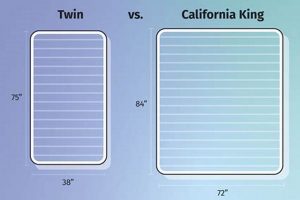
A recreational vehicle sleeping platform designed to accommodate two adults comfortably often requires specific dimensions. This sleeping arrangement, analogous in width to a standard king mattress but potentially shorter in length, allows for a more spacious sleeping experience within the confined quarters of a camper or motorhome. These mattresses are built to match the constraints in a recreational vehicle, which may not be same as standard household mattresses.
The adoption of a larger sleeping surface in RVs contributes significantly to improved sleep quality and overall comfort during travel. Historically, RV sleeping arrangements were often cramped and uncomfortable. The availability of larger mattress sizes reflects a growing demand for enhanced amenities and a more home-like experience while on the road. This development enhances recreational vehicle value to potential buyers.
The subsequent sections will detail the diverse types of these large sleeping platforms, factors to consider when selecting one, and the impact of materials and construction on comfort and longevity.
Selecting an RV King Size Mattress
Optimizing the selection process requires careful consideration of several key factors. Prioritize research and precise measurements to ensure compatibility and satisfaction.
Tip 1: Measure the Available Space Accurately. Precise measurements are crucial to ensure the chosen sleeping platform fits the designated area. Account for any obstructions or irregularities in the recreational vehicle’s sleeping quarters. Standard “king” dimensions may vary.
Tip 2: Consider Mattress Material Options. Evaluate the pros and cons of memory foam, latex, innerspring, and hybrid constructions. Memory foam offers pressure relief; latex is known for its durability and breathability; innerspring provides traditional support. The optimal choice depends on individual preferences and needs.
Tip 3: Assess Mattress Thickness and Weight. Recreational vehicles often have weight restrictions. A thicker mattress may provide greater comfort but also adds weight. Determine the maximum allowable weight for the sleeping area and choose a mattress accordingly.
Tip 4: Prioritize Comfort and Support. A comfortable and supportive sleeping surface is essential for quality rest. Consider factors such as firmness level, pressure point relief, and spinal alignment. Read reviews and, if possible, test mattresses before purchasing.
Tip 5: Evaluate Durability and Longevity. Invest in a high-quality mattress that can withstand the rigors of travel. Look for mattresses with durable materials and construction that are designed to resist wear and tear. A longer-lasting mattress provides better value over time.
Tip 6: Consider the Climate. If the RV is frequently used in hot or humid climates, choose a mattress with cooling properties. Breathable materials and gel-infused foams can help regulate temperature and prevent overheating. This helps prevent mold.
Tip 7: Review Warranty and Return Policies. Before making a purchase, carefully review the mattress warranty and return policies. A reputable manufacturer should offer a warranty against defects and a reasonable return period if the mattress does not meet expectations. This provides peace of mind during the purchasing process.
Careful consideration of these factors will facilitate the selection of a suitable recreational vehicle sleeping platform, ensuring restful sleep and enhanced travel experiences. This careful consideration can result in long-term satisfaction.
The subsequent sections will explore maintenance tips and potential challenges associated with this size mattress in recreational vehicles.
1. Dimensions

The physical proportions define the suitability and functionality of any sleeping platform within a recreational vehicle. Precise determination of dimensions is paramount, directly impacting both user comfort and efficient space utilization.
- Length and Width Constraints
Recreational vehicles often feature unique sleeping area shapes and sizes, deviating from standard residential mattress dimensions. The available length and width dictate the maximum sleeping surface, potentially necessitating a customized solution to fully utilize the space without impeding movement or storage access within the RV.
- Mattress Height Considerations
The vertical dimension, or thickness, of a sleeping platform influences overall accessibility and headroom within the recreational vehicle. An excessively thick mattress can reduce headroom, making it difficult to sit up comfortably. Conversely, an insufficient thickness might compromise support and comfort. Selecting an appropriate height balances these competing factors.
- Corner and Edge Design
The specific shape of an RV’s sleeping area corners and edges impacts the fitting of the mattress. Squared corners may permit standard rectangular designs, while rounded or angled corners necessitate a mattress with corresponding modifications. Inaccurate edge designs leads to discomfort and non-optimized space usage.
- Weight Distribution and Support Structure
While not a direct dimension, the planned dimensions have critical implications for weight distribution. Larger mattresses, particularly those constructed from dense materials, exert greater stress on the underlying support structure. Consideration must be given to the frame’s capacity to accommodate the weight, with reinforcements potentially required to prevent structural damage.
In summary, accurate assessment of length, width, height, corner design, and weight limitations enables informed selection of a recreational vehicle sleeping platform. Such careful planning optimizes the sleeping experience while ensuring structural integrity and spatial efficiency within the confined environment. Compromising dimension parameters may results in discomfort.
2. Comfort

Comfort, in the context of recreational vehicle sleeping platforms, directly influences sleep quality and overall travel satisfaction. An appropriately sized and constructed “rv king size mattress” can mitigate the physical discomforts associated with travel, such as motion sickness and restricted movement during sleep. Conversely, a substandard mattress of inadequate dimensions or construction can exacerbate these issues, leading to restless nights and reduced well-being.
Material selection significantly impacts comfort levels. Memory foam, for example, conforms to the body’s contours, providing pressure relief and minimizing motion transfer between sleeping partners. However, its density can also trap heat, potentially leading to discomfort in warmer climates. Latex offers an alternative, providing support and breathability, but may be less effective at motion isolation. Innerspring mattr
esses offer a traditional feel but may transmit more motion and provide less targeted support. These considerations are crucial for recreational vehicle sleeping platforms where space constraints exacerbate the impact of poor mattress selection. In contrast to a traditional mattress, an “rv king size mattress” often shares a small space and are frequently used.
Ultimately, the pursuit of comfort in recreational vehicle sleeping arrangements necessitates a holistic approach, balancing space limitations, material properties, and individual preferences. A well-chosen and maintained “rv king size mattress” not only promotes restful sleep but also contributes to an improved travel experience, fostering a sense of relaxation and rejuvenation on the road. This level of carefulness is essential for recreational use.
3. Support
Structural integrity and proper weight distribution are critical when considering the “rv king size mattress.” Inadequate support beneath a larger sleeping surface results in uneven wear, potential sagging, and a compromised sleeping experience. This is exacerbated in recreational vehicles due to factors such as frequent movement and uneven terrain, placing additional stress on the mattress foundation. For instance, a platform that lacks sufficient crossbeams or utilizes substandard materials will likely fail to provide adequate support, leading to premature mattress degradation and discomfort for occupants.
The construction of the mattress itself also contributes to the level of support provided. Mattresses with reinforced edges and strategically placed coils or foam layers offer greater stability and prevent excessive sinking along the perimeter. This is especially relevant for individuals who sleep near the edge of the bed. Without this enhanced support, the edges of the mattress may collapse over time, reducing the usable sleeping area and increasing the risk of rolling off during sleep. Proper mattress support ensures spinal alignment and prevents back pain, a common complaint among travelers.
Therefore, selecting a “rv king size mattress” requires a comprehensive evaluation of both the mattress construction and the underlying support structure. Prioritizing mattresses designed for enhanced support and ensuring the foundation is robust enough to handle the mattress’s weight are crucial steps in maximizing comfort and longevity, addressing a fundamental challenge in recreational vehicle living.
4. Durability
The longevity of a recreational vehicle sleeping platform is a primary consideration, directly affecting long-term cost-effectiveness and user satisfaction. The inherent conditions of RV travel, including temperature fluctuations, humidity, and frequent movement, place greater demands on mattress durability compared to stationary residential use.
- Material Resistance to Environmental Factors
The capacity of mattress materials to withstand the harsh environmental conditions prevalent in recreational vehicles significantly impacts their durability. Materials resistant to mold, mildew, and UV degradation are essential. For instance, closed-cell foams and treated fabrics mitigate moisture absorption and prevent the growth of harmful microorganisms, extending the lifespan of the mattress. Untreated materials are prone to premature degradation, leading to structural failure and health concerns.
- Construction Integrity Under Stress
Recreational vehicle mattresses are subjected to constant movement and vibration during transit. The structural integrity of the mattress construction is crucial in preventing premature wear and tear. Reinforced seams, robust internal support systems, and durable adhesives contribute to a mattress’s ability to withstand these stresses. Mattresses with weak or poorly constructed components are susceptible to deformation, sagging, and eventual failure, particularly under the weight of occupants.
- Resistance to Compression and Deformation
The ability of a mattress to recover its original shape after prolonged compression is a key indicator of its durability. High-density foams and resilient innerspring systems maintain their shape and support over time, resisting permanent deformation. Mattresses that exhibit significant compression or sagging after extended use fail to provide adequate support and comfort, necessitating premature replacement. This resistance is particularly important for recreational vehicle mattresses, which may be subjected to irregular weight distribution and prolonged periods of inactivity.
- Fabric Wear and Tear Resistance
The surface fabric of a recreational vehicle mattress is subject to abrasion from regular use and exposure to environmental elements. Durable, tightly woven fabrics resist tearing, pilling, and fading, maintaining the mattress’s aesthetic appeal and structural integrity. Fabrics with low abrasion resistance quickly deteriorate, leading to visible wear and tear and potentially compromising the underlying mattress materials. Selection of appropriate fabric types is therefore crucial for ensuring long-term durability.
In summation, prioritizing material resistance to environmental factors, construction integrity, compression resistance, and fabric durability is paramount when selecting a recreational vehicle sleeping platform. Failure to adequately address these factors leads to premature mattress failure, diminished comfort, and increased long-term costs. The durability of an “rv king size mattress” directly correlates with its value and its contribution to the overall travel experience.
5. Weight

The mass of a recreational vehicle sleeping platform represents a critical design and selection parameter. The weight of a “rv king size mattress” directly influences several key performance characteristics of the recreational vehicle. Increased weight contributes to diminished fuel efficiency, reduced payload capacity, and altered vehicle handling. A heavier mattress necessitates greater engine power for acceleration and climbing, resulting in increased fuel consumption. Furthermore, exceeding the vehicle’s maximum weight rating poses significant safety risks, including compromised braking performance and potential structural damage. Thus, careful consideration of mattress weight is essential to maintain safe and efficient operation of the recreational vehicle.
Material selection and mattress construction directly impact overall weight. Memory foam, while offering enhanced comfort, typically weighs more than traditional innerspring or latex mattresses. The density of the foam and the inclusion of additional comfort layers further increase the mattress’s weight. The frame or support structure beneath the mattress must also be robust enough to bear the weight, potentially adding to the overall load. For instance, a poorly designed support system may require reinforcement, increasing the vehicle’s overall weight and negating any weight savings achieved in the mattress itself. Example, certain type of RV require light weight mattresses or its affect RV weight.
In summary, the weight of a “rv king size mattress” is an integral factor in recreational vehicle performance and safety. Selecting a lightweight mattress that provides adequate com
fort and support is crucial to optimizing fuel efficiency, maintaining payload capacity, and ensuring safe handling. Compromising on weight without considering these consequences can lead to significant operational and safety issues. The balance between comfort, support, and weight must be carefully considered to avoid negative consequences.
6. Materials

The composition of a recreational vehicle sleeping platform directly dictates its performance characteristics. The selection of appropriate materials for an “rv king size mattress” is not merely an aesthetic consideration; it exerts a profound influence on comfort, durability, weight, and overall suitability for the demanding environment of mobile living. For instance, closed-cell foams are selected to mitigate moisture absorption, a prevalent concern in RV environments where condensation and humidity are common. The material’s inherent resistance to moisture inhibits mold and mildew growth, safeguarding the mattress’s structural integrity and promoting occupant health. This example illustrates a direct cause-and-effect relationship between material choice and mattress longevity, showcasing the importance of informed selection. Consider low VOC materials when choosing rv king size mattress for better sleep.
The practical significance of understanding material properties extends to weight management. High-density memory foam, while offering superior comfort and pressure relief, adds considerable weight to the mattress. This increased weight impacts fuel efficiency and reduces the recreational vehicle’s cargo capacity. In contrast, lighter-weight alternatives, such as latex or specialized open-cell foams, provide adequate support and comfort without significantly increasing the overall load. The practical application of this knowledge enables RV owners to make informed decisions that balance comfort with the operational constraints of their vehicles. For optimal weight distribution, materials with uniform density characteristics are preferred throughout the rv king size mattress.
In summation, the connection between materials and an “rv king size mattress” is intrinsic and multifaceted. The informed selection of materials, based on considerations of moisture resistance, weight, durability, and comfort, is crucial for optimizing the performance and longevity of the sleeping platform. A failure to appreciate the material’s effects inevitably leads to premature degradation, reduced comfort, and compromised vehicle performance. This understanding highlights the importance of material science in the design and manufacture of effective and reliable recreational vehicle sleeping solutions, an important consideration when choosing the best rv king size mattress.
Frequently Asked Questions
The following addresses common inquiries regarding RV king size mattresses. It aims to provide clarity on crucial aspects of selection, usage, and maintenance.
Question 1: How does an RV king size mattress differ from a standard king size mattress?
An RV king size mattress typically features dimensions tailored to fit within the confined spaces of recreational vehicles. While the width is often similar to a standard king, the length is frequently shorter to accommodate the RV’s layout. Dimensions must be carefully considered.
Question 2: What factors should be considered when selecting an RV king size mattress?
Key considerations include mattress dimensions, material type, weight, comfort level, and durability. Additionally, the RV’s climate and the user’s specific sleep preferences are relevant factors.
Question 3: Are specialized support systems required for an RV king size mattress?
While not always mandatory, a robust support system is recommended to ensure proper weight distribution and prevent mattress sagging. The existing RV platform should be evaluated for its load-bearing capacity and reinforced if necessary.
Question 4: How does mattress weight affect the recreational vehicle’s performance?
Excessive mattress weight negatively impacts fuel efficiency, reduces payload capacity, and alters vehicle handling. Lightweight mattress options should be considered to minimize these effects.
Question 5: What materials are best suited for RV king size mattresses in humid climates?
Materials with moisture-wicking properties, such as latex or open-cell foams, are recommended to prevent mold and mildew growth. Closed-cell foams are less breathable and may trap moisture.
Question 6: How can the lifespan of an RV king size mattress be extended?
Regular mattress rotation, the use of a mattress protector, and proper ventilation can help prolong the mattress’s lifespan. Avoiding excessive moisture and direct sunlight exposure is also advisable.
This FAQ section addresses critical considerations for RV king size mattresses. Careful attention to these points ensures informed decision-making and optimal comfort.
Subsequent discussions will focus on advanced customization options and specialized features for these mattresses.
RV King Size Mattress
The preceding discussion has elucidated the multifaceted considerations surrounding the selection, utilization, and maintenance of an RV king size mattress. From dimensional constraints and material properties to weight considerations and support system requirements, a comprehensive understanding of these elements is essential for optimizing comfort, durability, and overall performance within the unique environment of a recreational vehicle. The inherent limitations and demands of RV travel necessitate a more discerning approach than that typically applied to residential mattress purchases.
The informed application of this knowledge will undoubtedly contribute to enhanced travel experiences and improved long-term value. Neglecting these crucial factors risks compromising both the comfort of occupants and the operational efficiency of the recreational vehicle itself. Therefore, prioritize diligent research and thoughtful decision-making to ensure that the chosen RV king size mattress serves as a durable and supportive foundation for restful travel.
![Ultimate Tempur-Pedic King Size Mattress [Guide & Review] | Organic & Natural Mattress Buyer’s Guide: Non-Toxic Sleep Solutions](https://mattressworldpa.com/wp-content/uploads/2025/07/th-8395-300x200.jpg "Ultimate Tempur-Pedic King Size Mattress [Guide & Review] Organic & Natural Mattress Buyer’s Guide: Non-Toxic Sleep Solutions")