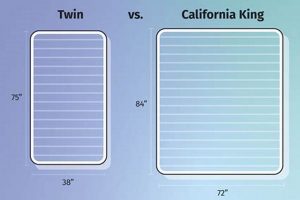
The specific dimensions of a California King bed are approximately 72 inches wide and 84 inches long. This elongated rectangular shape differentiates it from other mattress sizes, offering a distinct sleeping surface. For instance, it is narrower but longer than a standard King mattress.
The elongated design is particularly advantageous for taller individuals, providing extra legroom and preventing discomfort caused by feet hanging off the edge. This can contribute to improved sleep quality and overall physical well-being. The prevalence of this mattress type has increased in regions with a higher concentration of taller populations.
Understanding the measurements of this particular bed frame and mattress is crucial when selecting bedding, bedroom furniture, and planning bedroom layout. The subsequent sections will delve into detailed comparisons with other mattress dimensions, factors to consider when purchasing one, and tips for finding the right sheets and accessories.
Selecting and Maintaining a California King Mattress
This section offers practical advice for individuals considering or currently owning a California King size mattress. These tips aim to optimize comfort, prolong the lifespan of the mattress, and ensure proper fit with bedding and bedroom decor.
Tip 1: Assess Room Dimensions: Before purchasing, meticulously measure the bedroom space. Ensure adequate room remains after accommodating the mattress and bed frame, allowing for comfortable movement and placement of other furniture.
Tip 2: Consider Individual Height: This mattress is specifically designed for taller individuals. If the user’s height exceeds six feet, its extended length will provide superior comfort and prevent feet from hanging off the edge.
Tip 3: Select Bedding Carefully: Standard King-sized sheets will not fit a California King mattress. Purchase bedding specifically labeled as “California King” to ensure a proper fit and avoid slippage.
Tip 4: Utilize a Supportive Bed Frame: Employ a robust bed frame designed to support the increased length and weight. A weak or inadequate frame can lead to premature mattress sagging and reduced support.
Tip 5: Rotate Regularly: Rotate the mattress every six months, or more frequently if necessary, to distribute wear evenly and prevent indentations. This prolongs the mattress’s lifespan and maintains consistent support.
Tip 6: Invest in a Mattress Protector: A high-quality mattress protector shields against spills, stains, and dust mites. This simple investment can significantly extend the mattress’s hygiene and longevity.
Tip 7: Research Firmness Options: This mattress is available in various firmness levels. Consider personal sleeping preferences and physical needs when selecting a firmness that provides adequate support and comfort.
Implementing these measures will contribute to maximizing the benefits of this mattress size, ensuring restful sleep and preserving its value for an extended period.
The following section will address frequently asked questions regarding the specific attributes and uses of this elongated mattress size.
1. Overall Dimensions

The overall dimensions are a fundamental characteristic of a California King mattress, defining its physical boundaries and distinguishing it from other mattress sizes. These specific measurements72 inches in width and 84 inches in lengthdirectly influence its suitability for various bedroom sizes and individual preferences. For example, a narrower width compared to a standard King can be crucial in smaller bedrooms, while the added length is a primary driver for taller individuals seeking comfortable leg extension.
A failure to account for the overall dimensions can lead to practical problems. A mattress purchased without considering room size may result in cramped spaces and limited maneuverability. Bedding designed for other mattress sizes will invariably be incompatible, leading to ill-fitting sheets and compromised comfort. Therefore, understanding and accurately measuring the room, along with comparing these measurements against the stated dimensions, is a critical step in selecting a California King mattress.
In summary, the overall dimensions are an inseparable component of the California King mattress definition. They determine its spatial requirements, influence compatibility with accessories, and directly impact the user’s comfort, especially for taller individuals. Prioritizing this dimension in the purchasing decision minimizes potential issues related to space constraints and ensures an optimal sleeping experience. The following section will delve into mattress thickness, another vital dimension to consider.
2. Mattress Thickness

Mattress thickness, a critical attribute, significantly influences the overall sleeping experience on a California King mattress. While the length and width define the surface area, the thickness determines the mattress’s support level, comfort, and suitability for various bed frames. Insufficient thickness may compromise support, leading to discomfort and potential back pain, particularly for heavier individuals. Conversely, excessive thickness can result in difficulty getting in and out of bed, especially for those with mobility limitations. The interaction between thickness and the overall dimensions contributes to the perceived size and feel of the mattress.
For instance, a California King mattress with a pocketed coil system and a high-density foam layer may require a thickness of at least 12 inches to provide adequate support and pressure relief. Alternatively, a thinner memory foam mattress, while conforming to the body, may lack the necessary structural integrity for heavier individuals or those who prefer a firmer sleeping surface. The height of the mattress, determined by its thickness, also dictates the required height of the bed frame to ensure comfortable entry and exit. Selecting the appropriate thickness involves considering individual body weight, preferred sleeping position, and any existing physical conditions.
In summation, mattress thickness is an integral dimension inextricably linked to the overall dimensions of the California King mattress. Its impact on support, comfort, and accessibility is substantial, and it necessitates careful consideration during the purchasing process. Understanding the relationship between thickness and other mattress attributes is crucial for making an informed decision that aligns with individual needs and preferences. The subsequent discussion will address the bed frame dimensions necessary to support the California King mattress.
3. Bed Frame Size

The correlation between bed frame size and the dimensions of a California King mattress is fundamental to ensuring proper support and functionality. A California King mattress, with its specific measurements of 72 inches by 84 inches, requires a bed frame designed precisely to accommodate these dimensions. Using a bed frame too small can cause the mattress to sag or become misshapen, leading to premature wear and reduced comfort. Conversely, a frame that is too large provides insufficient support, potentially resulting in instability and a compromised sleeping surface. The precise matching of bed frame size to the mattress dimensions is not merely aesthetic but crucial for maintaining the structural integrity of the mattress and maximizing its lifespan. Failure to adhere to this principle can lead to financial repercussions due to accelerated mattress degradation and the necessity for earlier replacement. For instance, a consumer purchasing a standard King bed frame for a California King mattress would find the length inadequate, leaving a significant portion of the mattress unsupported and vulnerable to damage.
Consider the scenario of a platform bed designed for a California King. The platform must provide consistent, uniform support across the entire surface area of the mattress. Any gaps or unevenness in the platform will translate to pressure points on the mattress, leading to uneven wear and potential discomfort for the sleeper. Similarly, a slatted bed frame must have slats spaced closely enough to prevent the mattress from sinking between them. The number, width, and spacing of the slats are critical factors in determining the frame’s suitability for a California King mattress. The material of the bed frame also plays a role. A frame constructed from sturdy hardwood or reinforced metal will provide greater stability and support compared to one made from weaker materials. Regular inspection of the bed frame is also necessary to identify any signs of damage or wear that could compromise its ability to adequately support the mattress.
In conclusion, the bed frame size is an indispensable component in the context of a California King mattress. Its precise dimensions are a prerequisite for ensuring proper support, maximizing mattress lifespan, and optimizing sleeping comfort. The challenge lies in accurately identifying and selecting a bed frame specifically designed to accommodate the unique dimensions of a California King mattress, thereby mitigating the risk of premature mattress degradation and ensuring a restful and supportive sleep environment. This understanding contributes to the broader theme of informed purchasing decisions that prioritize both comfort and long-term value.
4. Sheet Dimensions

The relationship between sheet dimensions and a California King mattress is one of precise compatibility. Given the specific physical size of a California King mattress, selecting appropriately sized sheets is not merely a matter of aesthetics but a functional necessity for comfort and practicality.
- Fitted Sheet Depth
The depth of a fitted sheet is a crucial consideration, especially with the increasing prevalence of thicker mattresses. A fitted sheet with insufficient depth will not properly grip the mattress corners, leading to slippage and discomfort. Deep-pocket fitted sheets are often required for California King mattresses with pillow tops or additional comfort layers. The consequences of ignoring this dimension range from minor annoyances to significant sleep disturbances.
- Flat Sheet Dimensions
The dimensions of a flat sheet impact both functionality and appearance. A flat sheet that is too small will not provide adequate coverage, leaving the sleeper exposed at the edges of the mattress. Conversely, a flat sheet that is excessively large can result in cumbersome excess fabric. Precise flat sheet dimensions ensure sufficient tuck-in length and width for a neat and comfortable sleeping arrangement.
- Pillowcase Size
While seemingly less critical, pillowcase size contributes to the overall bedding ensemble. California King sheet sets typically include King-sized pillowcases, designed to fit larger pillows that often accompany this mattress size. Using standard-sized pillowcases on King-sized pillows results in a tight fit that can compromise pillow comfort and longevity.
- Material Stretch and Shrinkage
Different sheet materials exhibit varying degrees of stretch and shrinkage after washing. Natural fibers, such as cotton, are prone to shrinkage, whereas synthetic blends may exhibit greater stretch. Therefore, it is prudent to select sheet sets with dimensions that account for potential shrinkage, ensuring a consistently proper fit after laundering.
In summary, sheet dimensions are intrinsically linked to the size of a California King mattress, influencing not only the aesthetics of the bed but also the comfort and practicality of the sleeping experience. Paying meticulous attention to these dimensions, considering factors such as mattress thickness, desired coverage, and material properties, is essential for selecting sheet sets that provide optimal fit and functionality. Neglecting these considerations diminishes the overall benefit of a California King mattress, potentially leading to compromised sleep quality and increased frustration.
5. Sleeping Area

The correlation between the available sleeping area and the dimensions of a California King mattress is fundamental to its utility and perceived value. The physical size of the mattress, approximately 72 inches by 84 inches, defines its outer boundaries, but the usable sleeping area within those boundaries dictates the comfort and functionality for its occupants. Factors such as edge support, mattress construction, and the presence of features like pillow tops can influence the effective sleeping surface. Diminished edge support, for instance, reduces the usable width of the mattress, particularly for individuals who sleep near the edge. This reduction has a disproportionately larger impact on a California King compared to wider mattresses because the primary benefit of this format lies in its length, not width. In such instances, the potential advantage of the extended length is counteracted by the reduced usable width, negating its designed benefit. If two average sized adults used a California king size mattress, the effective sleeping area depends upon their sleeping habits.
The practical implications are evident in the context of couples sharing a bed. While the elongated format offers increased legroom for taller individuals, inadequate usable sleeping area can result in constricted space and compromised comfort, negating the intended benefits. Consider a scenario in which two individuals, each requiring ample space, share a California King mattress with poor edge support. The available sleeping area would be effectively reduced, leading to disrupted sleep and discomfort as each sleeper is forced to remain closer to the center. Conversely, a California King mattress with robust edge support maximizes the usable sleeping area, providing each occupant with ample personal space and minimizing sleep disruptions. A couple with child or pet, edge support may not be a benefit.
In summary, the usable sleeping area is an integral aspect of a California King mattress, directly affecting comfort and functionality. While th
e overall dimensions establish the potential sleeping surface, factors like edge support and mattress construction ultimately determine the actual usable space. The challenges are balancing the need for legroom, provided by the extra length, with ensuring adequate width for undisturbed sleep, especially when shared by multiple occupants. Therefore, prospective buyers should thoroughly assess the usable sleeping area in addition to the overall dimensions to ensure that the mattress effectively meets their individual and shared needs. The choice of size, design and construction of the sleeping area will determine how restful your sleep will be.
6. Room Footprint
The term “room footprint,” as it pertains to a California King mattress, describes the total area occupied by the bed within a bedroom. This area not only encompasses the dimensions of the mattress itself, but also includes any additional space required for the bed frame and surrounding clearance for movement. Accurately assessing the room footprint is crucial for effective bedroom planning, ensuring adequate space for other furniture and comfortable navigation.
- Minimum Room Size
The bare minimum room size required to comfortably accommodate a California King mattress should account for the mattress dimensions (approximately 72 inches by 84 inches) plus at least 24 inches of clearance on all sides. This translates to a room that is at least 10 feet wide and 11 feet long. Failure to adhere to these minimum dimensions can result in a cramped and impractical bedroom layout, restricting movement and limiting the placement of other essential furniture pieces.
- Impact on Furniture Placement
The room footprint directly dictates the optimal placement of other furniture pieces, such as dressers, nightstands, and seating. A larger room footprint necessitates careful consideration of traffic flow and accessibility. For example, placing a large dresser directly opposite the bed in a small room with a California King mattress can impede movement and create a sense of confinement. Strategic furniture placement, taking into account the room footprint, is essential for creating a functional and aesthetically pleasing bedroom.
- Doorway and Walkway Clearance
The room footprint must also account for adequate doorway and walkway clearance. A California King mattress placed too close to a doorway can obstruct entry and exit, particularly if the door swings inward. Similarly, narrow walkways around the bed can create hazards and discomfort. The room footprint should be planned to ensure unobstructed access to doorways and comfortable passage throughout the bedroom.
- Aesthetic Considerations
Beyond functionality, the room footprint influences the overall aesthetic of the bedroom. A California King mattress in a small room can visually dominate the space, creating a sense of imbalance. Conversely, in a larger room, the same mattress may appear appropriately scaled, contributing to a more harmonious and balanced aesthetic. The room footprint must be considered in conjunction with other design elements, such as wall color, lighting, and artwork, to achieve a visually pleasing and comfortable environment.
In conclusion, the “room footprint” is an indispensable concept when evaluating the suitability of a California King mattress for a particular bedroom. Its dimensions not only determine the practical constraints of furniture placement and movement, but also significantly affect the overall aesthetic and functionality of the space. A thorough understanding of the “room footprint” is essential for ensuring a comfortable and well-designed sleeping environment when choosing the size of your California King mattress.
7. Weight Capacity

The weight capacity of a California King mattress is a critical factor, inextricably linked to its overall size and construction. The dimensions dictate the surface area distributing weight, while the internal materials and design determine the mattress’s ability to withstand that weight without compromising support or longevity. Exceeding the stated weight limit can lead to premature sagging, decreased support, and ultimately, a reduction in the mattress’s lifespan. For instance, a California King innerspring mattress with a weight capacity of 600 pounds may exhibit significant structural damage if regularly subjected to 800 pounds of combined weight, resulting in diminished comfort and potential back pain for its users.
Different mattress types, such as memory foam, latex, and hybrid models, possess varying weight capacities due to their inherent material properties and construction techniques. A high-density memory foam California King might support a greater weight load than a comparable innerspring model, given its superior ability to distribute weight evenly. Furthermore, bed frames must also be considered; a flimsy frame, regardless of mattress weight capacity, can undermine the entire support system. A practical application involves calculating the combined weight of all individuals regularly using the mattress and comparing that figure against the manufacturer’s specified weight limit, factoring in a buffer for potential fluctuations. Neglecting to consider this factor can result in warranty voidance and costly premature replacement.
In summary, the weight capacity is an essential, albeit often overlooked, dimension of a California King mattress. Its interaction with mattress size, materials, and bed frame support dictates the mattress’s performance, longevity, and user comfort. Accurately assessing weight requirements and selecting a mattress with an appropriate weight capacity is crucial for maximizing its value and ensuring a restful sleep experience. Prioritizing weight capacity ensures a better and longer mattress lifecycle as part of the size selection process.
Frequently Asked Questions About the Size of California King Mattress
The following questions address common inquiries regarding the dimensions, applications, and considerations surrounding California King mattresses. The intent is to provide clear and concise information to assist in making informed purchasing decisions.
Question 1: Is a California King mattress larger than a regular King mattress?
No, a California King mattress is not larger in overall area than a standard King. It is longer (84 inches vs. 80 inches) but narrower (72 inches vs. 76 inches). The California King is designed for individuals requiring extra legroom, while the standard King offers more width.
Question 2: What is the ideal room size for a California King mattress?
A bedroom should be at least 10 feet wide and 12 feet long to comfortably accommodate a California King mattress and allow for adequate movement and furniture placement. Smaller rooms may feel cramped and limit design options.
Question 3: Can standard King-sized sheets be used on a California King mattress?
No. Standard King-sized sheets will not properly fit a California King mattress. California King-specific sheets are necessary to ensure adequate coverage and a secure fit.
Question 4: Is a California King mattress suitable for individuals with back pain?
Suitability depends on individual preferences and the specific mattress construction. Firmness level, supp
ort system, and materials all play a role in alleviating or exacerbating back pain. Consulting a medical professional or mattress expert is recommended.
Question 5: What is the average weight capacity of a California King mattress?
Weight capacity varies depending on the mattress type and construction. It typically ranges from 500 to 700 pounds. Refer to the manufacturer’s specifications for precise weight limits to prevent premature wear and ensure adequate support.
Question 6: Are California King mattresses more expensive than standard King mattresses?
Price points can vary based on brand, materials, and features. However, California King mattresses may be slightly more expensive than standard Kings due to their specialized dimensions and lower production volume.
In summary, California King mattresses offer unique advantages for taller individuals and specific bedroom layouts. However, careful consideration of dimensions, room size, and individual needs is crucial for maximizing satisfaction and ensuring a comfortable sleep experience.
The next section will provide a comprehensive comparison of California King mattresses with other mattress sizes, highlighting the pros and cons of each.
Size of California King Mattress
This article has provided a comprehensive exploration of the dimensions of a California King mattress, underlining its significance in bedroom planning and sleep comfort. Key points include the mattress’s specific measurements (72 inches wide and 84 inches long), its suitability for taller individuals, and the importance of selecting appropriately sized bedding and bed frames. Understanding the overall room footprint and weight capacity is crucial for maximizing the mattress’s lifespan and ensuring user satisfaction. Considerations of mattress thickness and usable sleeping area directly impact comfort and must be factored into the purchasing decision.
The “size of California king mattress” is a foundational element in creating a functional and restful sleep environment. Further investigation into mattress materials and construction techniques, alongside individual ergonomic needs, will contribute to informed choices. Prioritizing this knowledge will optimize long-term sleep quality and investment value. This information promotes thoughtful selection in a critical aspect of personal well-being.
![Ultimate Tempur-Pedic King Size Mattress [Guide & Review] | Organic & Natural Mattress Buyer’s Guide: Non-Toxic Sleep Solutions](https://mattressworldpa.com/wp-content/uploads/2025/07/th-8395-300x200.jpg "Ultimate Tempur-Pedic King Size Mattress [Guide & Review] Organic & Natural Mattress Buyer’s Guide: Non-Toxic Sleep Solutions")